
Table of Contents
7 Signs Your Event Needs Interpretation Equipment (Self-Assessment)
- Retekess
- Sep 22, 2026
Does my event need interpretation equipment? Yes — if three or more of the seven signals below score 2 — meaning attendees span three or more primary languages, the program runs in sessions too long to pause for interpreting, the audience is mostly listening rather than speaking, the content is high-stakes, the room fights your audio, you need recorded multilingual output, or someone has already asked you whether interpretation will be available.
That last signal is the strongest and most commonly ignored. When an attendee asks "will there be translation?", they are telling you one of two things: they need it, or they know someone who does and will not come otherwise.
Below is the full assessment, scored 0–14, with a recommended configuration for each score band — plus the three signals people usually overweight, which push them toward equipment they do not need.
How to Score
For each of the seven signals, score your next event:
| Score | Meaning |
|---|---|
| 0 | Not true for this event |
| 1 | Partly true, or true for some sessions |
| 2 | Clearly true across the program |
Total the seven scores. Interpretation of the total is at the end. Be honest on the low side — inflating a score here means buying equipment for a need you do not have, which is how perfectly good systems end up in a storage closet.
Sign 1 — Attendees Span Three or More Primary Languages
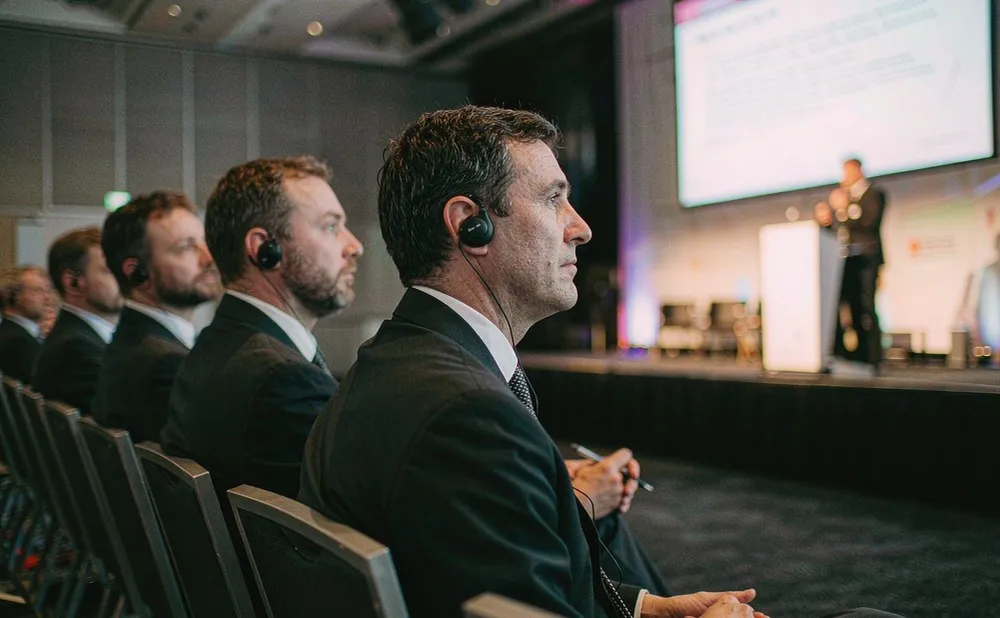
Why it matters: When an event involves three or more primary languages, channel isolation becomes non-negotiable. While two languages in a small workshop can sometimes be handled ambiently, three or more languages running in parallel will cause complete auditory chaos if broadcast into the open room.
The requirement here is not just interpretation, but multi-channel hardware architecture. Dedicated equipment (multi-channel transmitters, selective receivers, and console routing) is the only physical mechanism that allows multiple target languages—and potential relay channels—to broadcast simultaneously without acoustic interference.
Sign 2 — Sessions Run Longer Than 60 Minutes Without Natural Pauses
Score 2 if: your keynote or plenary runs 45+ minutes as a single continuous delivery.
Score 1 if: most sessions are 20–40 minutes with discussion breaks.
Score 0 if: your format is built around short segments, dialogue, or workshops with frequent pauses.
| Why it matters | Evidence |
|---|---|
| Consecutive interpreting approximately doubles session length — each statement is spoken twice | Mode mechanics |
| In a controlled comparison, simultaneous delivery ran 12.72 minutes versus 18.24 minutes for the next-fastest method — about 30% shorter with content held constant | Harvard-affiliated interpreting study (peer-reviewed) |
| Interpreters themselves rotate every 20–30 minutes because of cognitive load | AIIC professional guidance |
A 45-minute keynote delivered consecutively becomes 85–90 minutes. Audiences tolerate that in a workshop. They do not tolerate it in a plenary after lunch, and speakers cannot deliver a rehearsed narrative across constant interruptions.
Sign 3 — The Audience Is Mostly Listening, Not Speaking
Score 2 if: your program is keynotes, plenaries, sermons, training lectures, or any format where a small number of people speak to a large number of people.
Score 1 if: it is a mix — panels with some audience interaction.
Score 0 if: it is a workshop, negotiation, or roundtable where everyone speaks and the exchange is the content.
| Format | Listener-to-speaker ratio | Implication |
|---|---|---|
| Keynote / plenary | 100:1 to 1,000:1 | Simultaneous is the only viable mode |
| Panel | 20:1 | Simultaneous; multiple speakers make consecutive pauses chaotic |
| Sermon / teaching service | 50:1 to 300:1 | Simultaneous; the audience never speaks, so pauses have no value |
| Workshop / training | 5:1 | Consecutive often better — pauses aid processing |
| Negotiation / deposition | 1:1 | Consecutive — verbatim record and thinking time both matter |
The reason this signal matters: consecutive interpreting earns its value from dialogue. If your audience never speaks, the pauses it introduces buy nothing and cost double the time.
Sign 4 — High-Stakes Content or High-Stakes Audience
Score 2 if: the content includes legal, medical, regulatory, contractual, safety, or theological precision where a misunderstanding has real consequences — or the audience includes sponsors, regulators, board members, press, or prospective clients whose opinion of the event carries commercial weight.
Score 1 if: the stakes are internal — a company all-hands where comprehension affects execution but nothing legal turns on it.
Score 0 if: the content is informational and low-consequence.
| Why it matters | Evidence |
|---|---|
| Interpretation mode affects error rate materially: in one study, non-simultaneous methods produced 12 times more errors of moderate or greater significance | Harvard-affiliated study (p = 0.0002) |
| But accuracy is not automatic with simultaneous mode — one judicial study found 83–87% accuracy in simultaneous versus 95–98% in consecutive | Russell, University of Alberta (peer-reviewed, ASL/judicial setting) |
Read those two rows together, because they point in different directions. Simultaneous mode reduces communication errors in aggregate; consecutive mode produces more accurate interpreter output in forensic settings. The resolution is that mode selection depends on which risk you are managing: schedule collapse and comprehension failure (simultaneous) versus verbatim precision (consecutive).
For high-stakes content, both high scores on this signal and a careful mode decision are required. Equipment is not a substitute for choosing the right mode, and no equipment fixes a language pair with no qualified interpreter.
Sign 5 — The Room Fights Your Audio
Score 2 if: the venue has hard surfaces and audible reverb, high ceilings, HVAC noise, an open-plan exhibition floor adjacent to the session room, or you run parallel sessions in rooms that are not acoustically separated.
Score 1 if: the room is decent but a line feed from the soundboard is not available.
Score 0 if: the room is treated and front-of-house can give you a clean line feed.
| Condition | Effect on interpretation | Mitigation |
|---|---|---|
| Long reverb time | Interpreters hear reflected sound, not the speaker; every listener inherits the error | Line feed from the mixing console |
| High ambient noise floor | Listeners strain; whole-day fatigue sets in earlier | Line feed plus closed-back listener earphones |
| Adjacent simultaneous rooms | RF interference and audible bleed between language channels | Channel planning across rooms, frequency coordination |
| No available line output | The interpreter is working from a room microphone | Gain access to XLR/AUX/RCA — the TT119 interpreter console accepts all three |
This is the signal most often scored 0 when it should be 2. Planners score the venue as "fine" because attendees did not complain about the sound system — but the interpreter is hearing a different signal than the audience is, and their output quality degrades before anyone in the room can tell why.
Sign 6 — You Need Recorded or Post-Event Multilingual Output
Score 2 if: you record sessions and intend to publish them, or you need to produce multilingual marketing content, training material, or reports from the event.
Score 1 if: you record sessions but have no current distribution plan for them.
Score 0 if: nothing is recorded or published.
| Why it matters | Practical effect |
|---|---|
| Recorded sessions with multilingual audio or captions have a much longer shelf life than event-day-only delivery | Content reuse without additional event spend |
| Transcripts are far cheaper to correct than live audio is to re-record | Post-event quality control |
| Interpreted sessions produced with a clean line feed yield usable source audio | Reuse depends on capture quality, decided at setup |
Why this is an equipment signal, not just a content signal: whether your recorded sessions are reusable in other languages is determined on the day, by how the audio was captured. If the interpreter worked from a room microphone, the recording carries room reverb and is hard to repurpose. If they worked from a console line feed, you have clean audio you can caption, translate, and publish months later. That decision costs nothing to make correctly and cannot be recovered afterward.
Sign 7 — Someone Has Already Asked
Score 2 if: any attendee, member, sponsor, or prospective registrant has asked whether interpretation or translation will be available.
Score 1 if: you have never been asked, but your registration data shows a language group you have not been serving.
Score 0 if: no one has raised it and your data shows a single language group.
| Why this is the strongest signal | Reasoning |
|---|---|
| The ask came from the demand side, not from a vendor | It is revealed preference, not a projected need |
| People usually ask once, on behalf of others | One ask often represents a group that will otherwise not attend |
| "No" is a durable answer | An attendee told "no interpretation" may not ask again — they simply do not return |
How to capture it if you have never been asked: add one optional field to registration — "Which language would you prefer to follow sessions in?" — and one line to the post-event survey — "Could you follow the sessions comfortably?" One cycle of those two questions tells you whether Sign 7 is about to start scoring 2, before you learn it the hard way.
Scoring: What Your Total Means
| Total | Interpretation | Recommended configuration |
|---|---|---|
| 0–3 | No dedicated equipment needed | No equipment. If two languages are present, a bilingual staffer or consecutive interpreting is sufficient. Do not buy hardware for this event |
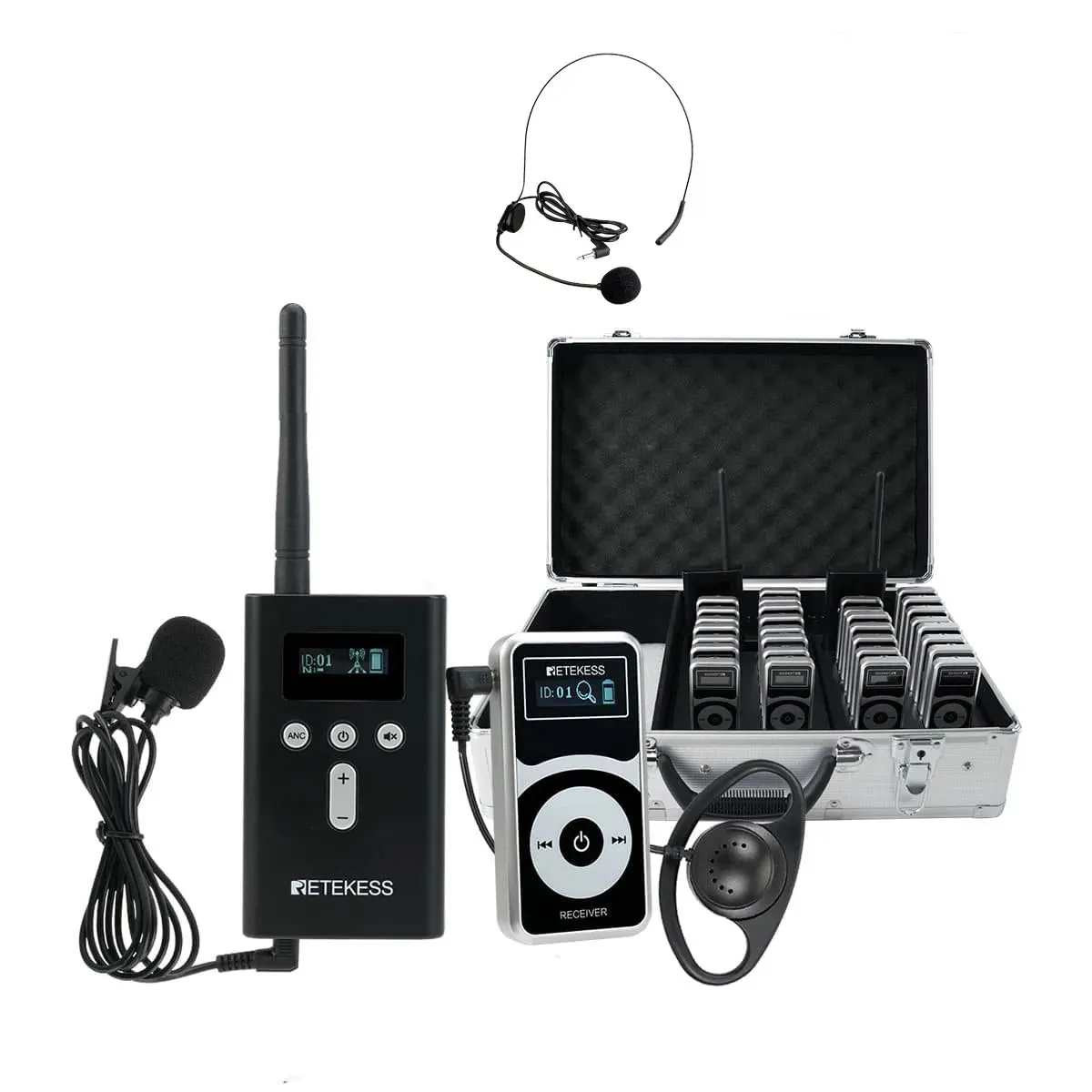
| 4–7 | Basic system | One target language, dedicated receivers for that cohort. FM in the small-to-mid room —TT117. Plan 10–15% spares. Confirm your country's frequency allocation before ordering |
| 8–11 | Full simultaneous setup | Two interpreters per language on the 20–30 minute rotation, one interpreter console per language, one transmitter per language. TT118 plus TT119 covers 20–200 listeners. Take a line feed from front-of-house |
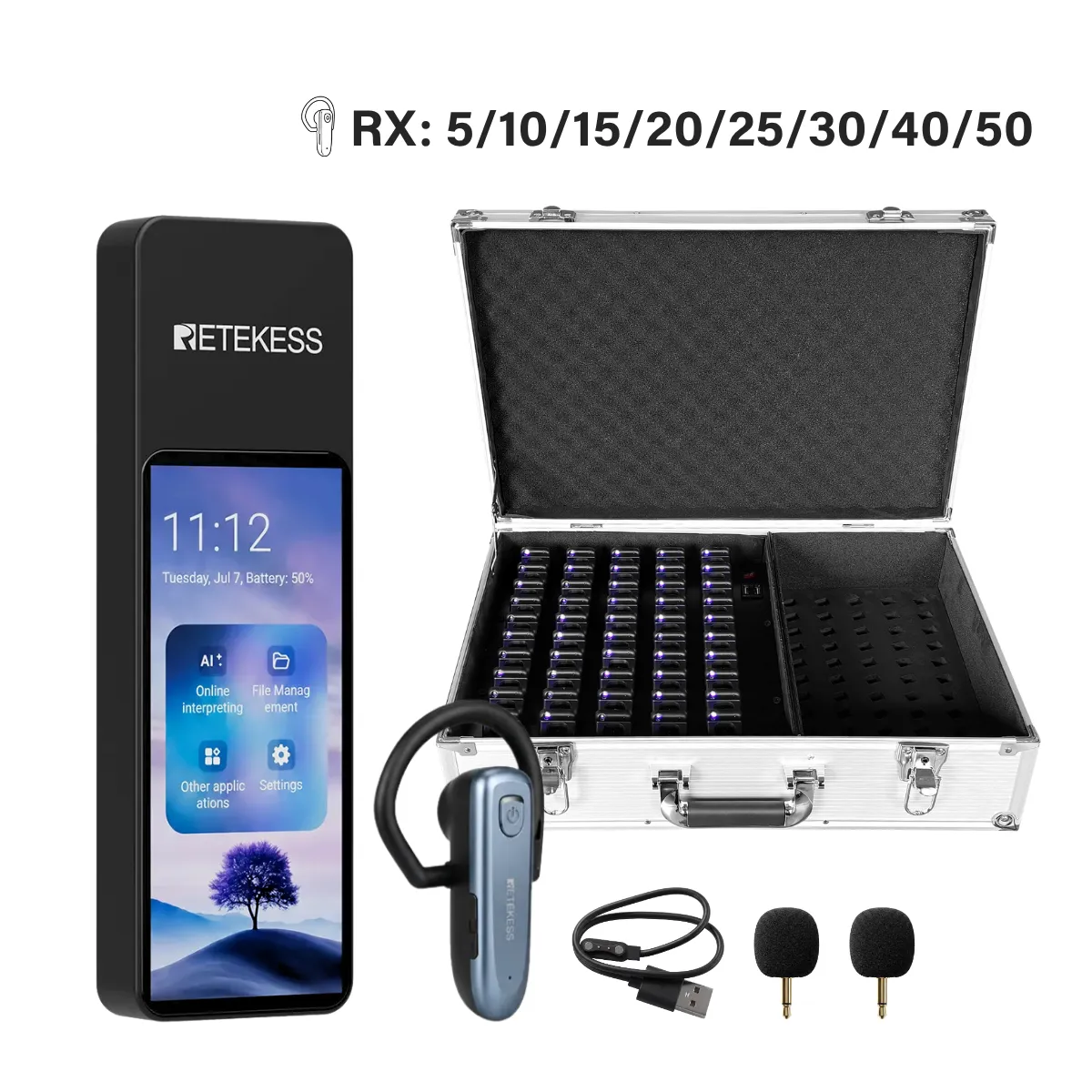
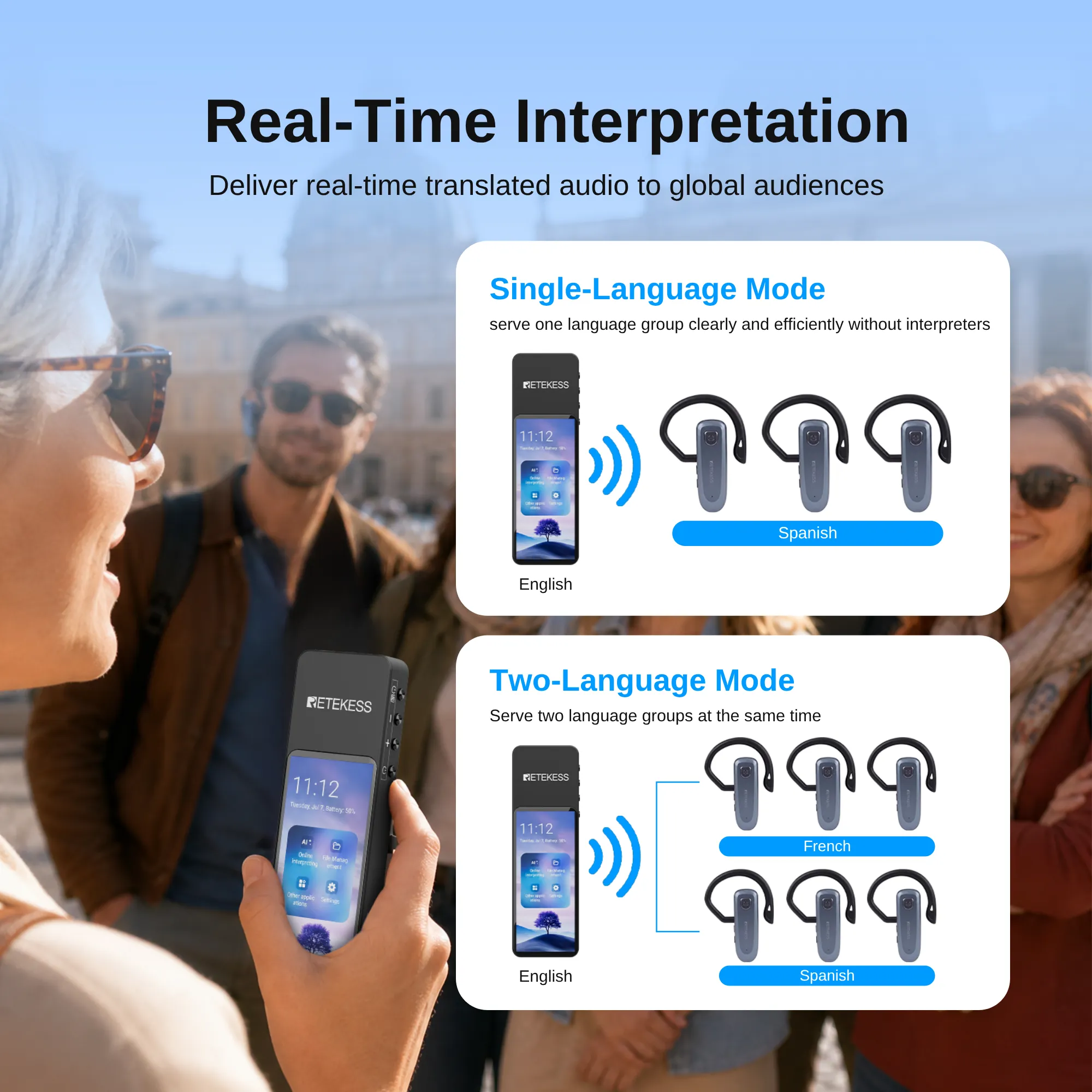
| 12–14 | Professional multi-session architecture | Parallel rooms with separate language channels —TT116 with 50 channels. Multi-day battery logistics —T130P with its 14–54 hour window. For rare languages with no available interpreter, add an AI channel via TT136 |
The bands are a starting point for a procurement conversation, not a substitute for one. A score of 9 with a rare language pair and no available interpreter is a different project than a score of 9 in English–Spanish.
Three Signals People Overweight
These push planners toward configurations they do not need. Each one is a real consideration — just not a reason to buy equipment.
1. "We have international attendees."
Having international attendees is not the same as having attendees who cannot follow the working language. Many international professionals work in English all day. Check whether your international attendees actually need another language, or whether they simply travel from abroad.
2. "It would look more professional."
Presentation value is real at some events, and equipment does signal a certain level of production. But a system the volunteers cannot operate confidently looks worse than a clean consecutive arrangement. Operational reliability beats perceived sophistication — every time, in a room full of people watching.
3. "Last year went fine without it."
This is the hardest one to argue against, and it is not a signal — it is an absence of measurement. Nobody complains about comprehension. Disengagement is polite: attendees who cannot follow go quiet in Q&A and leave at the break, and your attendance scans record it as normal ebb. If you have not asked the comprehension question, "it went fine" means "nobody told me otherwise," which is a different claim.
One more, going the other direction: if your language pair is rare and you cannot find a qualified interpreter, does equipment help? Only partly. Equipment distributes interpretation; it does not create it. In that case an AI translation channel is better than excluding the audience — but it is a scope decision, not a solution to a staffing problem.
FAQ
How do I know if my event needs interpretation equipment?
Score the seven signals above. A total of 4 or more generally justifies a basic system; 8 or more justifies full simultaneous interpretation with interpreters. The strongest single indicator is that someone has already asked whether interpretation will be available.
What is the single strongest sign that I need interpretation equipment?
An attendee, member, sponsor, or prospective registrant asking whether translation will be available. That is demand expressed directly by the market rather than projected by a supplier — and people who ask usually ask on behalf of others who will otherwise not attend.
Is consecutive interpretation enough for a small event?
Often, yes. Consecutive interpreting needs no equipment and can be more accurate than simultaneous mode in one-to-one or forensic settings. It stops being practical past roughly 50 listeners, and when sessions run longer than about 40 minutes, because it approximately doubles session length.
Can one interpreter handle three languages?
Not in real time. With three or more primary languages you need multiple interpreters working in parallel or a relay through a pivot language, and relay adds a second layer of interpretation error. This is the point where separate equipment channels become structurally necessary rather than convenient.
What if we have international attendees who all speak English?
Then language is not your constraint and this assessment should not push you toward equipment. Having international attendees and having attendees who cannot follow the working language are different problems. Ask your registration data which one you have.
How much does a basic system cost for 100 listeners?
A single-language FM system for roughly 100 listeners runs in the low thousands of dollars plus receiver cost, and receivers are typically 40 each. Buying is usually cheaper than renting from about the third or fourth comparable event onward — see Interpretation Equipment Cost: Buy vs Rent.
Can I use app-based translation instead of equipment?
For small, mobile groups arranged in ones and twos, yes. For a seated audience of 50 or more depending on the event working smoothly, dedicated receivers avoid competing for venue Wi-Fi and do not require every attendee to have a compatible device and enough battery.
Leave a Reply

![[18th Anniversary] 18 Years of Echoing Excellence: Making Communication Easier, Connecting Trust Beyond Borders](https://res.retekess.com/z_file/20260716/retekess-brand-story-making-communication-easier_20260716151044_7682.jpg)
![[18 Years in Wireless Communication] Silent Disco Systems Anniversary Celebration: Top-Selling Headphones & Event Mechanics Revealed!](https://res.retekess.com/z_file/20260713/18-years-in-wireless-communication-silent-disco-systems-anniversary-celebration_20260713175011_5749.webp)
![[Anniversary Carnival] Ding-dong! 18th Anniversary Mega Sale on Guest Paging & Calling Systems: Full Reveal of 12+ Products & Promo Rules!](https://res.retekess.com/z_file/20260713/18th-anniversary-mega-sale-on-guest-paging-calling-systems_20260713175257_0295.webp)
![[Retekess 18th Anniversary Teaser] Tour Guide System Exclusive Perks: Sneak Peek at Event Dates & Mechanics!](https://res.retekess.com/z_file/20260713/retekess-18th-anniversary-tour-guide-system-exclusive-perks--2-_20260713180135_6435.webp)
Follow Us
Pay With


 Google
 Amazon
Comments (0)