
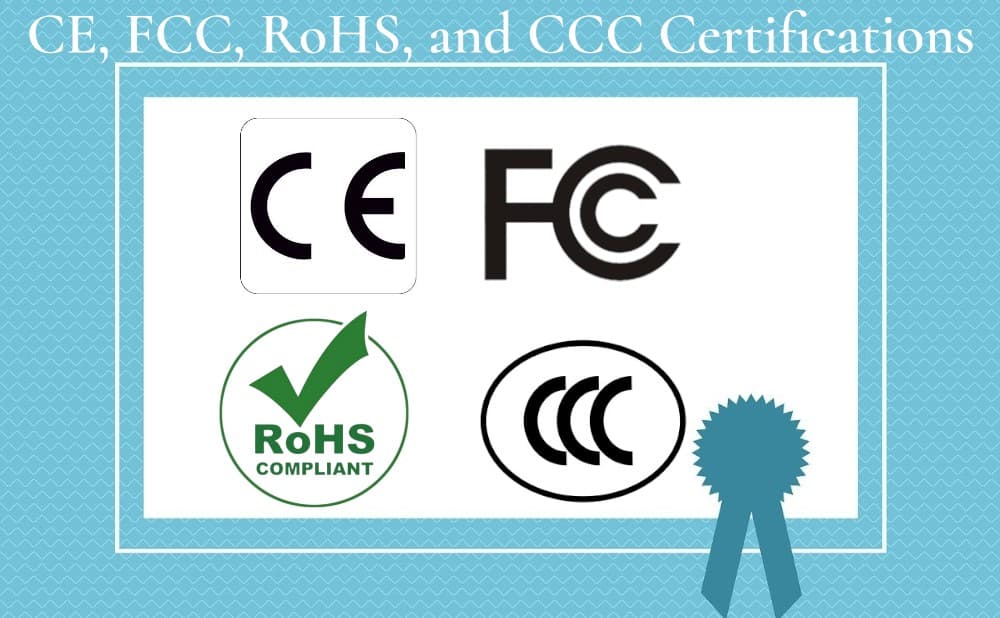
As the world's most influential compliance marks, the four major certifications—CE, FCC, RoHS, and CCC—run through the entire production and sales process of multiple industries such as electronics and electrical, machinery, and home appliances.
Today, we’ll dive deep into these four major certifications to help you understand global industry standards and how to identify safe, high-quality products at a glance.
Core Overview of the Four Major Certifications: Distinguish Key Differences at a Glance
Before diving into details, let's quickly grasp the core differences of the four major certifications through a table to help you establish a preliminary understanding, and then we will dissect the details one by one:
|
Certification Name |
Applicable Region |
Full Name |
Mandatory |
Core Category |
Core Focus |
|
CE Certification |
EU and European Economic Area (EEA) |
Conformité Européenne (European Conformity Certification) |
Yes |
Safety/EMC/Environmental Protection |
Overall product compliance for free circulation in the EU |
|
FCC Certification |
United States |
Federal Communications Commission Certification |
Yes |
Electromagnetic Compatibility (EMC) |
Control wireless frequency and electromagnetic interference to ensure communication safety |
|
RoHS Certification |
EU |
Restriction of Hazardous Substances Directive |
Yes (RoHS 2.0 fully implemented) |
Environmental Protection (Chemical Safety) |
Restrict the content of hazardous substances such as lead and cadmium in products |
|
CCC Certification |
China |
China Compulsory Certification |
Yes |
Compulsory Safety Certification |
Comply with Chinese national standards to ensure personal and property safety |
Detailed Dissection: Core Details and Compliance Points of the Four Major Certifications
I. CE Certification: "Entry Passport" for the EU Market
CE certification is a mandatory certification for products entering the EU and European Economic Area (EEA) markets. It covers multiple categories such as electronics and electrical, machinery, medical devices, and toys, equivalent to a "EU passport" for products—products with the CE mark can circulate freely in 27 EU member states as well as Iceland, Liechtenstein, Norway and other regions, without the need to meet separate compliance requirements of each country.
The core point is that CE certification is not issued by a single institution. Instead, manufacturers self-declare that their products meet the basic requirements for safety, health, environmental protection and consumer protection in the EU's "New Approach Directives". For some high-risk products (such as medical devices and pressure equipment), intervention and evaluation by EU Notified Bodies are required. Common CE directives include the Low Voltage Directive (LVD, ensuring electrical safety), Electromagnetic Compatibility Directive (EMC, controlling electromagnetic interference and immunity), and Radio Equipment Directive (RED, regulating radio frequency performance). Enterprises need to meet the testing requirements of the corresponding directives according to their product types.
Notes: The CE mark must be affixed by the manufacturer itself. Abuse of the CE mark (such as affixing it without meeting standards) will face product removal, heavy fines and even criminal liability. In addition, the UK has fully implemented the UKCA mark since 2023, and the CE mark is gradually restricted in the UK market. Enterprises exporting to the UK need to pay special attention to compliance updates.
II. FCC Certification: "Electromagnetic Passport" for the US Market
FCC certification is a mandatory certification formulated by the US Federal Communications Commission (FCC). It applies to all electronic and electrical products sold in the United States that may generate radio frequency interference, ranging from mobile phones and chargers to industrial equipment and wireless communication devices, all of which need to pass this certification to enter the US.
The core of FCC certification focuses on Electromagnetic Compatibility (EMC) and Radio Frequency (RF) performance, mainly divided into two categories: one is FCC SDoC (Supplier's Declaration of Conformity), applicable to most ordinary electronic devices (such as power supplies and monitors), which can be self-verified by the manufacturer or importer; the other is FCC Certification, applicable to devices that intentionally emit radio frequency energy (such as Wi-Fi, Bluetooth, and mobile phones), which requires review by a FCC-recognized TCB (Telecommunication Certification Body) and assignment of an FCC ID, with higher testing stringency.
Notes: Products that have not passed FCC certification will be prohibited from entering or being sold by US Customs due to electromagnetic interference issues. After certification, compliance information (such as FCC ID or SDoC declaration) must be marked on the product or its packaging, otherwise compliance penalties will be imposed.
III. RoHS Certification: "Environmental Protection Threshold" for the EU Market
RoHS certification is a mandatory environmental protection directive of the EU. Its core purpose is to restrict the use of hazardous substances in electronic and electrical products to protect human health and the environment. It is usually used together with CE certification and is the "environmental protection passport" for products entering the EU market. The currently implemented RoHS 2.0 version restricts a total of 10 hazardous substances, including 6 basic items (lead, cadmium, mercury, hexavalent chromium, polybrominated biphenyls, polybrominated diphenyl ethers) and 4 additional items (phthalates, hexabromocyclododecane). Among them, cadmium has the strictest limit requirement (<0.01%), and the limit for other substances is <0.1%.
Unlike other certifications, RoHS does not have a unified certification mark. After passing the test, enterprises can mark "RoHS Compliant" (meets RoHS requirements) on product reports or labels. During testing, the product needs to be disassembled into homogeneous materials and tested chemically one by one to ensure that each material meets the limit requirements. In addition, China has also put forward RoHS control requirements for electronic information products, and some products sold domestically will be affixed with a circular icon with Arabic numerals, where the number inside the circle represents the environmental protection service life.
Notes: RoHS compliance needs to run through the entire supply chain. Enterprises need to require suppliers to provide RoHS compliant material declarations and third-party test reports to avoid overall product non-compliance due to excessive raw material content.
IV. CCC Certification: "Mandatory Entry Order" for the Chinese Market
CCC certification (also known as "3C certification") is China's mandatory product certification, uniformly managed by the State Administration for Market Regulation. It applies to products included in the "Catalogue of Mandatory Product Certification", which currently covers 21 categories and more than 100 types of products, including home appliances, computers, mobile phones, wires and cables, electric tools and other products closely related to consumers' personal and property safety.
According to Chinese laws and regulations, products that have not obtained the CCC certification certificate and marked the certification mark shall not be manufactured, sold, imported or used in business activities. For example, since August 1, 2024, power banks and lithium-ion batteries that have not passed CCC certification have been prohibited from circulating in the domestic market. The core requirements of CCC certification include electrical safety (such as insulation, withstand voltage, and grounding) and electromagnetic compatibility (EMC). Testing is based on Chinese national standards (GB) and is carried out and certified by institutions authorized by the Certification and Accreditation Administration of China (CNCA).
Notes: The CCC mark must be affixed after certification and shall not be forged or falsely used; some products (such as audio-visual equipment and information technology equipment) have been included in the self-declaration model, but most products still need to be certified by designated institutions. Enterprises need to confirm in advance whether their products are included in the CCC catalogue.
Whether you are a manufacturer securing a "global passport" for trade or a consumer looking for a "safety shield" for your home, these certifications are the ultimate benchmarks of quality. They bridge the gap between complex industry regulations and the peace of mind every user deserves. In a world of choice, always look for the mark that proves a commitment to safety and excellence.
![[18th Anniversary] 18 Years of Echoing Excellence: Making Communication Easier, Connecting Trust Beyond Borders](https://res.retekess.com/z_file/20260716/retekess-brand-story-making-communication-easier_20260716151044_7682.jpg)
![[18 Years in Wireless Communication] Silent Disco Systems Anniversary Celebration: Top-Selling Headphones & Event Mechanics Revealed!](https://res.retekess.com/z_file/20260713/18-years-in-wireless-communication-silent-disco-systems-anniversary-celebration_20260713175011_5749.webp)
![[Anniversary Carnival] Ding-dong! 18th Anniversary Mega Sale on Guest Paging & Calling Systems: Full Reveal of 12+ Products & Promo Rules!](https://res.retekess.com/z_file/20260713/18th-anniversary-mega-sale-on-guest-paging-calling-systems_20260713175257_0295.webp)
![[Retekess 18th Anniversary Teaser] Tour Guide System Exclusive Perks: Sneak Peek at Event Dates & Mechanics!](https://res.retekess.com/z_file/20260713/retekess-18th-anniversary-tour-guide-system-exclusive-perks--2-_20260713180135_6435.webp)


 Google
 Amazon
Comments (0)