
Table of Contents
SNR vs NRR: Deciphering the Standards for Hearing Protection
- Retekess
- May 29, 2026
When you are searching for the perfect pair of earplugs or earmuffs to protect your hearing, you are inevitably met with technical acronyms that seem to blur together. Among the most confusing are SNR and NRR. If you’ve ever wondered why your hearing protection lists a specific decibel (dB) value or how a 25 dB noise reduction rating actually translates to the real world, you are not alone.
Understanding these ratings is more than just a matter of shopping; it is a critical step in preventing noise-induced hearing loss. In this guide, we will break down the noise reduction rating, compare SNR vs NRR, and explain why these numbers matter in your daily life.
What is SNR?
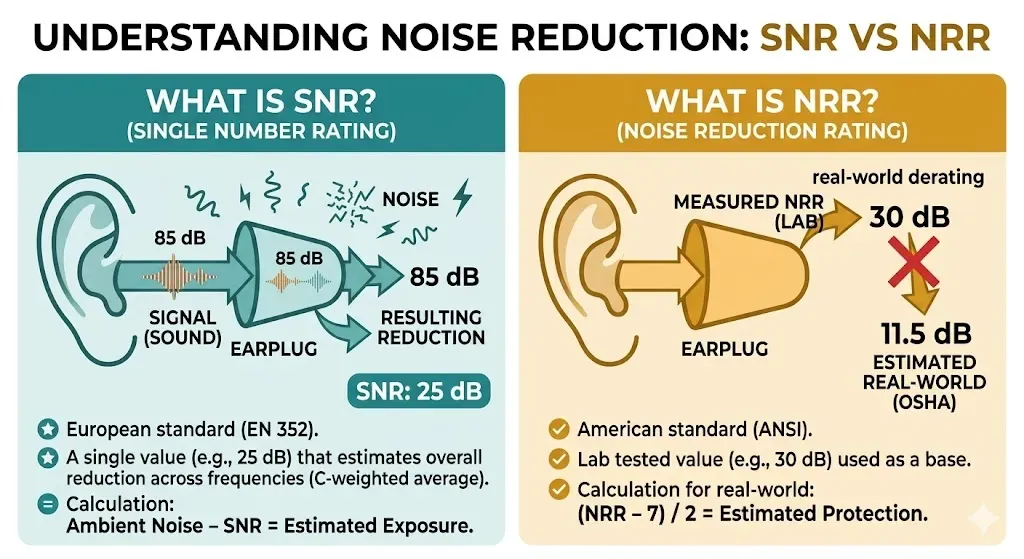
SNR stands for Single Number Rating. It is the standard method used primarily in Europe (under EN 352 standards) to indicate the attenuation, or noise reduction capability, of a hearing protection device.
The SNR meaning is straightforward: it provides a single-figure estimate of how many decibels a protector can reduce on average across various sound frequencies. Because sound consists of both high-frequency (like a whistle) and low-frequency (like engine hum) noises, the SNR is designed to account for a broad spectrum, making it a reliable indicator of general performance.
To estimate your noise exposure with an SNR-rated device, you simply subtract the SNR value from the ambient noise level. For instance, if you are in an environment with 100 dB of noise and are wearing a device with an SNR 15 rating, your estimated exposure would be approximately 85 dB.
What is NRR?
NRR stands for Noise Reduction Rating. If SNR is the European standard, NRR is its American counterpart. Regulated by the Environmental Protection Agency (EPA) and tested under ANSI standards, the NRR is the primary metric used in the United States to measure the effectiveness of hearing protectors.
The NRR meaning centers on providing a safety benchmark for workers and consumers. Similar to SNR, the NRR is expressed in decibels. When you see a product labeled with an NRR rating, it represents the potential noise reduction the device can achieve under ideal, laboratory-tested conditions.
What is the difference between SNR and NRR?
While both acronyms serve the same ultimate purpose—protecting your ears—the NRR vs SNR comparison is not an apples-to-apples one. Because they rely on different testing protocols and mathematical calculations, you cannot directly compare an SNR value to an NRR value.
1. Geographical Standards
The most immediate difference is the region of use. SNR is the hallmark of European safety standards (ISO/EN), while NRR is the mandatory standard for hearing protection in the United States (ANSI).
2. Calculation Methodology
The primary mathematical difference lies in how they handle uncertainty:
NRR: The calculation involves subtracting two standard deviations from the mean attenuation and then applying an additional "spectral uncertainty" factor (usually 3 dB). This makes NRR ratings more conservative.
SNR: SNR is generally calculated by subtracting only one standard deviation from the mean attenuation.
As a rule of thumb, you will often find that the SNR value for a specific product is 2–3 dB higher than its NRR value, simply due to these differing calculation formulas.
3. Real-World Application
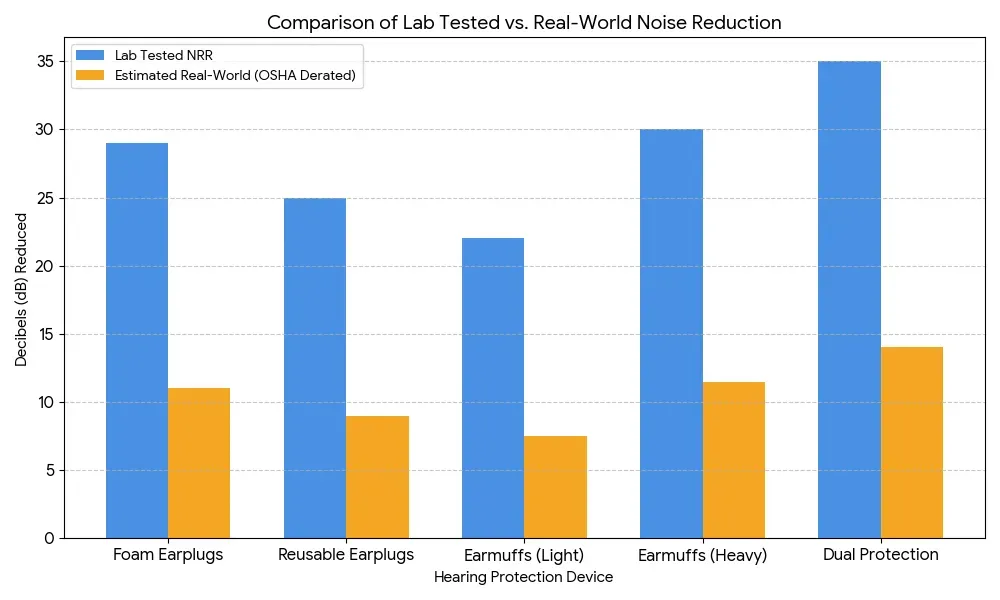
It is vital to understand that neither rating is a "guarantee" of performance. Both NRR and SNR are tested in controlled laboratory environments. In the real world, factors such as improper fit, hair interference, or eyeglasses can significantly degrade the actual protection provided.
| Feature | SNR | NRR |
|---|---|---|
| Region | European Union (EN 352) | United States (ANSI S3.19-1974) |
| Test signal | Pink noise (8 octaves) | Pink noise (9 octaves) |
| Calculation | C-weighted vs. A-weighted | A-weighted, 3–5 dB lower than SNR |
| Real-world usage | Used directly (Lc - SNR) | Often derated (NRR - 7 ÷ 2) |
| Typical range | 20–35 dB | 15–30 dB |
The Reality of "25 dB Noise Reduction"
One of the most frequent points of confusion is the math behind a 25 dB noise reduction claim. Users often assume that if they are in a 100 dB environment and put on a 25 dB device, they will hear 75 dB. Unfortunately, it is rarely that simple.
For NRR, the Occupational Safety and Health Administration (OSHA) suggests "derating" the protection because real-world usage rarely matches lab-perfect conditions. A common formula for adjusting NRR is:
Subtract 7 from the NRR value.
Divide by 2.
For an NRR of 25 dB, the calculation would be: (25 - 7) / 2 = 9 dB. This indicates that the realistic protection you should expect in an average workplace is significantly lower than the advertised number. Always remember that proper insertion and maintenance of your hearing protection are the true keys to achieving the maximum potential of your device's rating.
Choosing the Right Protection for Your Needs
Whether you are looking at s.n.r. values for a concert in Europe or NRR ratings for a construction site in the U.S., the goal remains the same: safeguarding your auditory health.
Assess your environment: Are you dealing with high-frequency industrial noise or low-frequency ambient drone?
Prioritize fit: An expensive set of earmuffs with a high NRR will fail if they do not create a proper seal around your ears.
Check the labels: Regardless of the standard, always ensure the product is certified for your region.
Understanding these ratings allows you to move past the marketing numbers and make informed decisions about your long-term health. By demystifying SNR vs NRR, you are now better equipped to find the right tool to keep your hearing safe in a noisy world.
Leave a Reply




![[18th Anniversary] 18 Years of Echoing Excellence: Making Communication Easier, Connecting Trust Beyond Borders](https://res.retekess.com/z_file/20260716/retekess-brand-story-making-communication-easier_20260716151044_7682.jpg)
![[18 Years in Wireless Communication] Silent Disco Systems Anniversary Celebration: Top-Selling Headphones & Event Mechanics Revealed!](https://res.retekess.com/z_file/20260713/18-years-in-wireless-communication-silent-disco-systems-anniversary-celebration_20260713175011_5749.webp)
![[Anniversary Carnival] Ding-dong! 18th Anniversary Mega Sale on Guest Paging & Calling Systems: Full Reveal of 12+ Products & Promo Rules!](https://res.retekess.com/z_file/20260713/18th-anniversary-mega-sale-on-guest-paging-calling-systems_20260713175257_0295.webp)
![[Retekess 18th Anniversary Teaser] Tour Guide System Exclusive Perks: Sneak Peek at Event Dates & Mechanics!](https://res.retekess.com/z_file/20260713/retekess-18th-anniversary-tour-guide-system-exclusive-perks--2-_20260713180135_6435.webp)

Follow Us
Pay With


 Google
 Amazon
Comments (0)