
Table of Contents
What Do Gain Decibels, 16 Channels, and WDRC mean in a Hearing Aid?
- Judy
- Aug 26, 2026
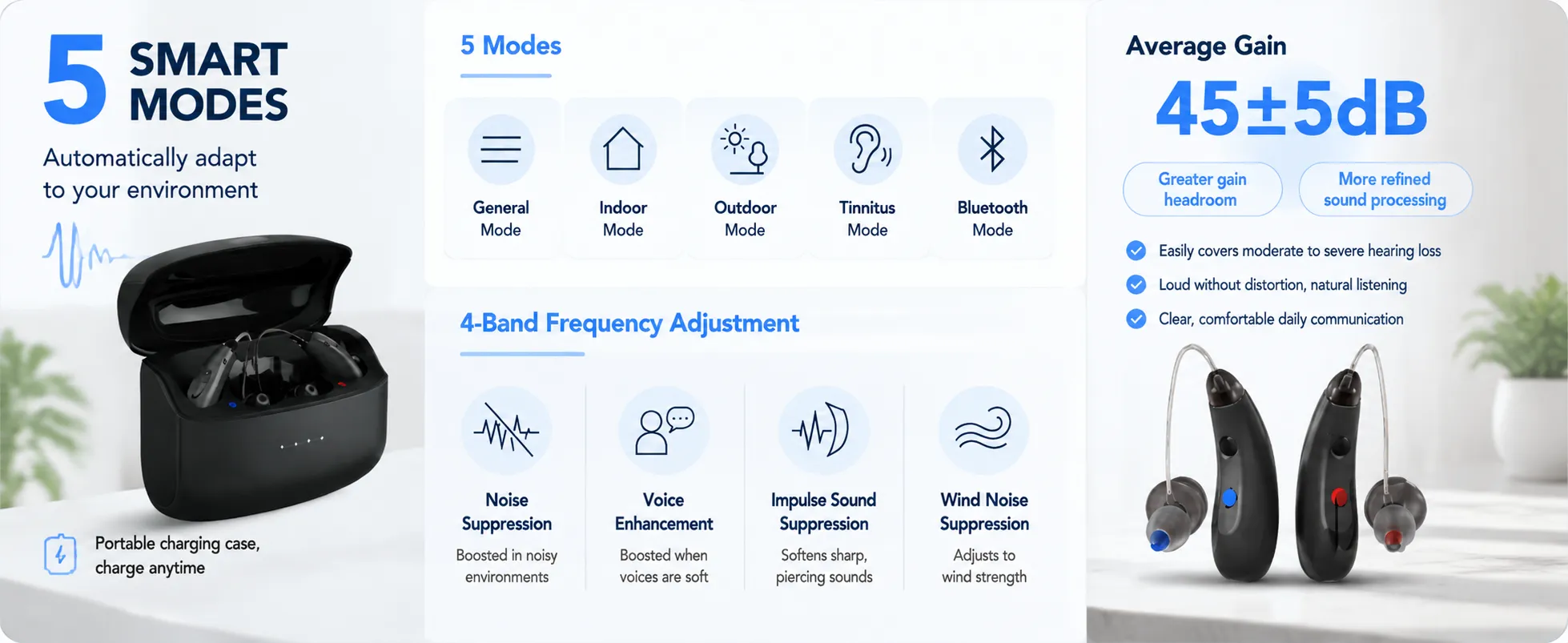
Fundamentally, maximum gain values of 45±5 dB and 30±5 dB represent the maximum extent to which a hearing aid can amplify incoming sound. The key difference between the two lies not in volume settings, but in their amplification capabilities—specifically, the upper limit of hearing loss compensation they can provide.
1. Understanding "Gain"
Suppose the ambient sound level is 50 dB SPL:
Max Gain = 30 dB
→ Theoretically, after amplification by the hearing aid, the output is approximately 80 dB SPL.
Max Gain = 45 dB
→ Theoretically, the output can reach approximately 95 dB SPL.
Of course, real-world performance isn't a simple "Input + Gain" calculation; it is influenced by factors such as compression, frequency, output limits, and DSP algorithms.
In simple terms:
Gain = The hearing aid's capacity to amplify sound.
2. Higher Gain ≠ A Better Hearing Aid
A hearing aid's performance is not determined by the maximum gain parameter alone.
For example:
Product A: Max Gain 45 dB
Characteristics:
Higher gain
Average noise handling
Average speech recognition
Average feedback control
Product B: Max Gain 30 dB
Characteristics:
Lower gain
Superior DSP algorithms
Better speech enhancement
Better noise suppression
Better feedback cancellation
For a user with mild hearing loss, Product B might well provide a more comfortable listening experience than Product A.
3. What is the fundamental difference?
From a hardware or acoustic perspective, the fundamental difference is:
The maximum acoustic gain the hearing aid can provide.
In other words, under the right conditions, a 45 dB product can provide stronger sound amplification.
Think of them as two amplifiers with different power ratings:
30 dB Gain:
Quiet sound → Amplified → Reaches the user's required auditory level
45 dB Gain:
Quiet sound → Amplified to a greater degree → Meets higher compensation needs
However, a hearing aid is not merely a simple power amplifier.
Actual gain often varies depending on the frequency. The fundamental difference between 30±5 dB and 45±5 dB lies in the upper limit of the maximum amplification gain they can provide.
30 dB → Lower maximum amplification capability; typically better suited for mild hearing loss.
45 dB → Higher maximum amplification capability; offers greater gain headroom and generally covers a wider range of needs.
However, gain is just one dimension of hearing aid performance and does not solely determine "how well one hears." The actual user experience also depends on the DSP, speech enhancement, noise reduction, feedback suppression, frequency response, compression algorithms, and the actual fitting/adjustment process.
4. What problem does WDRC actually solve?
WDRC stands for Wide Dynamic Range Compression.
This is key to understanding the difference between the two.
People with normal hearing have a wide dynamic range:
Very soft sounds → Normal sounds → Loud sounds
In contrast, users with hearing loss may experience:
Inability to hear soft sounds → Sounds become sufficiently loud with a slight increase in volume → Sounds become uncomfortably loud with further increases.
This is the issue hearing aids need to address.
One of the purposes of WDRC is to:
Apply more gain to soft sounds and less gain to loud sounds.
5. What are 16 channels?
16 channels does *not* mean 16 times the amplification.
Nor does it mean:
16 microphones
16 speakers
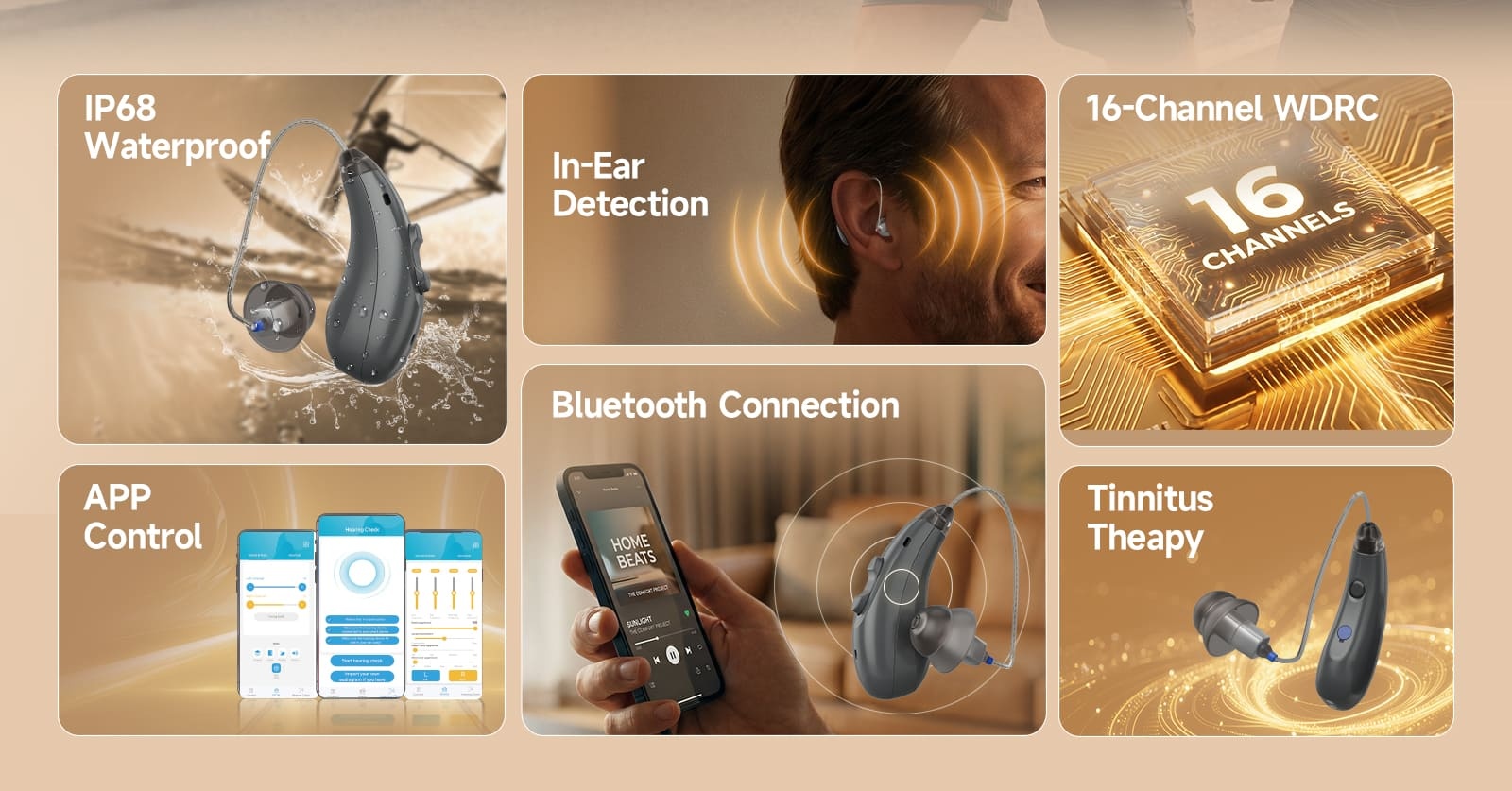
Instead, the DSP divides the sound spectrum into multiple processing channels. Each frequency band is processed independently—applying WDRC, noise reduction, and gain control—before the sound is output to the ear. Theoretically, the more channels there are, the more precisely different frequency regions can be processed.
6. 30±5 dB + 16-channel WDRC vs. 45±5 dB + 16-channel WDRC:
While the DSP processing capabilities of both may be similar, the 45 dB version has a higher maximum gain limit, resulting in greater "available gain headroom."
Leave a Reply


![[18th Anniversary] 18 Years of Echoing Excellence: Making Communication Easier, Connecting Trust Beyond Borders](https://res.retekess.com/z_file/20260716/retekess-brand-story-making-communication-easier_20260716151044_7682.jpg)
![[18 Years in Wireless Communication] Silent Disco Systems Anniversary Celebration: Top-Selling Headphones & Event Mechanics Revealed!](https://res.retekess.com/z_file/20260713/18-years-in-wireless-communication-silent-disco-systems-anniversary-celebration_20260713175011_5749.webp)
![[Anniversary Carnival] Ding-dong! 18th Anniversary Mega Sale on Guest Paging & Calling Systems: Full Reveal of 12+ Products & Promo Rules!](https://res.retekess.com/z_file/20260713/18th-anniversary-mega-sale-on-guest-paging-calling-systems_20260713175257_0295.webp)
![[Retekess 18th Anniversary Teaser] Tour Guide System Exclusive Perks: Sneak Peek at Event Dates & Mechanics!](https://res.retekess.com/z_file/20260713/retekess-18th-anniversary-tour-guide-system-exclusive-perks--2-_20260713180135_6435.webp)

Follow Us
Pay With


 Google
 Amazon
Comments (0)