
Table of Contents

What is a Communication System? | Retekess Communication System
- Retekess
- Aug 14, 2026
Have you ever stopped to think about the miracle of sending a text, making a video call, or even turning on the radio? The seamless flow of information that we take for granted is made possible by something called a communication system. But what exactly is it?
What is a Communication System?
A Communication System is any complete technology and organizational framework that enables the transfer of information (data, voice, video, etc.) between two or more terminals.
It encompasses both hardware (transmitters, receivers, antennas, channels) and software (protocols, coding, modulation), forming the invisible backbone of modern life.
Communication System Principles
At its most basic, a communication system is any framework—a collection of devices, networks, and protocols—designed to transmit information from one point to another. As simply defined by ScienceDirect Topics, it’s a system "in which information is transmitted from one physical location to another." Whether it's a person whispering across a room or a satellite beaming data across continents, the core purpose remains the same: to bridge the gap between a source and a destination.
Communication System Core Components
Every communication system, from the simplest to the most complex, can be understood through a fundamental model involving five key components:
-
Information Source: This is where the message originates. It could be you speaking into a phone, a computer sending an email, or a sensor recording temperature data.
-
Transmitter: The transmitter's job is to take the raw message and prepare it for the journey. It encodes and modulates the signal, often converting it into a form (like a specific radio wave or electrical pulse) that can travel efficiently over the chosen medium. Think of it as packaging a letter for the postal service.
-
Channel/Medium: This is the physical path the signal travels through. It can be wired, like fiber optic cables or copper telephone lines, or wireless, like the air carrying radio waves, microwaves, or satellite signals. The channel often introduces challenges like noise and distortion.
-
Receiver: Located at the destination end, the receiver performs the reverse function of the transmitter. It captures the incoming signal, filters out interference, and demodulates/decodes it to recover the original message.
-
Destination: This is the final intended recipient of the information—the person listening on the other end of the call, the computer screen displaying the webpage, or the server storing the sensor data.
Communication System Block Diagram

Communication System Types
Communication systems are further defined by how they operate:
-
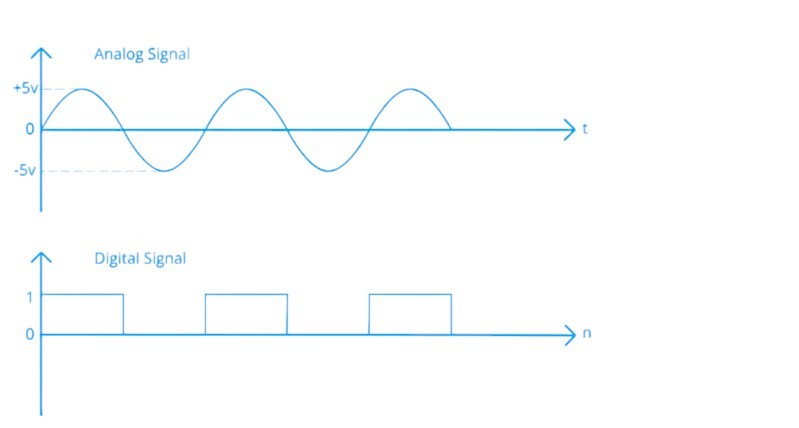
Signal Type: They can process Analog signals (continuous waves, like traditional FM radio) or Digital signals (discrete binary bits of 0s and 1s, which dominate modern systems like 4G/5G and Wi-Fi due to better noise resistance).
-
Direction of Flow:
-
Simplex: One-way only (e.g., broadcast radio, TV).
-
Half-Duplex: Two-way, but only one can transmit at a time (e.g., walkie-talkies).
-
Full-Duplex: Two-way simultaneous communication (e.g., a telephone conversation).
-
-
Scale & Network: They can be a simple point-to-point link or part of a vast, interconnected network like the internet, which is essentially a "collection of individual telecommunications networks," as noted by Wikipedia.
Digital vs. Analog: A Foundational Distinction
Communication systems are broadly categorized based on the nature of the signals they handle: analog signal or digital signal. Understanding this distinction is key to grasping modern telecommunications.
Analog Systems convey information through continuous signals that vary in amplitude or frequency. Think of the undulating waves of a traditional radio broadcast or an old landline telephone signal. While they can provide a very direct representation of sound or images, they are susceptible to degradation. Noise and interference accumulate during transmission and amplification, leading to signal distortion and loss of quality over long distances.
Digital Systems represent information using discrete, binary values (0s and 1s). Voice, text, or video is first converted into this digital code. The primary advantage of this approach lies in its robustness. Since the receiver only needs to distinguish between discrete states (e.g., high or low voltage), it can accurately regenerate the original signal even if it has been weakened or slightly corrupted by noise. This makes digital transmission exceptionally reliable for data integrity and is the basis for all modern computing and internet communications.
Retekess Wireless Communication System
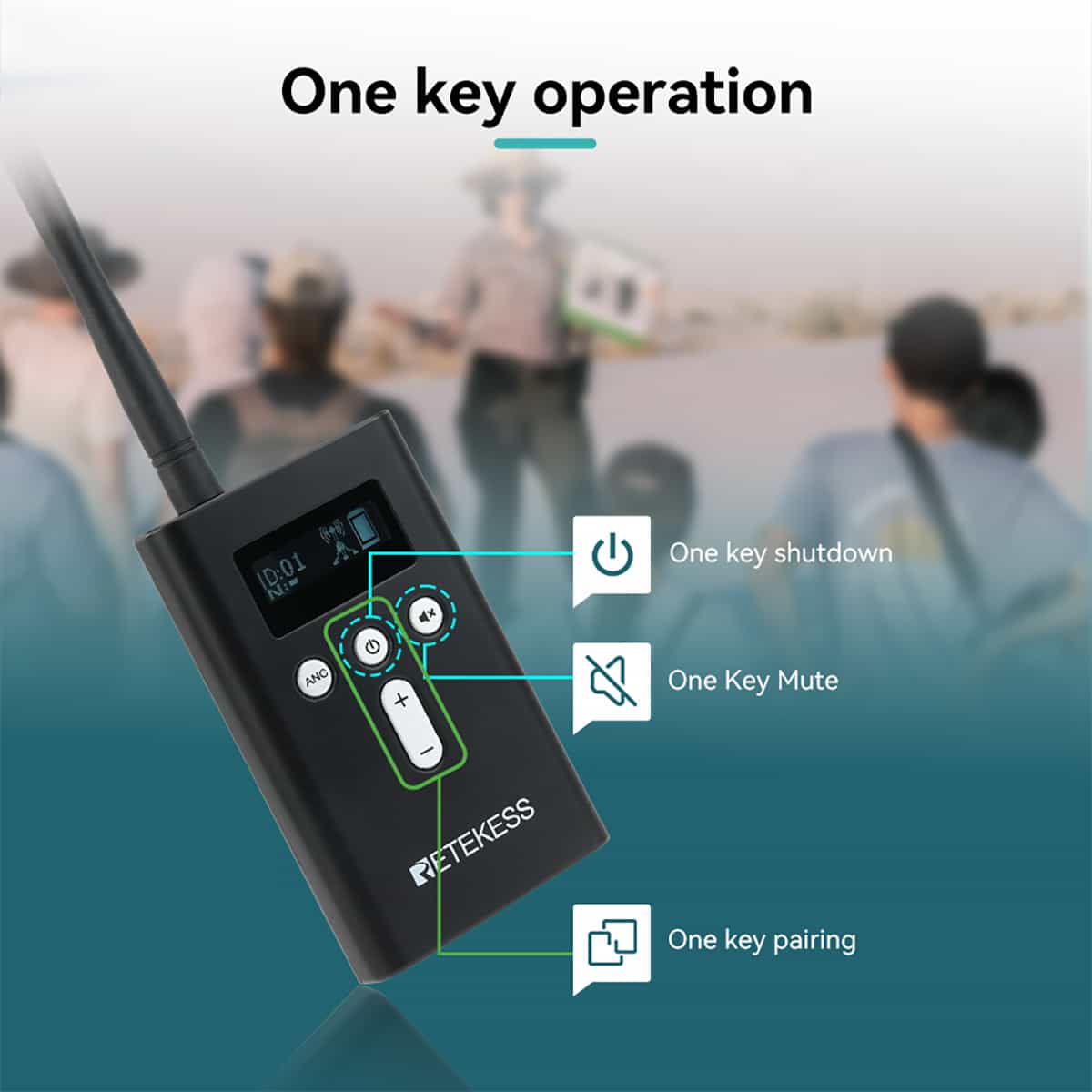
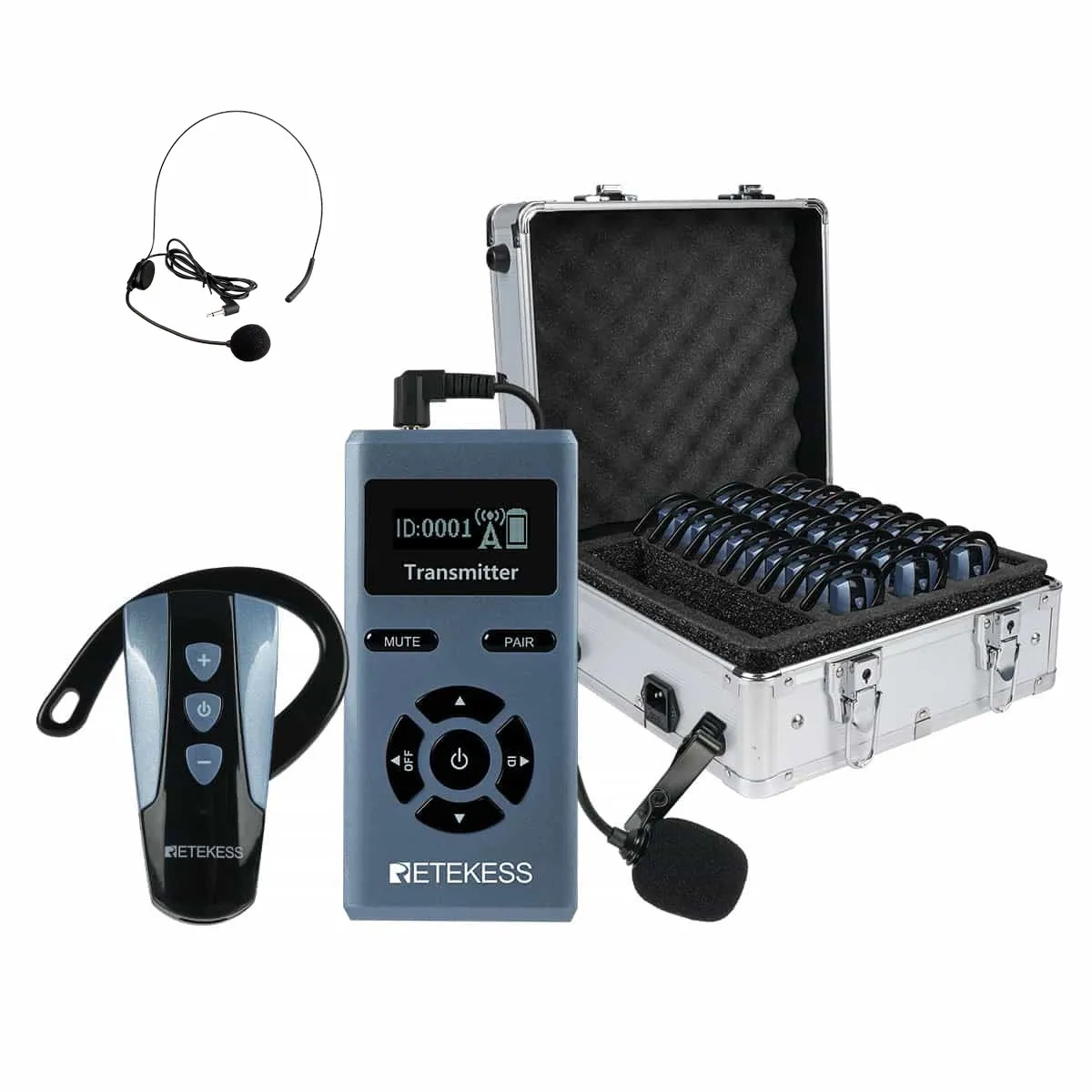
Retekess integrates this fundamental communication principle into practical, user-centric solutions. Our product lines—encompassing Tour Guide Systems, Translation Devices, and professional Simultaneous Interpretation Equipment—are not just isolated tools; they are complete, tailored communication ecosystems designed to solve specific real-world challenges.
Retekess systems excel by enhancing each component. For instance, our use of DSP noise-canceling chips purifies the signal at the source, while stable RF technology ensures the channel is robust against interference. This systematic approach is what transforms basic audio transmission into a clear, reliable, and scalable communication experience.
The Retekess Advantage
Guaranteed Compatibility: Every component, from transmitters and receivers to charging cases and microphones, is engineered to work together flawlessly, eliminating technical guesswork.
Scalable Architecture: Start with a basic kit (1 transmitter + 10 receivers) and expand effortlessly to support large events (multiple transmitters + 100+ receivers). The system grows with your needs.
Simplified Management: Features like one-touch pairing, batch power control, and centralized bulk charging (using our TT026 Charging Case) drastically reduce operational complexity and staff time.
Reliable Performance: By controlling the entire signal chain—from input to output—we ensure consistent audio quality, stable transmission, and durable hardware built for professional use.
More Than Just Talk: Why It Matters
Communication systems are the invisible backbone of modern civilization. As highlighted by resources like CISA (Cybersecurity & Infrastructure Security Agency), these systems are critical for monitoring, controlling, and managing nearly every aspect of our critical infrastructure—from energy grids and water supplies to transportation and financial networks. They enable global commerce, emergency services, social interaction, and the instant access to information that defines our era.
In essence, a communication system is the engineered solution to a fundamental human need: to connect, share, and exchange ideas across any distance. The next time you send a message or stream a show, remember the intricate, invisible system working flawlessly to make it happen. It’s not just technology; it’s what connects our world.

Leave a Reply












![[18th Anniversary] 18 Years of Echoing Excellence: Making Communication Easier, Connecting Trust Beyond Borders](https://res.retekess.com/z_file/20260716/retekess-brand-story-making-communication-easier_20260716151044_7682.jpg)
![[18 Years in Wireless Communication] Silent Disco Systems Anniversary Celebration: Top-Selling Headphones & Event Mechanics Revealed!](https://res.retekess.com/z_file/20260713/18-years-in-wireless-communication-silent-disco-systems-anniversary-celebration_20260713175011_5749.webp)
![[Anniversary Carnival] Ding-dong! 18th Anniversary Mega Sale on Guest Paging & Calling Systems: Full Reveal of 12+ Products & Promo Rules!](https://res.retekess.com/z_file/20260713/18th-anniversary-mega-sale-on-guest-paging-calling-systems_20260713175257_0295.webp)
![[Retekess 18th Anniversary Teaser] Tour Guide System Exclusive Perks: Sneak Peek at Event Dates & Mechanics!](https://res.retekess.com/z_file/20260713/retekess-18th-anniversary-tour-guide-system-exclusive-perks--2-_20260713180135_6435.webp)

Follow Us
Pay With


 Google
 Amazon
Comments (0)