
|
Trait |
Expression |
|
Depth over distance |
Choosing to explore one city thoroughly rather than skimming five |
|
Human connection |
Seeking out teachers, artisans, and elders — not just attractions |
|
Climate awareness |
Adapting schedules to work with the weather, not against it |
|
Local-first thinking |
Rediscovering nearby capitals and hometowns with fresh eyes |
|
Experience over acquisition |
Investing in memories and skills, not souvenirs |
Table of Contents
2026 Summer Travel Trends: Why Travelers Are Going Deeper, Not Farther
- Retekess
- Jul 17, 2026
From "Capitalmaxxing" to "Gran Turismo" to "Dusking" — the three defining shifts reshaping how the world vacations this summer.
If there's one word that defines summer 2026, it isn't "farther." It's deeper.
After years of bucket-list sprinting — cramming five countries into ten days, chasing the next undiscovered island, chasing viral TikTok destinations — travelers are pumping the brakes. The new status quo? Return to the places you thought you knew and experience them like never before. Learn a skill from someone who's spent a lifetime mastering it. And when the summer heat peaks, wait for golden hour rather than fighting the midday sun.
These are the three trends that GetYourGuide — a platform offering over 200,000 bookable experiences across more than 18,000 cities worldwide — has identified as the defining movements of summer 2026, drawing on 17 years of booking data from major markets including the UK, Germany, France, and the US.
Here's what's happening, why it's happening, and what it means for your summer plans.
Trend 1: "Capitalmaxxing" — The Art of Going Deep at Home
Travelers Are Rediscovering Their Own Capitals
Remember when "real travel" meant crossing as many borders as possible? That mindset is fading fast. In its place, a new movement has emerged that GetYourGuide has dubbed "Capitalmaxxing" — the practice of returning to your own country's capital (or a major city you've visited before) and exploring it with the depth and curiosity usually reserved for far-flung destinations.
The data, published in GetYourGuide's Summer 2026 Travel Trends press release, backs it up:
- UK travelers searching for London experiences: up 35% year-over-year (GetYourGuide, June 2026)
- French travelers booking Paris activities: up 17% year-to-date (GetYourGuide, June 2026)
- Classic Paris experiences: seeing triple-digit growth (GlobeNewswire / Edmonton Journal, June 2026)
What This Looks Like in Practice
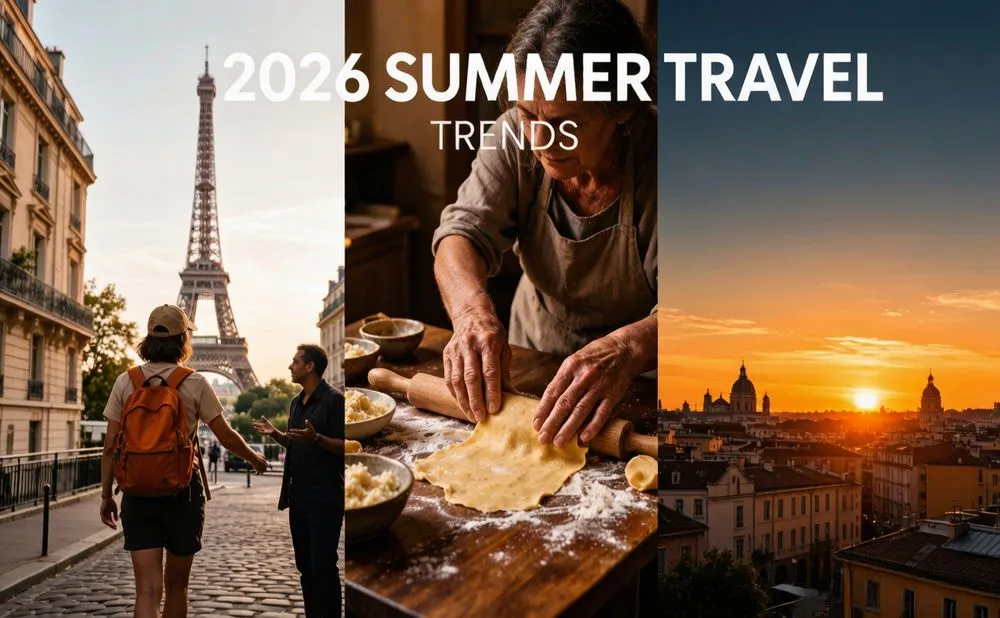
In Paris, the trend manifests as a surge in demand for experiences that go beyond the selfie-at-the-Eiffel-Tower routine. Travelers are booking Louvre guided tours led by art historians, descending into the Paris Catacombs, gliding along the [Seine at sunset](https://www.getyourguide.com/paris-l16/ Seine-river-cruises-tc27/), and — notably — queuing (or rather, skipping queues) for immersive VR tours of the Eiffel Tower that offer behind-the-scenes access most visitors never see.
"The Eiffel Tower is a global treasure for a reason — but we're seeing more people want to experience it with a real insider's view." — Lucas Glowowski, GetYourGuide's France Travel Expert (GetYourGuide, June 2026)
In London, the pattern repeats: locals who once dismissed their own capital as "too familiar" are now booking walking tours of hidden neighborhoods, afternoon tea experiences in historic venues, and behind-the-scenes tours of landmarks they've walked past a hundred times without entering.
Why It's Happening
Several forces are converging. Post-pandemic, there's a growing appreciation for what's close to home — both for sustainability reasons and for the simple pleasure of spending less time in transit and more time experiencing. Social media has also played a role: travelers are increasingly aware that the "perfect Instagram shot" of a famous landmark is less satisfying than a genuine, memorable encounter with a place and its people.
There's also an economic dimension. With the cost of long-haul travel remaining elevated, investing in a deeper experience closer to home offers better value per memory created. This aligns with broader research from the European Travel Commission (a GetYourGuide data partner) on the shift toward more meaningful, lower-carbon travel choices.
Trend 2: "Gran Turismo" — Learning From a Lifetime of Mastery
When Your Teacher Has Spent 60 Years Perfecting One Thing
The second trend is perhaps the most emotionally resonant of the three. GetYourGuide calls it "Gran Turismo" (or "Grandma Tourism") — and it represents a fundamental shift in what travelers want to learn and who they want to learn it from.
In recent years, "educational travel" has meant taking a cooking class or a craft workshop. But the 2026 version goes deeper: travelers want to learn from people who have dedicated their entire lives to mastering a skill, and that often means learning from older, local artisans whose knowledge has been passed down through generations.
The numbers tell the story: workshops and hands-on courses on GetYourGuide have grown more than 250% between 2023 and 2025, and that momentum is carrying into summer 2026 (GetYourGuide, June 2026).
The Nonna Effect
The trend's poster child is Rome, where travelers are flocking to pasta-making classes taught not by professional chefs, but by nonnas — Italian grandmothers whose cooking expertise was honed over decades in family kitchens.
One standout is Nonna Rosella, who grew up in a village near Rome and has turned a lifetime of cooking experience into a cultural exchange with travelers from around the world. Her pasta-making workshops, which include hands-on instruction and wine tasting, sell out consistently.
"People come to Italy for the food and sights, but one tip to really make memories is to learn about traditions from those handing traditions to the next generation: nonnas." — Francesca De Falco, GetYourGuide's Italy Regional Manager (GetYourGuide, June 2026)
The Bigger Picture
"Gran Turismo" reflects a broader hunger for authenticity and human connection in an increasingly digital world. Travelers aren't just consuming a destination; they're seeking a transfer of wisdom that can't be replicated by a YouTube tutorial or an AI chatbot. There's an implicit recognition that some forms of knowledge — the kind embedded in a grandmother's hands as she rolls pasta dough — are irreplaceable and worth traveling for.
This trend also aligns with growing interest in intergenerational experiences and cultural preservation through tourism. By booking these experiences, travelers are economically supporting the preservation of traditional crafts and knowledge that might otherwise fade away. This mirrors findings from UNWTO on the role of cultural tourism in safeguarding intangible heritage.
Trend 3: "Dusking" — The 5 PM Revolution
Beating the Heat by Embracing the Golden Hour
Summer 2026's third defining trend is a pragmatic one, born from necessity: "Dusking" — the practice of scheduling experiences after 5 PM to escape peak summer heat, enjoy quieter crowds, and bask in the magic of golden-hour light.
GetYourGuide reports that post-5 PM activity bookings are up nearly 40% year-over-year, a staggering increase that reflects both climate realities and changing traveler preferences (GetYourGuide, June 2026).
The dusking trend is further reinforced by GetYourGuide's July 2026 heatwave analysis, which found that worldwide bookings of experiences during the 5–9 p.m. window are up 29% compared to last year, with Asian evening bookings up 64% year-over-year (GetYourGuide, July 2026).
What Dusk-Seekers Are Doing
In Austin, Texas, one of the trend's epicenters, travelers are booking dusk kayak tours to watch the city's famous bat colony emerge from under the Congress Avenue Bridge. It's an experience that combines wildlife, exercise, and a spectacular light show — and it's essentially impossible to replicate at noon.
"Dusk is genuinely one of the best times to explore, especially with older kids. The heat drops, the light turns golden, and you discover a completely different version of a city." — Chris Hohorst, GetYourGuide's US Travel Expert (GetYourGuide, June 2026)
The dusking trend extends beyond Austin. In southern European cities where summer temperatures regularly exceed 35°C (95°F), travelers are shifting sightseeing to early evening: sunset food tours in Seville, twilight walking tours of Rome's historic center, and evening boat cruises along the Amalfi Coast.
Why It Works
The logic is simple and compelling. Summer afternoons in many popular destinations are genuinely uncomfortable — sometimes dangerously so. By shifting activities to the evening, travelers:
- Avoid heat exhaustion and sun damage
- Skip the crowds that thin out as day-trippers head home
- Experience a different atmosphere — cities come alive at dusk with street performers, outdoor dining, and a social energy that's absent at midday
- Capture better photographs in the soft, warm light of golden hour
It's a trend that's both reactive (responding to climate) and proactive (seeking a better experience). Expect it to grow as summers get hotter.
What These Trends Tell Us About the Traveler of 2026
Step back from the individual trends, and a clear portrait emerges of the 2026 summer traveler:
These aren't isolated preferences. They're interconnected expressions of a generation of travelers who have been everywhere, seen everything on their feeds, and are now asking a more fundamental question: What actually makes a trip worth taking?
The answer, increasingly, isn't about where you go. It's about how deeply you engage, who you learn from, and when you choose to explore.
How to Put These Trends Into Your Summer Plans
If these movements resonate with you, here's how to put them into action for your own summer 2026 travels:
Revisit a city you've "already done." Book one deep-dive experience — a specialized museum tour, a neighborhood walking tour, a behind-the-scenes access pass — rather than another generic overview.
Seek out a master, not a class. Look for workshops led by local artisans, cooks, or craftspeople with decades of experience. Ask platforms like GetYourGuide for experiences led by locals with generational knowledge.
Shift your schedule. Plan your heaviest outdoor activities for early morning or after 5 PM. Reserve midday for museums, long lunches, or a genuine rest — your body and your photos will thank you.
Think local first. Before booking a flight across an ocean, check what's within a train ride. You may be surprised by what your own region offers when you approach it with a traveler's curiosity.
Looking Ahead
GetYourGuide has announced that its next major trend report — "Hidden Trends 2027" — will be published in autumn 2026, offering a forward look at what will shape travel next year (GetYourGuide, June 2026).
But for now, the message of summer 2026 is clear: the most rewarding journeys might not require a passport stamp at all. They might just require seeing a familiar place — or a familiar time of day — with entirely new eyes.
Leave a Reply












![[18th Anniversary] 18 Years of Echoing Excellence: Making Communication Easier, Connecting Trust Beyond Borders](https://res.retekess.com/z_file/20260716/retekess-brand-story-making-communication-easier_20260716151044_7682.jpg)
![[18 Years in Wireless Communication] Silent Disco Systems Anniversary Celebration: Top-Selling Headphones & Event Mechanics Revealed!](https://res.retekess.com/z_file/20260713/18-years-in-wireless-communication-silent-disco-systems-anniversary-celebration_20260713175011_5749.webp)
![[Anniversary Carnival] Ding-dong! 18th Anniversary Mega Sale on Guest Paging & Calling Systems: Full Reveal of 12+ Products & Promo Rules!](https://res.retekess.com/z_file/20260713/18th-anniversary-mega-sale-on-guest-paging-calling-systems_20260713175257_0295.webp)
![[Retekess 18th Anniversary Teaser] Tour Guide System Exclusive Perks: Sneak Peek at Event Dates & Mechanics!](https://res.retekess.com/z_file/20260713/retekess-18th-anniversary-tour-guide-system-exclusive-perks--2-_20260713180135_6435.webp)
Follow Us
Pay With


 Google
 Amazon
Comments (0)