
Table of Contents
How AI Translator Devices Are Reshaping Group Tour Communication
- Retekess
- Sep 5, 2026
Professional multilingual group tours have long faced a simple constraint. Every additional language needs another human interpreter, another transmitter, and another daily fee.
A standard mid-range simultaneous interpretation system supports 6 channels. Higher-end FM systems reach 17. Most tour operators cap their language offering at 3 to 5 languages. Staffing interpreters beyond that point costs too much.
Professional interpreters in North America and Western Europe charge $300–$800 per day per language. A six-language factory visit therefore costs $1,500–$4,000 in interpretation fees alone. Smaller languages — Arabic, Mandarin, Japanese, Korean, Portuguese, Russian, Polish — often go unoffered entirely.
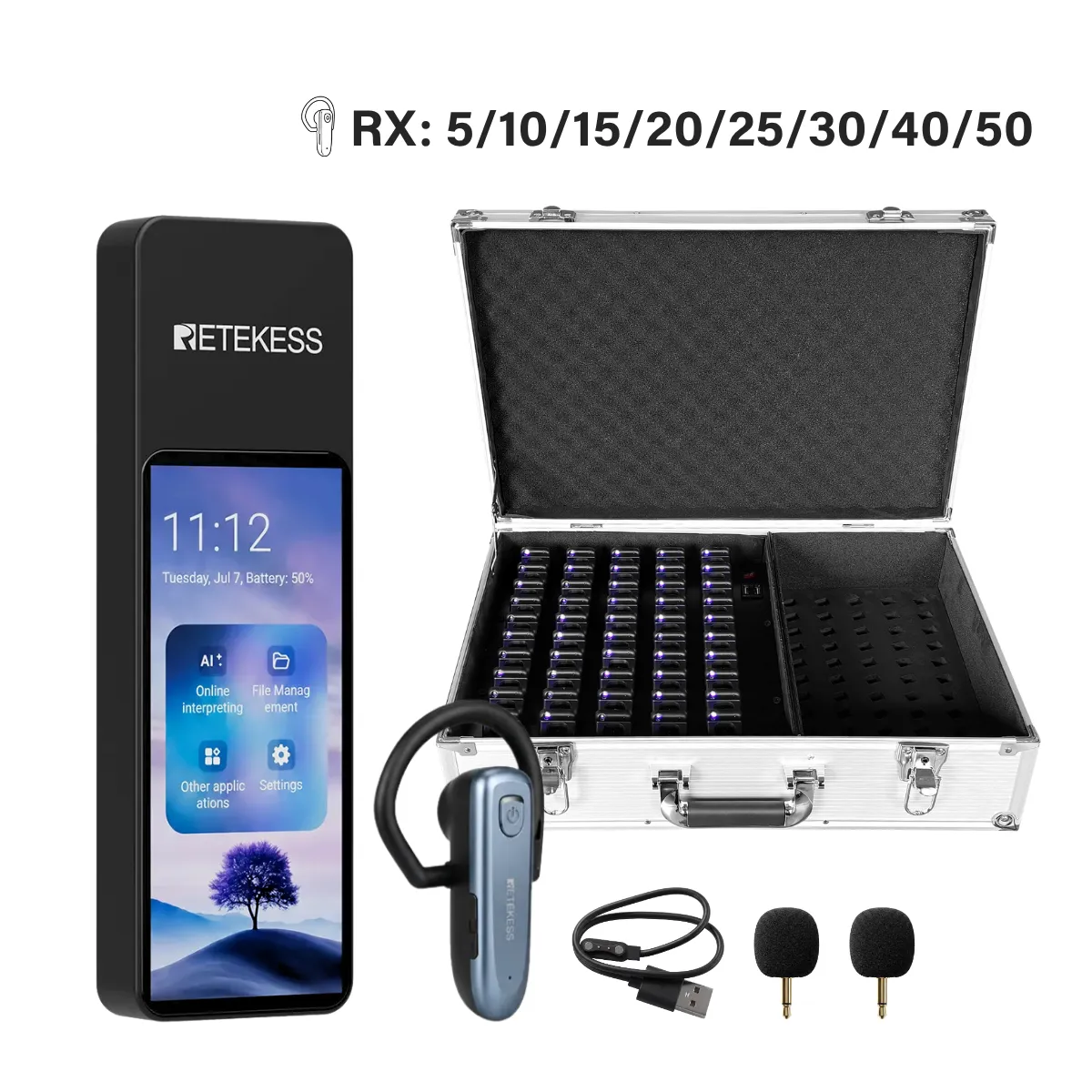
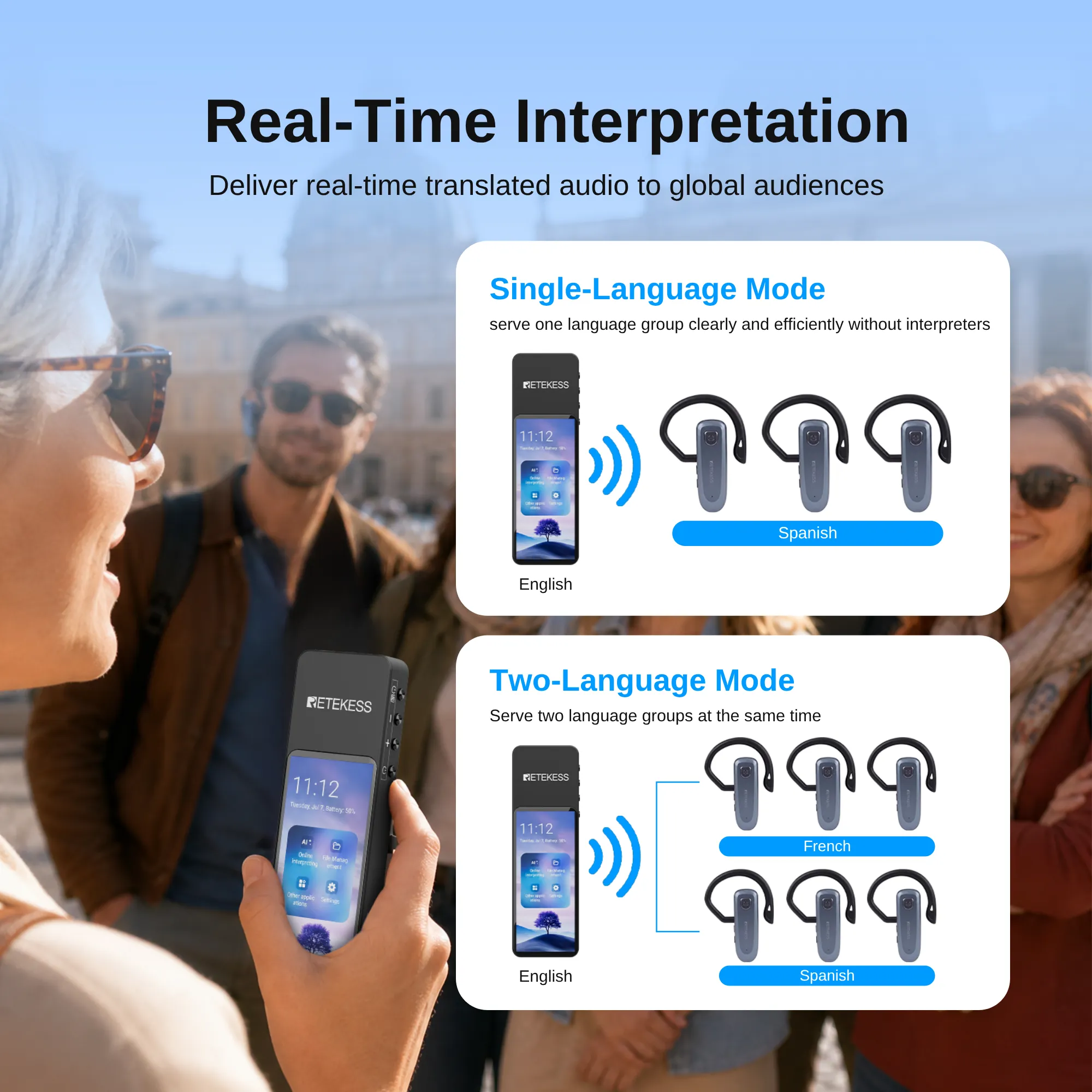
That constraint is now breaking. In 2026, a new category of AI translator device built for group settings has entered the market. These devices translate speech into 120 or more languages in real time and broadcast each language on a separate channel simultaneously. No human interpreters required.
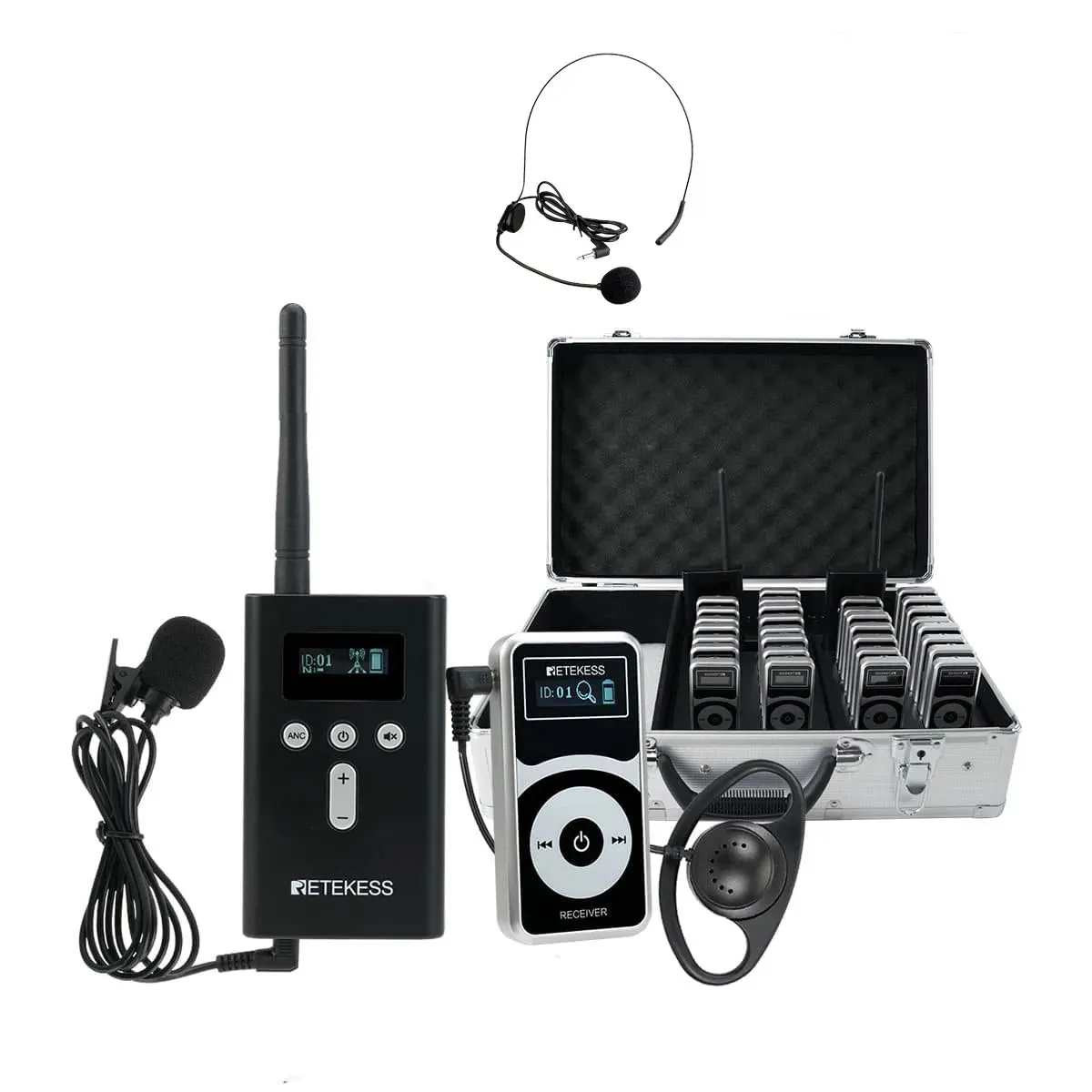
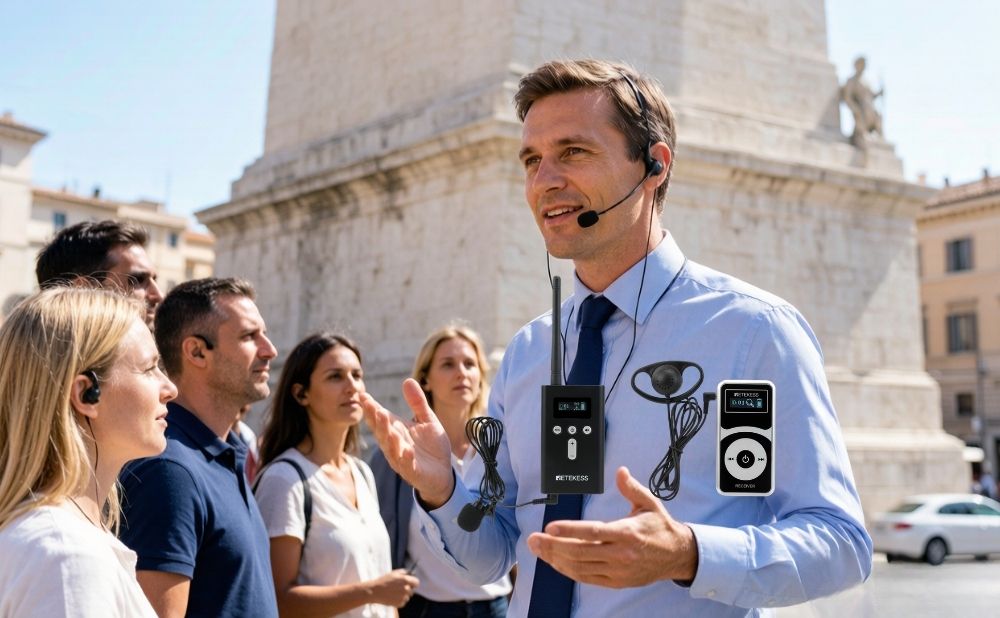
The hardware uses the same wireless transmitter-and-receiver architecture that tour guide systems have used for years. The change sits between the guide's voice and the visitor's ear. An AI translation engine converts speech into dozens of languages in under one second. It reaches approximately 96% accuracy for major language pairs, according to 2026 industry sourcing data from Alibaba's B2B technology report.
The Market: Slow Hardware, Fast Intelligent Growth
The global tour guide system hardware market grows modestly. Industry Research Co. values the worldwide tourguide system market at **$262.9 million in 2026**. It projects $345.7 million by 2035 — a CAGR of just 3.1%. Museum audio tour devices reach $360 million in 2026 and grow at 6.9% through 2034 (Intel Market Research).
The real growth sits one layer up. Data Insights Market values the global intelligent tour guide system market at $1.5 billion in 2024 with a 12.5% CAGR. This market bundles AI features, software platforms, and connected hardware. Its growth rate runs roughly four times faster than the underlying hardware.
The gap between 3.1% and 12.5% marks the space where AI translation is entering. Plain audio transmitters and receivers are commodities. Systems that automatically translate a guide's voice into dozens of languages are not.
The Old Model: Multi-Channel Simultaneous Interpretation
The standard setup works like this. The guide speaks into a transmitter on Channel 1. Each interpreter listens to Channel 1 through a receiver, translates in real time, and speaks into a second transmitter on a different channel. Visitors select the channel that matches their language.
This architecture has hard limits.
Every language costs money. Each additional language needs a separate interpreter, transmitter, and microphone. A six-language tour requires at least five interpreters plus the guide.
Channel capacity is finite. Entry-level systems support 4 channels. Mid-range systems support 6. Higher-end FM interpretation systems reach 17. Most operators hit a practical ceiling at 6 to 8 languages.
Small languages are economically impossible. A museum might support Dutch, English, German, French, and Spanish. Adding Arabic, Mandarin, Japanese, Korean, Portuguese, Russian, Italian, and Polish would require eight more interpreters per tour. No small institution can afford that.
Interpreters are people. They fatigue. They make mistakes in noisy environments. They may not be available on short notice. A factory with 85-decibel machine noise does not help a human interpreter catch every technical term.
The New Model: AI-Powered Multilingual Group Translation
Instead of requiring a human interpreter for each language, the system captures the guide's speech, transcribes it, translates it with an AI engine, converts it back to speech, and broadcasts it on a separate channel. The whole process takes roughly one second.
Several technical improvements have crossed practical thresholds in 2026.
Translation accuracy has reached usable levels. On-device neural translation models now achieve approximately 96% accuracy for major language pairs (Alibaba, 2026). A human interpreter still wins on nuance and technical jargon. But 96% accuracy covers most tour narration, safety briefings, and general explanations.
Latency has dropped below the awkward threshold. Early AI translation systems took 3–5 seconds to process and output a translated sentence. That delay made conversations feel stilted. Current high-end systems process speech in under one second for major language pairs. Some on-device implementations claim sub-100-millisecond processing.
Language counts have exploded. Human-staffed systems top out at 6–8 practical languages. The new generation of AI-powered group translation systems supports 120 languages or more out of the box. A guide speaking German can reach listeners in English, Mandarin, Arabic, Portuguese, Japanese, Swahili, Vietnamese, and 112 other languages simultaneously. Each additional language adds zero cost.
Dual-channel broadcast preserves the original. Better systems broadcast both the original voice and the translated voice on separate channels. Visitors who understand the guide's language hear the original with full tone and nuance. Visitors who need translation select their language channel. This matters because AI-translated speech — even at 96% accuracy — loses the speaker's personality, humor, and emphasis.
Offline capability is becoming standard. Factories, museum basements, cave attractions, and remote industrial sites often have poor or no cellular coverage. The latest AI translator device implementations include on-device neural models for major language pairs. These models let translation continue without an internet connection. Three years ago, all translation had to travel to a cloud server.
The result: a system that replaces the interpreters, not the guide. The guide still leads the tour, reads the room, and answers questions. The guide's voice now reaches every visitor in their own language, automatically, at a fraction of the previous cost.
Where It Is Actually Being Used
Factory and Industrial Site Visits
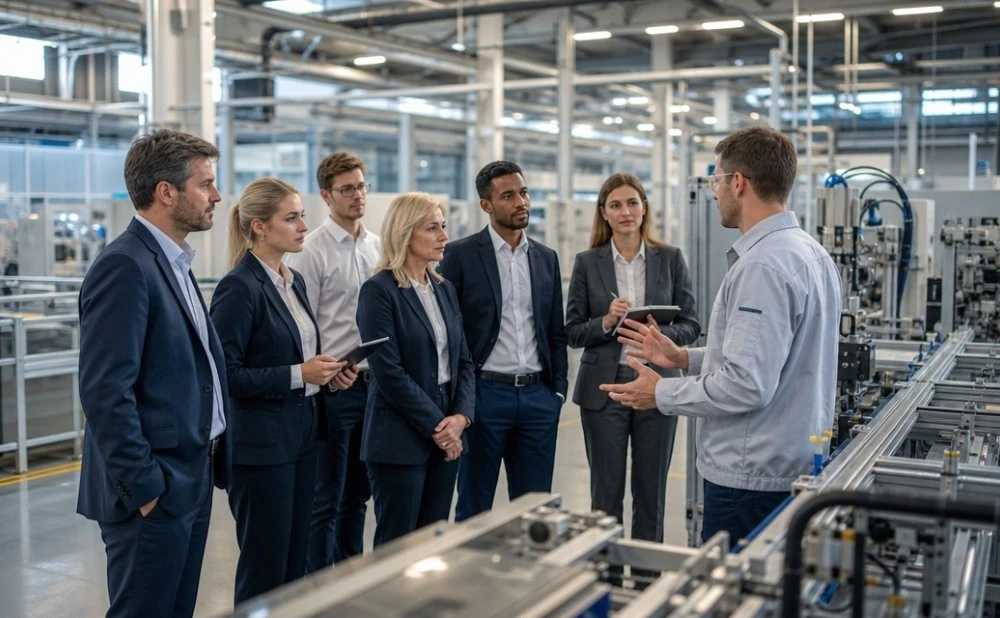
Factories make up the strongest early adopter category. Manufacturing companies host international customers, suppliers, and auditors on a regular basis. A typical mid-sized German or Japanese factory hosts 20–40 international tour groups per year. Each visit used to require interpreters.
The factory environment also favors AI over human interpreters. Machine noise often runs 80–90 decibels. Human interpreters struggle to hear the guide and fatigue quickly. AI systems with noise-canceling microphones isolate the guide's voice more consistently. German engineering firm LEONHARD WEISS adopted a professional tour guide audio system for its Satteldorf and Göppingen sites in 2026. The company specifically wanted to maintain voice clarity in noisy production environments (BMS Audio case study).
The economic case is straightforward. A factory hosting 30 international tours per year, each requiring two interpreters at $400/day, spends $24,000 annually on interpretation. An AI group translation system requires a one-time hardware purchase. High-volume facilities recover that cost in under one year.
Museums and Cultural Institutions

Museums need multilingual audio content for self-guided visitors, not live interpretation. Traditionally, producing a multilingual audio guide cost a lot and took a long time. A 90-stop tour in four languages required four separate studio sessions, four voice actors, and four rounds of synchronization. Convo.app describes six months as the practical minimum production timeline. Most small museums shipped English-only guides.
AI voice generation has collapsed that timeline. The same approved English script can become 8–10 language versions without rebooking studio time. Adding a new language costs almost nothing. VoxBooster's 2026 guide notes that practical museum deployments now commonly cover 12–20 languages.
Self-service audio guide hardware has evolved in parallel. Current-generation devices support up to 41 preloaded languages, 16GB of internal storage (roughly 455 hours of audio), and 40 hours of standby battery life. These figures come from published product specifications by major tour audio equipment manufacturers.
Corporate Events and Study Travel
Business conferences and product launches have long used professional simultaneous interpretation booths. These booths cost $5,000–$20,000 per day for a multi-language conference. AI group translation systems now serve the lower end of this market — small to mid-sized corporate events with 50–500 attendees where a full booth costs too much but multilingual access matters.
The study travel market adds another dimension. Rich Age estimates the global study travel market at $242 billion in 2026. The company notes that high-channel-capacity systems (80 channels) let multiple classes and languages tour the same museum simultaneously. One channel carries English, another Mandarin, another Spanish — with no audio bleed between groups.
What AI Group Translation Still Cannot Do Well
Complex technical terminology remains a weak point. A guide explaining a specific manufacturing process, medical procedure, or legal concept may use vocabulary the AI model has not learned. The system produces something, but it may be a paraphrase rather than the precise term. High-stakes environments — medical consultations, legal proceedings, technical certification audits — still need human interpreters.
Accents and overlapping speech can break the system. A guide with a strong regional accent, a fast talker, or a conversation where multiple people speak at once can cause the speech-to-text layer to mis-transcribe. Human interpreters handle these situations through context and by asking for clarification. AI systems do not yet ask good clarifying questions.
The robot voice problem persists. Even at 96% accuracy, AI-generated speech lacks tone, humor, hesitation, and emphasis. A safety briefing works fine. A cultural tour where storytelling is the product falls flat in translation. Dual-channel systems help because they let visitors hear the original if they can.
Latency in conversational Q&A is still noticeable. A narrated monologue hides a one-second delay. A back-and-forth conversation does not. The visitor finishes speaking, waits a second, hears the translation. The guide answers, waits another second, the visitor hears the answer. A 15-minute Q&A session feels slow and stilted. Real-time two-way conversational translation remains the hardest and least solved problem.
The Competitive Landscape: Three Categories Converging
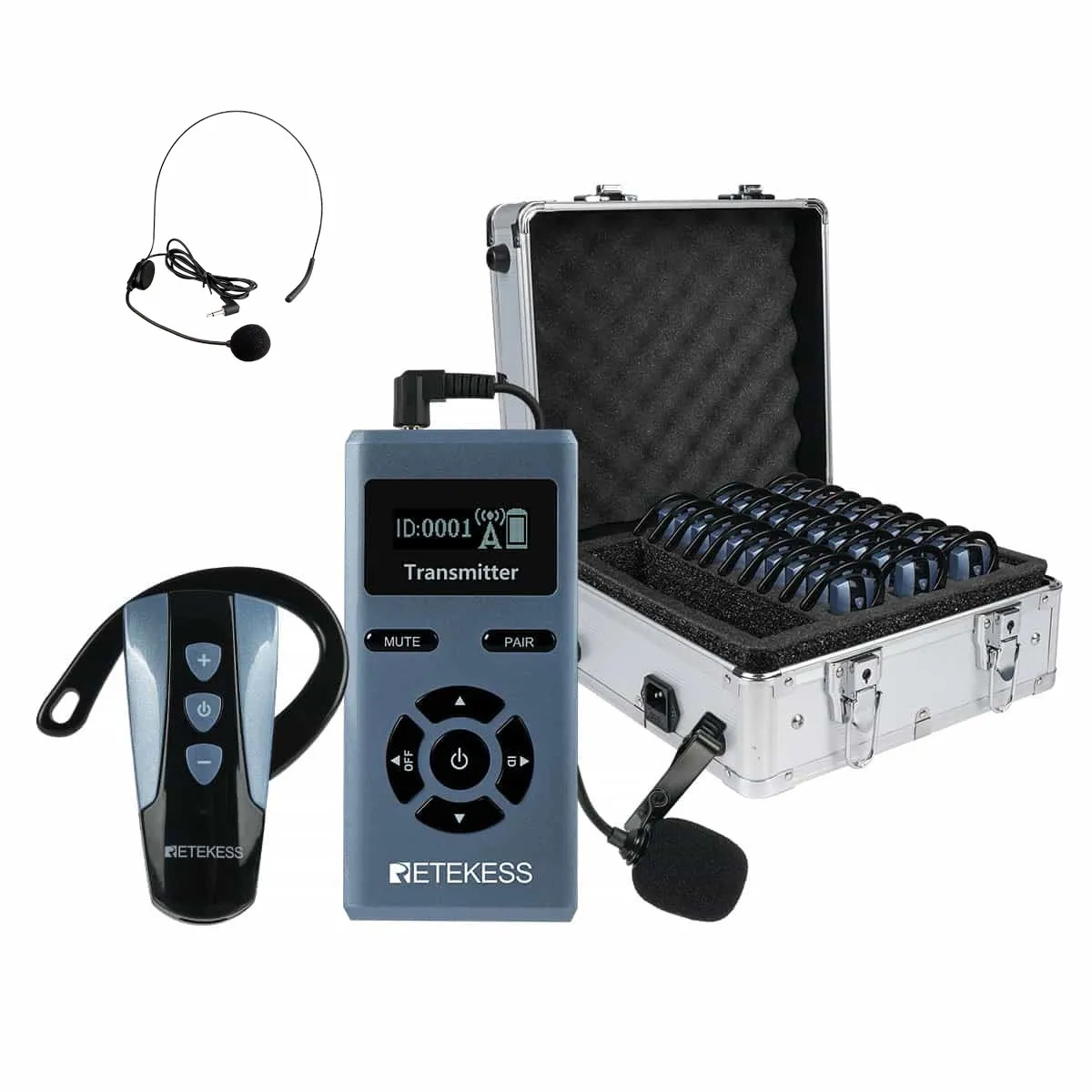
Traditional tour guide system manufacturers add AI translation as a feature layer on existing hardware. They already sell wireless transmitters, receivers, and charging cases to museums, factories, and tour operators. Their advantage is existing distribution channels and hardware expertise. Their challenge: AI translation is a software and machine-learning capability, not a hardware capability.
AI translation device companies — the same firms that make personal pocket translators and translation earbuds — extend upward from individual devices to group systems. They already own the AI translation engine, language models, and cloud infrastructure. Their challenge: professional group audio systems need different hardware. They need longer-range transmitters, multi-channel broadcasting, fleet management, bulk charging cases, and durable receivers that survive 500 different visitors.
Cloud-based software platforms take a third approach: no hardware at all. LiveVoice (Austria) streams multilingual audio directly to visitors' own smartphones over Wi-Fi or mobile data. It supports 70+ languages through a mix of human interpreters and AI voice translation. LiveVoice reported in September 2026 that tour operators, museums, and heritage sites in over 100 countries use its platform. The advantage: zero hardware procurement, zero charging, zero device loss. The disadvantage: every visitor needs a smartphone, a data connection, and enough battery life.
These three categories also partner with each other. The eventual market structure will likely form a stack. AI translation engines sit at the bottom. Group audio hardware sits in the middle. Venue-specific software sits on top.
The Structural Shift
The most important change is not any single product or feature. It is the economic structure of multilingual group communication.
Under the old model, cost scaled linearly with the number of languages. Each additional language meant another interpreter, another transmitter, another daily fee. A six-language tour cost roughly twice as much as a three-language tour. A twelve-language tour was economically impossible for most organizations.
Under the AI model, cost is essentially fixed. The guide speaks. The system translates into 120 languages. Every additional language adds zero marginal cost. A twelve-language tour costs the same as a three-language tour.
This is a classic technology-driven cost-curve collapse. It follows the same pattern as long-distance calling, digital photography, and GPS navigation. When the marginal cost of something drops to near zero, behavior changes. Organizations that previously offered only English tours will offer twenty languages. Small museums that had no audio guide will have multilingual guides. Factories that previously only hosted local-language customers will actively invite international delegations.
The AI translator device is not just a new gadget. It is the hardware through which a fundamental economic shift reaches the physical world of tours, factories, museums, and events. The shift already happened in software. Google Translate, DeepL, and smartphone apps made individual translation free. What is new in 2026 is that the same shift arrives in professional group audio systems. One person's voice can reach hundreds of people in dozens of languages simultaneously. Dedicated hardware makes this work in noisy factories, dark museum halls, and remote outdoor sites.
The interpreters are not disappearing entirely. High-stakes, nuanced, conversational interpretation will remain a human profession. But the broad middle ground — narrated tours, safety briefings, general information, cultural explanations — is moving to AI.



![[18th Anniversary] 18 Years of Echoing Excellence: Making Communication Easier, Connecting Trust Beyond Borders](https://res.retekess.com/z_file/20260716/retekess-brand-story-making-communication-easier_20260716151044_7682.jpg)
![[18 Years in Wireless Communication] Silent Disco Systems Anniversary Celebration: Top-Selling Headphones & Event Mechanics Revealed!](https://res.retekess.com/z_file/20260713/18-years-in-wireless-communication-silent-disco-systems-anniversary-celebration_20260713175011_5749.webp)
![[Anniversary Carnival] Ding-dong! 18th Anniversary Mega Sale on Guest Paging & Calling Systems: Full Reveal of 12+ Products & Promo Rules!](https://res.retekess.com/z_file/20260713/18th-anniversary-mega-sale-on-guest-paging-calling-systems_20260713175257_0295.webp)
![[Retekess 18th Anniversary Teaser] Tour Guide System Exclusive Perks: Sneak Peek at Event Dates & Mechanics!](https://res.retekess.com/z_file/20260713/retekess-18th-anniversary-tour-guide-system-exclusive-perks--2-_20260713180135_6435.webp)
Follow Us
Pay With


 Google
 Amazon
Comments (0)