
Table of Contents
What Is Translation Equipment? A Complete Guide for Beginners
- Retekess
- Sep 5, 2026
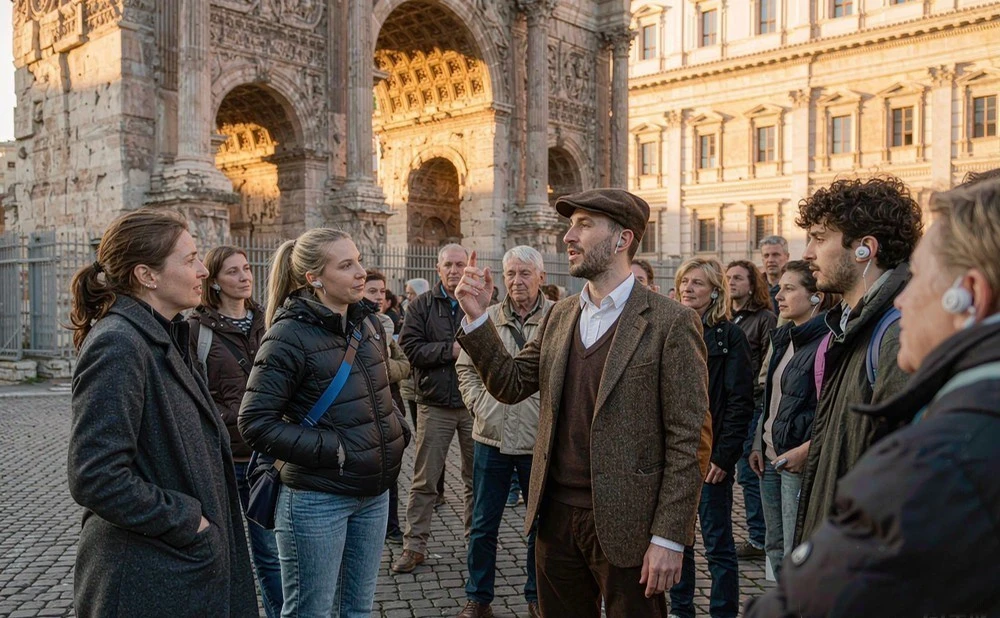
If you've ever watched a congregation listen to a sermon in two languages, sat through a UN press briefing with smooth real-time captions, or joined a tour group where every visitor heard the guide in their own language — you've already seen translation equipment at work. You just didn't notice it because, when it's working well, it's invisible.
This guide is for first-time buyers. By the time you finish reading, you'll understand what translation equipment actually is, the five common types you'll meet on a price quote, the scenarios each one is built for, and the four buying questions that will save you from overspending on the wrong system.
What Does "Translation Equipment" Actually Mean?
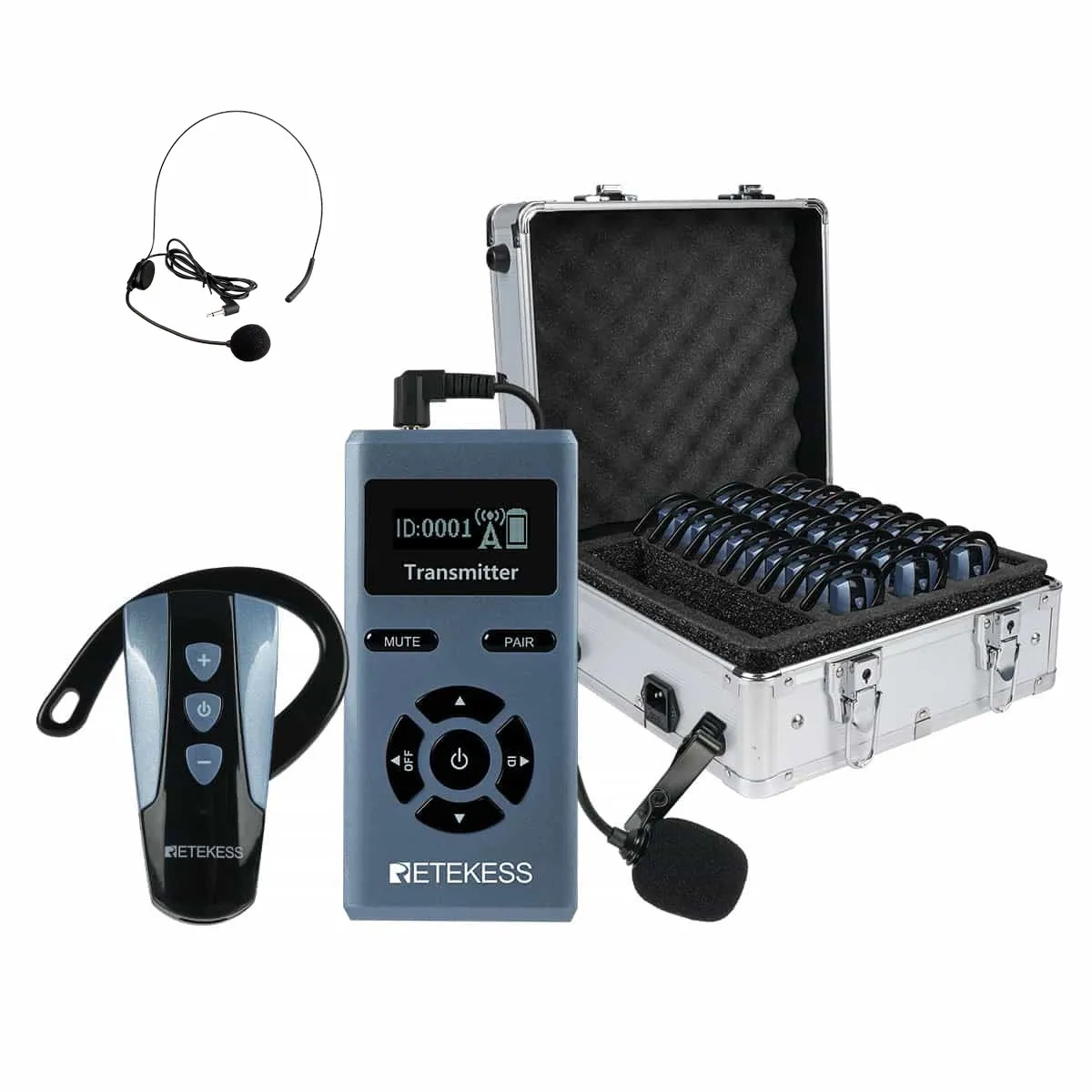
Translation equipment is the umbrella term for any hardware that helps a speaker's words reach listeners in a different language in real time. It includes the transmitter the speaker uses, the receivers the listeners wear, and (when needed) the interpreter's console where a human or AI converts the source language into the target language on the fly.
Three things separate professional translation equipment from a generic voice amplifier:
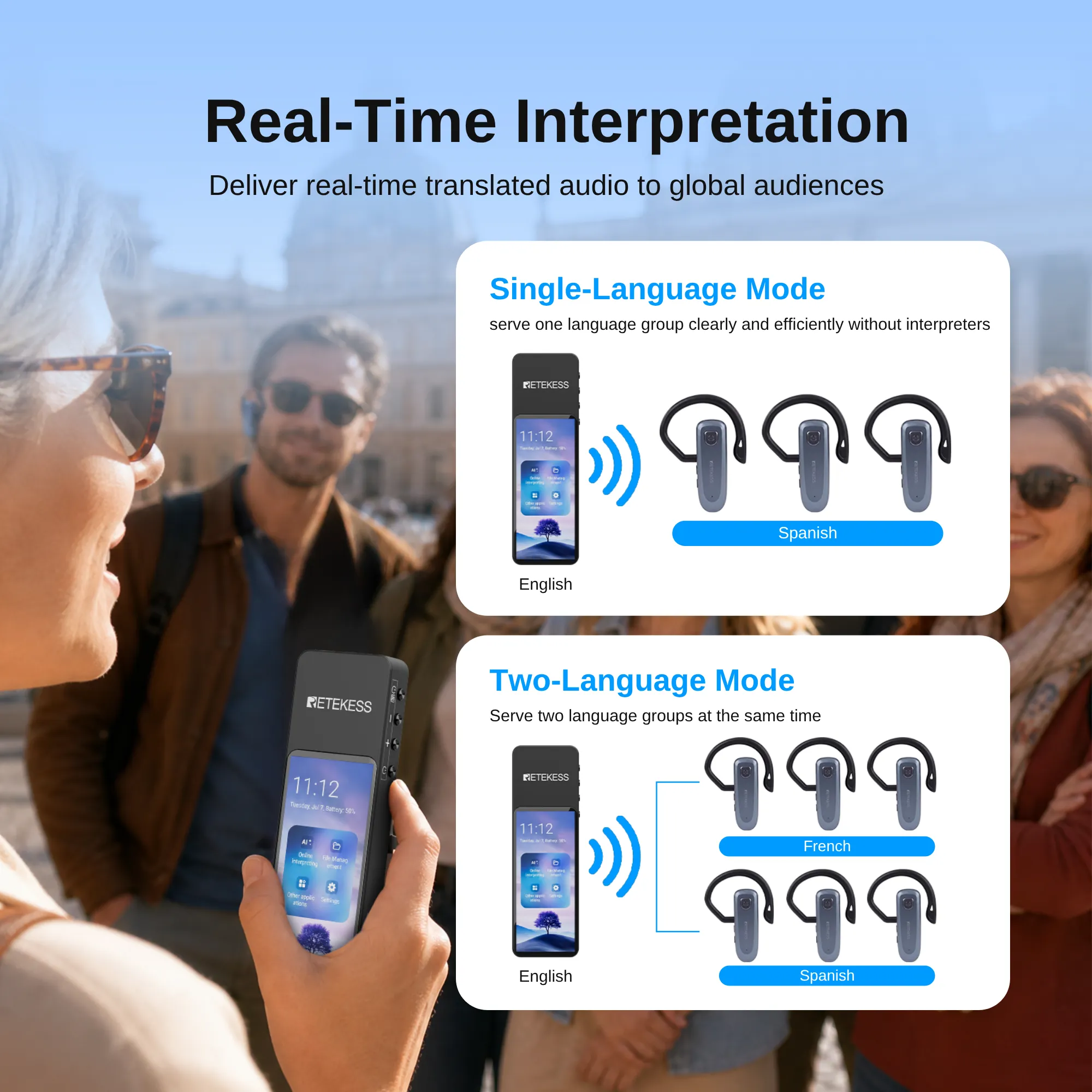
- It is designed for two languages to coexist on the same channel. A pastor speaks English on channel A, while a Spanish interpreter rebroadcasts on channel B. Listeners pick the channel that matches them.
- It is designed for groups, not one-to-one conversations. A single transmitter can usually feed 50, 100, or even 1,000 receivers at once.
- It is built for the venue. Conference-grade equipment resists RF interference in a hotel ballroom; church-grade equipment prioritizes simple on/off for elderly congregants; tour-grade equipment prioritizes battery life and weather resistance.
The 5 Main Types of Translation Equipment You'll See on a Quote
Not every "translation system" does the same job. Here are the five types you'll actually be choosing between.
1. FM (Radio Frequency) Interpretation Systems
How it works: The speaker's microphone feeds a transmitter; receivers tuned to the same FM frequency play the audio. Often paired with a second channel where an interpreter rebroadcasts in another language.
- Best for: churches, mid-size conferences, factory tours
- Example: Retekess TT117 and TT118 — 17-channel FM systems covering up to 262 ft (80 m), widely used in bilingual churches
- Watch out: in some countries FM requires a license; always check local frequency regulations before importing
2. Infrared (IR) Interpretation Systems
How it works: Audio is sent via infrared light emitters mounted on the walls or ceiling. Listeners wear IR receivers. Because light cannot pass through walls, IR is naturally secure — no one outside the room can listen in.
- Best for: courtrooms, boardrooms, high-security government meetings
- Trade-off: requires line-of-sight; not great for outdoor or mobile venues
- Standards check: ISO 20109:2025 governs modern IR interpretation; Televic and Bosch dominate this segment
3. AI Automatic Translation Devices
How it works: The transmitter captures speech, on-board or cloud AI translates it, and listeners hear the translation in their language within 1–5 seconds — no human interpreter required.
- Best for: tour groups, factory visits, churches where interpreter cost is a barrier, small businesses testing bilingual services for the first time
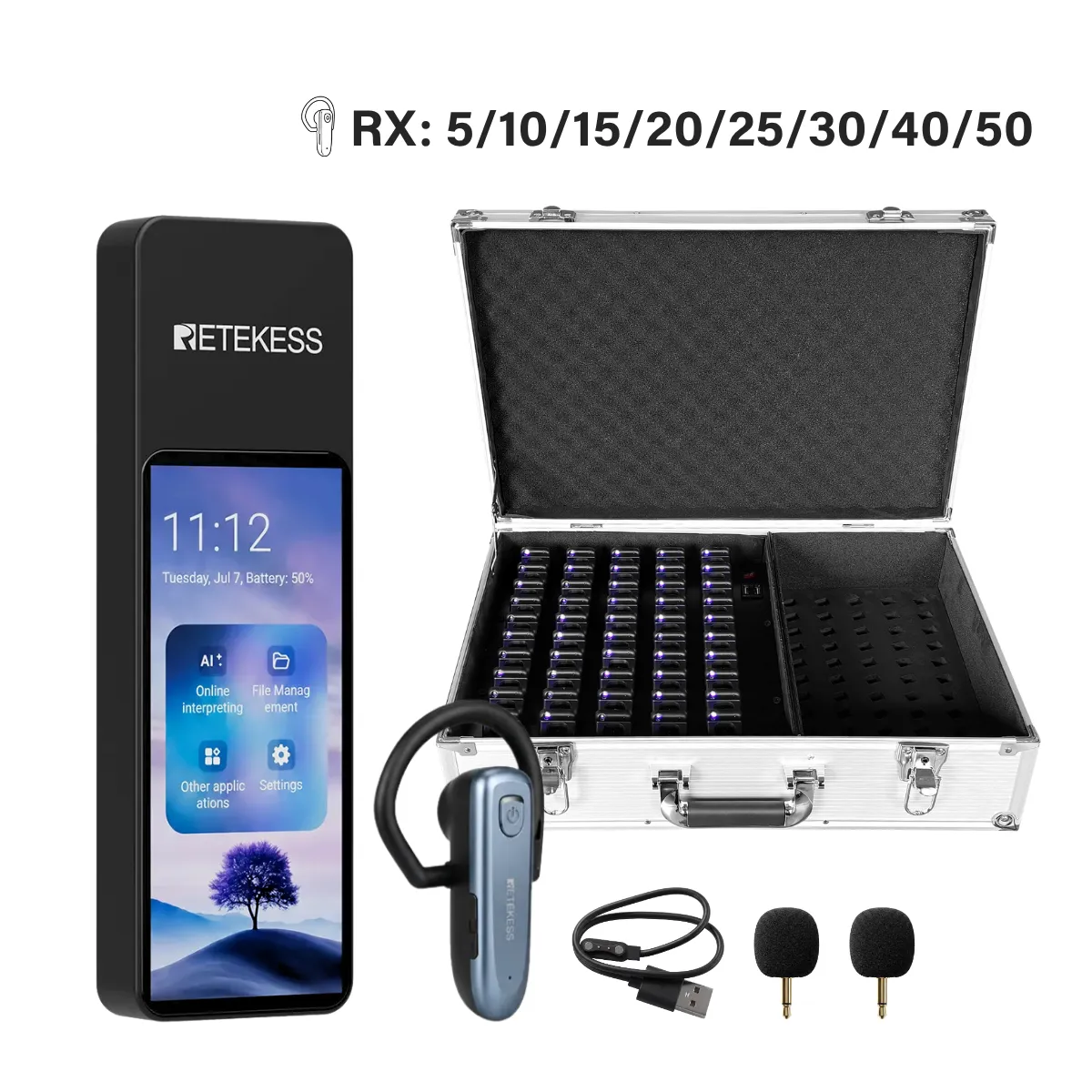
- Example: Retekess TT136 — 120-language AI translation, dual-channel broadcast, dedicated ear-hook receivers (no smartphone required)
- Honest caveat: AI translation is great for "tour-grade" delivery; for medical, legal, or simultaneous interpretation at a UN summit you still want a human interpreter
4. Tour Guide Systems (Whisper / Wireless Guide)
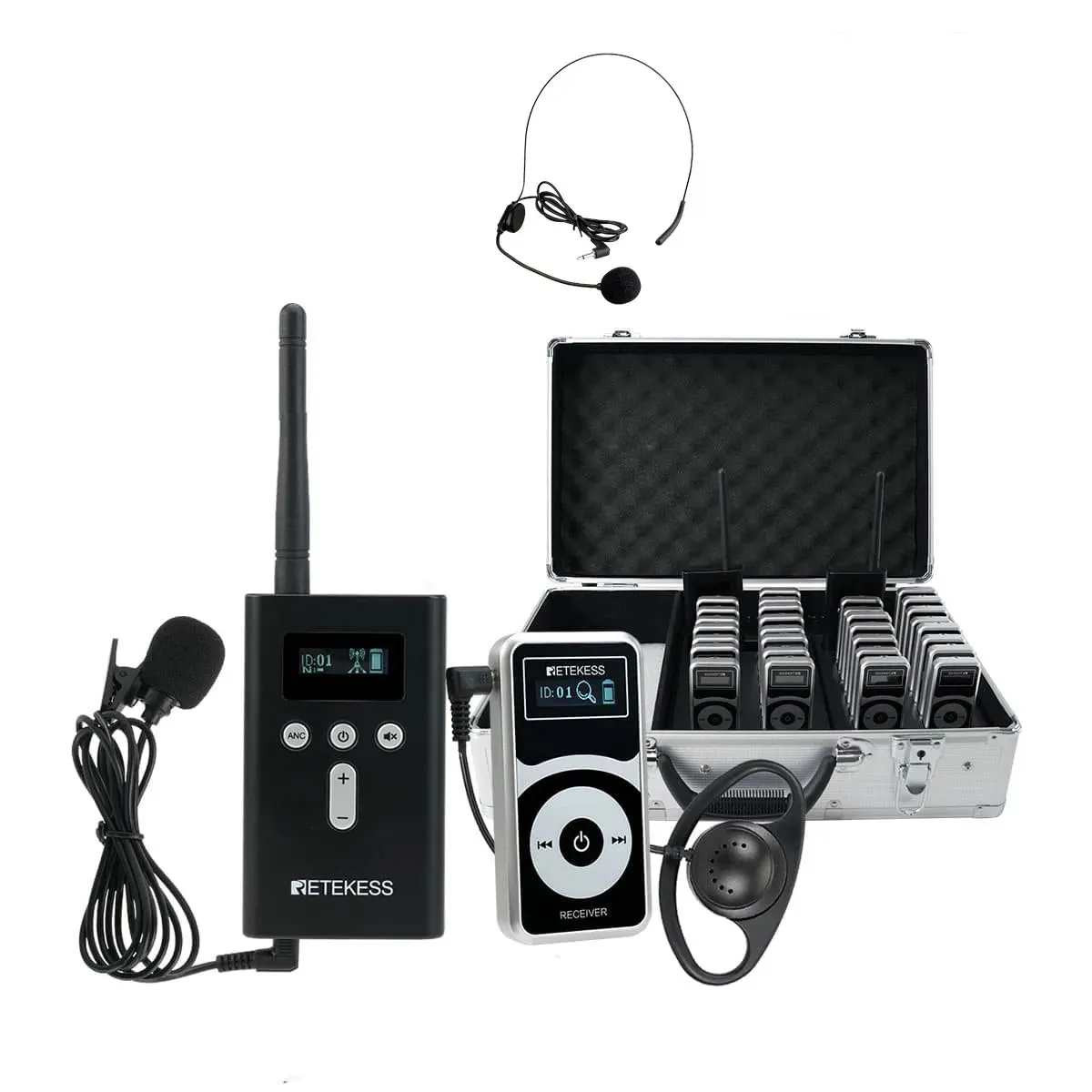
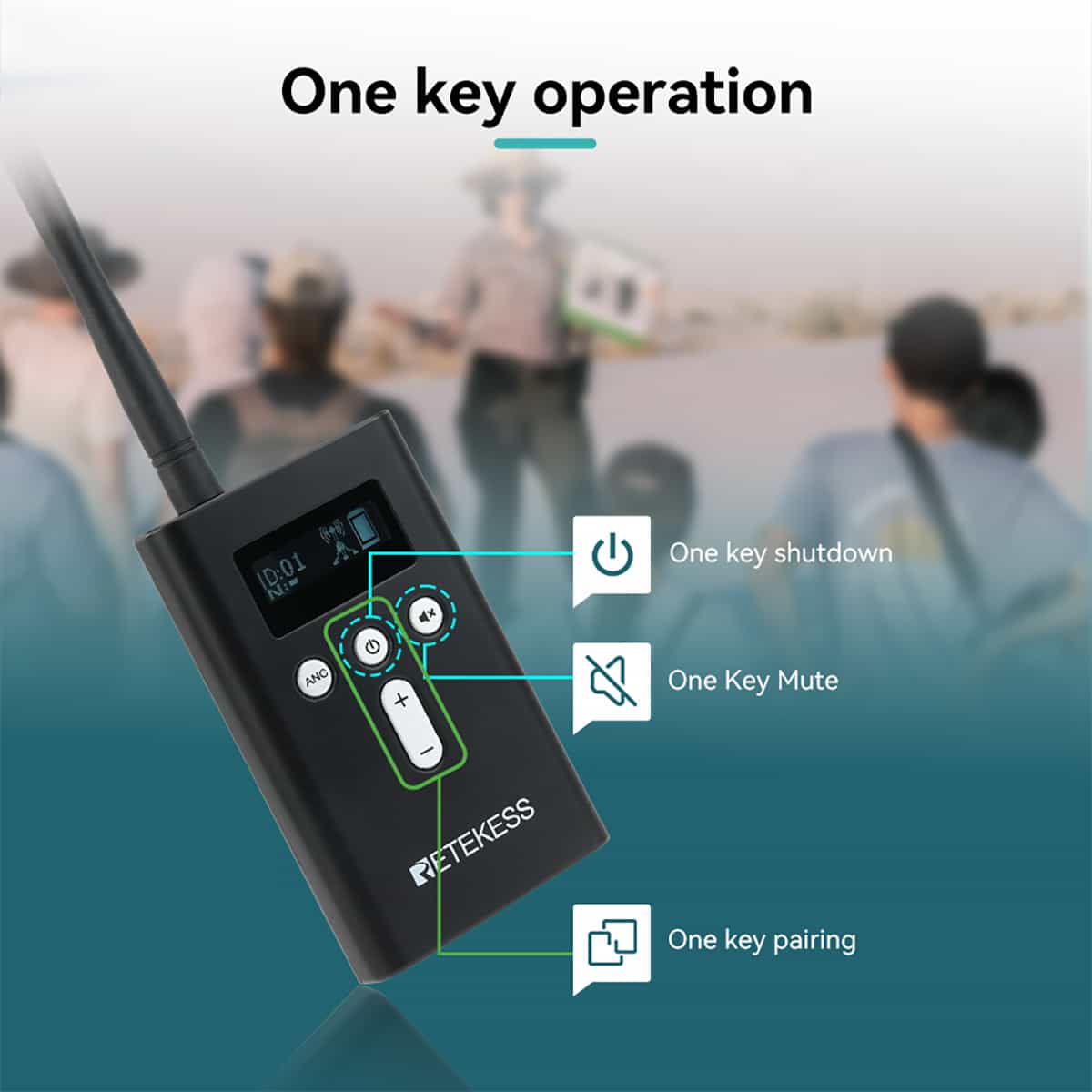
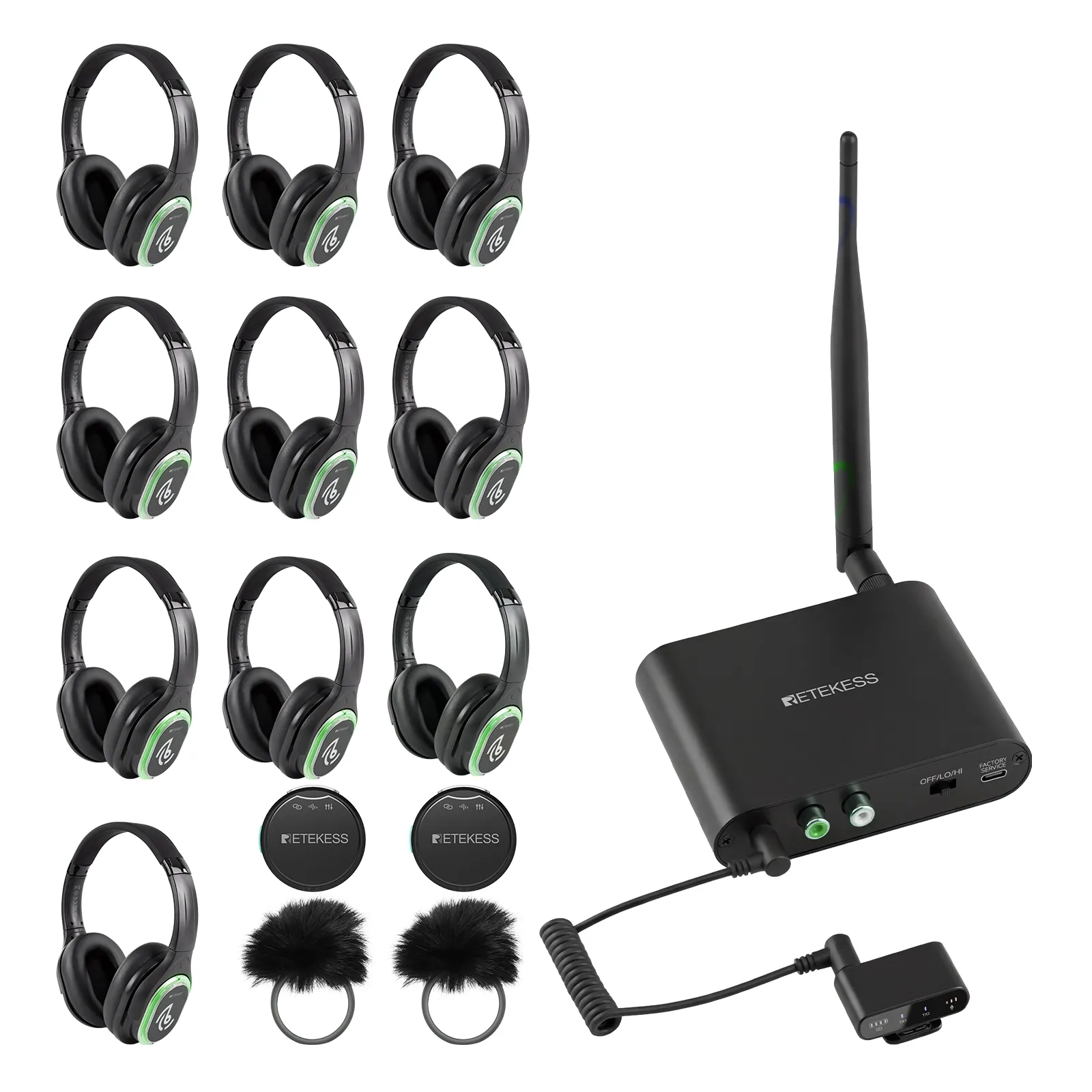
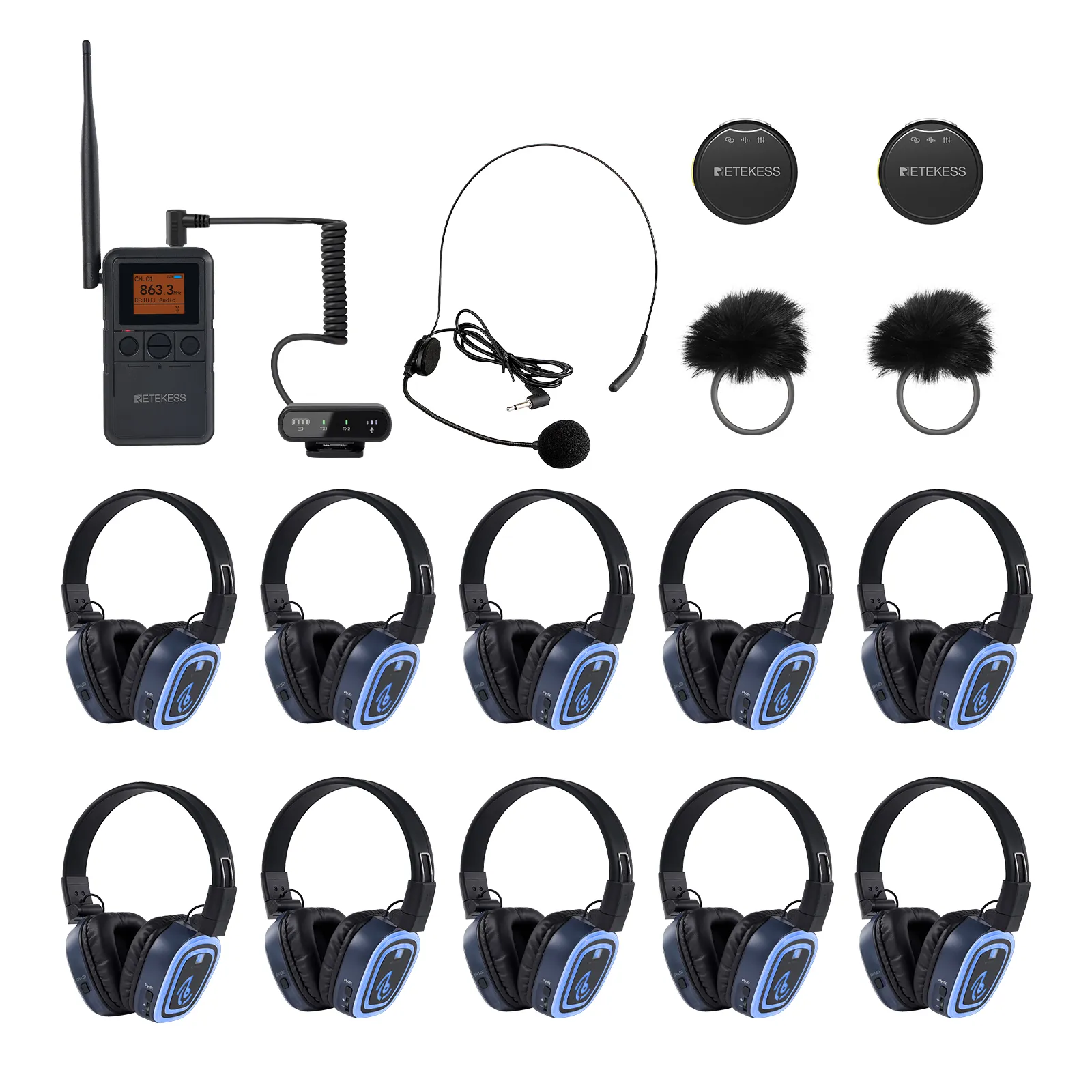
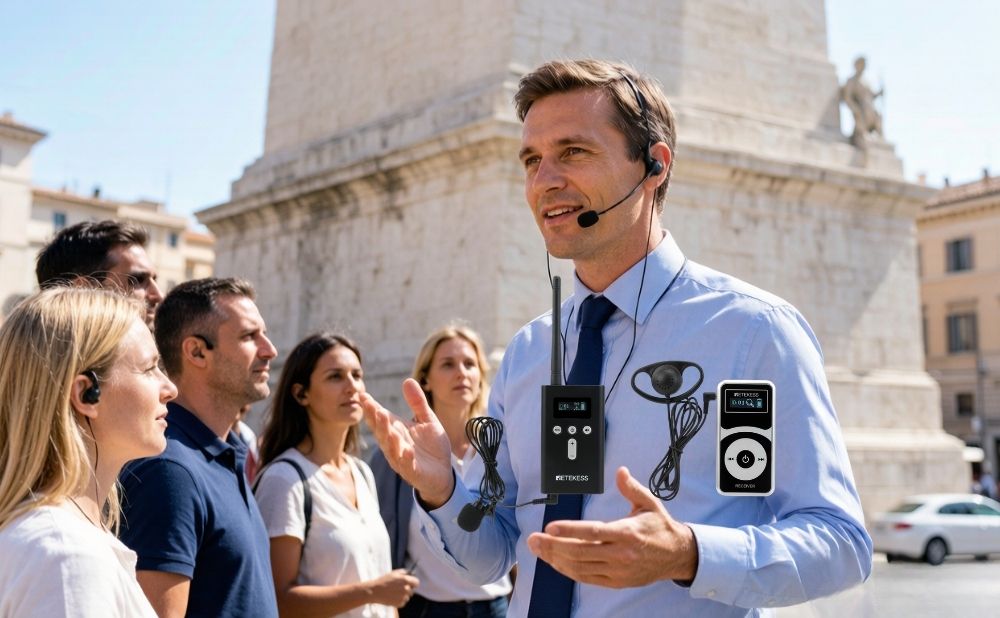
How it works: A handheld or headset microphone for the guide; one-way wireless transmission to receiver earphones. Often single-language, used when everyone in the group shares a language but the guide needs to be heard over noise or distance.
- Best for: factory tours (high ambient noise), museum tours, large outdoor walking tours, wine cellar tours
- Example: Retekess T130P — 49-channel UHF, up to 160 m range, 14-hour battery
5. Conference Interpretation Consoles (Booth + ISO-Compliant)
How it works: A professional interpreter sits in a soundproof booth, listens to the speaker through headphones, and rebroadcasts the translation through a delegate console. Built to ISO 20109 and ISO 40403 standards.
- Best for: international conferences, EU-style parliamentary events, multi-language summits
- Example: Retekess TT119 — interpreter monitor console with XLR/AUX/RCA/USB input, 17 channels
- Reality check: expect to budget for the booth, the technician, and the interpreters themselves — the console is only one part of the bill
Who Actually Uses Translation Equipment?
Translation equipment used to live only in the back rooms of the United Nations. In 2026, it shows up in surprisingly ordinary places:
- Churches running bilingual or multilingual services — one of the largest growing segments in North America
- Factory and supplier audits where overseas buyers visit manufacturing plants
- Tour operators running city tours, wine tours, and museum tours in tourist-heavy cities (Rome, Paris, Barcelona, New York)
- International schools hosting parent meetings where some parents don't speak the local language fluently
- Nonprofits serving refugee and immigrant communities
- Conferences and trade shows with international attendees
- Sports coaching camps with multilingual athlete rosters
If your audience speaks more than one language, you are the target buyer.
The 4 Buying Questions That Decide Which System You Need
Before you compare brands, answer these four questions:
- How many listeners at peak? 5 people = a different system than 50.
- How many languages simultaneously? Two languages fit cleanly on a dual-channel FM system. Five languages require IR or a hybrid AI+human setup.
- Indoor or outdoor? Outdoor venues (tours, drive-in services, vineyards) demand battery life, weather tolerance, and 2.4 GHz or 800 MHz UHF bands — not IR.
- Is a human interpreter available, or do you need AI? This single question often decides the entire budget line.
Recommended Starter Kits by Scenario
| Scenario | Group Size | Recommended System | Why |
|---|---|---|---|
| Bilingual church (English + Spanish) | 20–50 | TT117 or TT118 + interpreter | FM is reliable, no app needed |
| Multilingual factory tour | 25 | TT136 | AI-powered multilingual translation |
| Walking city tour (English + Italian) | 10–25 | TT106S or TT136 | 2.4 GHz with strong battery life, weather-resistant |
| Small international conference | 10–20 | TT119 + delegate receivers | Interpreter console, ISO-aligned |
| Nonprofit / refugee community org | 5–20 | TT106S starter kit | Lowest entry price, expandable receivers |
FAQ
Q: Is "translation equipment" the same as "interpretation equipment"?
A: In practice, yes — the two terms are used interchangeably in product listings. Strictly, translation often refers to written text and interpretation to spoken, but for hardware both words cover the same gear.
Q: Can I use regular wireless microphones instead?
A: Not for multilingual groups. Regular wireless mics only carry one voice to one channel; they don't give you a second language stream or a way for an interpreter to rebroadcast.
Q: Do listeners need a smartphone?
A: With AI earbuds like Timekettle or Vasco, yes. With dedicated receivers like the Retekess TT136, no — they receive audio through ear-hook receivers.

![[18th Anniversary] 18 Years of Echoing Excellence: Making Communication Easier, Connecting Trust Beyond Borders](https://res.retekess.com/z_file/20260716/retekess-brand-story-making-communication-easier_20260716151044_7682.jpg)
![[18 Years in Wireless Communication] Silent Disco Systems Anniversary Celebration: Top-Selling Headphones & Event Mechanics Revealed!](https://res.retekess.com/z_file/20260713/18-years-in-wireless-communication-silent-disco-systems-anniversary-celebration_20260713175011_5749.webp)
![[Anniversary Carnival] Ding-dong! 18th Anniversary Mega Sale on Guest Paging & Calling Systems: Full Reveal of 12+ Products & Promo Rules!](https://res.retekess.com/z_file/20260713/18th-anniversary-mega-sale-on-guest-paging-calling-systems_20260713175257_0295.webp)
![[Retekess 18th Anniversary Teaser] Tour Guide System Exclusive Perks: Sneak Peek at Event Dates & Mechanics!](https://res.retekess.com/z_file/20260713/retekess-18th-anniversary-tour-guide-system-exclusive-perks--2-_20260713180135_6435.webp)
Follow Us
Pay With


 Google
 Amazon
Comments (0)