
Table of Contents

Best Real Time Translation Device 2026: 8 Options Reviewed by Real Use Case
- Retekess
- Oct 10, 2026
Most "best translation device" listicles rank eight products that do eight different jobs and then declare a winner. That is why they fail the reader. A device that is genuinely the best real time translator device for two people at dinner is close to useless for a guide addressing thirty tourists, and the reverse is equally true.
So this review does something different: it awards a winner per use case, then tells you plainly where each option falls short. Prices are approximate and move with promotions; treat them as bands, not quotes.
How We Judged
- Listener capacity — how many people can actually hear the translation at once.
- Language coverage and whether multiple languages can run at the same time.
- Real-world latency, not marketing latency.
- Behaviour without reliable Wi-Fi.
- Performance in noise — the spec sheet never mentions it, and it decides most outcomes.
- Total cost over a year of typical use, not just the sticker price.
- Setup burden on whoever has to operate it at 8 a.m. on a Sunday.
Quick Verdict: The Best Real Time Translation Device by Use Case
|
Award |
Winner |
Why it wins here |
|
Best for groups (tours, churches, factories, schools) |
Retekess TT136 AI Translation Tour Guide System |
One transmitter broadcasts live translation to unlimited receivers; 120+ online languages; bilingual broadcast; no app on the listener side |
|
Best for one-to-one travel conversation |
AI translation earbuds (Timekettle-class) |
Hands-free, discreet, good latency for two-person conversations |
|
Best free option |
Google Translate or Apple Translate conversation mode |
Zero cost, huge language coverage, already on your phone |
|
Best if you already own a recent Pixel or iPhone |
Pixel Buds with Gemini live translation / AirPods Live Translation |
Deepest OS integration, no extra gadget to charge |
|
Best handheld with its own connection |
Standalone handheld translators with built-in data or offline packs |
Works where your phone has no roaming; speaker-style turn-taking |
|
Best for small multilingual meeting rooms |
Timekettle X1-class AI interpreter hub |
Designed for multi-person, multi-language meeting scenarios |
|
Best when you already have an interpreter |
Retekess T130T desktop interpretation consoles |
Interpreter monitor, mute key, proper channel control |
|
Best for installed venues and large conferences |
Enersound Cloud, Vox Aura class venue systems |
Captions to phones, venue-grade coverage, professional channel management |
The Reviews
1. Retekess TT136 — Best Real Time Translation Device for Groups
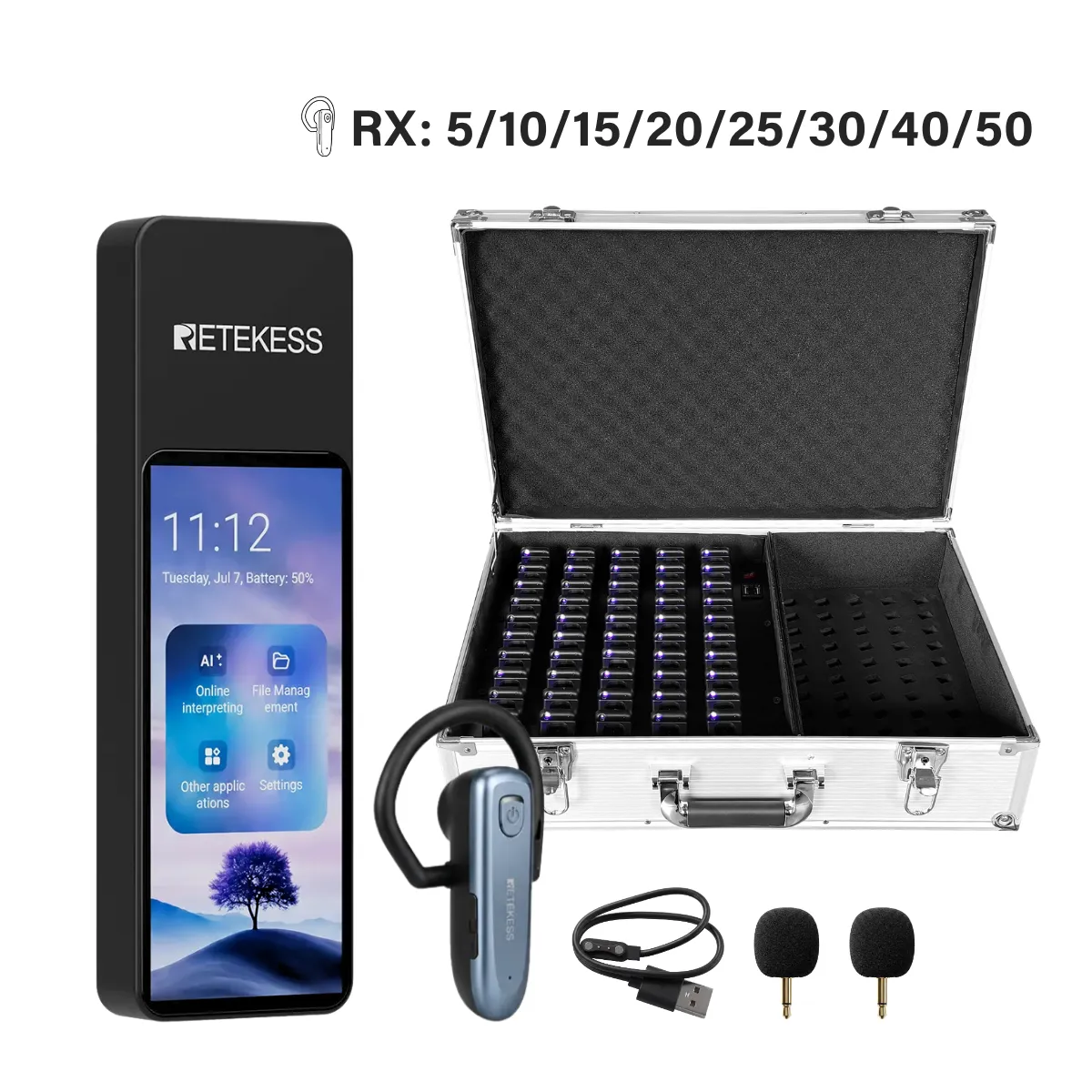
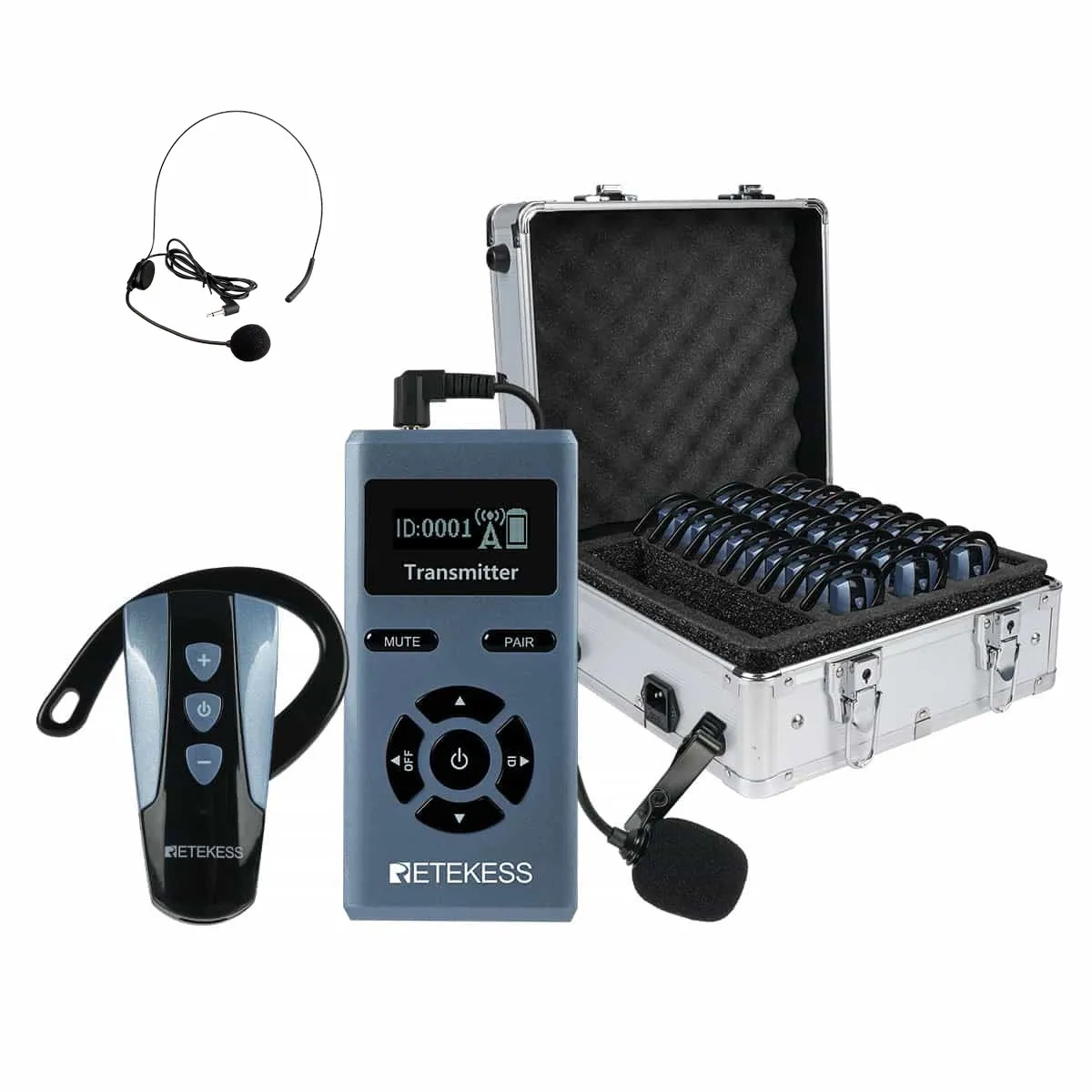
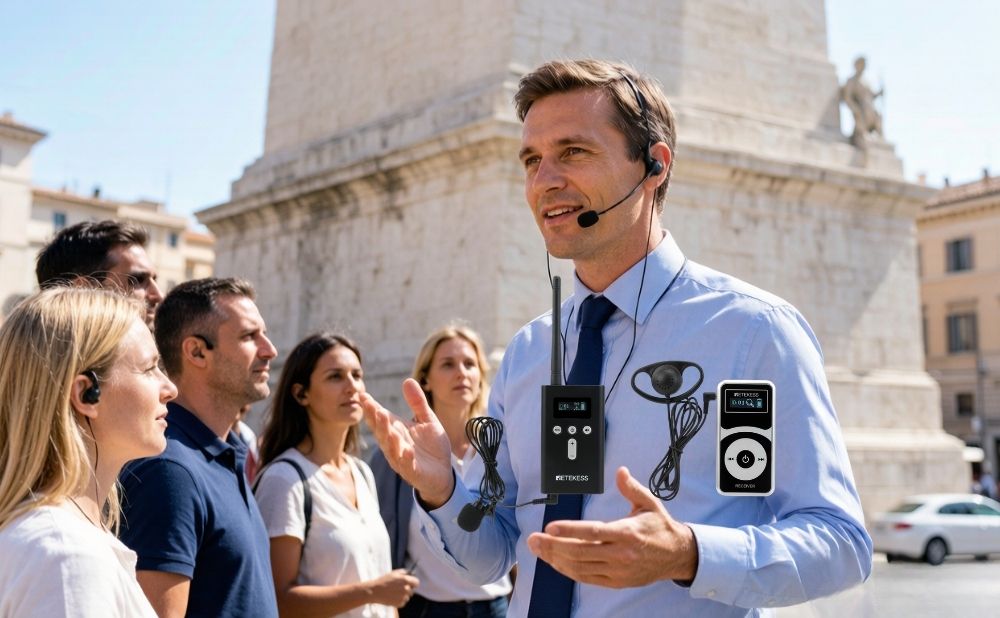
What it is: a translation terminal and a wireless tour guide transmitter in one 155 g handheld body. The operator speaks, the device translates, and the translated audio is broadcast over 2.4 GHz to any number of lightweight open ear-hook receivers.
Best for: guided tours, church services, factory and plant visits, museum groups, school parent nights, nonprofit community meetings — any situation where one person speaks and a mixed-language audience listens.
Strengths:
- One speaker, unlimited listeners. This is the single capability no earbud in this review can match.
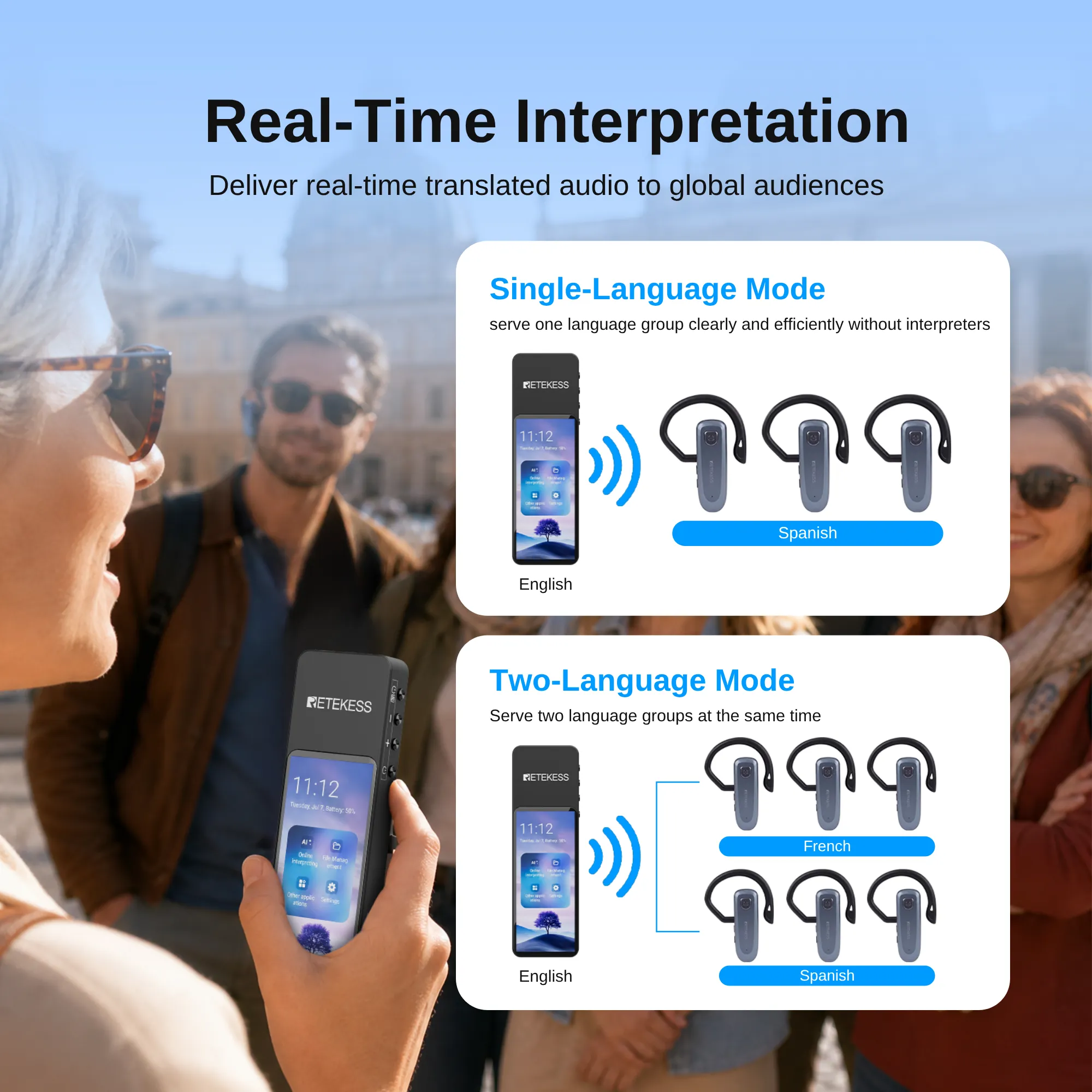
- Around 120 online languages, plus free-recognition mode that auto-detects the speaker language inside a 10-language preset — no wrong-button failures in mixed groups.
- Bilingual broadcast: two target languages simultaneously, listeners choose a channel. One guide, one group, no splitting.
- Two-way dialogue mode using separate blue and green receiver channels, which turns a lecture into an actual conversation.
- Open ear-hook receiver at roughly 13 g: non-in-ear, comfortable, hygienic for shared public use, wearable left or right.
- 4 GHz with 0 - 9999 channels and roughly 150 - 200 m open-area range.
- 99-inch Android touchscreen with recording and AI summarisation.
- Optional 30-slot or 50-slot charging case with UV sanitisation — the unglamorous feature that makes daily deployment possible.
Watch-outs: it needs network access for online translation (Wi-Fi or a phone hotspot), it is a device for a speaker and an audience rather than for a private whisper, and translation quality still depends on language pair and acoustics like every other option here.
Price band: portable group kits in this class typically land in the several-hundred to low-thousands range depending on receiver count and charging case. Check the current configuration for your group size.
2. AI Translation Earbuds (Timekettle-class) — Best for One-to-One Travel
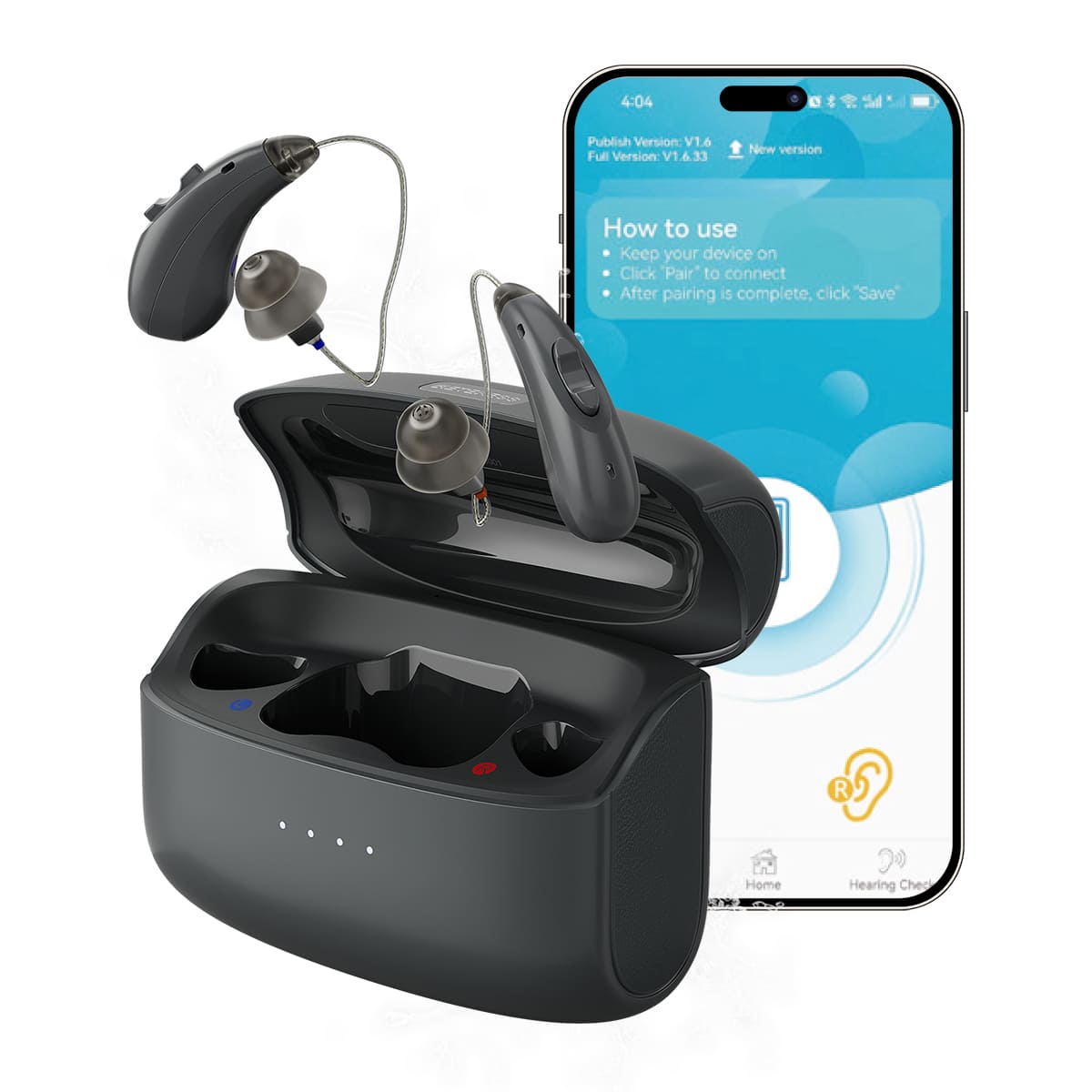
What it is: a pair of earbuds paired to a phone app. Some models add bone-conduction pickup to improve capture in noisy streets. Language coverage is broad on mainstream pairs.
Best for: two people talking. Ordering food, asking directions, a taxi ride, a one-to-one business lunch.
Strengths: discreet, hands-free, no one else has to know you are translating, mature product category with several credible brands, typically $100 - $350.
Watch-outs: only the wearer hears anything. For a group of ten you need ten pairs, ten phones and ten app sessions, and the speaker still has to talk into one microphone. Shared use also raises a hygiene question that tour operators and churches care about more than consumers do. Dependent on a phone and a network.
3. Google Translate / Apple Translate — Best Free Option
What it is: conversation mode on the phone you already own, with very wide language coverage and live camera and transcription extras.
Best for: occasional informal use, and as a fallback that costs nothing.
Strengths: free, enormous language coverage, always updated, no hardware to charge or sanitise.
Watch-outs: pass-the-phone turn-taking is socially awkward and slow, the microphone struggles in noise, and it cannot serve a group. Many churches and schools also object to asking elderly or privacy-sensitive participants to install and log into an app.
4. Pixel Buds with Gemini Live Translation / AirPods Live Translation — Best OS Integration
What it is: live translation delivered through earbuds you already own, driven by the phone OS rather than a third-party app.
Best for: travellers already inside the Google or Apple ecosystem who want the least friction.
Strengths: tight integration, good voice quality, nothing extra to carry, growing language support.
Watch-outs: hardware and OS requirements exclude most visitors, volunteers and congregants. Still one listener per pair. Language coverage varies by release, so verify your specific pair before an event.
5. Standalone Handheld Translators — Best for Reception Desks and Remote Travel
What it is: a self-contained unit with its own microphone, speaker and screen, often with built-in data connectivity in many countries or downloadable offline language packs.
Best for: hotel reception, clinic intake, border and customs counters, travellers without roaming.
Strengths: no phone required, works where your SIM does not, typically $250 - $600.
Watch-outs: speakerphone-style turn-taking is loud and public. Still one listener at a time. Offline packs are noticeably weaker than online engines.
6. Timekettle X1-Class AI Interpreter Hub — Best for Small Multilingual Meeting Rooms
What it is: a hub designed for multi-person, multi-language meeting scenarios, marketed with capacity figures in the range of tens of participants and several simultaneous languages, and positioned as a no-subscription product with ongoing firmware updates.
Best for: team meetings, workshops and classrooms where several people take turns speaking and everyone needs their own language.
Strengths: strong industrial design, good meeting and remote-conference integration, high brand recognition.
Watch-outs: at the upper end of consumer pricing, dependent on network and per-participant hardware, and latency is not designed for professional simultaneous-interpretation standards. One-to-many broadcast capability is weaker than a purpose-built tour transmitter, because each participant effectively holds a device.
7. Retekess T130T — Best When You Already Have an Interpreter
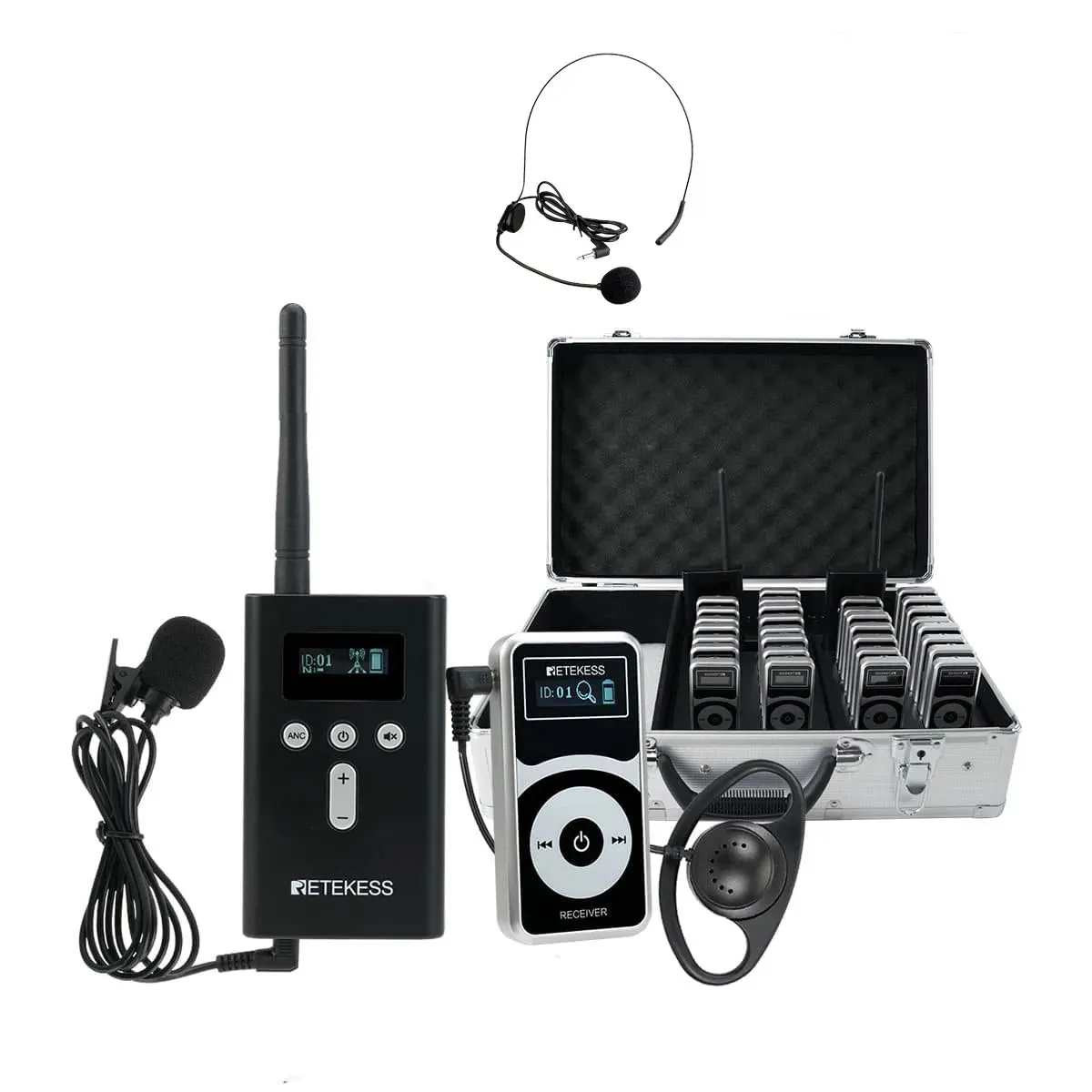
What it is: portable simultaneous interpretation systems built around a human interpreter, including desktop consoles with interpreter monitoring.
Best for: churches with a volunteer interpreter, small conferences, court and public meetings, any event where a qualified human is translating and needs proper tooling.
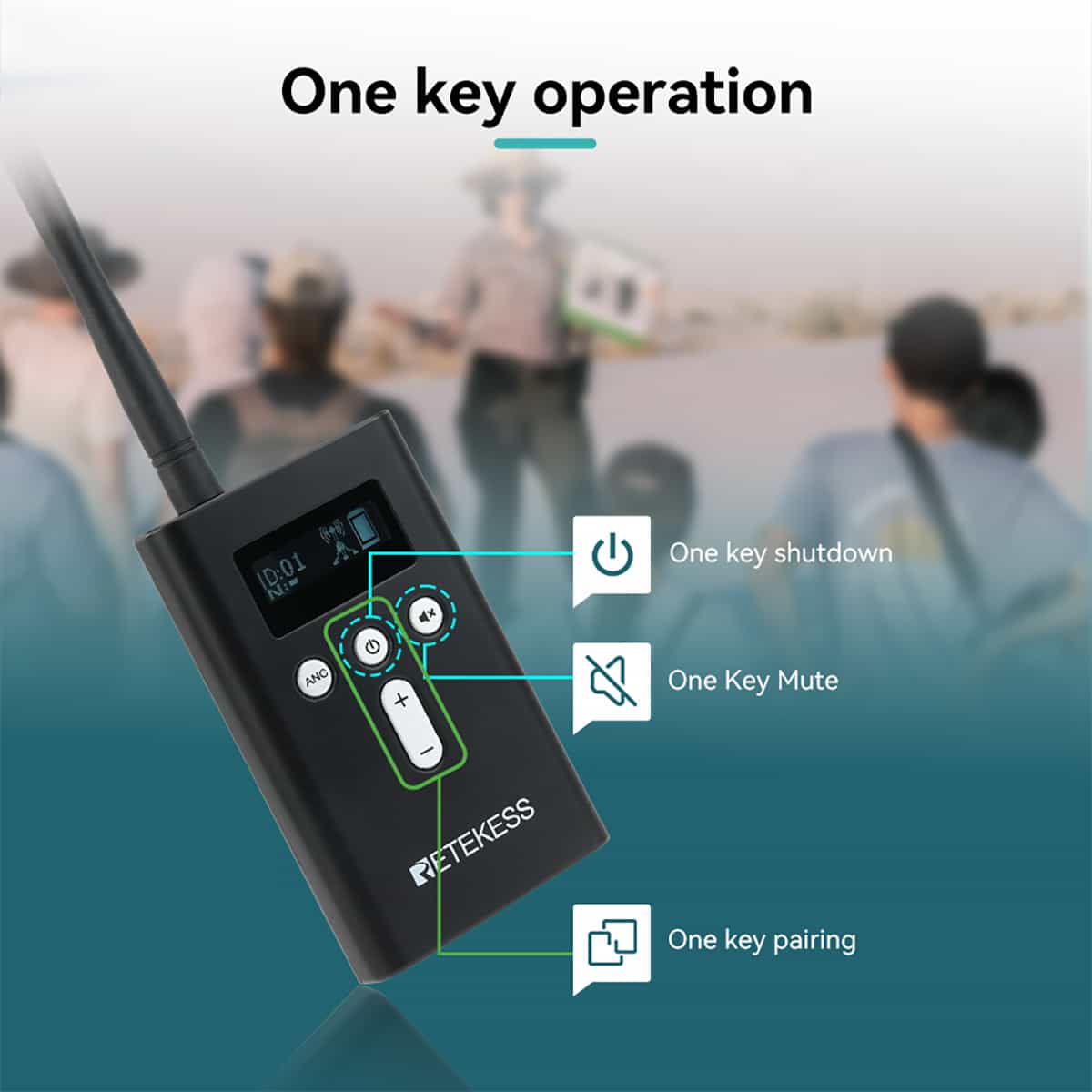
Strengths: long transmission range—820 ft, an interpreter monitor so the translator hears the source cleanly, a mute key for coughs and pauses, multiple interpreter channels, and the accuracy of a human being. The T130T is a professional conference interpretation device.
Watch-outs: requires an interpreter. If you do not have one — and most small churches, tour companies and nonprofits do not — the TT136 AI route is the practical alternative.
8. Enersound Cloud and Vox Aura Class Venue Systems — Best for Installed Venues
What it is: venue-grade systems combining wireless audio distribution with neural translation, sometimes adding captions delivered to the audience phones by QR code, or AI smart transmitters that broadcast a guide voice into several language channels.
Best for: museums, large houses of worship, cruise operations, conference centres with permanent infrastructure and a technical team.
Strengths: professional coverage, caption accessibility, deep language libraries, some offline content capability.
Watch-outs: pricing is often opaque or B2B-quoted, deployment is a project rather than a purchase, and some designs require the audience to own a compatible smartphone — which excludes children, elderly congregants and visitors who simply do not want to install an app.
Side-by-Side Comparison
|
Option |
Listeners at once |
Languages at once |
Needs phone/app |
Works in loud venues |
Approx. price |
|
Retekess TT136 |
Unlimited receivers |
1 or 2 broadcast |
No (listener side) |
Yes with close mic |
Mid, one-time |
|
Retekess T130T |
Unlimited receivers |
Multiple interpreter channels |
No |
Yes with headset mic |
Mid, one-time |
|
AI translation earbuds |
1 |
1 pair |
Yes |
Weak |
$100 - $350 per person |
|
Phone translation app |
1 - 2 |
1 pair |
Yes |
Weak |
Free |
|
Handheld translator |
1 - 3 |
1 pair |
No |
Weak |
$250 - $600 |
|
AI interpreter hub |
Tens |
Several |
Usually yes |
Moderate |
Upper consumer |
|
Venue cloud system |
Hundreds |
Several |
Sometimes for captions |
Yes with pro mics |
Quoted B2B |
What Real Time Translation Device Reviews Complain About Most
Read a few hundred user reviews across this category and the same five complaints appear again and again. Notice how many of them are buying mistakes rather than product defects.
|
Common complaint |
Actual root cause |
How to avoid it |
|
"It did not work for my group" |
Bought a one-listener device for a many-listener job |
Decide listener count first; above about five people, use a broadcast system |
|
"Too slow, conversation felt unnatural" |
Latency from phone-relay architecture or weak network |
Ask for end-to-end latency, and test on your own network before the event |
|
"Stopped working when Wi-Fi dropped" |
Online-only engine with no connectivity plan |
Budget a hotspot or a device with its own data; preload content where possible |
|
"Could not hear me on the factory floor" |
Microphone, not translation, was the failure |
Choose a system designed for high-noise environments (T130P with roughly 23 dB reduction, TT116, or TT136 with a close-talking transmitter) |
|
"Volunteers could not set it up in time" |
Setup procedure too long for the operator |
Require under-ten-minute setup and a single-button listener experience |
How to Read Reviews of the "Best Translator Device" Critically
- Check who wrote it. A solo traveller reviewing earbuds and a tour operator reviewing earbuds are answering different questions.
- Look for a group-size number. Reviews that never mention how many people were listening cannot help you if you have an audience.
- Check the date. Language coverage and OS-level translation features changed materially in 2024 - 2026. A 2023 review is historical.
- Note whether network conditions are described. "It worked great" in a hotel lobby says little about a warehouse.
- Be suspicious of single-winner rankings. If a list ignores listener capacity, it is optimised for affiliate clicks, not for your event.
Which One Should You Buy? Answer These Four Questions
- How many people need to hear at once? One or two — earbuds or an app. Five or more — a broadcast system.
- Do you have a qualified interpreter? Yes — TT118, TT119 or T130T. No — TT136.
- Is the venue loud? Yes — prioritise the microphone and noise reduction: T130P, TT116 or TT136.
- Will the audience use a smartphone? If not — children, elderly congregants, visitors — remove every app-dependent option from your shortlist immediately.
FAQ
What is the best real time translation device overall in 2026?
For a group, the Retekess TT136, because it is the only class of device here that scales to unlimited listeners without giving each person a phone and an app. For a private one-to-one conversation, a good pair of AI translation earbuds is the better and cheaper answer.
Is there a best translator device that works for both?
The TT136 is deliberately built to cover both: two-way dialogue mode for face-to-face negotiation, and one-to-many broadcast for addressing a group. That is the closest thing to a single-device answer on the market today.
How much should I budget?
Roughly $100 - $350 per person for earbuds, $250 - $600 for a handheld, and a one-time mid-range kit purchase for a portable group system that scales with receiver count. Compare that with $4,000 - $8,200 per day for a professional interpreter or $300 - $500 per event for rental.
Conclusion
The best real time translation device in 2026 is the one whose delivery method matches your audience size. Get that right and everything else — languages, latency, price — becomes a manageable trade-off. Get it wrong and no amount of translation accuracy will save the event.
If you are speaking to a room, a congregation, a tour group or a plant floor, start with the Retekess TT136 and scale receivers to your headcount. If you have an interpreter, move to TT119 or T130T. If the only problem is noise, T130P or TT116 is the cheaper fix.
Leave a Reply


![[18th Anniversary] 18 Years of Echoing Excellence: Making Communication Easier, Connecting Trust Beyond Borders](https://res.retekess.com/z_file/20260716/retekess-brand-story-making-communication-easier_20260716151044_7682.jpg)
![[18 Years in Wireless Communication] Silent Disco Systems Anniversary Celebration: Top-Selling Headphones & Event Mechanics Revealed!](https://res.retekess.com/z_file/20260713/18-years-in-wireless-communication-silent-disco-systems-anniversary-celebration_20260713175011_5749.webp)
![[Anniversary Carnival] Ding-dong! 18th Anniversary Mega Sale on Guest Paging & Calling Systems: Full Reveal of 12+ Products & Promo Rules!](https://res.retekess.com/z_file/20260713/18th-anniversary-mega-sale-on-guest-paging-calling-systems_20260713175257_0295.webp)
![[Retekess 18th Anniversary Teaser] Tour Guide System Exclusive Perks: Sneak Peek at Event Dates & Mechanics!](https://res.retekess.com/z_file/20260713/retekess-18th-anniversary-tour-guide-system-exclusive-perks--2-_20260713180135_6435.webp)
Follow Us
Pay With


 Google
 Amazon
Comments (0)