
Table of Contents
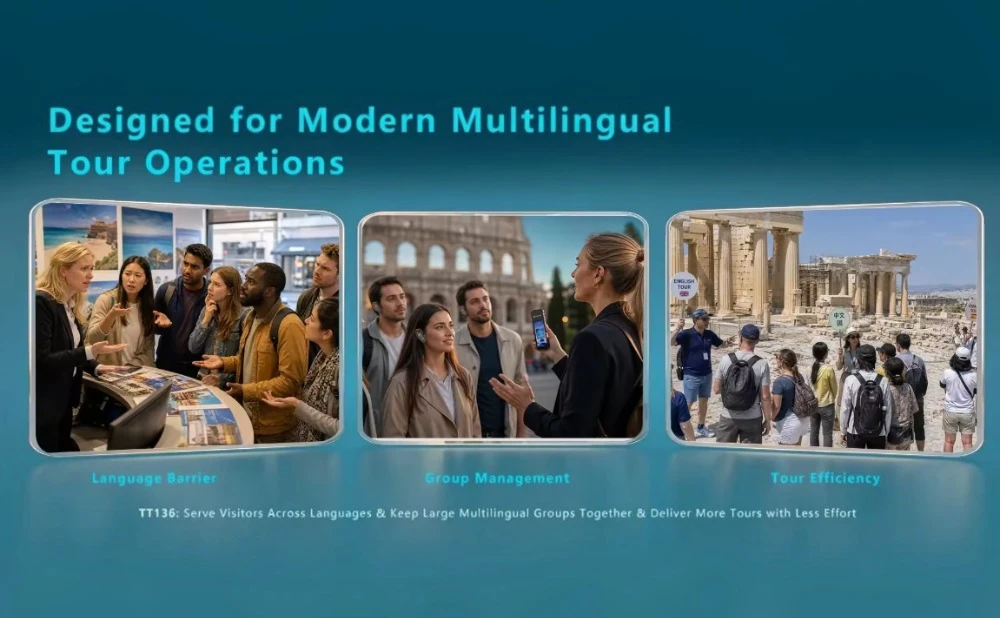
All-Scenario Audio Guide Solution for Long-Haul European Group Tours
- Retekess
- Sep 29, 2026
Long-haul European group tours cover three to five countries in 10 to 15 days. Most operators plan language support around the sightseeing hours. They book local guides for each country and assume the rest of the trip works itself out.
It rarely does.
Tour directors handle language problems all day: bus announcements, restaurant orders, hotel check-ins, tax-free shopping, medical visits. These moments produce more complaints than the guided sights, and most equipment on the market only covers the sights.
The language gaps follow a clear pattern across a multi-country itinerary.
The Language Gap Map on a Long-Haul European Tour
A typical tour day contains five recurring gaps.
1. The country-to-country handover
Each new country brings a new local guide. The tour director briefs the incoming guide on special diets, health issues, schedule changes, and shopping commitments. Details get lost in every handover. The group hears different versions of the same rules as the tour moves on.
2. The bus ride
Buses connect cities, borders, and hotels across the whole itinerary. Announcements made at the front of the coach do not reach the back rows. Directors walk the aisle while the bus moves, repeat information three times, or skip updates altogether.
3. Restaurants and hotels
Group meals involve fixed menus, allergies, and special requests. Hotel check-ins expose room problems and payment questions. A director cannot translate for 30 guests at once at a restaurant counter or a front desk. Guests with no shared language handle these moments alone.
4. Free time and emergencies
Free time means tax refunds, shopping, missed connections, and occasional medical visits. Guests scatter beyond sight of the guide. One guest with a problem can tie up the director for an hour while the rest of the group waits.
5. Busy attractions
Popular European sites run at capacity. Groups spread out over 50 meters or more. Shouted commentary reaches only the guests nearest the guide, and the back of the group misses the story.
One Device, Four Modes for the Full Itinerary
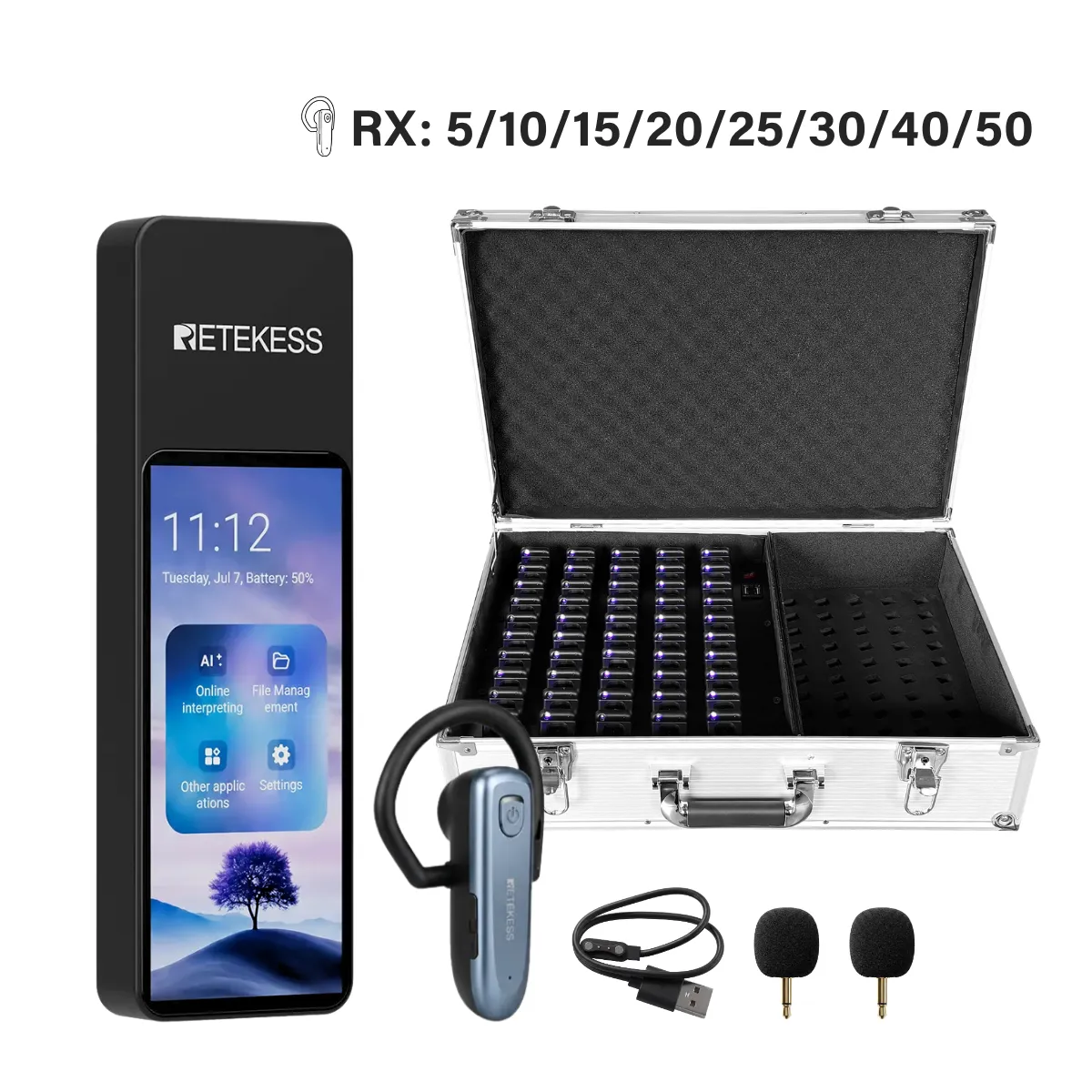
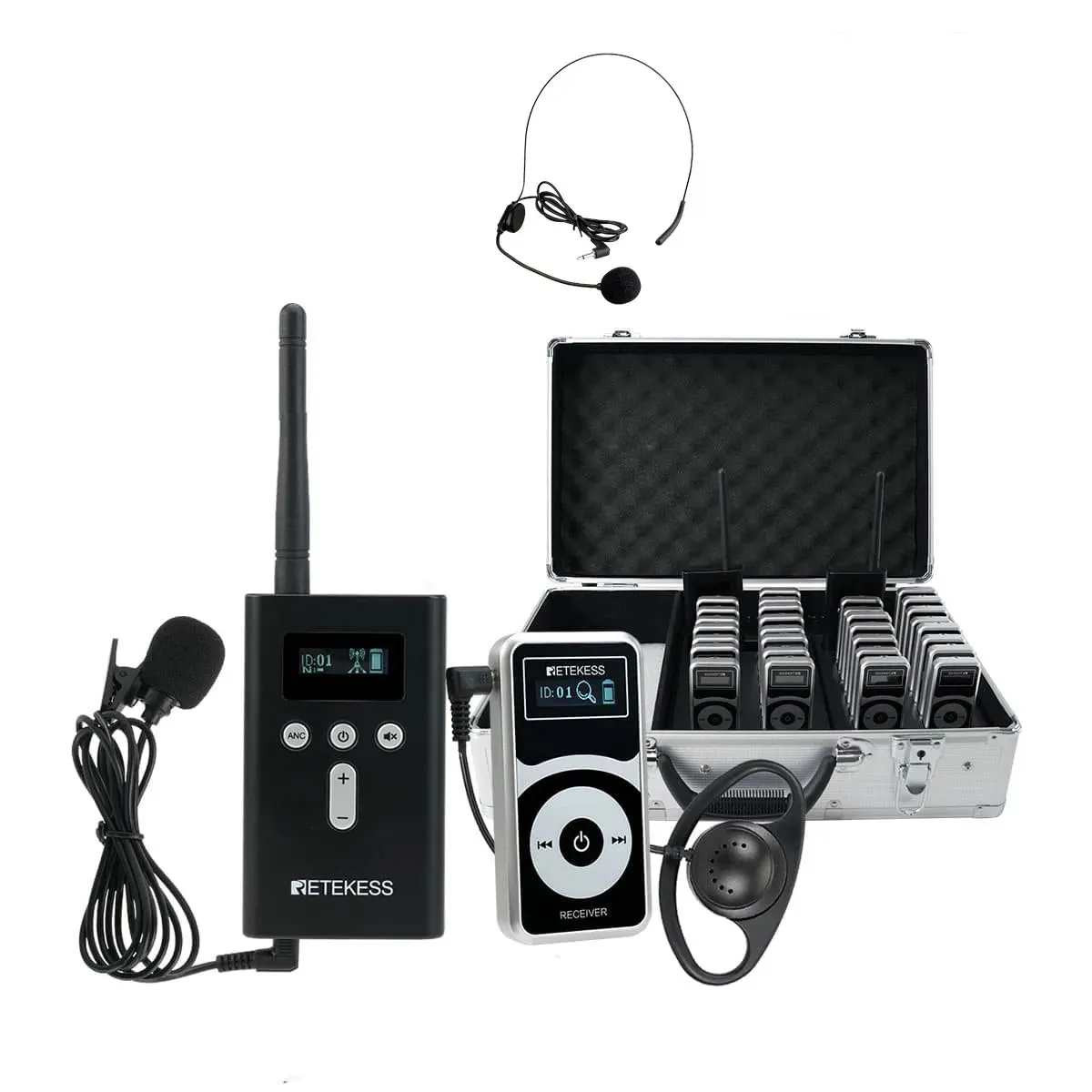
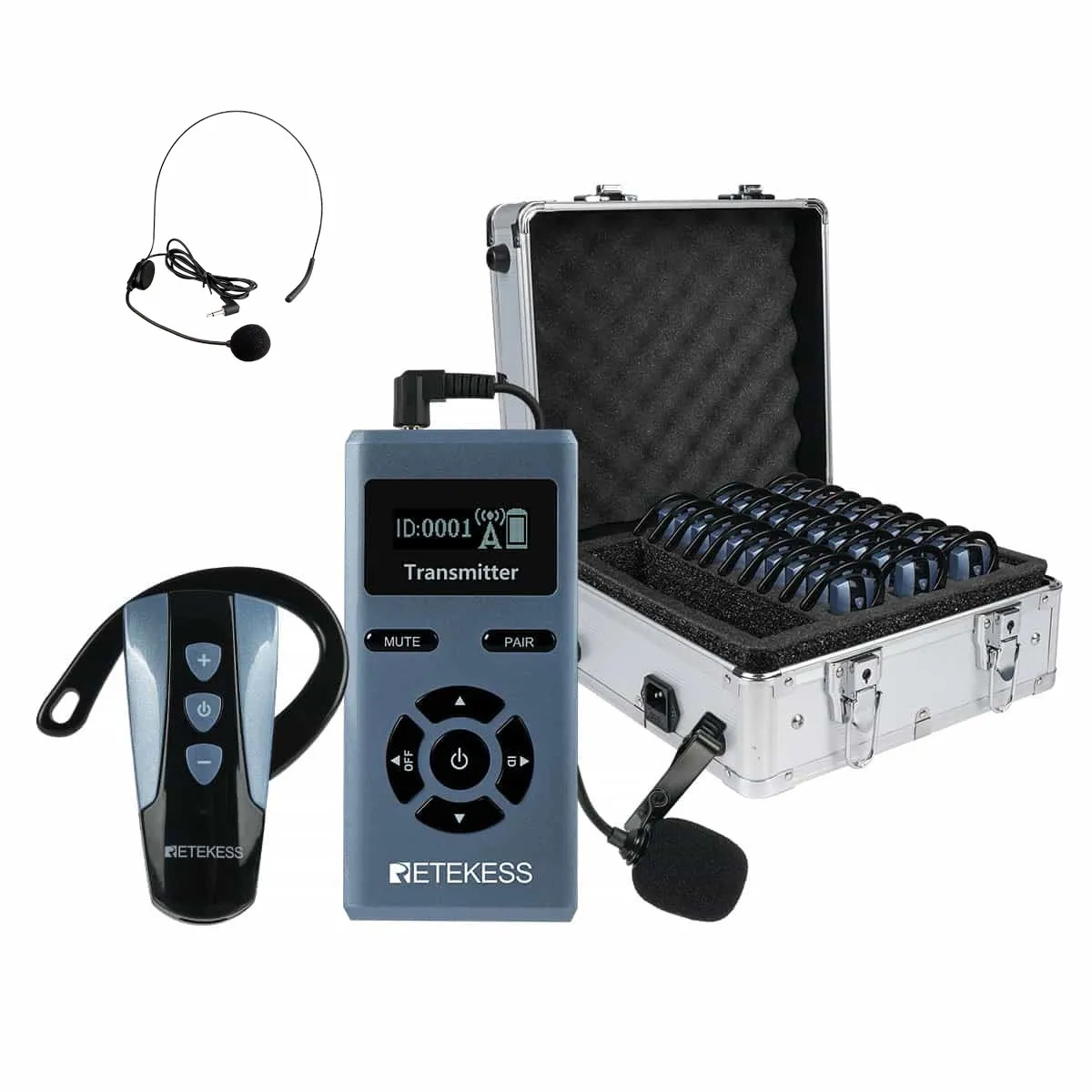
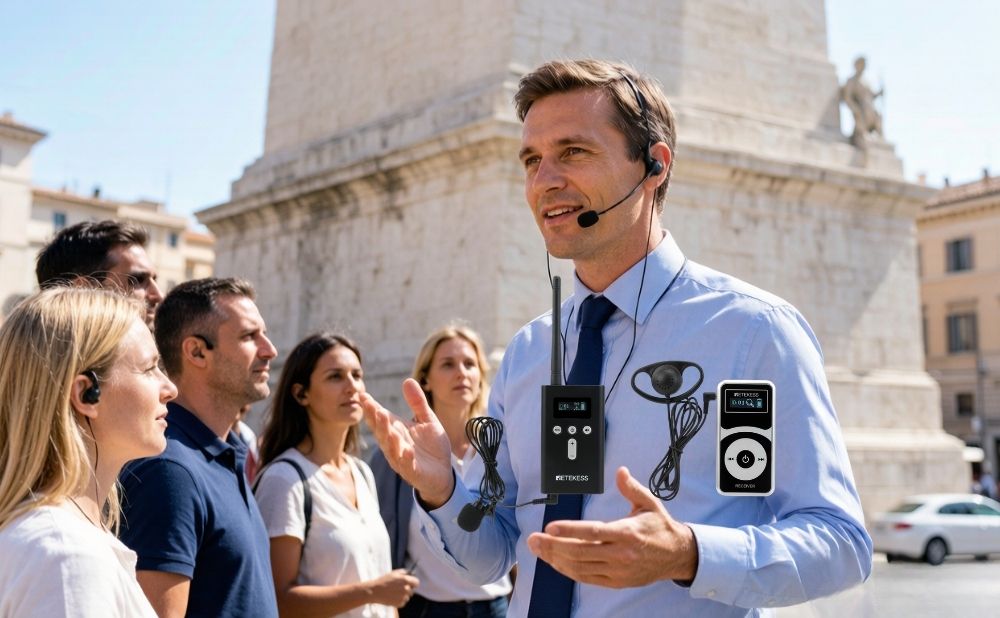
The Retekess TT136 combines a wireless tour guide transmitter with an AI translation device in one handheld unit. It pairs with lightweight earhook receivers for the group. Its four modes map directly to the gaps above.
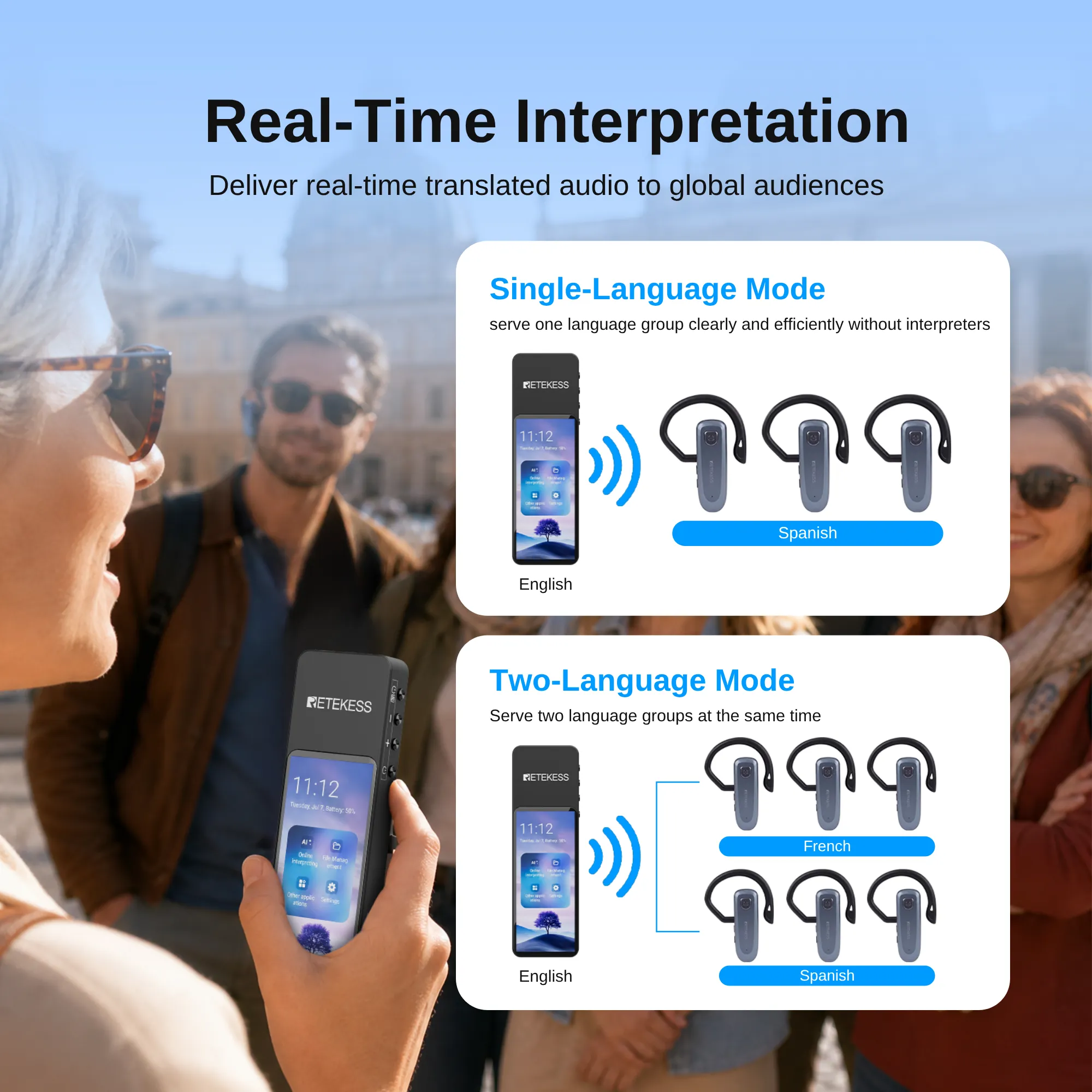
Single-language broadcast for buses and briefings
The director speaks once into the transmitter. Every guest hears the announcement through a receiver at the same volume. This mode handles bus briefings, schedule updates, and general group instructions.
It runs on the 2.4G wireless link with a range of 150 to 200 meters. It needs no internet and uses no translation credits. This covers the largest share of daily tour work at no extra cost.
Dual-language broadcast for mixed-language groups
The transmitter broadcasts two target languages at the same time. Guests switch between the two language channels on their receivers. One guide keeps a mixed-language group together instead of splitting it into two smaller tours.
This mode fits international family groups, delegations, and tours with two main guest languages. The limit is two output languages at once.
Two-way dialogue for restaurants, hotels, and shops
Two-way mode translates a live conversation between the director or guest and a local speaker. It supports 120+ languages online through Microsoft and Google translation engines.
It covers the routine cross-language moments of a tour day:
restaurant orders and allergy requests
hotel check-in and room issues
tax-free shopping and returns
pharmacy visits and basic medical communication
The director carries one device from the breakfast table to the hotel lobby. Guests get help without phone apps, roaming charges, or hand signals.
Free recognition for group questions
Free recognition picks up speech from multiple speakers and translates it into two target languages. It fits group discussions, interview segments, and visitor Q&A after a site visit. Several guests ask questions in different languages within the same conversation.
Long-range audio for busy sites and free time
The 2.4G link reaches 150 to 200 meters in open areas and supports channels numbered 0 to 9999. Multiple tour groups run in parallel without cross-talk. At a busy landmark, the front and back of the group hear the same commentary. During free time, guests within range stay connected to the director.
The Cost Picture: Free Mode and AI Mode
The TT136 runs in two distinct modes, and buyers should understand both before purchase.
Tour guide mode is free to run. It transmits the director's original voice. It works offline and consumes no translation credits. A full charge supports up to 40 hours in pure transmission, which covers the longest travel days.
AI translation mode works online and uses credits. Translation requires Wi-Fi or a mobile hotspot. Each second of translation consumes two credits, and additional credit packages are available when needed. Translation and transmission running together deliver about 6 hours of use on a full charge.
Translation accuracy runs above 85% for standard languages through the main engine. A backup system for dialects and regional accents can raise accuracy to around 97%, excluding classical or poetic text. Response delay typically falls between 80 and 400 milliseconds depending on the network.
Compare this with human interpreters. In Western European markets, professional interpreters commonly charge EUR 750 to EUR 1,200 per day per person, and standard practice places two interpreters on each language pair, rotating every 20 to 30 minutes. The TT136 does not replace professional interpreters for formal conferences or legal work. It removes the repeated cost of routine cross-language moments across a 10- to 15-day tour.
Built for Multi-Day Group Logistics
Long-haul tours live or die on daily logistics. The TT136 kit supports the specific workflow of moving a group across borders.
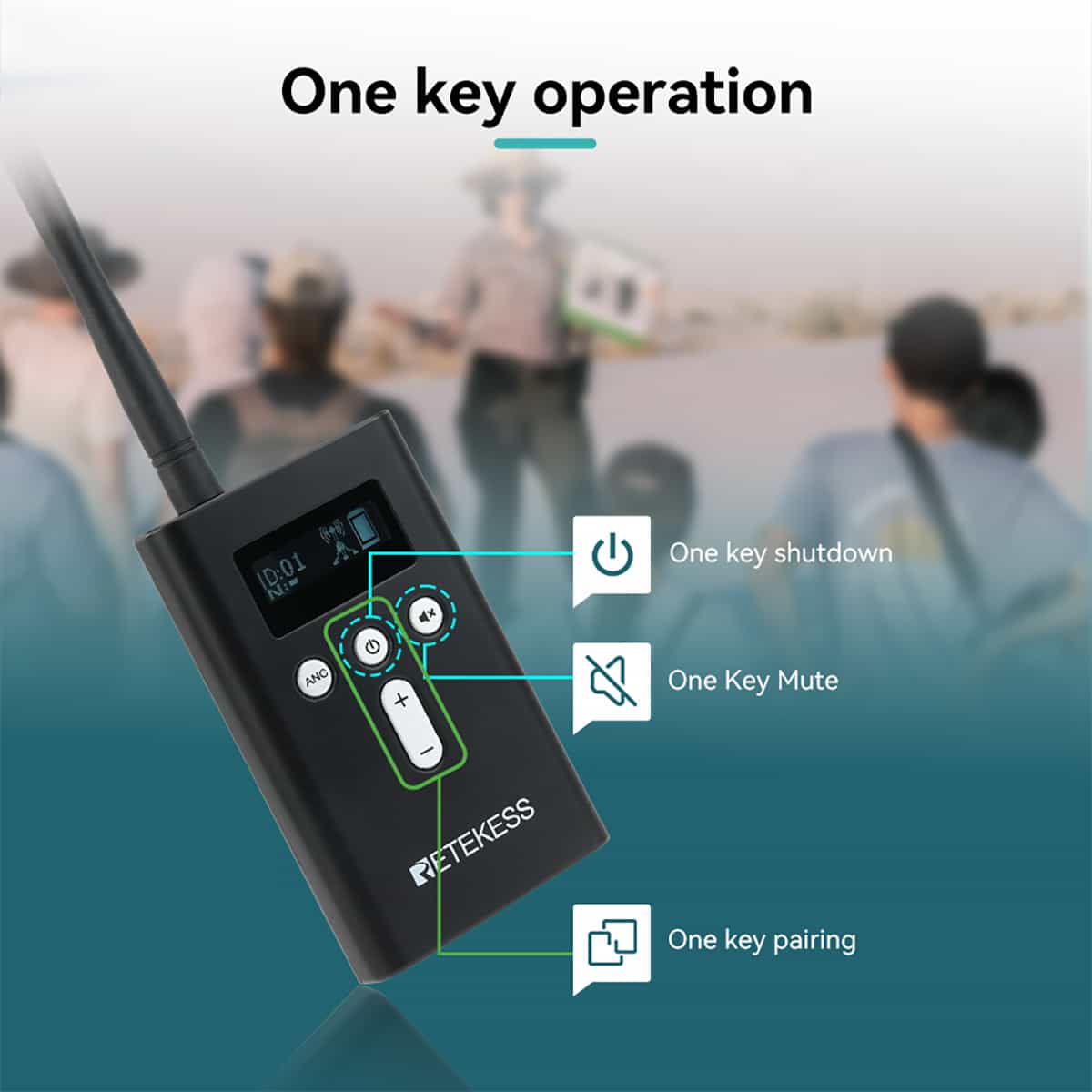
3.99-inch touchscreen: The director sees channel, battery, and signal status at a glance and switches modes on one display.
30- or 50-slot charging cases: All units charge overnight in one case at the hotel. The cases include UV sanitization between uses and protect the devices during border transfers.
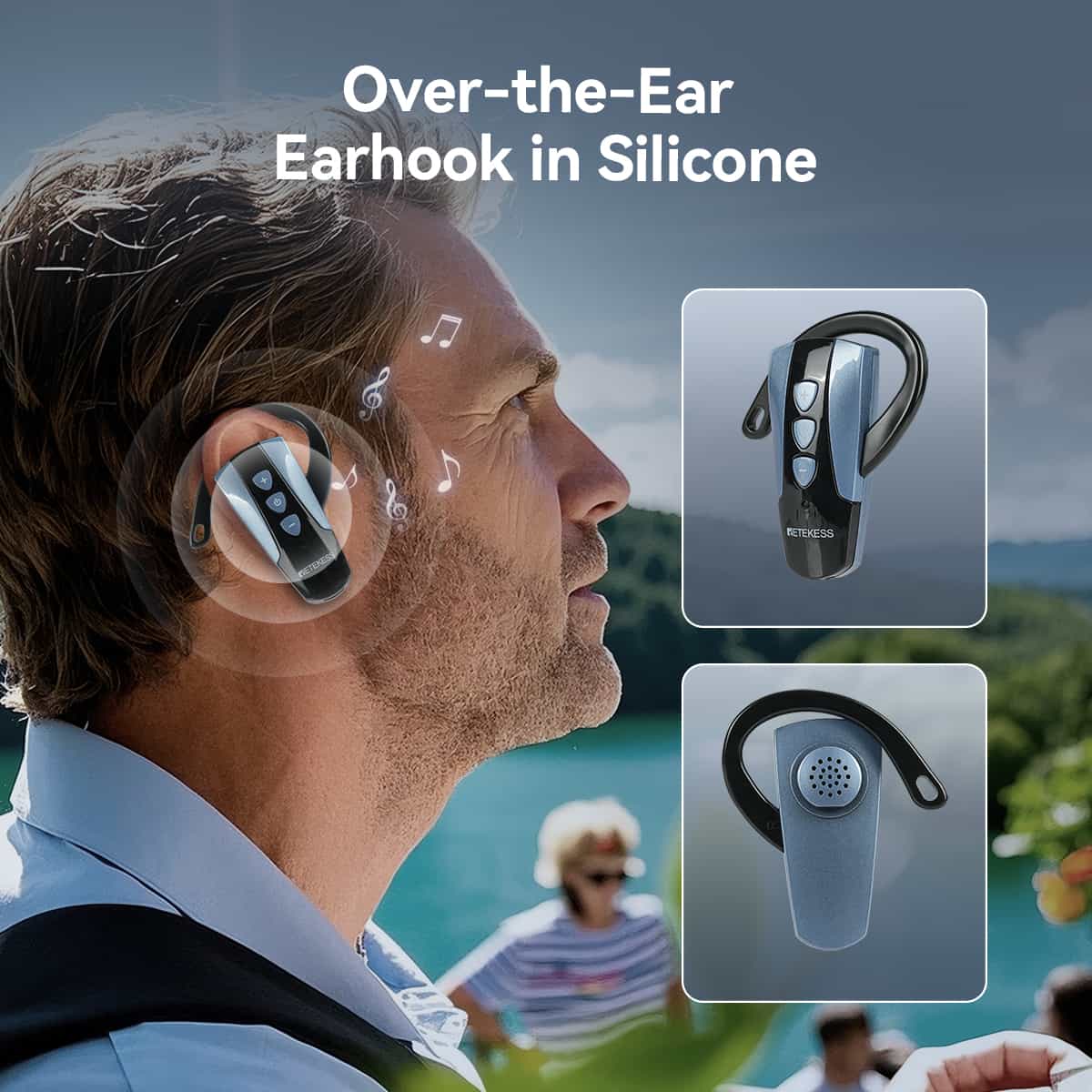
Universal earhook receivers: Receivers fit the left or right ear and offer five volume levels. Guests wear them all day without pressure.
155-gram transmitter: The director carries one handheld unit instead of a separate radio, megaphone, and translator.
Auto pairing: Transmitters and receivers pair automatically within five meters after power-on, so a new day starts without technical setup.
Final Note
Long-haul European group tours compete on the complete journey, not on a single landmark. Guests remember the bus announcements, the restaurant handling their allergy, and finding the group after free time.
The TT136 addresses these moments with a free offline guide mode for daily briefings and an online AI translation mode for 120+ languages. It keeps mixed-language groups together, covers the full spread at busy sites, and charges as a single kit each night.
Outbound agencies and tour directors can book a free selection consultation to match the device setup to the countries and languages on each itinerary. Every kit also comes with a 30-day full refund, so teams can test the system on a real tour before committing.


![[18th Anniversary] 18 Years of Echoing Excellence: Making Communication Easier, Connecting Trust Beyond Borders](https://res.retekess.com/z_file/20260716/retekess-brand-story-making-communication-easier_20260716151044_7682.jpg)
![[18 Years in Wireless Communication] Silent Disco Systems Anniversary Celebration: Top-Selling Headphones & Event Mechanics Revealed!](https://res.retekess.com/z_file/20260713/18-years-in-wireless-communication-silent-disco-systems-anniversary-celebration_20260713175011_5749.webp)
![[Anniversary Carnival] Ding-dong! 18th Anniversary Mega Sale on Guest Paging & Calling Systems: Full Reveal of 12+ Products & Promo Rules!](https://res.retekess.com/z_file/20260713/18th-anniversary-mega-sale-on-guest-paging-calling-systems_20260713175257_0295.webp)
![[Retekess 18th Anniversary Teaser] Tour Guide System Exclusive Perks: Sneak Peek at Event Dates & Mechanics!](https://res.retekess.com/z_file/20260713/retekess-18th-anniversary-tour-guide-system-exclusive-perks--2-_20260713180135_6435.webp)
Follow Us
Pay With


 Google
 Amazon
Comments (0)