
Table of Contents
Real Time Translation Device: How It Works, What It Costs, and Which Type You Actually Need
- Retekess
- Oct 10, 2026
Real Time Translation Device: How It Works, What It Costs, and Which Type You Actually Need
Search for "real time translation device" and you will get earbuds, handheld gadgets, phone apps and rack-mounted conference systems, all wearing the same label. That is the problem with the term: it describes an outcome, not a product. Sixty-eight percent of global conference organizers now use some form of real-time AI translation, and the global AI translation platform market is projected to grow from $2.31 billion in 2025 to $9.84 billion by 2034. Demand is real. The vocabulary is a mess.
This guide fixes the vocabulary first, then the buying decision. By the end you should be able to name which of the four device types you actually need, what it will cost you over a year, and where AI translation should stop and a human interpreter should start.
1. What Is a Real Time Translation Device?
A real time translation device is any piece of hardware that captures spoken language, converts it into another language, and delivers the result to a listener fast enough that a conversation or a presentation can continue without stopping. "Fast enough" is doing a lot of work in that sentence: for AI systems today it usually means one to five seconds for wireless devices.
Real-time translation devices can perform the following three tasks.
Job 1: Capture the voice
A microphone hears the speaker. In a quiet hotel lobby that is easy. In a machine shop, on a windy street, or in a church with a live band, it is the hardest part of the whole chain. Bone conduction microphones, boom mics and noise-cancelling headsets all exist to solve this step, and this is where cheap devices fail first.
Job 2: Convert the meaning
Speech is transcribed (ASR), translated by a neural machine translation engine (MT), and then either spoken back by a synthetic voice (TTS) or shown as captions. Accuracy depends heavily on language pair, accent, background noise and domain vocabulary. Mainstream pairs such as English-Spanish, English-French, English-Italian or English-Mandarin are in good shape. Rare pairs and heavy jargon are not.
Job 3: Deliver the result
This is the step almost every buyer forgets, and the one that decides whether the device works for two people or two hundred. Delivery options are a phone screen, an earbud in your own ear, a speaker on a handheld unit, or a wireless transmitter that broadcasts to many receivers at once.
2. Is There a Real Time Translation Device That Actually Works?
A real time translation device works well today when four conditions are met:
- The language pair is mainstream. English, Spanish, French, Italian, German, Portuguese, Mandarin, Japanese, Korean and Arabic are well served. Tagalog-to-Swahili is not.
- The acoustic environment is manageable. Quiet rooms and normal conversational volume are fine. Industrial noise, wind and overlapping speakers are not.
- The stakes are recoverable. If a mistranslation means a wrong train platform, that is acceptable. If it means a wrong dosage or a wrong contract clause, it is not.
- The number of listeners matches the delivery method. This is the condition buyers break most often, and the reason many "the device did not work" reviews are really "the device was the wrong type".
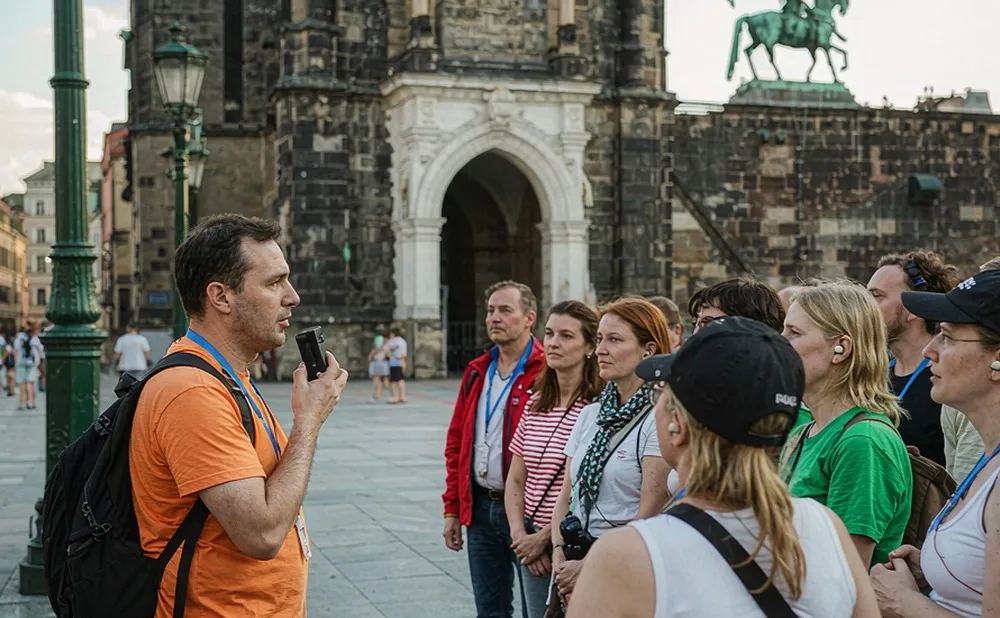
A consumer-grade translation device is indeed a great tool for a dinner shared by two people. However, it is not suitable for a tour guide addressing a group of thirty tourists, as it is not designed for group use.
3. How Real-Time Speech Translation Works, Step by Step
Understanding the chain helps you diagnose problems on site. When translation breaks, it almost always breaks at step one or step four.
|
Step |
What happens |
Typical latency |
Where it breaks |
|
1. Capture |
Microphone picks up speech; noise suppression and beamforming clean the signal |
Instant |
Industrial noise, wind, distance from mouth, multiple overlapping speakers |
|
2. ASR |
Automatic speech recognition turns audio into source-language text |
0.3 - 0.8 s |
Accents, fast speech, jargon, proper nouns |
|
3. MT |
Neural machine translation renders the text into the target language |
0.2 - 0.6 s |
Rare language pairs, idioms, domain terminology |
|
4. TTS |
Text-to-speech generates the translated voice, or captions are rendered |
0.3 - 0.8 s |
Robotic delivery, poor punctuation, no speaker-emotion cues |
|
5. Distribution |
The translated audio reaches the listener: earbud, speaker, or wireless broadcast |
Depends on method |
Phone-relay designs add 5 - 10 s; one-to-many broadcast adds near zero per extra listener |
Total end-to-end latency on a well-designed translation device is around one to three seconds. Systems that bounce audio through a smartphone and back over Bluetooth, such as some tour-guide plus app hybrids, routinely land in the five to ten second range, which is enough to break the rhythm of a live conversation.
4. The Four Types of Real Time Translation Device
This is the comparison that most buying guides skip, and it is the one that actually matters.
|
Type |
How it works |
Who it serves |
Price band |
Main limit |
|
Smartphone app |
Phone mic captures speech, cloud translates, result is shown or spoken. Google Translate conversation mode and Apple Translate are the reference examples |
1 - 2 people, informal travel situations |
Free to a few dollars per month |
Requires a phone in hand, awkward turn-taking, poor in noise, unusable for groups |
|
AI translation earbuds |
Earbuds pair with a phone app; some models add bone-conduction pickup. Examples: Timekettle series, Pixel Buds with Gemini live translation, AirPods Live Translation |
1 - 2 people, conversations, business pairings |
Roughly $100 - $350 |
Only the wearer hears translation. Everyone needs their own unit, phone and app account |
|
Handheld standalone translator |
Self-contained unit with its own microphone, speaker, screen and often a built-in data connection or offline language packs |
1 - 3 people, kiosk-style exchanges, border and reception desks |
Roughly $250 - $600 |
Speakerphone-style turn-taking in public; still one listener at a time |
|
Group broadcast translation system |
One transmitter captures the speaker and broadcasts translated audio wirelessly to any number of lightweight receivers. Includes AI-only systems and interpreter-driven systems |
5 to 500+ listeners: tours, churches, meetings, factory visits, school events |
Roughly $400 - $2,000+ one-time for portable kits |
Higher upfront cost; needs a charging and storage routine |
The dividing line is simple. If one person needs to understand one other person, buy earbuds. If one person needs to be understood by many, buy a broadcast system. Almost every disappointed buyer we hear from bought the first when they needed the second.
5. Matching the Device Type to Your Scenario
Below is the matching table we use with tour operators, church administrators, meeting planners and plant managers across North America, Italy, Spain and France.
|
Scenario |
Listeners |
Languages at once |
Recommended type |
Why |
|
Solo travel, restaurant, taxi |
1 - 2 |
1 pair |
App or translation earbuds |
Nothing to broadcast; privacy and portability win |
|
Walking city tour, Italy or Spain |
10 - 40 |
1 - 4 |
Group broadcast, AI (TT136) |
Guide speaks once; everyone hears their own language; no app on the visitor side |
|
Museum or heritage site group |
10 - 50 |
2 - 4 |
Group broadcast, AI or interpreter (TT136 / T130P) |
Quiet-indoor etiquette plus multilingual coverage |
|
Church service, English-Spanish congregation |
30 - 300 |
1 - 2 |
Group broadcast, AI or volunteer interpreter (TT136 / TT117) |
Elderly members trust a physical receiver more than an app |
|
Business meeting or supplier audit |
5 - 40 |
2 |
Two-way broadcast (TT136) or interpreter console (TT118 / TT119) |
Questions must come back in the other direction |
|
Factory or plant tour |
10 - 30 |
1 - 3 |
Noise-cancelling group system (T130P / TT116 / TT136) |
Machinery noise breaks phone and earbud microphones first |
|
Parent-teacher conference night |
40 - 200 |
3 - 8 |
Group broadcast, AI (TT136) |
Many home languages in one room; privacy matters |
|
Nonprofit or community meeting |
20 - 150 |
3 - 8 |
Group broadcast, AI (TT136) |
Budget is one-time, languages are many, volunteers operate it |
6. Five Specs That Matter and Three That Do Not
Specs that change the outcome
- Listener capacity. How many people can hear the translation at once, and how receivers are charged and stored.
- Language coverage and direction. "120 languages" on a box usually means 120 online pairs in one direction at a time. Ask how many can run simultaneously.
- Network dependency. Online engines are far more accurate. If your venue has no Wi-Fi, you need a hotspot plan, a SIM-enabled device, or preloaded offline content.
- Microphone and noise handling. If you will use it near machinery, traffic or a crowd, this outranks everything else.
- Setup time and operator skill. Volunteers, guides and teachers need something that works in under ten minutes.
Specs that mostly sell boxes
- Accent counts. "106 accents" is marketing math, not a measurable spec.
- Camera or photo translation. Rarely used in the scenarios above.
- Offline language count, unless your venue genuinely has no connectivity. Offline packs are usually materially less accurate than online engines.
7. Where the Retekess TT136 Fits
The Retekess TT136 was built for the row of that table that no consumer earbud serves: one speaker, a mixed-language audience, no interpreter on staff, and a schedule that does not wait.
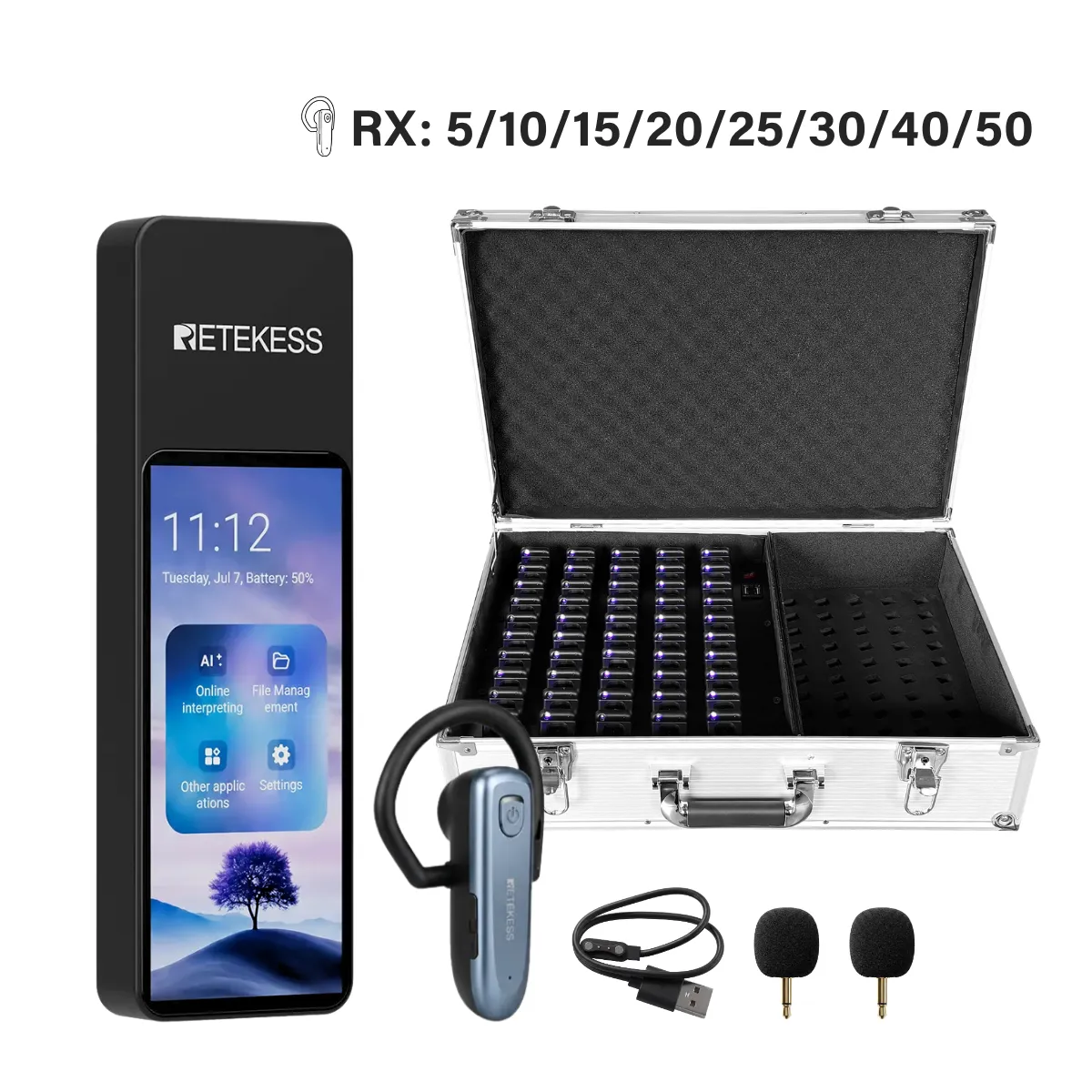
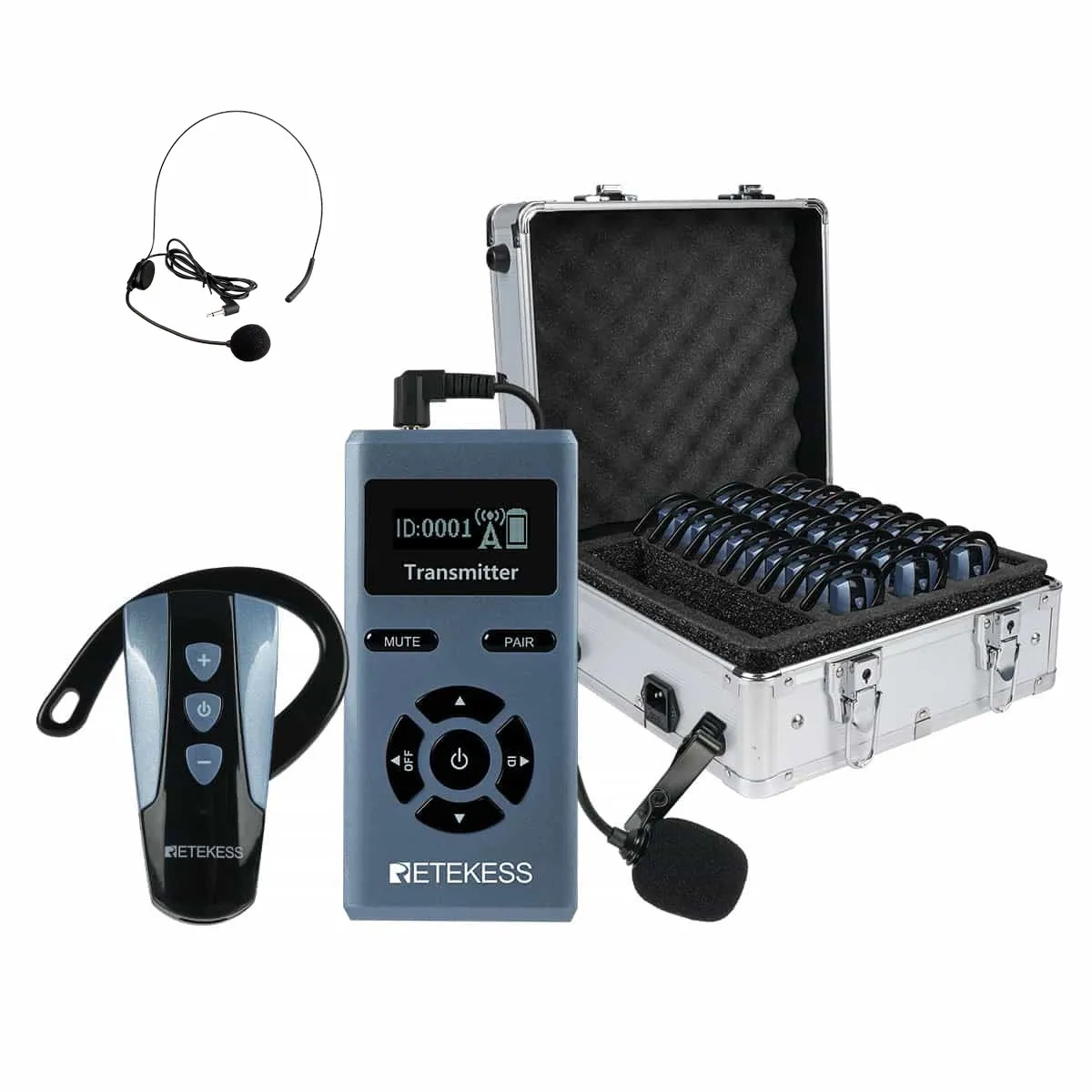
It is a translation terminal and a wireless tour guide transmitter in a single 155 g body, so an operator does not have to choose between a translator and a group audio system.
Core capabilities
- Online translation for roughly 120 languages, connected by Wi-Fi or a phone hotspot.
- Free-recognition mode: the transmitter auto-detects the speaker language within a 10-language preset, which removes the wrong-language-button failure that plagues handheld devices in mixed groups.
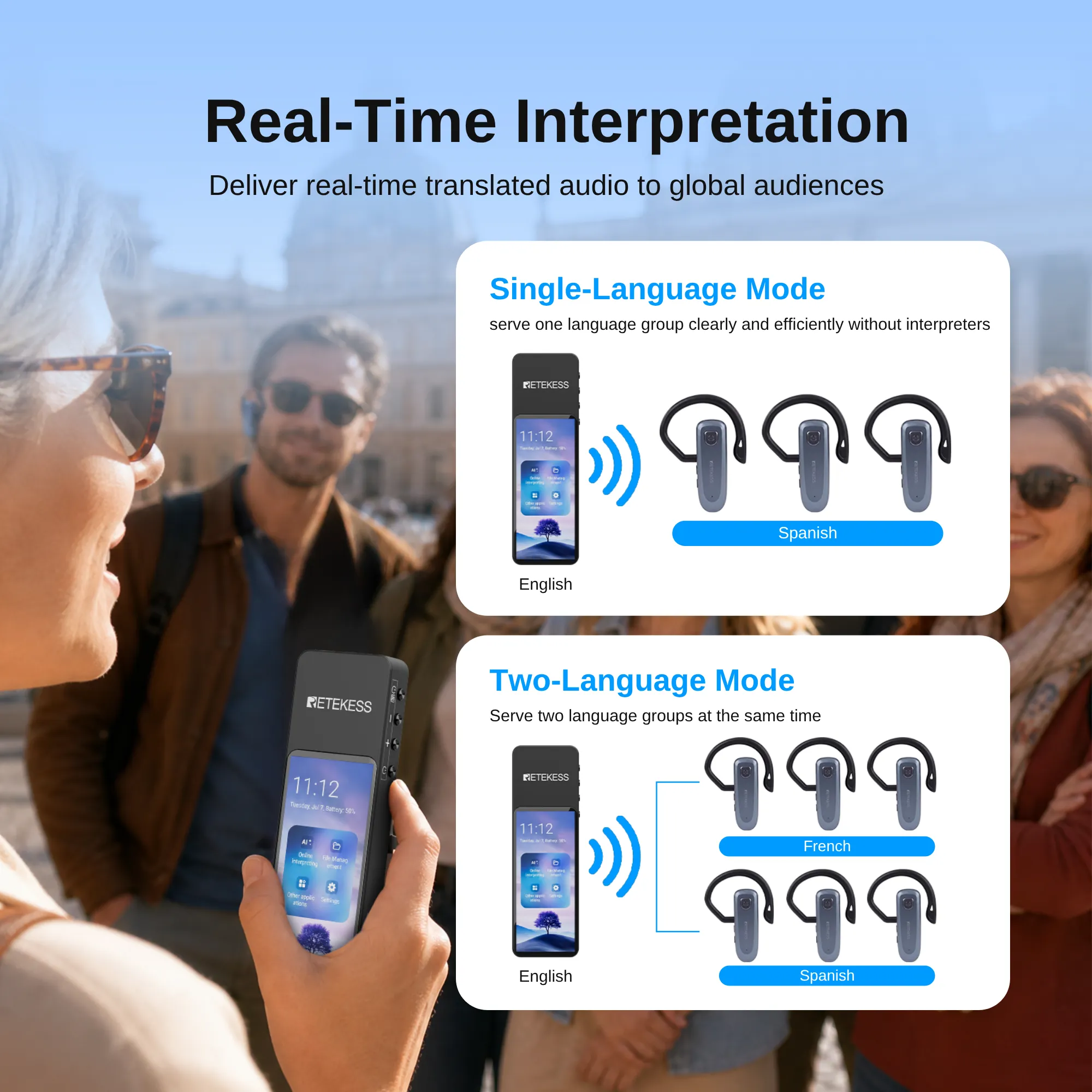
- Mono or bilingual broadcast: one guide can serve a single-language group, or output two translated languages at once while listeners pick a channel.
- Two-way group dialogue via separate blue and green receiver channels, so two language groups can actually hold a conversation, not just listen.
- Original-audio one-to-many mode, so the same kit works as a standard tour guide system when no translation is needed.
- 4 GHz wireless transmission, 0 - 9999 channels, roughly 150 - 200 m open-area range for factories, warehouses, scenic areas and large halls.
- 99-inch Android touchscreen with recording, playback and AI summarisation, useful for training records and post-event notes.
- Open ear-hook receiver at roughly 13 g: non-in-ear, comfortable for shared public use, switchable left or right.
- Optional 30-slot or 50-slot charging case with UV sanitisation for centralised charging, storage and hygiene.
When to choose a different Retekess model
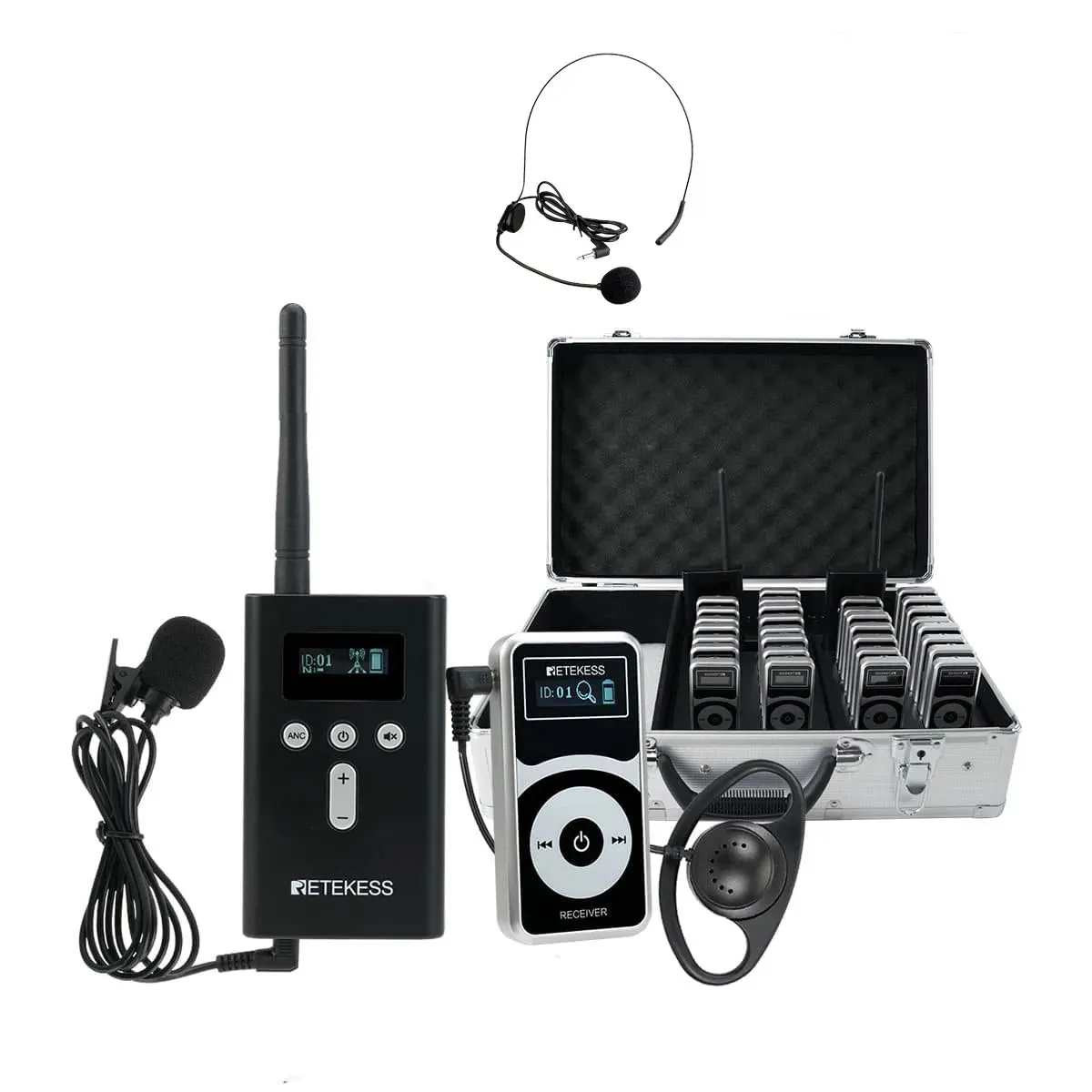
TT136 is the no-interpreter answer. It is not the answer to everything. If you have a qualified interpreter on site, a console-based system gives them a monitor, a mute key and proper channel control: TT117 for multi-channel value deployments, TT118 and TT119 for desktop simultaneous interpretation with interpreter monitoring. If you do not need translation at all but the environment is loud, T130P with roughly 23 dB of noise reduction, or TT116 with a 50-channel radio and a 30-slot charging case, is the more economical buy. TT106S works as a low-cost expansion set when you simply need more receivers in the field.
8. What a Real Time Translation Device Actually Costs
Hardware price is the least interesting number. What matters is cost per event over a year.
|
Option |
Upfront cost |
Ongoing cost |
Cost per event at 20 events per year |
|
Smartphone app |
$0 |
$0 - $10 / month |
Near zero, but no group capability |
|
Translation earbuds |
$100 - $350 per person |
Possible subscription |
$100 - $350 per person who needs one |
|
Handheld translator |
$250 - $600 |
Possible data plan |
$30 - $60, one listener at a time |
|
Portable group broadcast kit (TT136 class) |
$400 - $2,000 one-time |
Translation time credit, charging |
$20 - $100, scales to any group size |
|
Rental of professional interpretation equipment |
$0 |
$300 - $500 per event |
$300 - $500, plus interpreter fees |
|
Professional human simultaneous interpreter |
$0 |
$4,000 - $8,200 per day per language pair |
$4,000 - $8,200 per day |
The break-even is quick. A single day of professional simultaneous interpretation for one language pair costs roughly what a complete portable group kit costs, several times over. Any organisation running multilingual tours, services or meetings more than a handful of times a year recovers a kit purchase inside a season. That is why rental customers are often the easiest buyers: they have already proven the demand, they are just paying for it per event.
9. Who Should Not Buy a Real Time Translation Device
Being straight about this is what makes the rest credible. Use a qualified human interpreter when:
- The content is legal, medical, diplomatic or crisis communication, and a mistranslation has irreversible consequences.
- The language pair is rare and the engine has thin training data.
- The event is one-off, high-visibility and cannot be repeated.
- You need certified accuracy for a record, a court filing or a regulated consent process.
A common and sensible pattern is hybrid: a human interpreter covers the headline session, and an AI translation device covers every parallel breakout, workshop, tour and side meeting.
10. Frequently Asked Questions
Is there a real time translation device that works without internet?
Partially. Offline language packs exist on some handheld devices, but accuracy drops noticeably compared with online engines. For group systems, the practical workaround is a phone hotspot or a local Wi-Fi connection. Some tour systems can also stream preloaded multilingual content when the network drops, so the narration continues even if live translation pauses.
Do translation earbuds work for a group?
Not really. Earbuds are a one-listener device. Every additional person needs their own pair, their own phone and their own app session, and the guide still has to speak into one of them. For groups of five or more, a transmitter-and-receiver architecture is both cheaper and more reliable.
How accurate is real time translation in 2026?
For mainstream language pairs in quiet conditions, good enough for tourism, training, worship and internal business communication. Not good enough for legal, medical or contractual language. Always test your own jargon before a live event.
Can one device translate into two languages at once?
Some can. The TT136, for example, supports bilingual broadcast, where one transmitter outputs two target languages simultaneously and listeners select their channel on the receiver. That is the feature that lets one guide serve a French-and-German group without splitting it.
Will a real time translation device replace my interpreter?
It will replace how often you reach for one. Most organisations keep an interpreter for the rare, high-stakes event and use an AI device for the weekly reality.
Conclusion: Name the Job Before You Name the Product
"Real time translation device" is an outcome, not a category. Decide first how many people need to hear, in how many languages, in what noise, and under whose operation. That answer points to one of four device types, and it points there fast.
For one-to-one conversations, earbuds are a mature, affordable answer. For anyone addressing a group — a guide in Rome, a pastor in Texas, a plant manager in Emilia-Romagna, a principal in a multilingual school district — a broadcast architecture such as the Retekess TT136 is the answer that actually scales, with no app on the listener side and no interpreter line item in the budget.
Leave a Reply


![[18th Anniversary] 18 Years of Echoing Excellence: Making Communication Easier, Connecting Trust Beyond Borders](https://res.retekess.com/z_file/20260716/retekess-brand-story-making-communication-easier_20260716151044_7682.jpg)
![[18 Years in Wireless Communication] Silent Disco Systems Anniversary Celebration: Top-Selling Headphones & Event Mechanics Revealed!](https://res.retekess.com/z_file/20260713/18-years-in-wireless-communication-silent-disco-systems-anniversary-celebration_20260713175011_5749.webp)
![[Anniversary Carnival] Ding-dong! 18th Anniversary Mega Sale on Guest Paging & Calling Systems: Full Reveal of 12+ Products & Promo Rules!](https://res.retekess.com/z_file/20260713/18th-anniversary-mega-sale-on-guest-paging-calling-systems_20260713175257_0295.webp)
![[Retekess 18th Anniversary Teaser] Tour Guide System Exclusive Perks: Sneak Peek at Event Dates & Mechanics!](https://res.retekess.com/z_file/20260713/retekess-18th-anniversary-tour-guide-system-exclusive-perks--2-_20260713180135_6435.webp)
Follow Us
Pay With


 Google
 Amazon
Comments (0)