
Table of Contents
Construction Machine Operator Training: Clarity in Noisy Machining Workshops
- Retekess
- Aug 20, 2026
Why Noisy Workshops Undermine Machining Training Quality
Machining and metal fabrication workshops are inherently loud environments. Typical lathes, milling machines, and grinding equipment operate at 85–95 dB, a level at which normal speech becomes unintelligible even at short distances. For training programs, this noise is more than an inconvenience — it directly impacts skill mastery, compliance, and on-site safety.
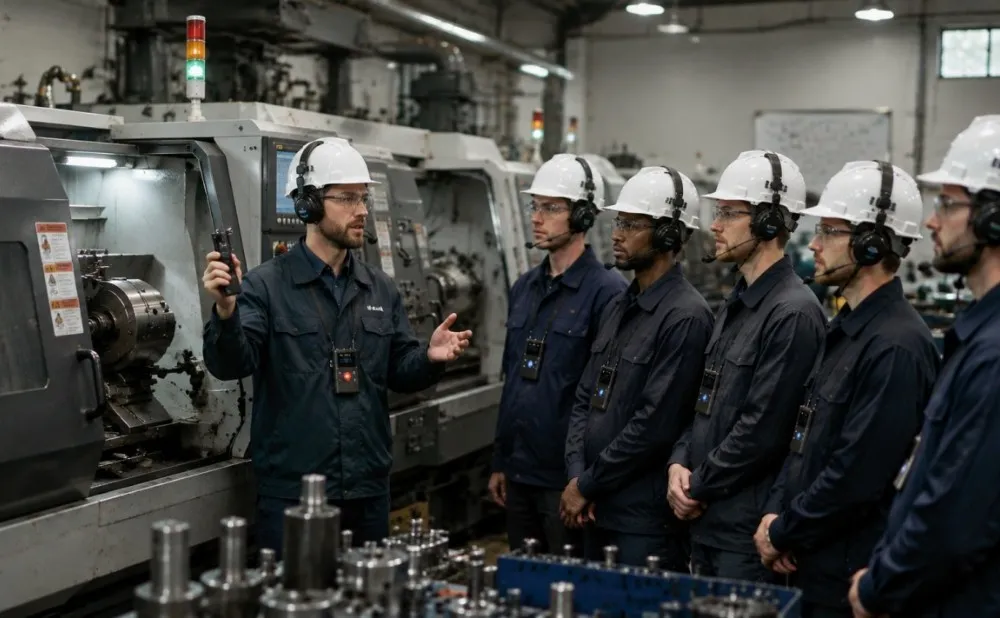
Unlike classroom learning, industrial skills training is hands-on and movement-based. Instructors demonstrate tool setup, feed rate adjustments, and emergency stop procedures while standing alongside running equipment. Trainees gather around workstations, often wearing hard hats and safety gear, and strain to hear instructions over machinery hum. What seems like a minor communication gap can translate to incorrect tool alignment, improper workpiece clamping, or failure to follow lockout/tagout protocols — errors that carry real safety consequences.
For program managers and training leads, three consistent challenges stand in the way of consistent, high-quality training delivery.
1. Critical safety and operation steps are easily missed
The core risk of noisy training environments is information loss. A single missed detail — such as the correct order for engaging a spindle, the proper grip for a grinding tool, or the location of an emergency stop — can create immediate safety hazards and reinforce bad habits that are hard to correct later.
In traditional training setups, instructors must raise their voices or pause machinery to explain each step. Pausing equipment slows training throughput, while shouting causes vocal fatigue and reduces clarity. Even when instructors speak loudly, trainees positioned farther from the workstation or standing at an angle still miss key details. For construction machine operator training, where procedural accuracy directly prevents workplace injuries, this gap is unacceptable.
2. Batch training creates uneven learning outcomes
Most vocational and corporate training programs run with 10–20 trainees per instructor. In a workshop setting, only 2–3 trainees can stand close enough to hear and see the demonstration clearly. The rest rely on secondhand information or catch partial explanations as they rotate through stations.
This uneven access leads to inconsistent skill levels across the group. Instructors are forced to repeat the same demonstration 3–4 times per session to ensure everyone follows along, cutting into hands-on practice time and extending training cycles. For training teams working on tight schedules or tight budgets, this inefficiency limits how many trainees can be upskilled each month.
3. Real-time feedback and Q&A are nearly impossible
Effective skills training depends on immediate correction. When a trainee makes a mistake — holding a tool at the wrong angle, setting a feed rate too high, or skipping a safety check — the instructor needs to intervene right away, before the error becomes a habit or causes an incident.
In noisy workshops, real-time feedback breaks down. Trainees cannot easily ask questions mid-demonstration without shouting across the room, and instructors cannot correct individual trainees without walking over and interrupting the entire group. Spontaneous questions, which often reveal the most common knowledge gaps, go unasked and unanswered. The result is passive, one-way training that fails to build confident, competent operators.
How Two-Way Wireless Audio Solves Workshop Training Pain Points
Purpose-built two-way tour guide systems, paired with noise-canceling headphones, address all three challenges by creating a direct, private audio channel between instructor and every trainee — regardless of distance or background noise.
Instead of shouting, the instructor speaks at a normal volume into a transmitter microphone. Every trainee wears a receiver and headphones, hearing the instruction directly in their ear with ambient noise filtered out. For two-way systems, trainees can also press a button to speak, asking questions or confirming steps without raising their voice or leaving their workstation.
This model transforms training delivery in three meaningful ways:
- Clarity first: Every trainee hears every word at the same volume, no matter where they stand in the workshop.
- Interactive learning: Questions and corrections happen in real time, without disrupting the flow of the demonstration.
- Scalable efficiency: One instructor can guide an entire group simultaneously, with no repetition and no rotation required.
For programs focused on construction machine operator training, this means shorter training cycles, more consistent skill mastery, and better adherence to safety protocols.
Retekess TT126 + TT034: Built for Industrial Training Environments
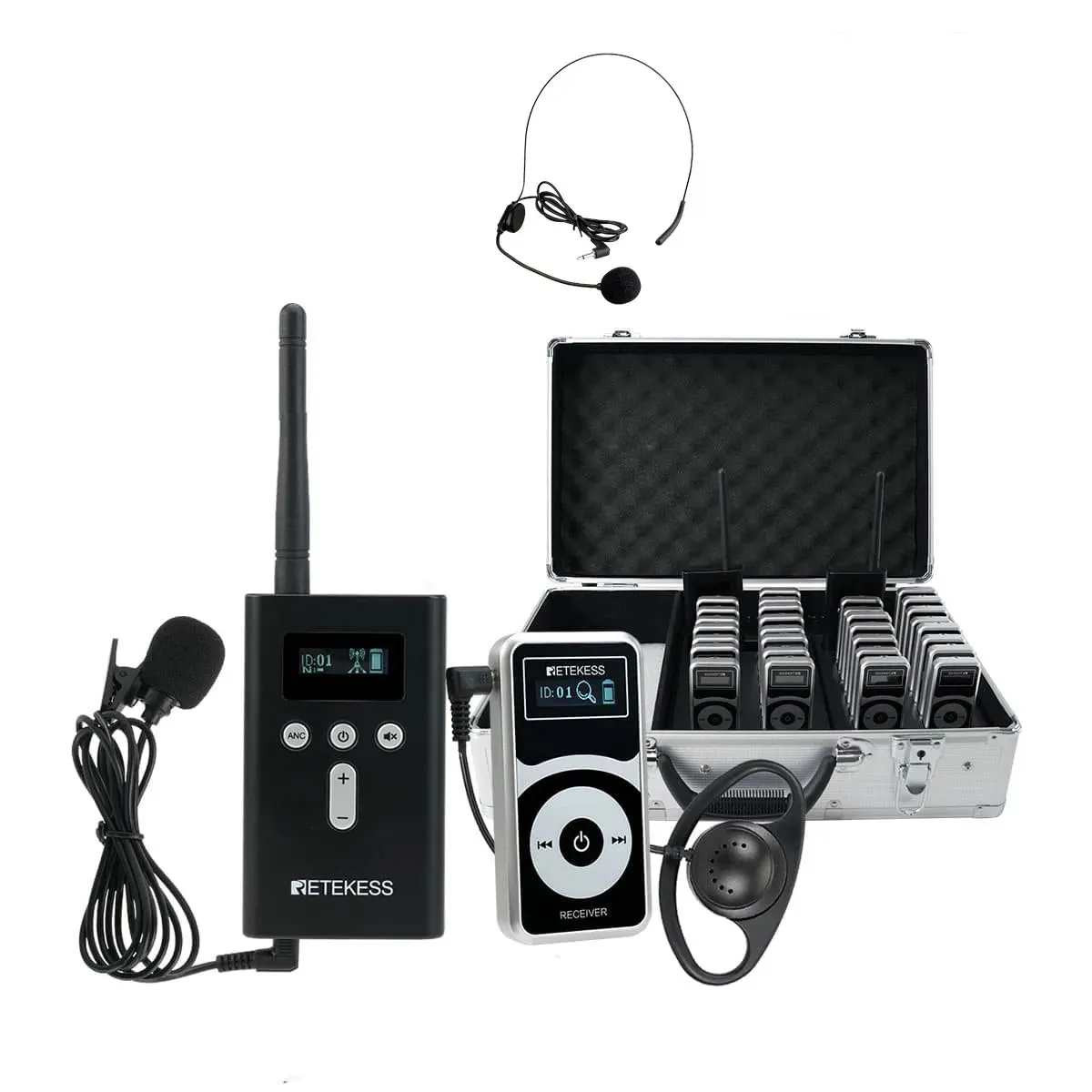
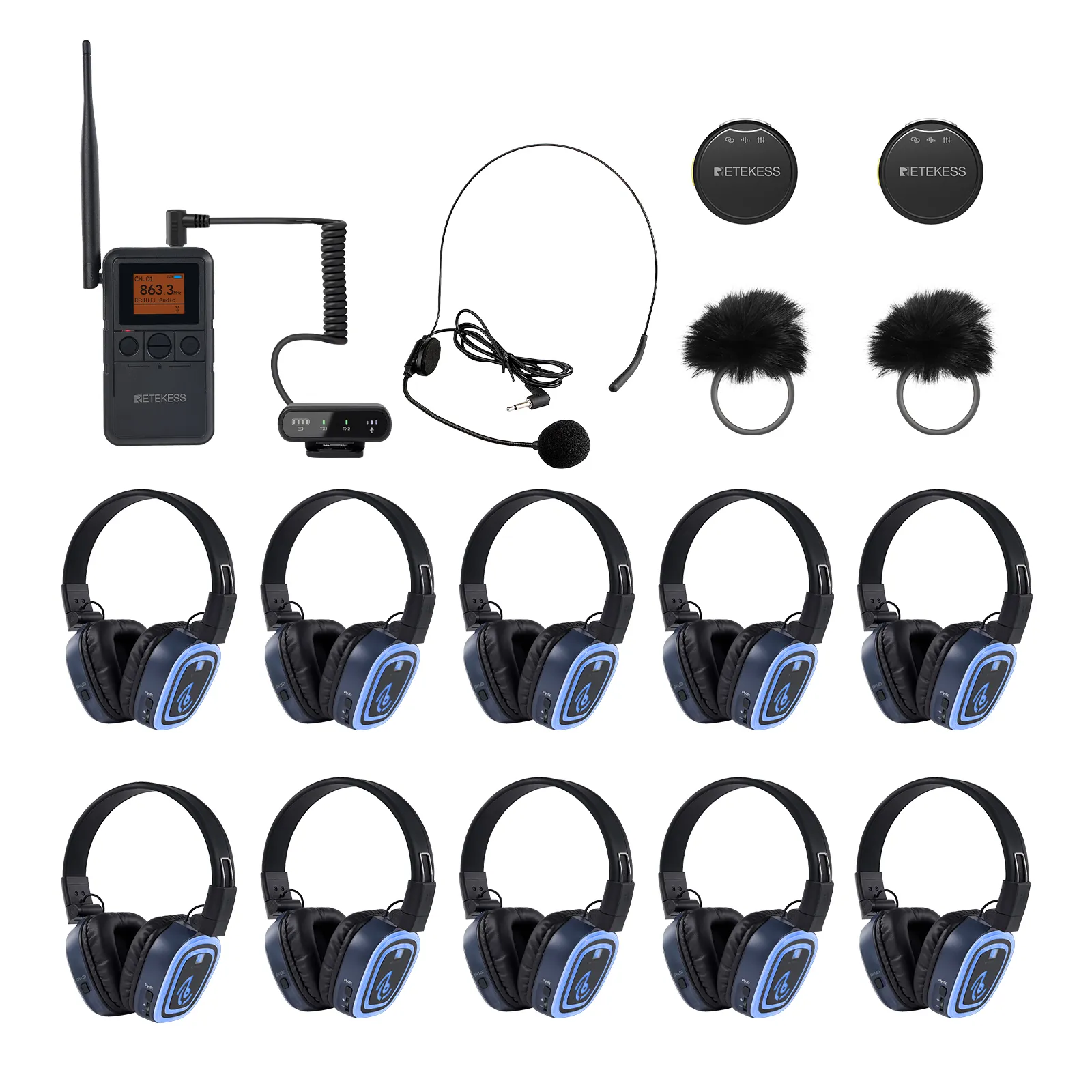
The Retekess TT126 Two-way Tour Guide System, paired with TT034 over-ear noise-canceling headphones, is engineered specifically for high-noise industrial settings like machining workshops, fabrication labs, and heavy equipment training facilities. It combines professional audio performance, safety-compliant design, and practical fleet management features that fit the needs of vocational schools and corporate training teams.
Noise-canceling headphones designed for workshop safety
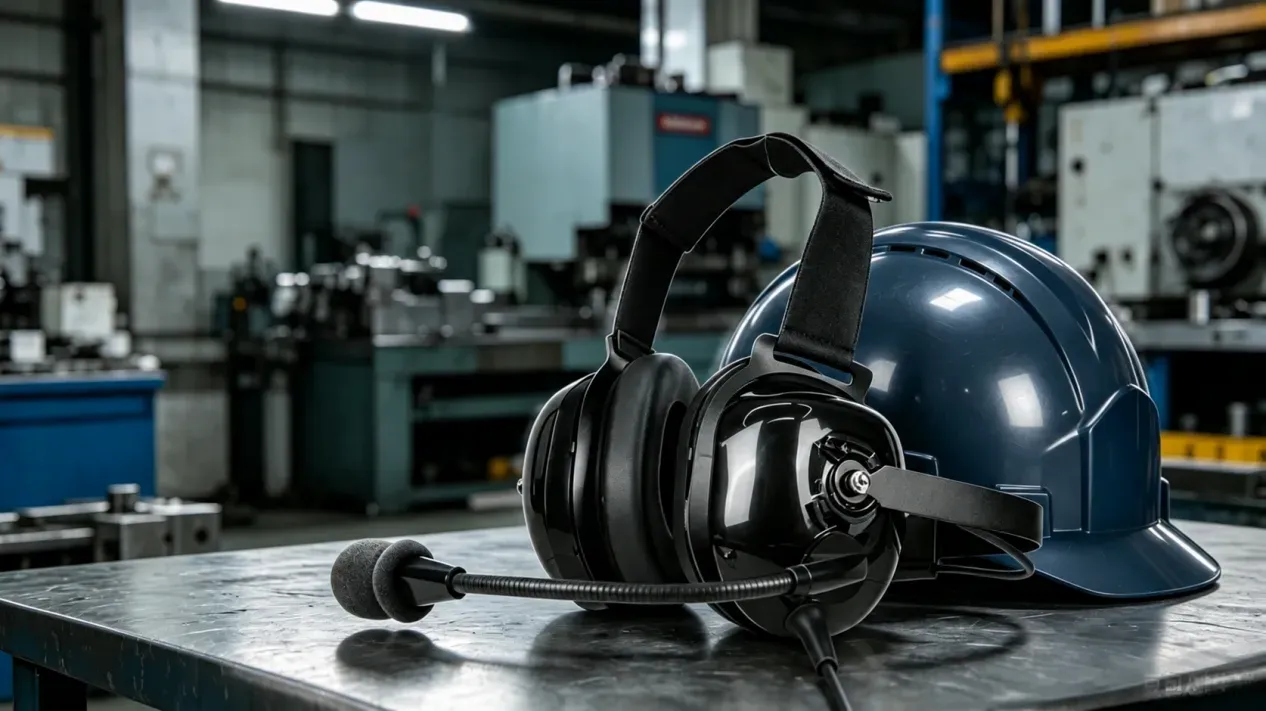
The TT034 factory noise-canceling headphones deliver up to 23 dB of noise reduction, effectively blocking the low-frequency hum of motors, fans, and machining equipment. This brings workshop noise down to a comfortable level, so trainees hear the instructor’s voice clearly without the instructor raising their volume.
Crucially, the headphones are designed to work safely with standard hard hats. The headband shape avoids internal collision with hard hat shells, so trainees can wear full personal protective equipment without discomfort or equipment damage. An adjustable magic headband accommodates different head sizes, ensuring a secure, comfortable fit for hours of hands-on practice. For all-day training sessions, this combination of noise reduction and wear comfort keeps trainees focused and protected.
Two-way communication for interactive, hands-on learning
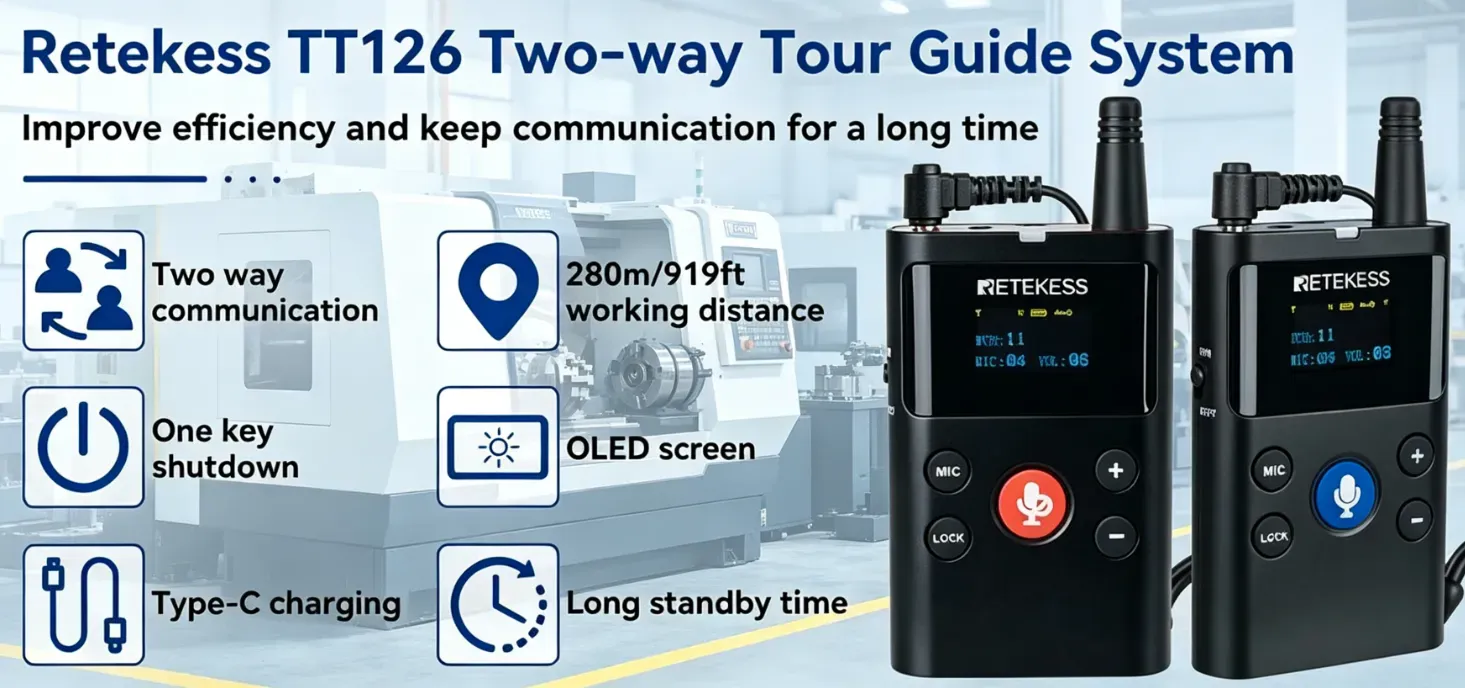
The TT126 system supports full two-way audio between the main transmitter and all receiver units. In a training context, this means instructors can narrate demonstrations in real time, and trainees can ask questions or confirm procedures with a single button press.
When a trainee asks a question, every member of the group hears both the question and the answer. This turns individual questions into shared learning moments, and reduces the number of repeat explanations an instructor needs to give. For safety-critical steps, instructors can also call on individual trainees to confirm understanding, ensuring full engagement and compliance before moving to the next procedure.
Wide coverage and multi-channel support for large training facilities
With a 280-meter (918-foot) open-air transmission range, the TT126 system works seamlessly across large workshop floors, multi-station training labs, and outdoor heavy equipment yards. Instructors can move between workstations with trainees, and the signal remains stable without dropouts.
The system also offers 25 selectable channels, so multiple training groups can operate in the same facility at the same time without frequency crosstalk. For vocational colleges with multiple classes running simultaneously, or corporate training centers with parallel skill tracks, this eliminates scheduling conflicts and maximizes facility utilization.
Simple operation that stays out of the way of training
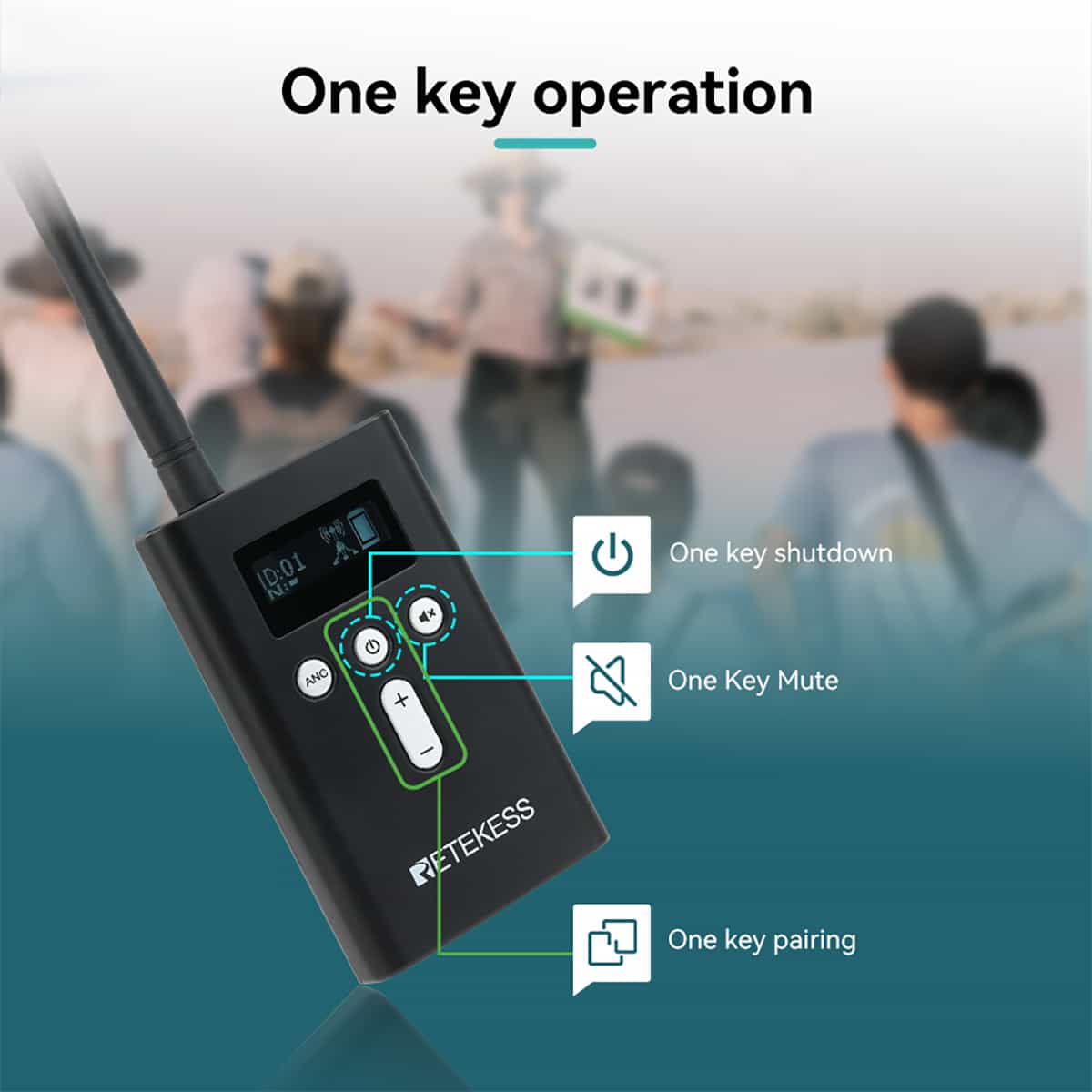
Training time should be spent on skills, not on learning how to use audio equipment. The TT126 system is designed for one-touch operation: one-touch pairing between the main transmitter and all receivers, one-touch mute for the instructor microphone, and long-press batch shutdown for all receivers at the end of class. Devices automatically memorize paired channels, so they are ready to use immediately on power-up with no reconfiguration needed.
Instructors can set up the entire system in under a minute before class. Trainees simply put on the headphones and power on the receiver — no menus, no settings, no training required. Adjustable microphone gain (1–7 levels) lets instructors optimize voice clarity for different noise levels, and 10-level volume adjustment lets each trainee set a comfortable listening level. An automatic 20-minute power-off function also conserves battery when devices are left idle between sessions.
Practical fleet management for training programs
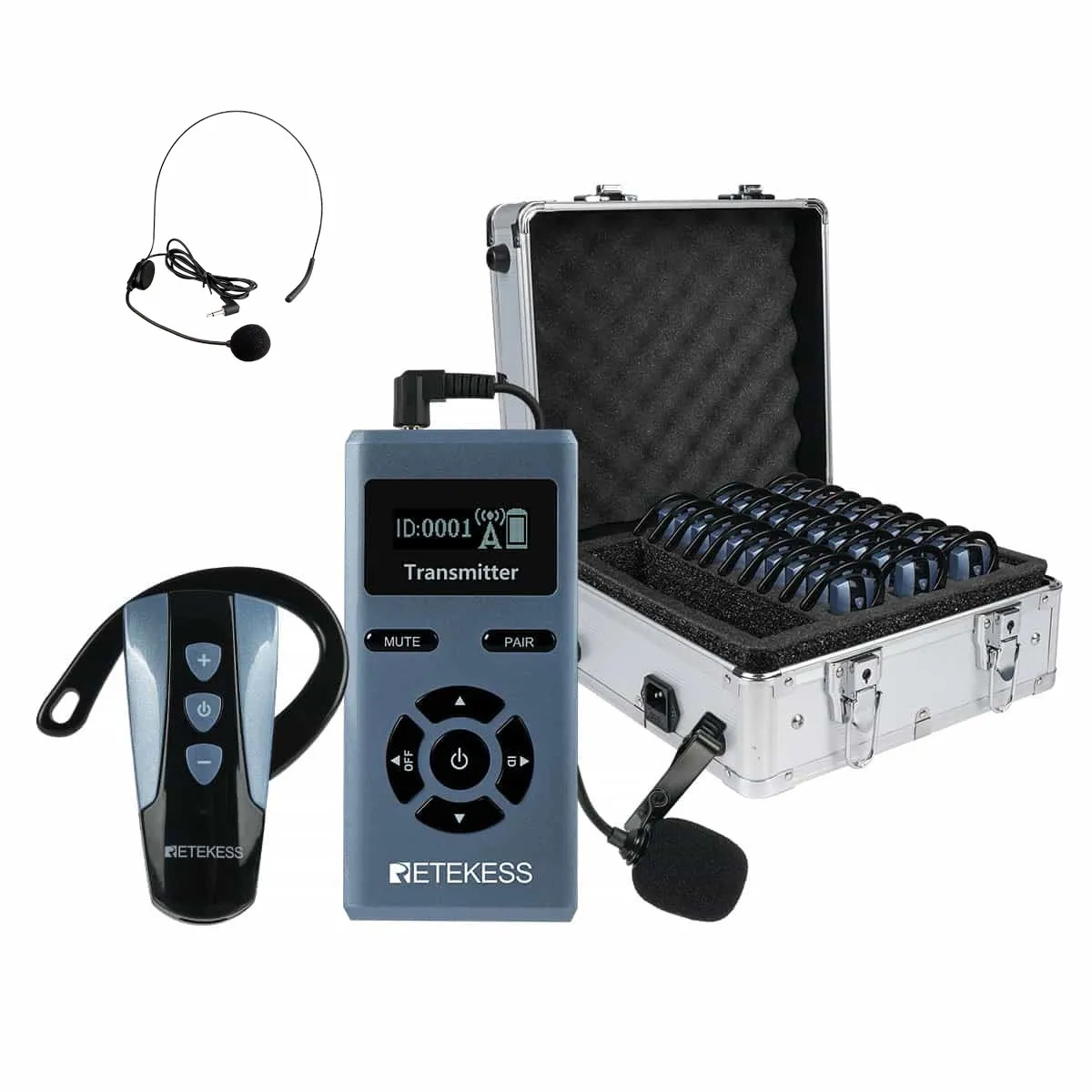
Training departments need equipment that is easy to charge, store, and maintain. The TT126 system supports flexible charging options to fit different program sizes. Individual units charge via the included USB cable, while full fleets can be charged in bulk using a 16-slot charging base or 24-slot aluminum charging case.
Both charging solutions use contact charging — staff simply drop devices into the slots, no plugging or unplugging required. The durable 24-slot charging case also doubles as a storage case, holding receivers, microphones, headphones, lanyards, and cables in one organized unit. For vocational schools managing shared equipment across multiple classes, this reduces administrative work and extends equipment lifespan. The system also supports unlimited receiver expansion, so programs can add more units as trainee cohorts grow.
Real-World Training Scenarios Where the TT126 System Delivers Value
Vocational college CNC lathe training
In a community college machining program, an instructor leads 15 students through CNC lathe setup and operation. With the TT126 system and TT034 headphones, every student hears tool change procedures, offset adjustments, and safety checks clearly, even while the spindle runs. Students can ask clarifying questions mid-demonstration, and the instructor corrects positioning errors in real time without walking to each station. Practical exam pass rates improve, and total training time per cohort drops by 20%.
Corporate welding operator onboarding
A metal fabrication company runs 3-week onboarding programs for new welders. Instructors use the TT126 system to deliver safety briefings, demonstrate joint preparation techniques, and correct hand position while trainees practice at individual booths. The 25-channel capacity allows three training groups to run simultaneously in the same workshop. New hires reach basic proficiency faster, and safety incident rates during training drop to zero.
Heavy equipment operator assessment
For construction machine operator training assessments, evaluators use the two-way system to deliver instructions and confirm procedure steps from a distance. Candidates wear headphones and receive clear guidance even in open outdoor yards with engine noise. Assessors can ask follow-up questions and correct unsafe actions immediately, creating a fairer, safer, and more consistent evaluation process.
Final Thoughts
High-quality machining and heavy equipment training depends on clear communication — and clear communication cannot rely on shouting over machinery. For vocational schools, corporate training teams, and skill instructors, upgrading to a two-way wireless audio system is a targeted investment that improves safety, reduces training time, and creates more consistent learning outcomes for every trainee.
The Retekess TT126 system paired with TT034 noise-canceling headphones brings professional-grade audio clarity, safety-compliant design, and practical fleet management to industrial training environments. It turns noisy, one-way demonstrations into interactive, immersive learning experiences where every step, every safety rule, and every question is heard loud and clear.
If you’re looking to upgrade your construction machine operator training or machining workshop programs, explore the full specifications of the TT126 two-way system and TT034 headphones, and find the configuration that matches your training size and facility needs.










![[18th Anniversary] 18 Years of Echoing Excellence: Making Communication Easier, Connecting Trust Beyond Borders](https://res.retekess.com/z_file/20260716/retekess-brand-story-making-communication-easier_20260716151044_7682.jpg)
![[18 Years in Wireless Communication] Silent Disco Systems Anniversary Celebration: Top-Selling Headphones & Event Mechanics Revealed!](https://res.retekess.com/z_file/20260713/18-years-in-wireless-communication-silent-disco-systems-anniversary-celebration_20260713175011_5749.webp)
![[Anniversary Carnival] Ding-dong! 18th Anniversary Mega Sale on Guest Paging & Calling Systems: Full Reveal of 12+ Products & Promo Rules!](https://res.retekess.com/z_file/20260713/18th-anniversary-mega-sale-on-guest-paging-calling-systems_20260713175257_0295.webp)
![[Retekess 18th Anniversary Teaser] Tour Guide System Exclusive Perks: Sneak Peek at Event Dates & Mechanics!](https://res.retekess.com/z_file/20260713/retekess-18th-anniversary-tour-guide-system-exclusive-perks--2-_20260713180135_6435.webp)
Follow Us
Pay With


 Google
 Amazon
Comments (0)