
Table of Contents
Industrial Communication Solutions on the Production Line: How to Improve Real-Time Collaboration
- Retekess
- Aug 20, 2026
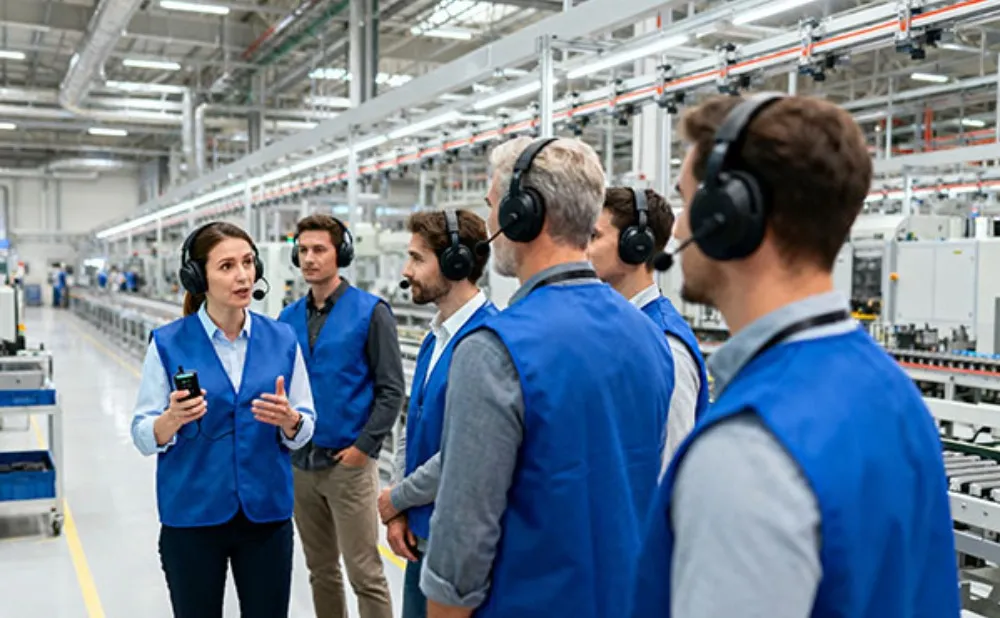
Industrial communication solutions are becoming more important on the production line because modern manufacturing depends on fast, clear, and reliable communication. Workers, supervisors, and technicians need to share updates in real time, especially during inspection, setup, troubleshooting, and training. In these environments, two way communication is not just helpful. It is part of the workflow.
Many teams still rely on basic tools, but that often leads to delays, noise problems, and repeated instructions. For production line work, the better answer is a system that supports real collaboration across distance and noise. That is why more factories are looking for industrial communication solutions that make communication faster, clearer, and easier to manage.
1. Why Real-Time Communication Matters on the Production Line
Industrial communication is not the same as everyday communication. On a production line, every second matters. If a worker misses a signal, the next step may slow down. If a technician cannot confirm a setting quickly, the whole process may stop.
That is why production teams need two way communication tools that support instant feedback. A system that allows people to talk and listen clearly helps the line stay active and reduces unnecessary delay. In fast-moving industrial spaces, communication is part of productivity.
2. Why Traditional Tools Fall Short in Industrial Environments
Many sites still depend on face-to-face talk, phones, or basic radios. These tools can work in simple settings, but they often break down in busy plants.
Face-to-face communication
At first glance, speaking in person seems easiest. But in industrial settings, noise and distance often force people to walk closer, stop their work, or gather in one place. That breaks the workflow and wastes time. On a large production floor, it may not even be possible to get close enough without interrupting machines or safety zones.
Standard walkie-talkies
Basic walkie-talkies help more than shouting, but they still have limits. Most are half-duplex, which means only one person can speak at a time. The user has to press a button, wait, talk, release, and then wait for the reply. In a fast-moving work environment, that can slow everything down. It can also create confusion when several people need to confirm different details at once.
Mobile phones
Phones solve some distance problems, but they also bring new ones. Signal can be weak in certain areas. Dialing takes time. A phone call can feel too formal and too slow for quick floor communication. In a noisy workspace, phone audio is often hard to hear clearly. Phones also take attention away from the task at hand.
This is why many teams now look for better industrial communication solutions instead of relying on basic 2 way communication devices.
3. Why Full-Duplex Matters for Real-Time Collaboration
This is where full-duplex audio becomes important. Full-duplex means both sides can speak and listen at the same time. There is no need to wait for a turn, press a button, or pause the conversation.
That may sound simple, but it changes the way people work together.
It feels like a real conversation
Instead of sending short bursts of sound back and forth, workers can communicate naturally. One person can explain while another reacts immediately. That makes the exchange faster and more useful, especially in technical work.
It supports instant confirmation
On the production line, people often need quick answers. “Yes, that part is correct.” “No, move to the left.” “Check the valve again.” With full-duplex communication, these responses can happen right away, without slowing the task.
It keeps hands free
In industrial work, hands matter. People often need to hold tools, inspect equipment, or move between stations. A hands-free system makes communication easier without interrupting the job.
It helps reduce mistakes
When workers can clarify things in real time, there is less room for misunderstanding. That matters during inspections, setup, troubleshooting, and training.
This is why full-duplex communication is more than a technical feature. It can make two way communication feel more like a real conversation and less like a radio exchange.
4. Where Two-Way Audio Changes the Game
The value of full-duplex audio becomes even clearer when you look at the actual work on a production line.
Floor inspections
During inspections, an engineer may spot an issue in one area and need a technician from another area to confirm it right away. With normal tools, that can mean walking back and forth or repeating the same message several times. With full-duplex audio, the two people can speak in real time and solve the issue faster.
Equipment debugging
Debugging often requires one person at the control panel and another person at the machine. They need to compare what they see, hear, and measure. If they can talk and listen at the same time, they can move through the process more smoothly and avoid long pauses between steps.
Troubleshooting
When a machine stops working, more than one expert may need to join the conversation. Maintenance teams, operators, and supervisors may all need to weigh in. Full-duplex communication helps make that feel less chaotic. People can react, explain, and confirm without waiting for a channel to clear.
On-the-job training
Training is another area where two-way communication matters. New workers often learn best when they can ask questions while watching the job happen. A trainer can explain a step, and the trainee can respond right away. That shortens the learning curve and lowers the risk of mistakes.
These are all examples of where industrial communication solutions can improve the way teams work.
Matching the System to the Workflow
Not every industrial site works the same way. That is why the communication system should match the workflow.
For long-range, high-mobility operations, Retekess TT126 is a practical fit. It offers 280 meters of coverage, stable wireless transmission, and a full-duplex setup that supports real-time interaction. Its 7-level adjustable microphone gain helps teams adapt to different noise zones on the floor. For environments with heavy machinery noise, it can be paired with optional TT034 noise-canceling headphones, which deliver 23 dB of ambient noise reduction and are designed to fit comfortably under safety helmets.
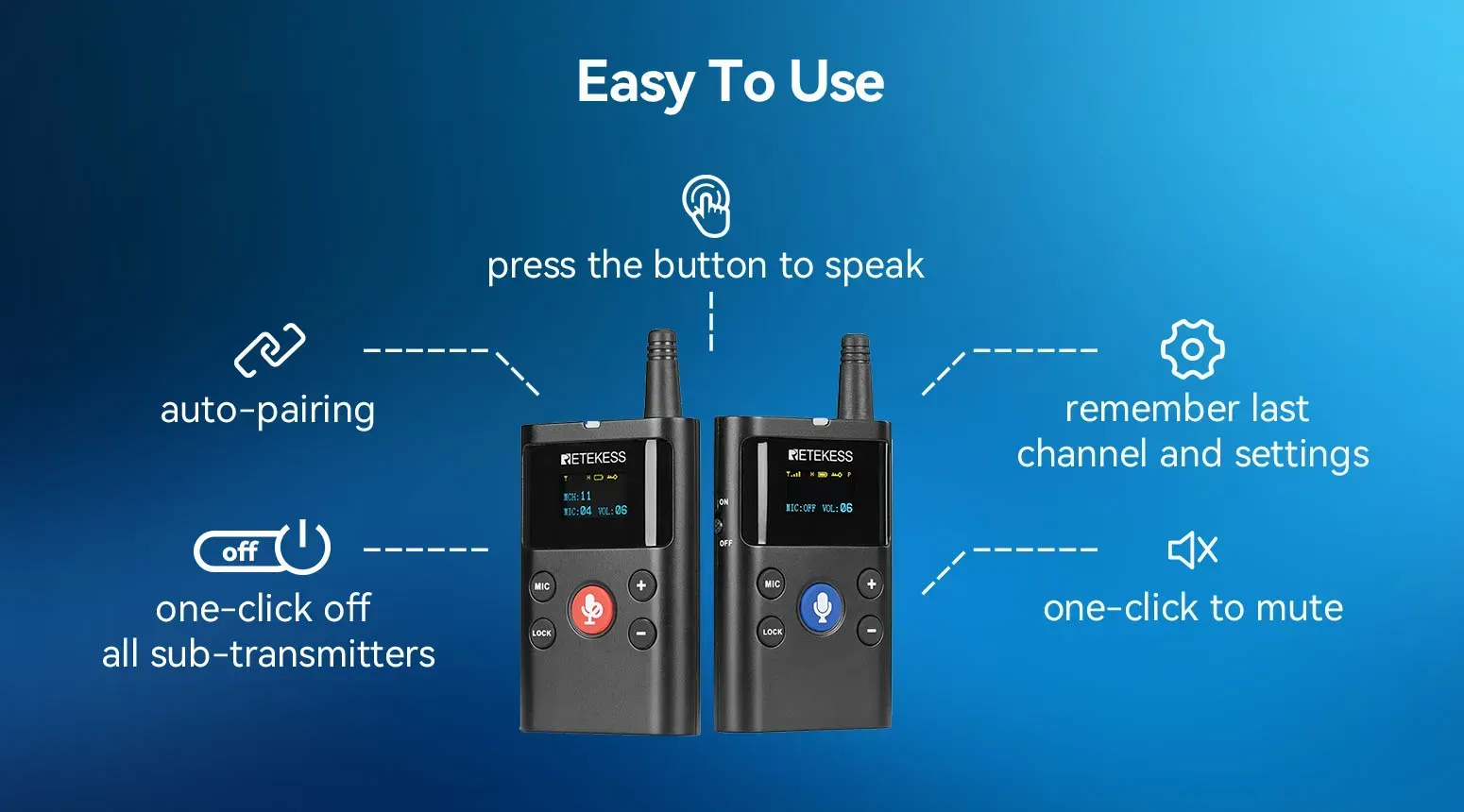
For multi-role, high-density collaboration, Retekess TT129 is a strong choice. It supports three-person full-duplex communication, which is especially useful when more than two people need to stay in the conversation. Its 4-level intelligent noise reduction helps filter out workshop noise, and its FHSS frequency-hopping technology improves interference resistance in busy environments.
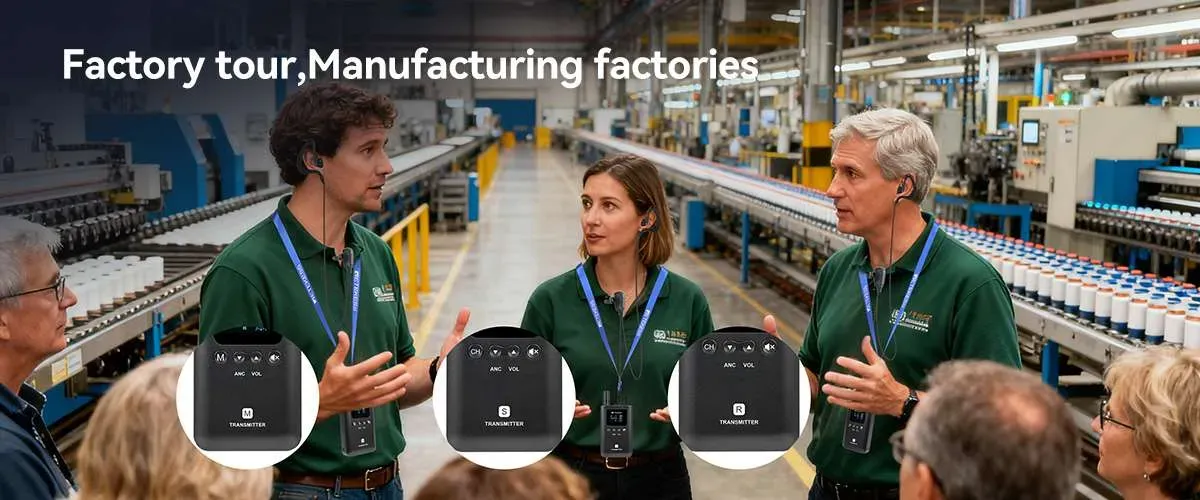 If your team needs 2 way communication devices that can support inspections, training, and troubleshooting, the right choice depends on the workflow. That is why plant tours communications and production line communication should always be planned around real jobsite needs.
What to Look for in Industrial Wireless Audio
If you are choosing wireless audio for production line work, a few features matter most.
Full-duplex communication
This should be the baseline if the work depends on collaboration. If the system requires push-to-talk, it may not be built for true teamwork.
Adjustable noise reduction
Different parts of a plant can have very different noise levels. A system should be able to adapt.
Long battery life
Industrial shifts can be long. Equipment that dies halfway through the day is not practical.
Strong range
Real factory layouts include obstacles, corners, and open spaces. A system should have enough range to handle the environment with some margin.
Easy deployment
If setup takes too long, the system becomes a burden. Automatic pairing and simple controls can make a big difference.
These features help turn communication from a weak point into a reliable part of daily operations.
Final Takeaway: Better Communication Helps Production Run Better
Production line work depends on fast updates, clear instructions, and instant feedback. That is why industrial communication solutions matter so much. They help teams move faster, make fewer mistakes, and stay aligned during inspection, debugging, training, and daily operation.
Retekess TT126 and TT129 show how different workflows can benefit from different wireless audio setups. One supports long-range, high-mobility collaboration. The other supports dense, multi-person coordination in noisy environments.
In the end, better communication does more than save time. It helps reduce mistakes, improve training, support safety, and keep the line moving. And in industrial work, that makes productivity easier to see.







![[18th Anniversary] 18 Years of Echoing Excellence: Making Communication Easier, Connecting Trust Beyond Borders](https://res.retekess.com/z_file/20260716/retekess-brand-story-making-communication-easier_20260716151044_7682.jpg)
![[18 Years in Wireless Communication] Silent Disco Systems Anniversary Celebration: Top-Selling Headphones & Event Mechanics Revealed!](https://res.retekess.com/z_file/20260713/18-years-in-wireless-communication-silent-disco-systems-anniversary-celebration_20260713175011_5749.webp)
![[Anniversary Carnival] Ding-dong! 18th Anniversary Mega Sale on Guest Paging & Calling Systems: Full Reveal of 12+ Products & Promo Rules!](https://res.retekess.com/z_file/20260713/18th-anniversary-mega-sale-on-guest-paging-calling-systems_20260713175257_0295.webp)
![[Retekess 18th Anniversary Teaser] Tour Guide System Exclusive Perks: Sneak Peek at Event Dates & Mechanics!](https://res.retekess.com/z_file/20260713/retekess-18th-anniversary-tour-guide-system-exclusive-perks--2-_20260713180135_6435.webp)

Follow Us
Pay With


 Google
 Amazon
Comments (0)