
Table of Contents
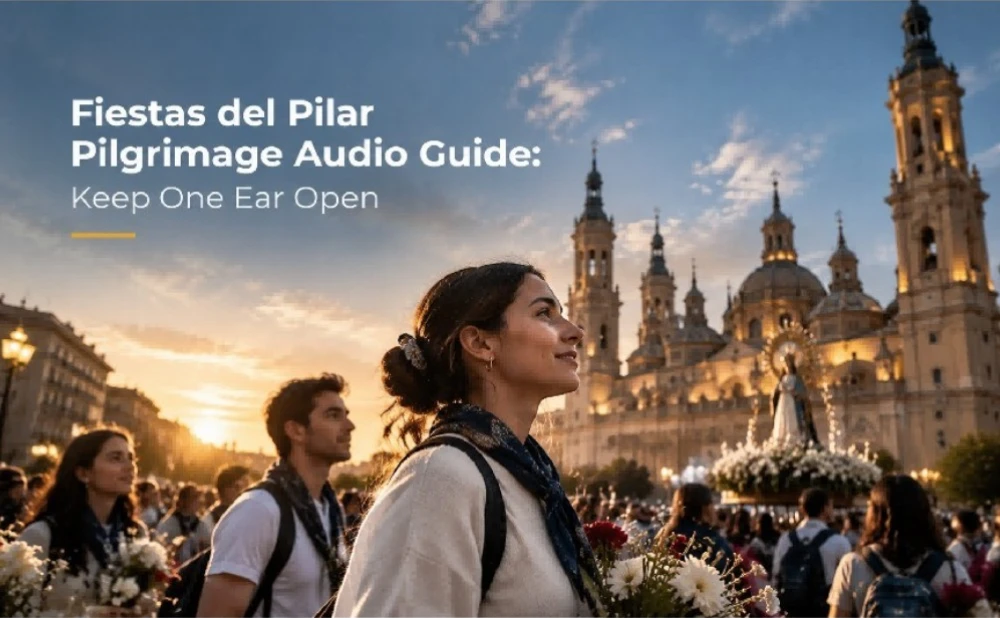
Fiestas del Pilar Pilgrimage Audio Guide: Keep One Ear Open
- Retekess
- Oct 27, 2026
A parish, a brotherhood, or a Spanish-speaking association registers for the Ofrenda de Flores every year. It brings 20 to 200 members, a tax identification number, and a starting slot drawn by lot. Two entry points feed the route, and the offering runs from half past six in the morning until minutes before midnight.
The person carrying the papers does not simply walk. That person leads through drums, crowds, and a church where Mass is in progress.
On October 12 the air around the basilica carries what the basilica itself describes plainly: thousands of bass drums and gaita de boto pipes, sound that reverberates in the chest. Inside the same building, Mass is celebrated all day and visitors are asked to keep their voices down. The group crosses both worlds in one morning.
This is the setting a pilgrimage audio guide has to work in.
Two Sound Worlds, One Morning
Outside, the Ofrenda is the largest public act of the Fiestas. The 2026 edition carried 134,000 flower bearers, and more than 410,000 people passed through the square. Drums and pipes are not background music. They are the order of the procession, and the rules keep dance groups and drum bands on schedule.
Inside, the basilica stays a working church. The Santa Capilla controls entry at peak hours, tower visits leave in groups of twenty every fifteen minutes, and cathedral rules across Spain say the same thing: do not raise your voice, do not cluster, keep the recollection.
A pilgrimage group does not sightsee past this contrast. It lines up, enters, attends Mass, venerates the pillar, and lines up again. The leader briefs the route, explains the symbols, calls the timing, and gives quiet instructions during the liturgy.
Headphones built for noisy construction sites solve the outside. Silence solves the inside. The group needs both, in one ear.
The Drums Are the Rite, Not the Noise
Most audio equipment treats the environment as a problem to remove. A pilgrimage inverts that logic.
In the Ofrenda, every pilgrim's ear carries three layers of sound at once. The rite: drums, gaita pipes, hymns, the celebrant's prayers, the rosary recited in the street. The guide: route instructions, meeting points, the meaning of the flower mantle, the timing of the next slot. Safety: volunteers and police directing the flow, a member who has drifted, a drum band coming through.
Sealed in-ear buds with noise cancellation strip out the rite and the safety layer and leave only the guide. In a factory that is a benefit. In a procession it is wrong: they seal the pilgrim off from the rite and the crowd.
A loudspeaker fails the other way. It cannot be heard over the drums outdoors, and it breaks the rules indoors.
Tour-audio specialists reached this conclusion years ago. The monaural single-ear set, one earpiece and one ear free, is the standard in cities because it never disconnects the wearer from the surroundings. The first radio-guide system, developed in 1999, was built for exactly these conditions: high noise outside, low voices inside churches and museums.
So the answer points one way. Keep one ear open. Put the leader's voice in the other.
One Ear Open, Three Layers Heard
The open-ear hook receiver is that answer.
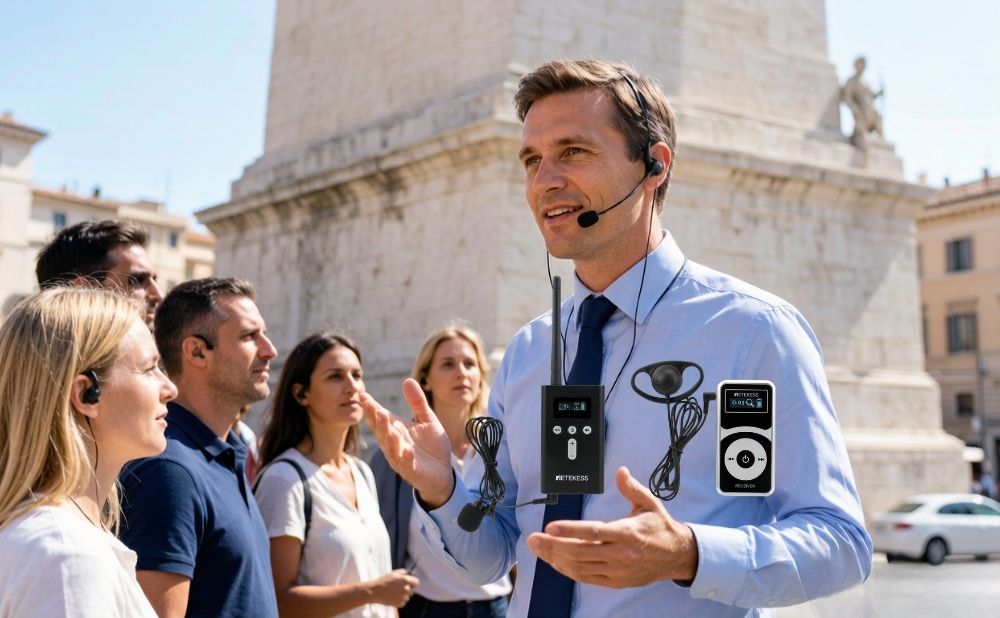
The receiver hangs on the outer ear and never enters the ear canal. At roughly fifteen grams it is light enough to forget, and it fits either ear with no fitting at the gate. Many groups include older parishioners, and that matters as much as the electronics: no insertion discomfort, no pressure, no shared eartip hygiene problem across nine days of thousands of visitors.
Nine volume levels do the work of moving between the two sound worlds. Inside the basilica, the level drops to a whisper. On the square, when the drums pass, the wearer turns it up. The guide never shouts, and nobody mimes a misunderstanding.
The design has one honest limit. When a drum band passes at arm's length, ambient sound presses over any open earpiece. The right response is not to fight it. Digital modulation keeps the leader's voice clear, and when the rite peaks, the rite takes precedence. A pilgrim who briefly hears the drum instead of the commentary is hearing the event they came for.
Holding a Procession Together
The receiver solves what the pilgrim hears. The transmitter solves what the leader can manage.
A registered group of 20 to 200 people stretches over a long street. The starting slot is fixed by draw, the two entry points are separated, and the flow lasts over seventeen hours. The risks are logistical: late arrivals, a split at a junction, a count that does not match the registration, a missed slot.
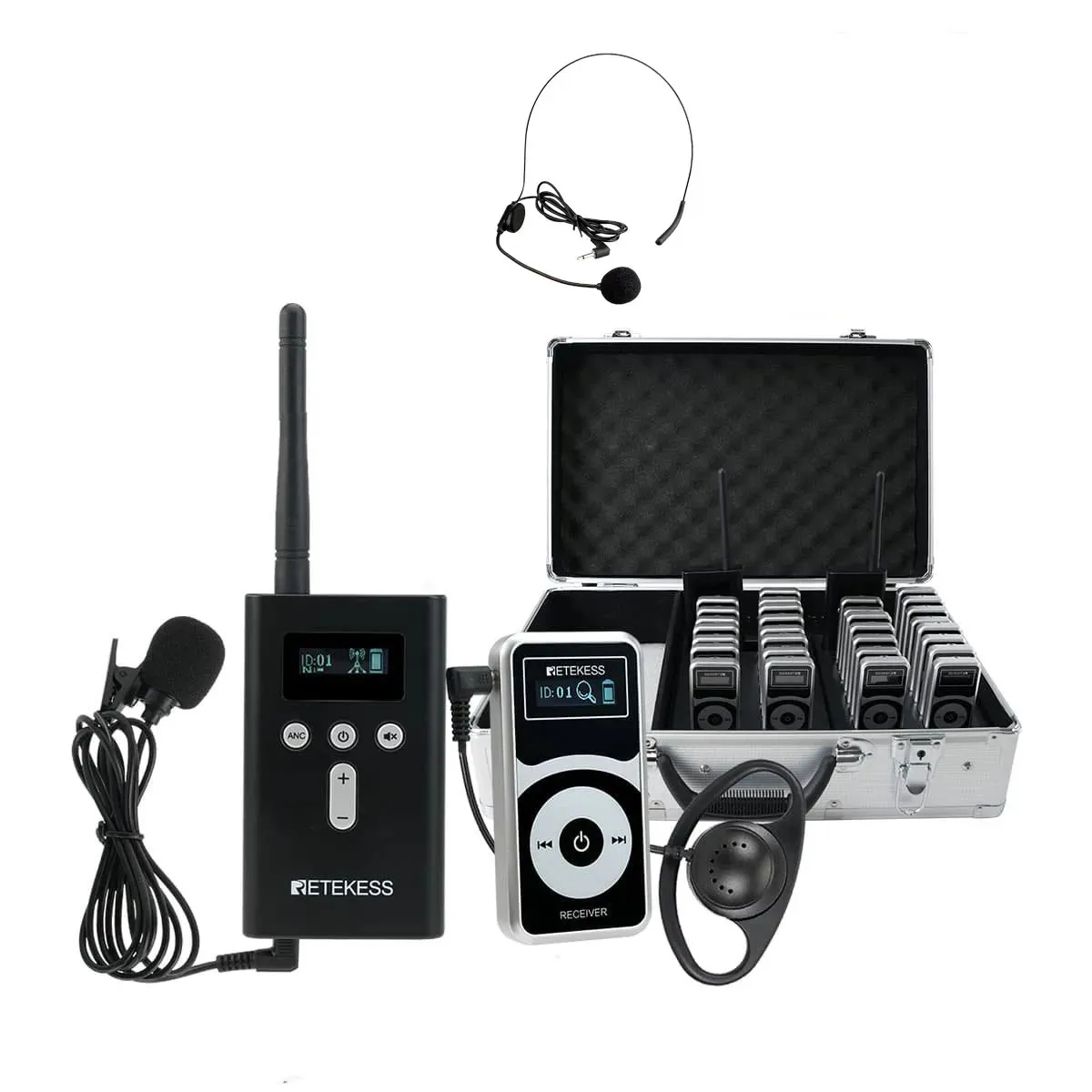
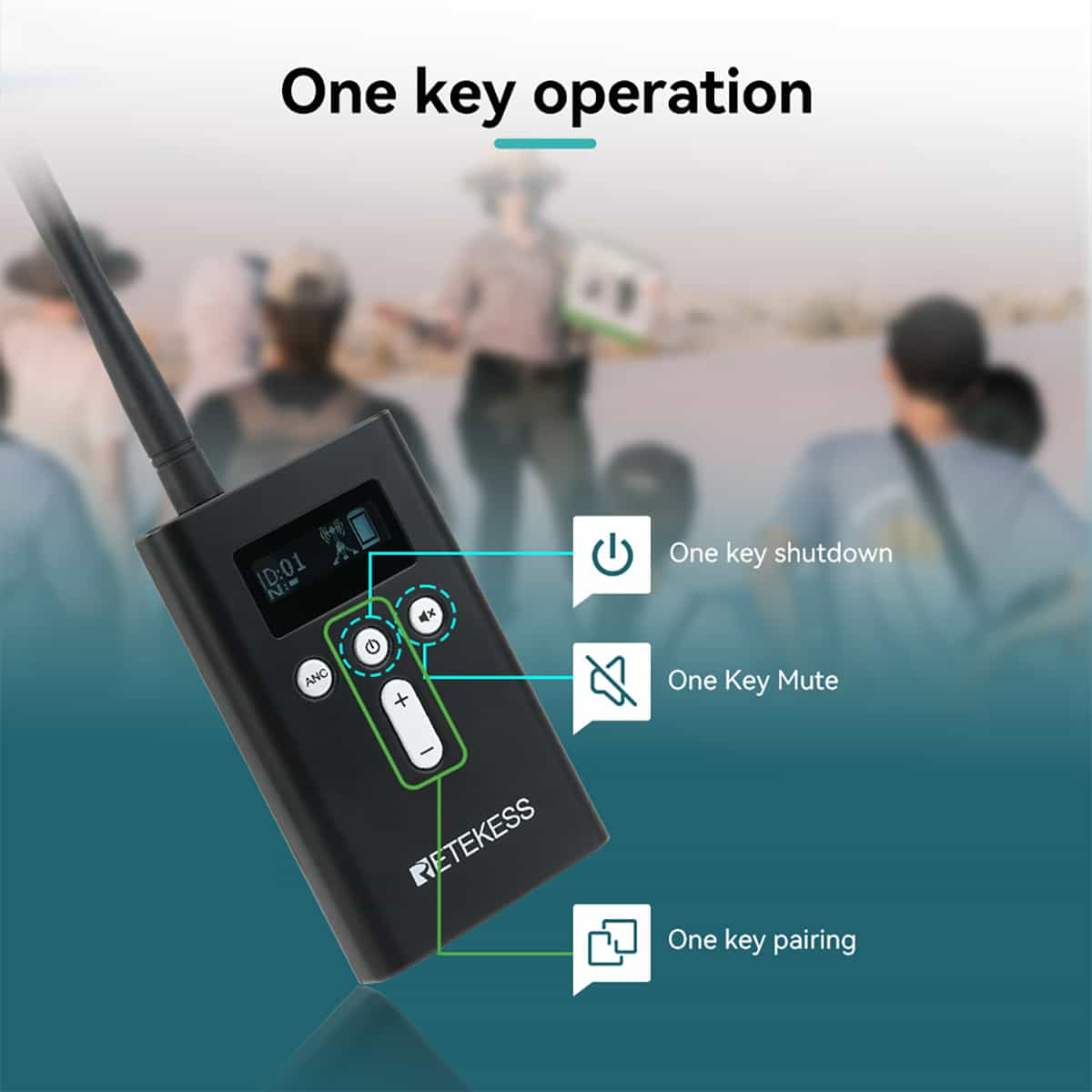
A transmitter with roughly two hundred meters of range covers a procession from head to tail. A mute button cuts the feed for private words or the silent moments of the Mass. One long press powers off every receiver on the channel, so the gate team does not chase dozens of units at the end. Auto-pairing remembers the channel, and receivers can be added in any number.
Channels matter when hundreds of groups share the same streets. The European version offers nineteen license-free channels in the 863–865 MHz band, so an agency can run several language groups, or a parish and a school, without cross-talk.
A 30-slot charging case made for the T131R handles the turnover. Units dock without cables, charge overnight, and travel in one aluminum case. Large groups run two cases in rotation, and an operator working all nine days never hands out a flat receiver.
Inside the Basilica: Speak Without Sound
The same kit changes behavior the moment the group enters the church.
This is not invented practice. Guided tours of the Pilar sold in Zaragoza already state that radio systems are used for groups over ten. Santiago de Compostela hands out radio guides and single-use headsets above the same size. The Pilar tower admits twenty people every fifteen minutes.
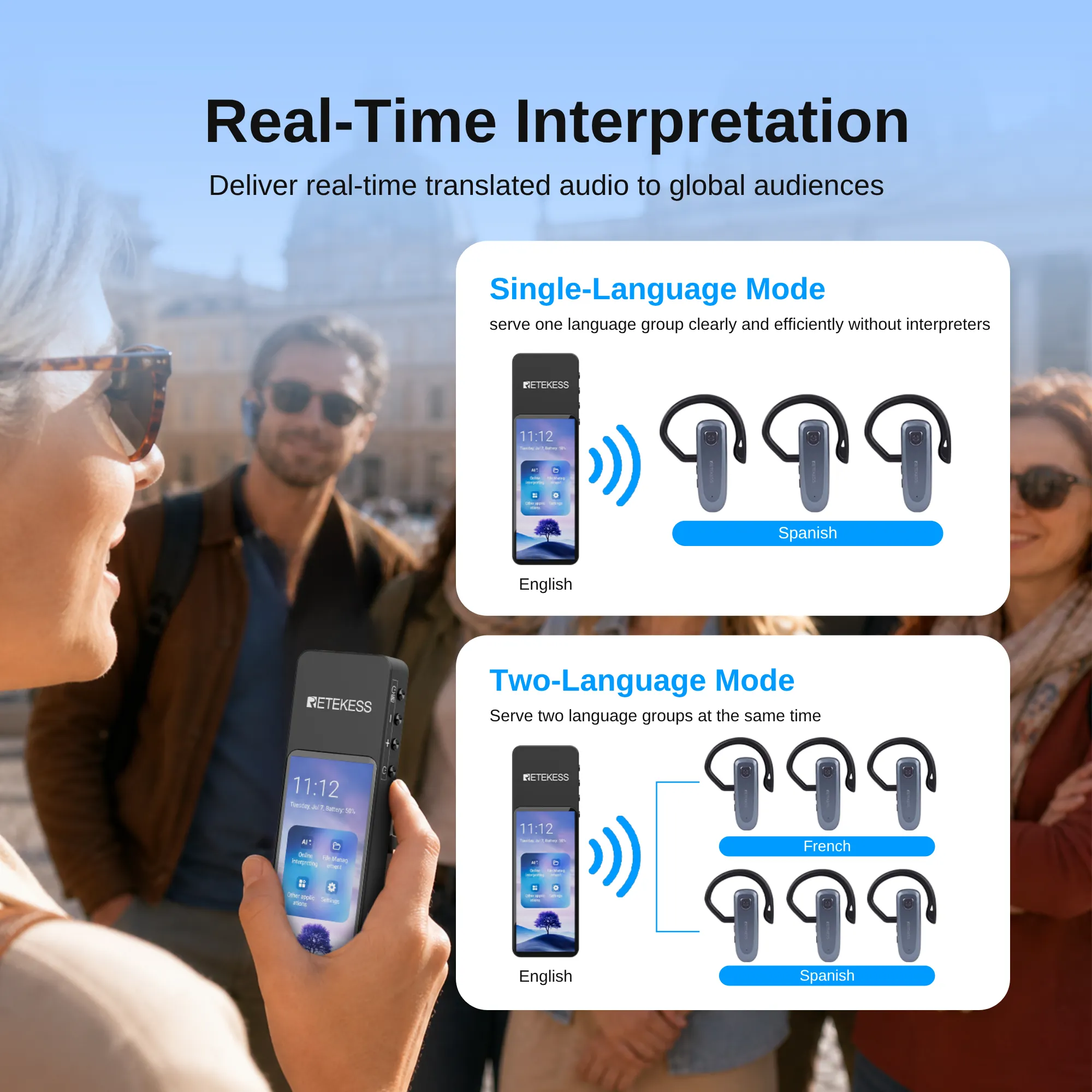
The leader speaks into a lavalier microphone at conversational level, a whisper if needed. The transmitter carries the voice. Pilgrims hear it privately. No one nearby hears anything, and the Mass continues undisturbed.
During the liturgy, the guide mutes the feed. The open ear keeps the prayers and hymns fully audible. When the group moves again, the commentary resumes. Worship and guidance stop competing for the same air.

The Kit: T130U Transmitter, T131R Open-Ear Receivers
The matching matters, because the open-ear receiver and the transmitter must share a band.
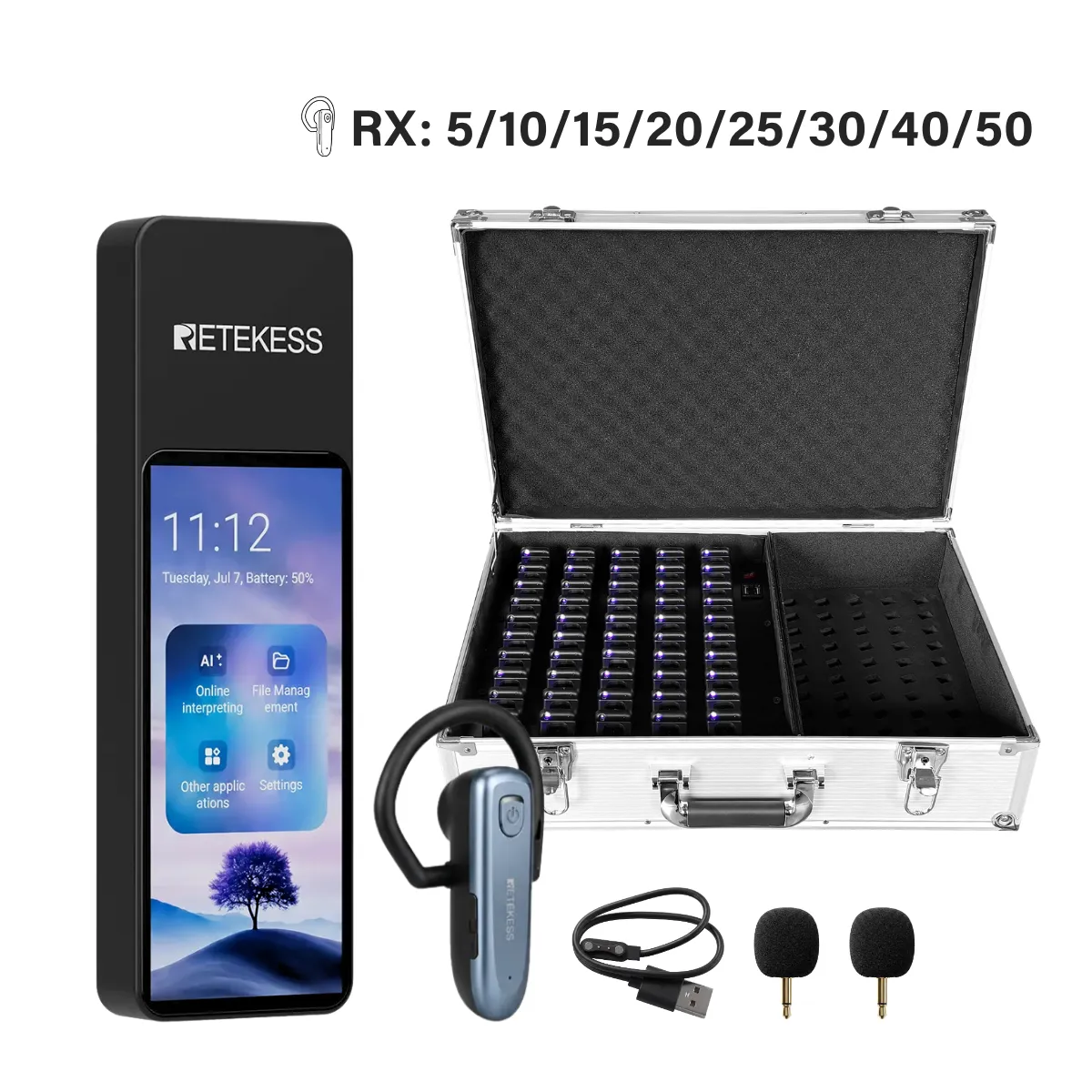
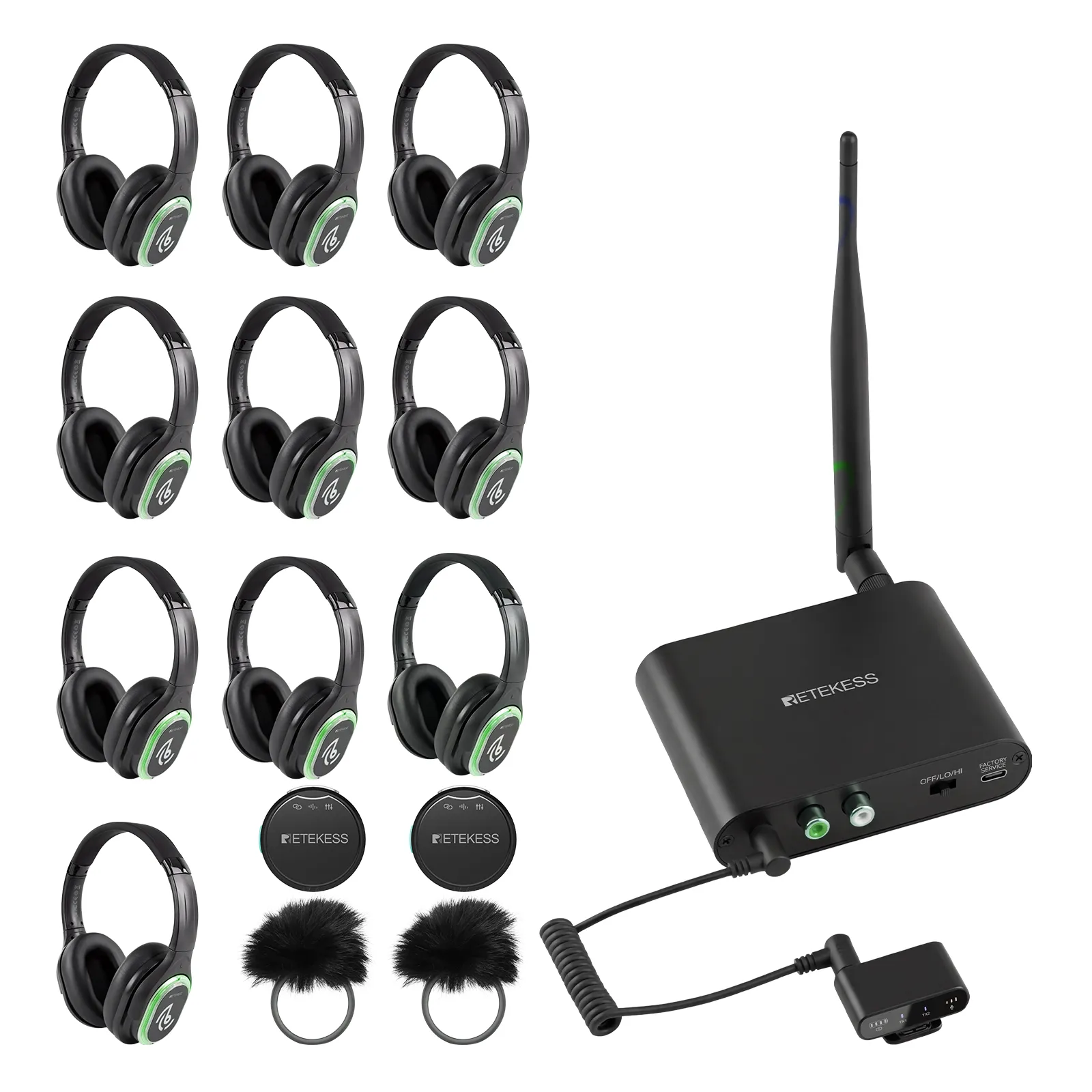
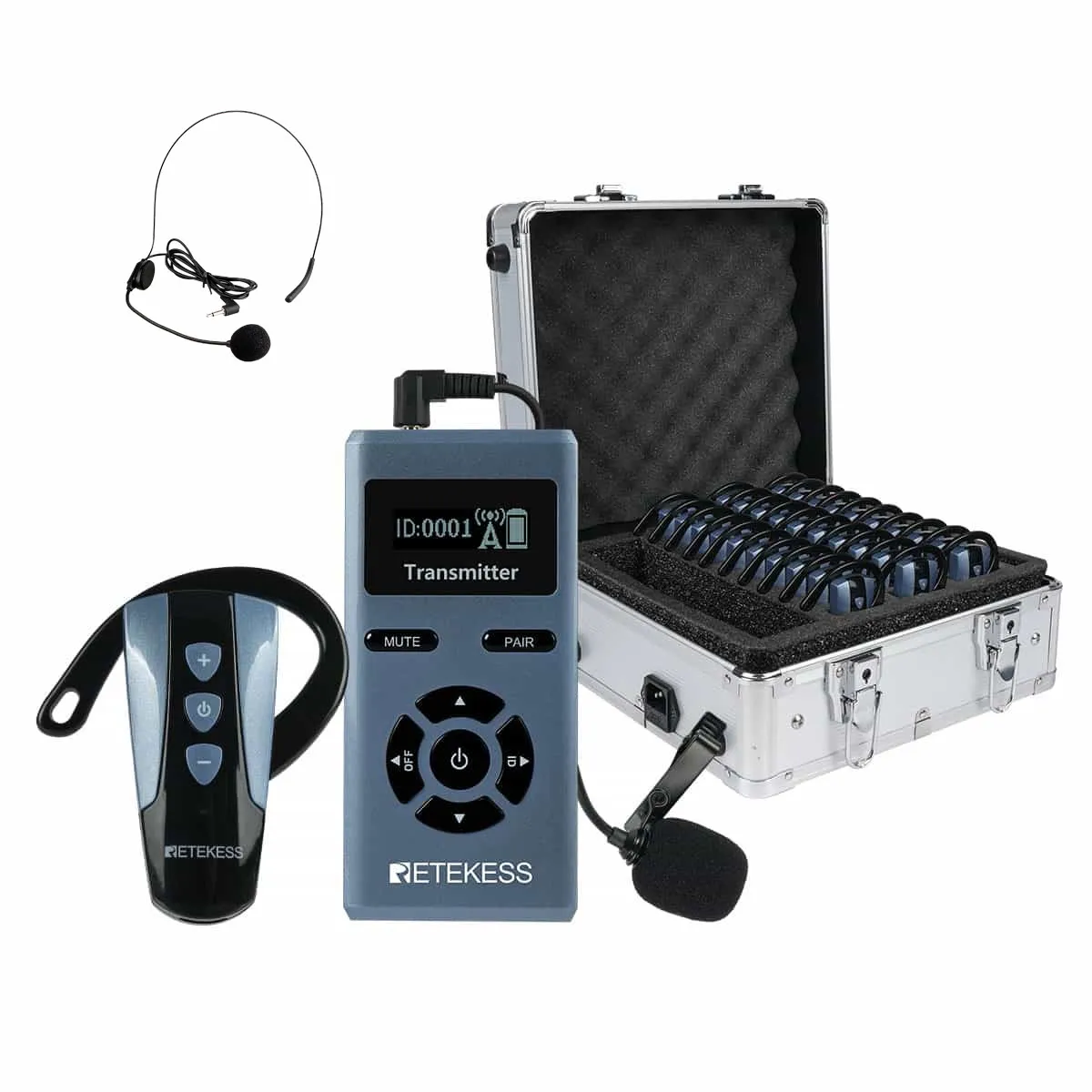
The open-ear T131R receiver is built for the European 823–832 and 863–865 MHz bands and pairs with the T130U transmitter on the same UHF digital system, not with the T130P, which runs on a different band with a different receiver. The pieces in this setup are:
- T130U transmitter: about 200 meters of range, around ten hours of operation, digital GFSK modulation for noise resistance, Bluetooth and AUX inputs, lavalier and headset microphones, mute and one-key shutdown.
- T131R receiver: 15-gram open-ear hook, left or right ear, about thirteen hours of battery, nine volume levels, roughly 150 meters of reception, USB-C or charging-case dock.
- TT037 charging case: 30 slots purpose-built for the T131R, charging and carrying the fleet between groups.
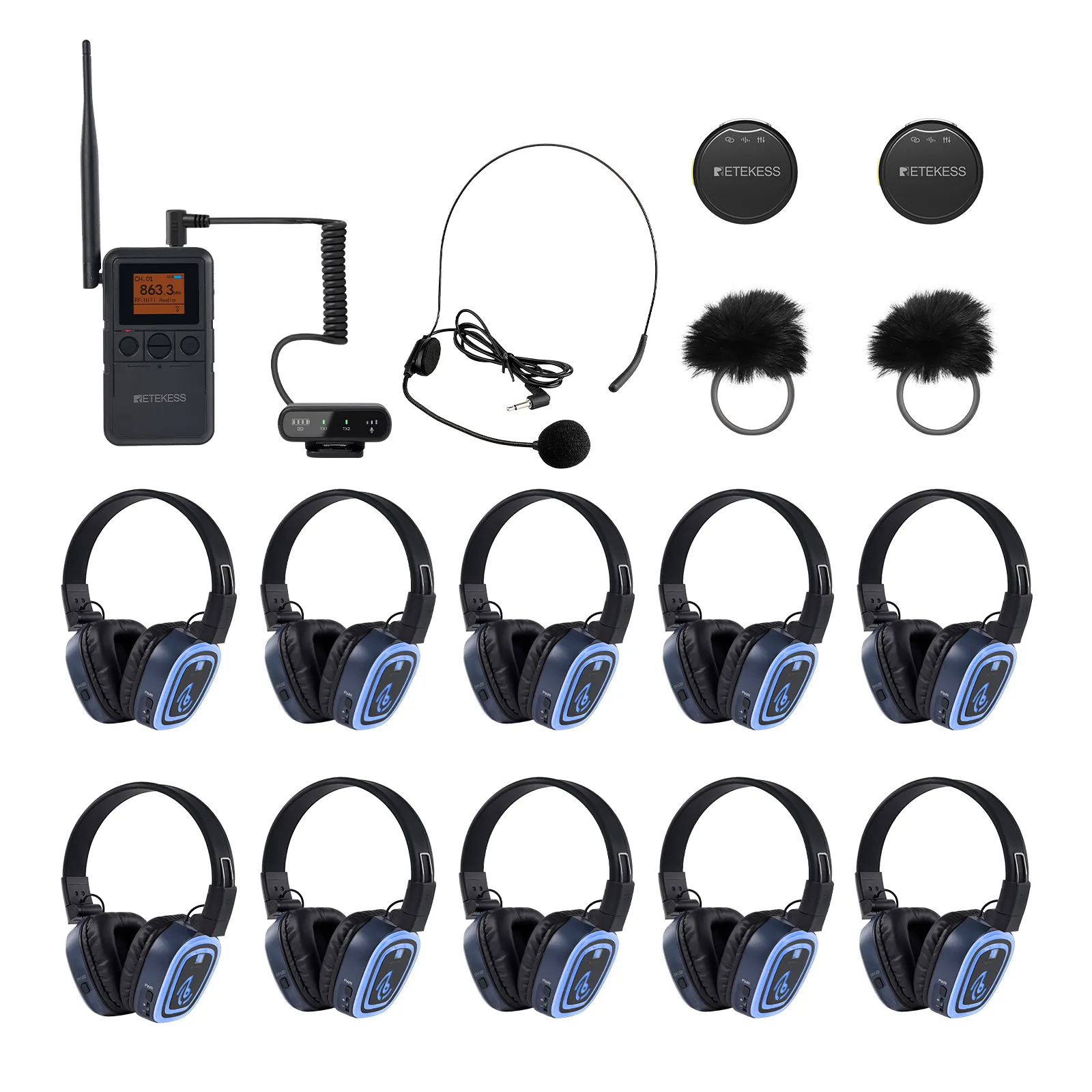
For purely indoor sessions in a quiet parish hall, the T130P system with in-ear receivers is a valid alternative with DSP noise cancellation and forty-nine channels. For the procession and the basilica, it gives up the environmental awareness that defines the day.
After October 12: A Year-Round Pilgrimage Calendar
The kit works nine days of October and earns its keep all year.
October 13 brings the Rosario de Cristal, a night procession of 19th-century glass lanterns with no equivalent in any other Spanish festival. More than two hundred groups took part in 2026. The same evening holds the Ofrenda de Frutos, the fruit offering.
Beyond the festival, the basilica anchors the Vía Basilicarum, a spiritual route linking five major basilicas across Aragon, with the Pilar as the first Marian shrine in Christendom. Parish groups walk it year-round.
Then there is Xacobeo 2027, the Holy Year of Santiago de Compostela. The Pilgrim's Office recorded 499,183 compostelas in 2024, and the 2025 figure passed half a million. Its cathedral already requires radio guides for groups over ten. Operators equipped for the Pilar arrive in Galicia with a compliant fleet and trained staff.
Add weekend parish pilgrimages and weekday assistive listening, and the festival becomes year-round work.
Fiestas del Pilar tests a pilgrimage audio guide harder than any ordinary tour, because the sound the group comes for is the sound that normally defeats a tour system: drums, pipes, hymns, crowds.
The open-ear answer does not remove that sound. It adds the leader's voice to it. One ear follows the rite; the other keeps the group together, inside the basilica as on the square.
For a pilgrimage, that is the right order.











Follow Us
Pay With


 Google
 Amazon

Comments (0)