
Table of Contents
2026 Industry Insight: An Ultimate Guide to Selecting Game Show Buzzers
- Retekess
- Jul 1, 2026
Driven by the growing adoption of interactive teaching, corporate team building and formal knowledge competitions, the global wireless quiz buzzer market continues to expand in 2026.
However, many users still choose products based only on price and quantity, often overlooking performance factors that truly affect real-world experience.
According to recent feedback from education and corporate event practitioners, two issues account for over 60% of negative user experiences. Power supply and unclear response ranking. They frequently lead to disputes and interruptions during events.
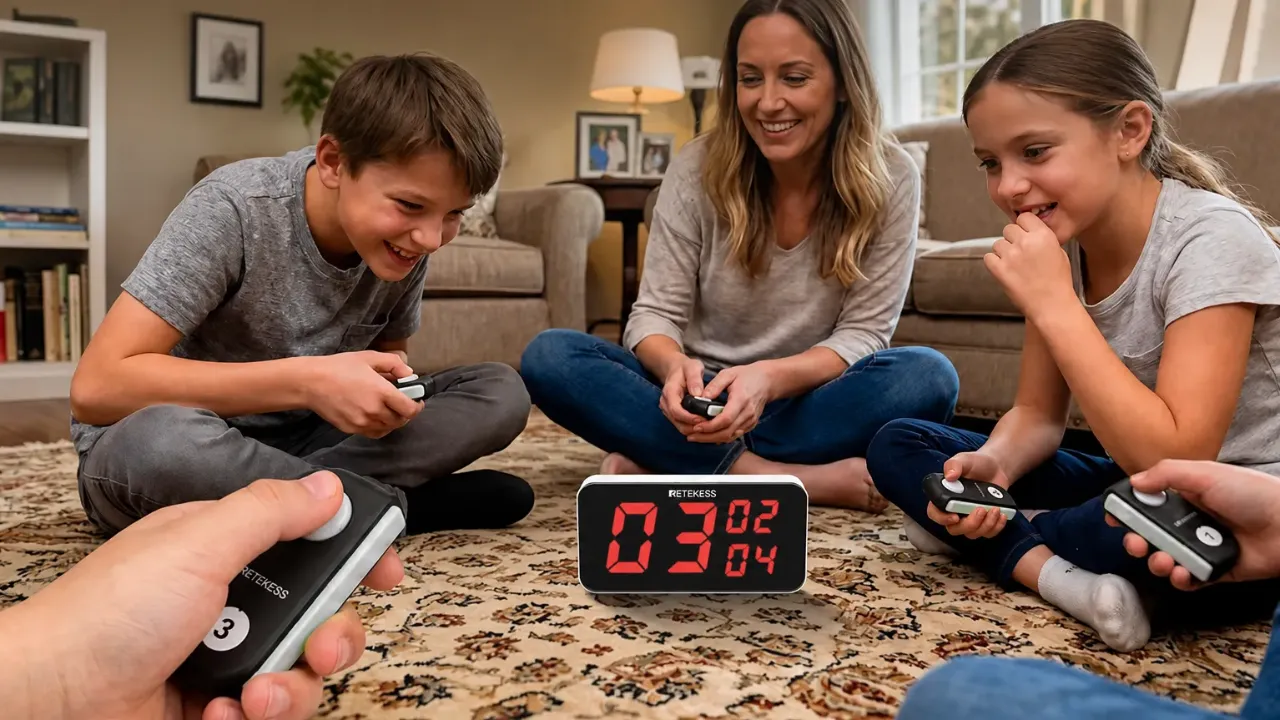
Whether you’re shopping for family game nights, equipping a classroom, or organizing small-scale quiz training events, this guide breaks down the key evaluation criteria of professional quiz buzzer systems and uses the Retekess TM103 as a reference to help you make a more informed choice.
5 Common Pain Points When Buying a Game Buzzer System
Batteries drain faster than you expect. Most entry-level buzzers run on AAA or AA cells. That sounds convenient until you realize you forget to stock up, the game stops before it starts.
The display only tells half the story. If there is no queue or ranking display, you are stuck restarting the round or making arbitrary judgment calls. That undermines the fairness that a buzzer is supposed to guarantee.
Wireless signals cross, lag, or drop entirely. Cheap models may suffer from cross-talk, noticeable delay, or signal drops when multiple buttons are active, breaking the flow of fast-paced competitions.
Setup is often unnecessarily complex. Some systems require channel pairing, DIP switches, or software configuration before use. In time-sensitive classroom settings, this creates frustration instead of engagement.
Storage and transport are poorly designed. Loose buttons, tangled cables, and lack of protective cases make the system vulnerable to damage and easy to misplace.
Benchmark Analysis: What Makes the TM103 Game Buzzer System Stand Out
As a representative model targeting commercial and educational scenarios, the TM103 addresses the two most prominent industry pain points through targeted technical optimization, and forms a clear experience gap with entry-level products in terms of stability and durability.
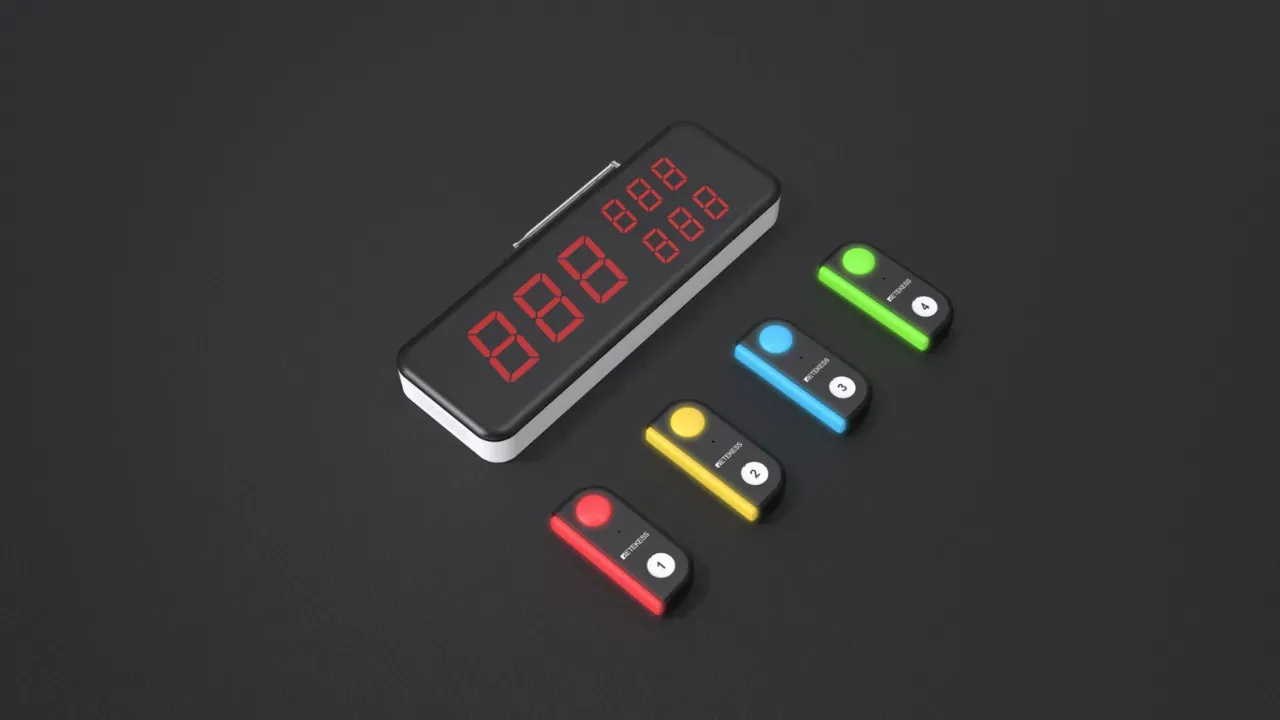
The Retekess TM103 is not an incremental update. It is a fundamental redesign of what a wireless quiz buzzer system should be in 2026. Where earlier models in the TM series were built around desktop disc buttons and disposable host batteries, the TM103 moves the entire platform to handheld ergonomics and full rechargeable power.
1. Full-device Rechargeable Lithium Battery System: Eliminating Consumable Costs
The most prominent differentiation of the TM103 is its built-in lithium battery design for both the host console and handheld buzzers, a direct response to the industry-wide pain point of frequent AAA battery replacement.
The main console is equipped with a 1000mAh lithium battery, delivering around 4 hours of continuous use on a full charge. Each handheld buzzer has a built-in 500mAh lithium battery, supporting 20 hours of standby time and fully charging within 2.5 hours. For users, this means no need to stockpile disposable batteries, no mid-event power failures caused by dead cells, and significantly lower long-term operating costs.
2. Ergonomic Handheld Design: Dual Adaptability for Handheld & Desktop Use
Unlike traditional flat push-button buzzers, the TM103 adopts a remote-control style handheld form factor. It fits comfortably in one hand for stable pressing during intense competitions, and can also be placed flat on the desktop for casual use.
This design greatly improves portability and grip comfort, making it suitable for both seated classroom activities and standing interactive games. The compact size also simplifies storage and transport, ideal for users who need to move the set between different venues.
3. Large LED Display & Multi-mode System: Flexible Rules for All Scenarios
Equipped with a large digital tube display, the TM103 supports ranking display for 1 to 9 positions, and clearly shows the top 3 buzz sequence. After the first-place contestant answers, the second-place ranking remains visible for follow-up responses, with a dedicated music prompt for the first-place winner.
The system comes with three core quiz modes to match different event rules:
● Standard mode: Fastest press wins, supports 1–5 successful buzzers at once
● Countdown rule mode: Early presses before the countdown ends are counted as fouls and locked with a red light
● Random draw mode: The host randomly selects a buzzer for answering
It also includes a lock function that freezes the fastest buzzer, giving other participants time to prepare and keeping the event on track.
4. Stable 2.4G GFSK Wireless Transmission: Wide Coverage & Anti-interference
Powered by 2.4GHz GFSK wireless frequency modulation with 15 independent communication channels, the TM103 achieves a transmission distance of 80–100 meters in open areas, and maintains stable connection through walls in indoor environments.
A single host supports up to 32 handheld buzzers online simultaneously. Multiple sets can operate in adjacent classrooms on different channels without signal interference, adapting to spaces from home living rooms to medium-sized conference halls.
Scenario-based Selection Logic: Matching Configurations to Actual Needs
Professional buzzer systems do not follow the principle of "the more, the better". Choosing a configuration and function mode that matches your usage scenario can not only control procurement costs, but also maximize the value of the device.
1. Education & Classroom Scenarios
For K-12 classroom interaction and training institution group competitions, the countdown rule mode effectively prevents early buzzing fouls, and the large-screen ranking mechanism eliminates manual judgment, ensuring fair competition while reducing teachers’ organizational burden.
Recommended set: 1-host 8-buzzer standard set | View this set on the product page
2. Home & Casual Gathering Scenarios
For family game nights, parent-child interaction and small gatherings with friends, the handheld design is portable and easy to store, the random draw mode adds interactive fun, and the lithium battery configuration supports charging anytime, no need to prepare batteries in advance.
Recommended set: 1-host 4-buzzer basic set | View this set on the product page
3. Small Quiz Training & Competition Scenarios
For knowledge competition training and small formal quiz events, the standard mode supports sequential answering, the ranking sequence is clear and traceable, and the lock function ensures a steady competition pace. The 80–100 meter transmission range adapts to small event halls.
Recommended solution: 8-buzzer standard set + additional buzzers on demand | View bulk purchase options
Conclusion
Looking at the development trend of the industry, lithium battery power supply, ergonomic form factor and intelligent rule setting have become the mainstream direction of quiz buzzer product upgrading. As the iterative benchmark model of Retekess, TM103 accurately matches the core demands of education, home and small competition scenarios, providing a reliable choice for users who value usage cost and scenario adaptability.
For complete technical parameters, enterprise bulk procurement solutions and the latest product information, you can visit the Retekess TM103 wireless quiz buzzer product detail page for further inquiry.
FAQs: Everything You Want to Konw About Wireless Quiz Buzzer System
1. What is the official warranty policy of the TM103?
The TM103 series provides a 36-month manufacturer's warranty and a 30-Day Money-Back guarantee. For non-human damage within the warranty period, free repair or replacement services are available, and long-term after-sales support for spare parts is provided to ensure stable long-term use.
2. Can the number of buzzers be expanded after purchase?
Yes. A single host supports pairing with up to 32 handheld buzzers. Users can purchase additional individual buzzers at any time according to demand, and the pairing process can be completed in a few simple steps.
3. What is the wireless range?
Approximately 80 to 100 meters in open field. Indoor range depends on walls and interference but is generally sufficient for classrooms and event halls.
4. Can I use the TM103 outdoors?
Yes, though direct sunlight on the LED display may reduce visibility. The buttons and host have no weather sealing, so avoid rain.
5. What is the difference between the TM103 and the TM101?
The TM103 uses handheld rechargeable buttons and a rechargeable host, includes a carrying case, and supports nine-place ranking. The TM101 uses desktop disc buttons, AAA batteries throughout, and only displays the first-place winner.

![[18th Anniversary] 18 Years of Echoing Excellence: Making Communication Easier, Connecting Trust Beyond Borders](https://res.retekess.com/z_file/20260716/retekess-brand-story-making-communication-easier_20260716151044_7682.jpg)
![[18 Years in Wireless Communication] Silent Disco Systems Anniversary Celebration: Top-Selling Headphones & Event Mechanics Revealed!](https://res.retekess.com/z_file/20260713/18-years-in-wireless-communication-silent-disco-systems-anniversary-celebration_20260713175011_5749.webp)
![[Anniversary Carnival] Ding-dong! 18th Anniversary Mega Sale on Guest Paging & Calling Systems: Full Reveal of 12+ Products & Promo Rules!](https://res.retekess.com/z_file/20260713/18th-anniversary-mega-sale-on-guest-paging-calling-systems_20260713175257_0295.webp)
![[Retekess 18th Anniversary Teaser] Tour Guide System Exclusive Perks: Sneak Peek at Event Dates & Mechanics!](https://res.retekess.com/z_file/20260713/retekess-18th-anniversary-tour-guide-system-exclusive-perks--2-_20260713180135_6435.webp)

Follow Us
Pay With


 Google
 Amazon
Comments (0)