
|
Specification |
Detail |
Why It Matters |
|
Range |
800m open area / 100–300m indoors |
Covers sprawling festival grounds, multi-zone bars, and large outdoor patios |
|
Pager Capacity |
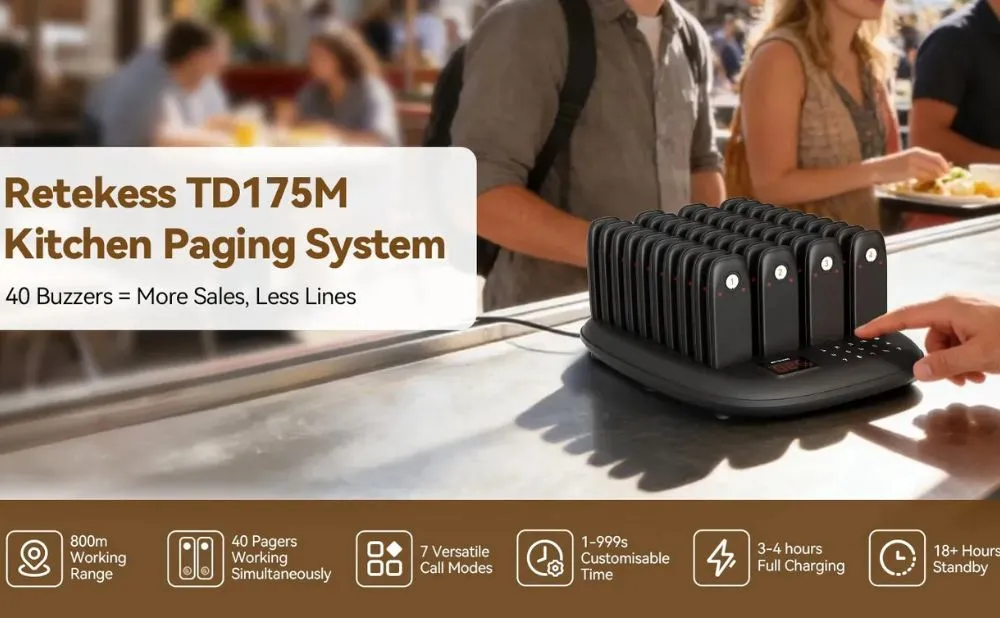
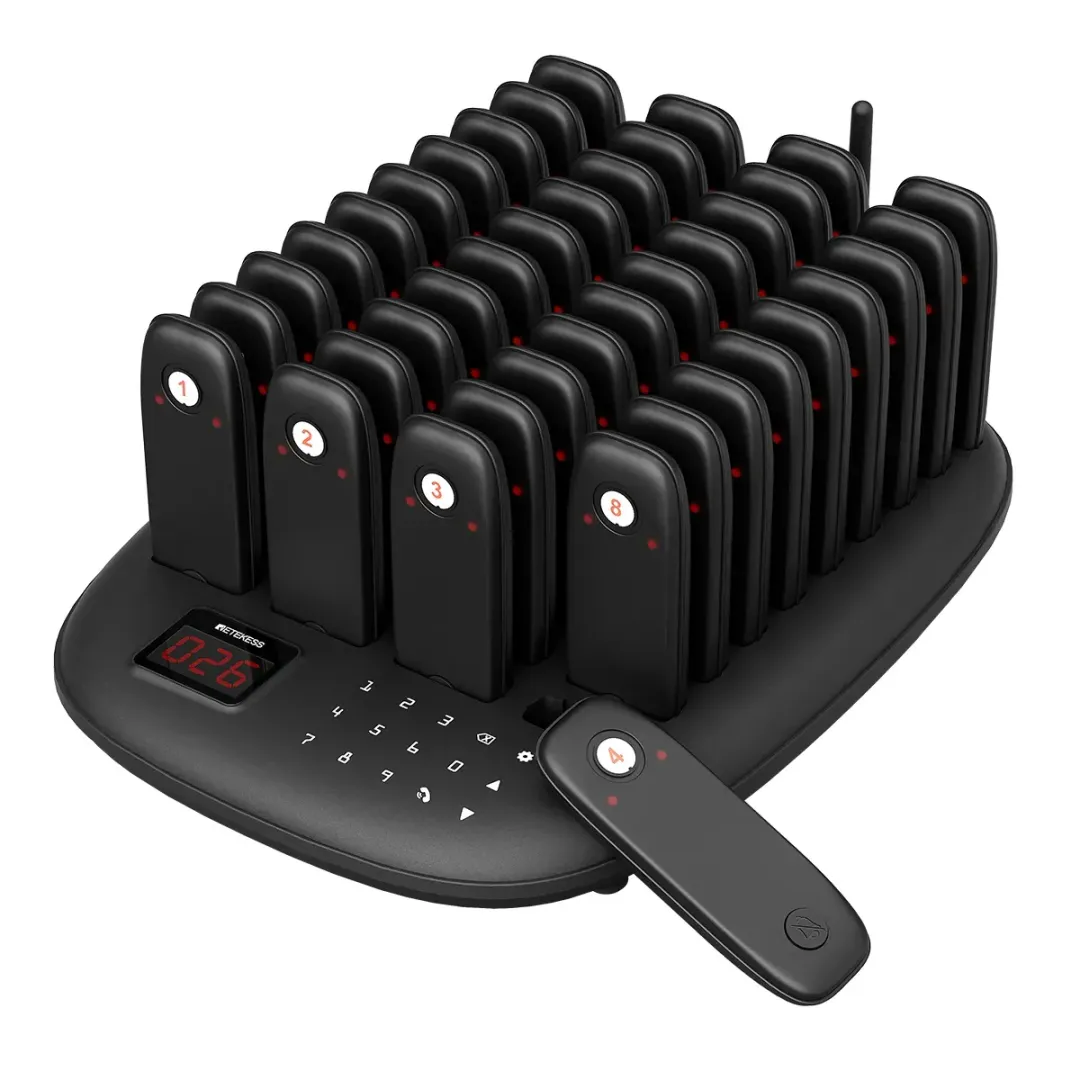
Up to 40 pagers |
Scale from intimate food trucks to high-volume night market stalls |
|
Alert Modes |
7 combinations (vibration, beep, flash) |
Cut through noise with multi-sensory alerts; silent mode for quiet zones |
|
Charging |
3–4 hours full charge |
Fast turnaround between shifts |
|
Standby |
Up to 18 hours |
Lasts entire festival days without mid-event recharging |
|
Alert Duration |
1–999 seconds customizable |
Match alert length to your environment's pace |
|
Design |
Compact, textured ABS, 30g pagers |
Easy for customers to carry; durable enough for daily abuse |
Table of Contents
Never Miss a Pickup: How Auto Redial and Call History Prevent Forgotten Orders at Busy Food Festivals
- Retekess
- Sep 5, 2026
Summer nights were made for outdoor dining—but your kitchen staff pays the price when customers miss their pickup alerts.
A customer places an order, gets handed a pager, and disappears into the crowd. Five minutes later, their food is ready. The kitchen presses the call button. The pager buzzes and flashes. But out in the noise, the customer is mid-conversation, dancing to a song, or queued at another stall.
They don't notice. The food sits. It gets cold. The pickup counter piles up. And your staff is left wondering: Did they get the alert? Should we call again?
This isn't just inconvenient. It's expensive
The Hidden Cost of Missed Pickups at Outdoor Events
At food festivals, night markets, and open-air bars, missed pickups aren't occasional hiccups—they're endemic. Studies of foodservice operations show that during peak outdoor events, pickup delays can spike by 40–60% compared to indoor dining. The culprits?
- Ambient noise drowning out single alert tones
- Distraction density—customers wander, socialize, and multitask
- No fixed seating—unlike restaurants, there's no table to associate with an order
- Staff bandwidth—employees juggling cooking, serving, and manually re-calling customers
Every missed pickup triggers a cascade of problems: food waste (unsold, cold orders), slower table turnover (or equivalent throughput), frustrated customers who leave negative reviews, and kitchen staff burning energy on manual follow-ups instead of cooking.
The question isn't whether missed pickups happen. It's whether your paging system is built to solve them.
Meet the TD175M: A Paging System Built for Chaos
The Retekess TD175M Guest Paging System isn't just a pager set—it's an operational safeguard designed for exactly the environments where traditional paging fails.
While most pager systems deliver a single alert and leave the rest to chance, the TD175M introduces two features that fundamentally change how outdoor foodservice operates: Auto Redial and Call History.
Let's break down why these aren't just nice-to-have features—they're revenue protectors.
Feature Deep Dive: Auto Redial — Your 24/7 Backup Caller
The Problem with "One and Done"
Standard paging systems operate on a simple model: press call, pager buzzes, job done. But that model assumes ideal conditions—quiet spaces, attentive customers, immediate response. Step outside into a summer festival, and that assumption collapses.
A single buzz in a noisy crowd is a gamble. Maybe the customer feels it. Maybe they don't. Maybe they see the flashing light—maybe they're facing the other direction, deep in conversation, or wearing a jacket that covers the pager.
When that single alert fails, your staff has three bad options:
1. Manually redial—pulling them away from cooking or serving
2. Wait and hope—letting food get cold and the counter clog
3. Make a public announcement—disrupting the atmosphere and annoying other customers
How Auto Redial Changes the Game
The TD175M's Auto Redial feature eliminates this dilemma entirely. Here's how it works:
With auto redial, the restaurant pager automatically retries if the initial call goes unanswered, ensuring reliable communication and better service without manual re-dialing.
Staff can customize the redial interval—from 1 to 5 minutes. If a customer doesn't respond to the first alert, the system automatically sends a second. No manual intervention. No staff distraction. Just persistent, polite reminders until the pickup happens.
Think of it like a conscientious waiter who checks on a table—except this one never forgets, never gets distracted, and never needs a break.
Why It Matters at Night Markets and Festivals
- Reliability in noise: Even if the first buzz is drowned out by music or crowd noise, the second gets through
- Vibration + light + sound combos: Paired with the TD175M's 7 alert modes (vibration, beeping, flashing lights, and combinations), auto redial ensures multi-sensory persistence
- Staff liberation: Cooks cook. Servers serve. Nobody has to play phone tag with a pager
- Throughput protection: Orders get picked up faster, the counter clears quicker, and more customers get served per hour
Feature Deep Dive: Call History — The Accountability Layer
Auto Redial solves the "right now" problem. Call History solves the "what happened?" problem.
10 Stored Call Records
The TD175M retains up to 10 call records at a time. This isn't just a log—it's an operational audit trail that helps staff:
- Verify alerts were sent: "Did we actually call pager #23?" Check the history. Yes, at 8:47 PM. Twice.
- Identify chronic no-shows: If the same pager number appears in call history repeatedly without pickup, staff can spot patterns and adjust workflow (e.g., asking those customers to stay closer)
- Resolve disputes: "I never got called!" The history says otherwise—helping protect your team from unfair complaints
- Optimize timing: Reviewing call history across a busy night reveals peak pickup windows and average response times
The Technical Backbone: Why the TD175M Performs Where Others Fail
Auto Redial and Call History are the headline features, but they're only as good as the hardware supporting them. Here's what makes the TD175M a workhorse in demanding environments:
Real-World Scenarios: Where Auto Redial Earns Its Keep
Scenario 1: The Summer Night Market
A Thai food stall at a weekend night market. 200 orders between 6 PM and 11 PM. Customers wander between stalls, sit on nearby benches, or stand in lines for drinks. Pager #17 belongs to a group of friends who split up—one waits for food, others browse handmade jewelry.
The order's ready. First call goes out. Pager #17 vibrates in the friend's back pocket, but she's trying on earrings and doesn't notice. Without auto redial, that's a cold pad thai and a frustrated customer.
With the TD175M, the system waits 3 minutes, then calls again. The friend feels the second vibration, checks the pager, and hustles to the stall. Food's still hot. Counter stays clear. Next order moves up.
Scenario 2: The Rooftop Beer Garden
A rooftop bar with 80 seats and a street-level kitchen. Orders go down, food comes up. But customers move between tables, the bar, and the balcony rail. A pager on a table gets buried under a jacket.
The kitchen sends the first alert. Nothing. Two minutes later, auto redial kicks in. The pager, now flashing and vibrating aggressively from under the jacket, finally gets noticed. The customer grabs their burger before the cheese congeals.
Meanwhile, the bartender never left the tap. The cook never left the grill. Nobody had to search for a customer or make an awkward PA announcement.
The Bottom Line: Better Service, Less Waste, Happier Staff
Missed pickups aren't just an operational annoyance. They're a leak in your revenue bucket. Cold food gets thrown away. Customers leave unhappy. Staff get stressed. And in competitive outdoor dining markets, reputation travels fast.
The TD175M's Auto Redial and Call History features directly address the root causes:
- Auto Redial → Eliminates human error and noise-related missed alerts through persistent, automated follow-up
- Call History → Creates accountability, enables pattern analysis, and protects against disputes
- 800m range + 40 pagers + 7 alert modes → Scales to any event size and cuts through any environment
It's not about replacing your staff's judgment. It's about removing the repetitive, failure-prone task of manual re-calling so they can focus on what humans do best: cooking great food and creating great experiences.
Upgrade Your Outdoor Dining Operation
The Retekess TD175M Guest Paging System is avail
able now with support for up to 40 pagers, auto redial, call history, and the range to cover even the largest festival grounds.
Don't let a missed buzz become a missed sale.
Invest in a paging system that works as hard as your staff—and never forgets to follow up.
Leave a Reply



![[18th Anniversary] 18 Years of Echoing Excellence: Making Communication Easier, Connecting Trust Beyond Borders](https://res.retekess.com/z_file/20260716/retekess-brand-story-making-communication-easier_20260716151044_7682.jpg)
![[18 Years in Wireless Communication] Silent Disco Systems Anniversary Celebration: Top-Selling Headphones & Event Mechanics Revealed!](https://res.retekess.com/z_file/20260713/18-years-in-wireless-communication-silent-disco-systems-anniversary-celebration_20260713175011_5749.webp)
![[Anniversary Carnival] Ding-dong! 18th Anniversary Mega Sale on Guest Paging & Calling Systems: Full Reveal of 12+ Products & Promo Rules!](https://res.retekess.com/z_file/20260713/18th-anniversary-mega-sale-on-guest-paging-calling-systems_20260713175257_0295.webp)
![[Retekess 18th Anniversary Teaser] Tour Guide System Exclusive Perks: Sneak Peek at Event Dates & Mechanics!](https://res.retekess.com/z_file/20260713/retekess-18th-anniversary-tour-guide-system-exclusive-perks--2-_20260713180135_6435.webp)
Follow Us
Pay With


 Google
 Amazon
Comments (0)