
You’re browsing a hearing aid product page when you come across a list of technical terms: Bluetooth, IP68, WDRC. Bluetooth and IP68 may look familiar, but WDRC? It sounds more like a model code than a feature you should care about.
It is not. WDRC is one of the most important settings in any modern hearing aid. It is also the reason a hearing aid can make a quiet voice across a table sound clear, without making a closing door feel like a gunshot. This is the core question behind wide dynamic range compression hearing aid product pages, and it is why people searching for a compression hearing aid keep seeing the same three letters.
Here is what WDRC means, how it works, and what to look for when you compare devices.
Think about the range of sounds in a normal day.
|
Sound Source |
Approximate Sound Level |
|
Whisper at Arm's Length |
30 dB |
|
Normal Conversation |
60 dB |
|
Vacuum Cleaner |
75 dB |
|
Rock Concert |
110 dB |
|
Jet Taking Off |
120 dB |
A person with healthy hearing can follow all of this. The ear adjusts automatically. Whispers become audible. Loud sounds stay tolerable. The brain fills in the gaps.
A person with sensorineural hearing loss lives in a narrower world. Their ear still hears loud sounds at roughly the same level everyone else does. But the soft sounds below a certain threshold disappear. A whisper is gone. A quiet voice across a restaurant is gone.
The result is a gap. The soft end of the volume range is missing. The loud end still arrives at full volume.
If a hearing aid simply turned everything up, the soft voices would become audible, but the loud sounds would become painful. That is why early hearing aids were known for making everything louder, not clearer. People stopped wearing them.
WDRC is the answer to that problem.
WDRC stands for Wide Dynamic Range Compression.
Here is the one-sentence version: WDRC turns up quiet sounds and turns down loud sounds, so everything lands in the narrow band of volume that your ear can actually use. This is how WDRC works at its most basic level.
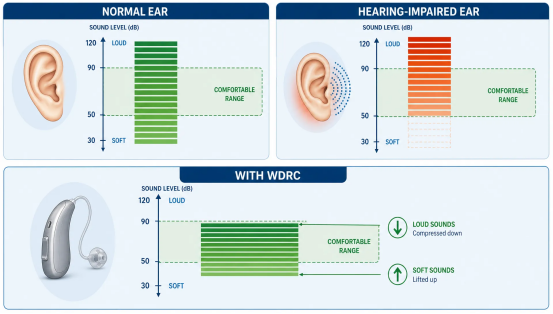
The metaphor is a car's automatic transmission. In a car with a manual transmission, the driver has to shift gears based on speed. An automatic transmission does it on its own. WDRC is an automatic volume knob for sound. It adjusts itself dozens of times per second based on what is coming in.
Soft speech gets a big boost. Normal conversation gets a moderate boost. Loud sounds get almost no boost, or even a small reduction. The result is that a 30 dB whisper and a 90 dB door slam both land inside a range the wearer can follow.
You do not need to memorize these, but they help understand what the settings mean.
This is the volume level where WDRC kicks in. Below the threshold, sounds are amplified normally. Above it, the aid starts compressing.
Think of it like a speed bump. Below the bump, the car drives normally. At the bump, the car slows down. The threshold is where the aid starts treating sounds differently.
This is how aggressively the aid squashes loud sounds. A ratio of 2:1 means that for every 2 decibels the incoming sound rises, the output rises by only 1. A ratio of 3:1 means even more compression.
A low ratio feels more natural. A high ratio feels more controlled. Most hearing aids use a mild ratio for everyday listening and switch to a stronger ratio in noisy environments.
This is how fast the aid reacts. Attack time is how quickly it turns down a sudden loud sound, like a plate clattering. Release time is how quickly it lets the volume back up after the loud sound passes.
Fast attack protects you from clatters and bangs. Slow release lets speech sound natural. Engineers tune these two numbers together so the aid feels invisible rather than jumpy.
Without compression, a hearing aid is just a microphone and an amplifier. It makes everything louder. A whisper becomes audible. A clap becomes uncomfortable. Music sounds flat because the loud parts and the quiet parts are all at the same volume.
With WDRC, the world has layers again. A quiet voice rises. A dishwasher hum stays in the background. A child calling from another room cuts through the noise.
This is the difference between a hearing aid that makes sound bigger and one that makes sound usable.
Older hearing aids compressed all frequencies together. If you were in a noisy restaurant, the aid could not tell the difference between the low hum of traffic and the high frequencies of human speech. It compressed both the same way.
Modern hearing aids split the sound into frequency channels. Each channel has its own WDRC. The low-frequency channels handle the hum and rumble. The high-frequency channels handle speech clarity.
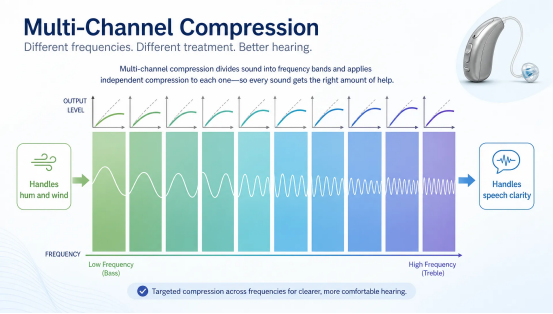
This is why two hearing aids can both say "WDRC" on the box but perform very differently. One has two channels. The other has four, eight, or more. More channels mean finer control.
Not always. Heavy compression makes loud sounds feel controlled, but it can also make the world feel muffled and distant. People who wear hearing aids often describe over-compression as feeling like they are listening to the world through a wall. The right amount is enough to make speech comfortable, not enough to flatten everything.
WDRC does not turn off loud sounds. It limits how much they are amplified. A 90 dB clap still arrives at a comfortable 80 dB. The wearer still hears it. They just do not startle.
Three things separate a basic WDRC implementation from a good one.
First, how many channels? A single-channel aid compresses everything together. A multi-channel aid treats speech frequencies differently from noise frequencies. This is the single biggest factor in how natural the aid sounds.
Second, can the wearer or audiologist adjust the compression strength? Fixed compression is fine for quiet rooms. Adjustable hearing aid compression settings help in restaurants, in cars, and on windy streets.
Third, does the aid pair WDRC with separate handling for wind noise and sudden impulse sounds? Wind hitting a microphone and a door slamming are not the same as steady background noise. They need their own processing.
 The Retekess TE105 RIC hearing aid is built around this idea: multiple independent frequency channels, each with its own compression, plus separate noise reduction settings for steady background sound, wind, and impulse noises. The point is not to list features. It is that the aid treats soft speech, room tone, wind, and clattering sounds as different problems rather than turning the same knob for all of them.
WDRC is the reason a modern hearing aid can make a quiet voice across a table sound clear without making a closing door feel loud. It is not a marketing abbreviation. It is the core technology that separates "everything louder" from "everything usable."
When you read WDRC on a product page, you now know what it means: an automatic volume knob that listens to the room and adjusts itself dozens of times per second. That is the technology working while you are having a conversation.
Not exactly. Automatic volume control adjusts overall loudness gradually, while WDRC responds to individual sounds in real time, reducing loud sounds and amplifying softer ones for more comfortable listening.
Heavy compression can reduce music's dynamic range. Good hearing aids offer different settings for speech and music, using lighter compression in music mode to preserve sound details and contrast.
Some hearing aids let you adjust basic compression settings through a companion app. However, advanced settings like attack time and compression ratio are usually configured by an audiologist.
Without WDRC, the hearing aid provides less control over volume differences. Soft sounds may be difficult to hear, while loud sounds can become uncomfortable. WDRC helps make listening more comfortable across different sound levels.
WDRC adjusts amplification based on sound levels, while noise reduction lowers unwanted background sounds like fans or traffic. They work together to make speech easier to hear.















 Google
 Amazon