
Table of Contents
What Should You Consider When Choosing a Type of Interpretation?
- Retekess
- Sep 23, 2026
What should you consider when choosing a type of interpretation? Six factors decide it: delivery mode, language pairs and direction, audience size and channel count, venue and acoustics, session duration and interpreter rotation, and regulation — frequency licensing, confidentiality, and any accessibility obligations that apply where you operate. The first three are the ones most guides cover. The sixth is the one that causes the most expensive mistakes, because it is a legal question rather than a technical one and it cannot be fixed after purchase.
Work through the six in order. Each one narrows the options the next one has to consider.
The Six Factors at a Glance
| # | Factor | What it decides | Common mistake |
|---|---|---|---|
| 1 | Delivery mode | Simultaneous, consecutive, whispered, or relay | Choosing simultaneous for a 6-person negotiation |
| 2 | Language pairs & direction | Interpreter count, whether relay is needed, equipment channels | Assuming any language pair is available on any date |
| 3 | Audience size & channel count | Receiver count, transmitter architecture, one room or many | Sizing receivers to registrations instead of to the target-language cohort |
| 4 | Venue & acoustics | Line feed availability, RF planning, mobility | Interpreting from a room microphone instead of the soundboard |
| 5 | Duration & rotation | Number of interpreters, battery logistics, multi-day planning | Booking one interpreter per language for a full day |
| 6 | Regulation | Frequency version, confidentiality architecture, accessibility | Buying in one country and deploying in another without checking allocation |
Factor 1 — Delivery Mode
The mode decides everything downstream, including whether you need equipment at all.
| Mode | Time cost | Equipment | Best for | Worst for |
|---|---|---|---|---|
| Simultaneous | Adds only a 2–5 second lag | Console, transmitter, receiver per listener | 50+ listeners, multiple languages, time-bound agendas | Small dialogue where accuracy outweighs schedule |
| Consecutive | Approximately doubles session length | None, or a microphone | Negotiations, depositions, workshops, medical consultations | Large audiences, tight schedules |
| Whispered (chuchotage) | Minimal | None | One or two listeners at a seat | More than three listeners — it is physically impossible |
| Relay | Adds a second interpretation layer | Channel per language | Rare language pairs with no direct interpreter | High-stakes precision content |
The time math, from a controlled study: simultaneous delivery averaged 12.72 minutes where the next-fastest method averaged 18.24 minutes on identical scripted content — roughly 30% shorter. Against consecutive specifically, the saving approaches half the session time, because each statement is otherwise delivered twice.
On accuracy, the honest version: simultaneous mode is not automatically more accurate. One study of ASL interpreters in judicial settings found 83–87% accuracy in simultaneous mode versus 95–98% in consecutive. Simultaneous is chosen for large, time-bound events with mostly listening audiences. Consecutive is chosen when verbatim precision matters more than the clock.
Default rule: if your audience exceeds about 50 people, or you need three or more languages, simultaneous is the practical choice. If accuracy matters more than speed and the group is small, consecutive wins and you may not need equipment at all.
Factor 2 — Language Pairs and Direction
This factor is about availability, and it is the one planners most often discover too late.
Ask these four questions before considering hardware:
- Is a qualified interpreter available for this pair on this date? Rare pairs book out weeks ahead, and conference season concentrates demand.
- Is the direction one-way or two-way? One-way (a speaker into an audience) needs one channel per target language. Two-way dialogue needs interpreters working in both directions and a different audio design.
- Do you need a relay? If no direct interpreter exists for, say, Japanese into Portuguese, you relay through English — which means two interpreters, two channels, and two opportunities for accumulated error.
- Does the content require subject specialization? Medical, legal, and technical sessions need interpreters with domain vocabulary. A generalist interpreter in a technical session produces fluent output that is quietly wrong, which is worse than obvious failure.
| Situation | Channel implication | Equipment implication |
|---|---|---|
| One source language, two targets | 2 target channels | 2 transmitters minimum |
| Two source languages, two targets (bidirectional) | 2 target channels, switching sources | Interpreter console must handle input switching |
| Rare pair requiring relay | 3 channels (source → pivot → target) | Additional transmitter, additional interpreter |
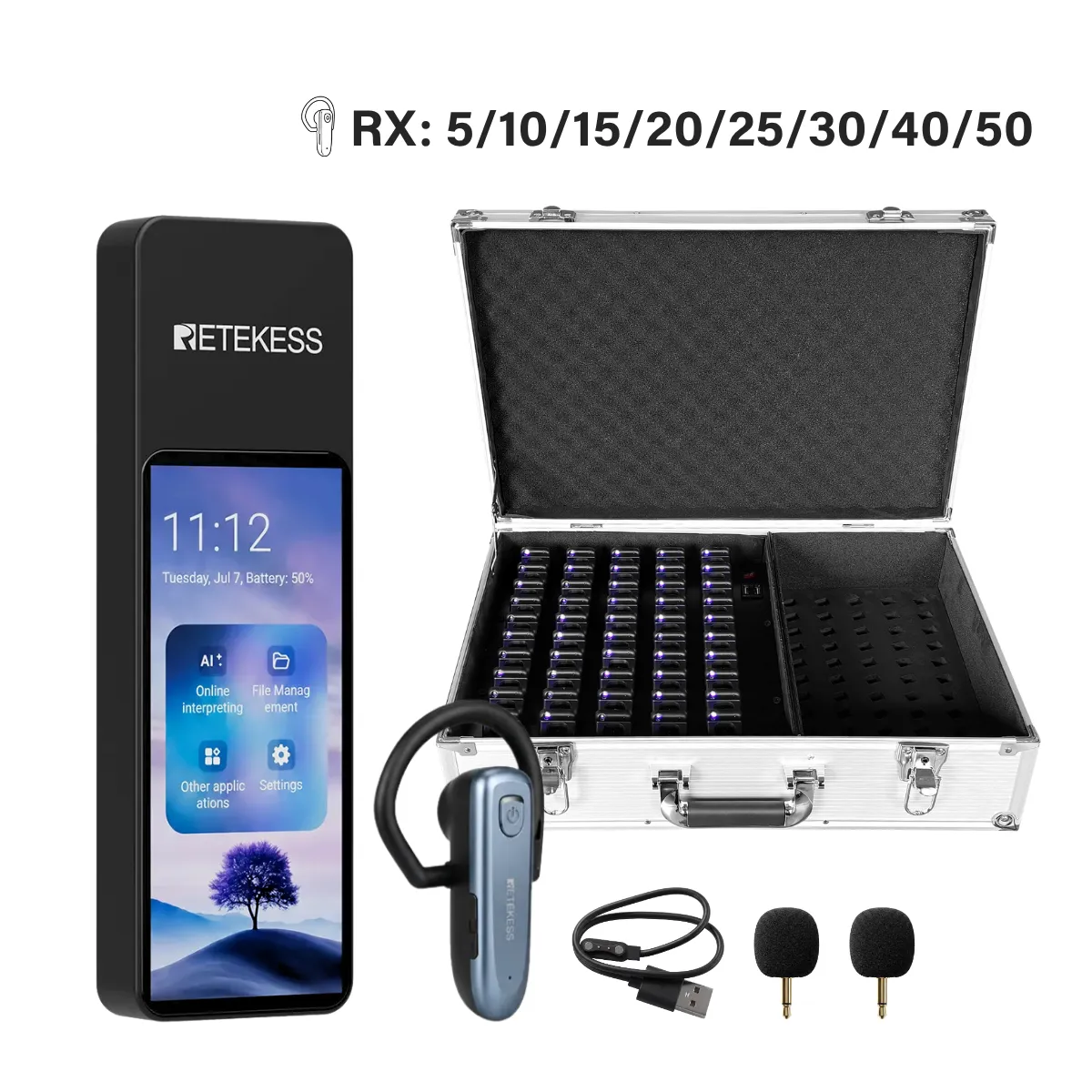
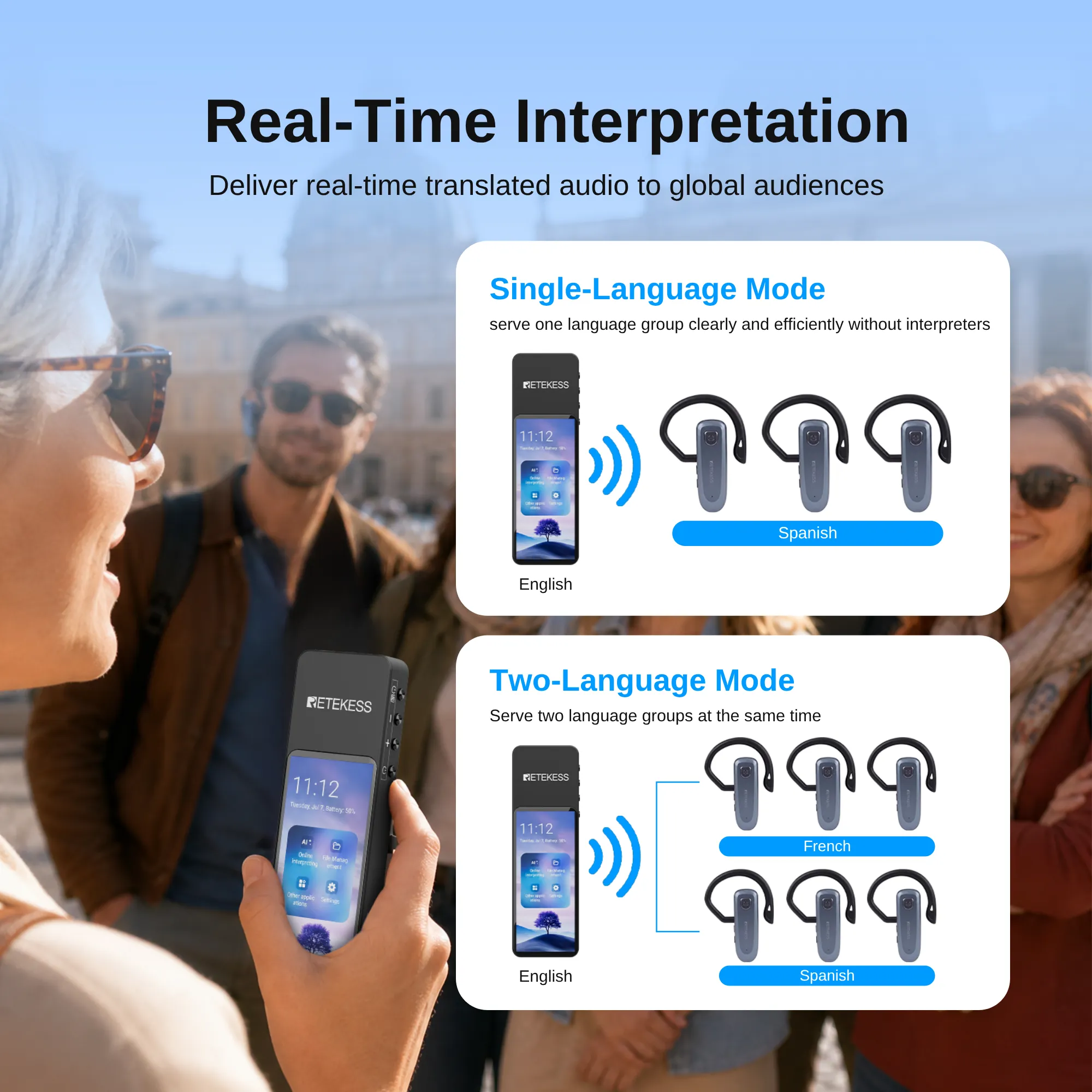
| No interpreter available at any price | AI channel as fallback | TT136-class device, scoped honestly to non-critical content |
Sequencing note: book interpreters before you buy or rent equipment. Equipment without an interpreter is an expensive way to distribute silence, and interpreters get booked out before hardware does.
Factor 3 — Audience Size and Channel Count
Size determines how many receivers you need; channel count determines how many languages you can carry simultaneously. These are separate decisions.
| Audience | Design implication |
|---|---|
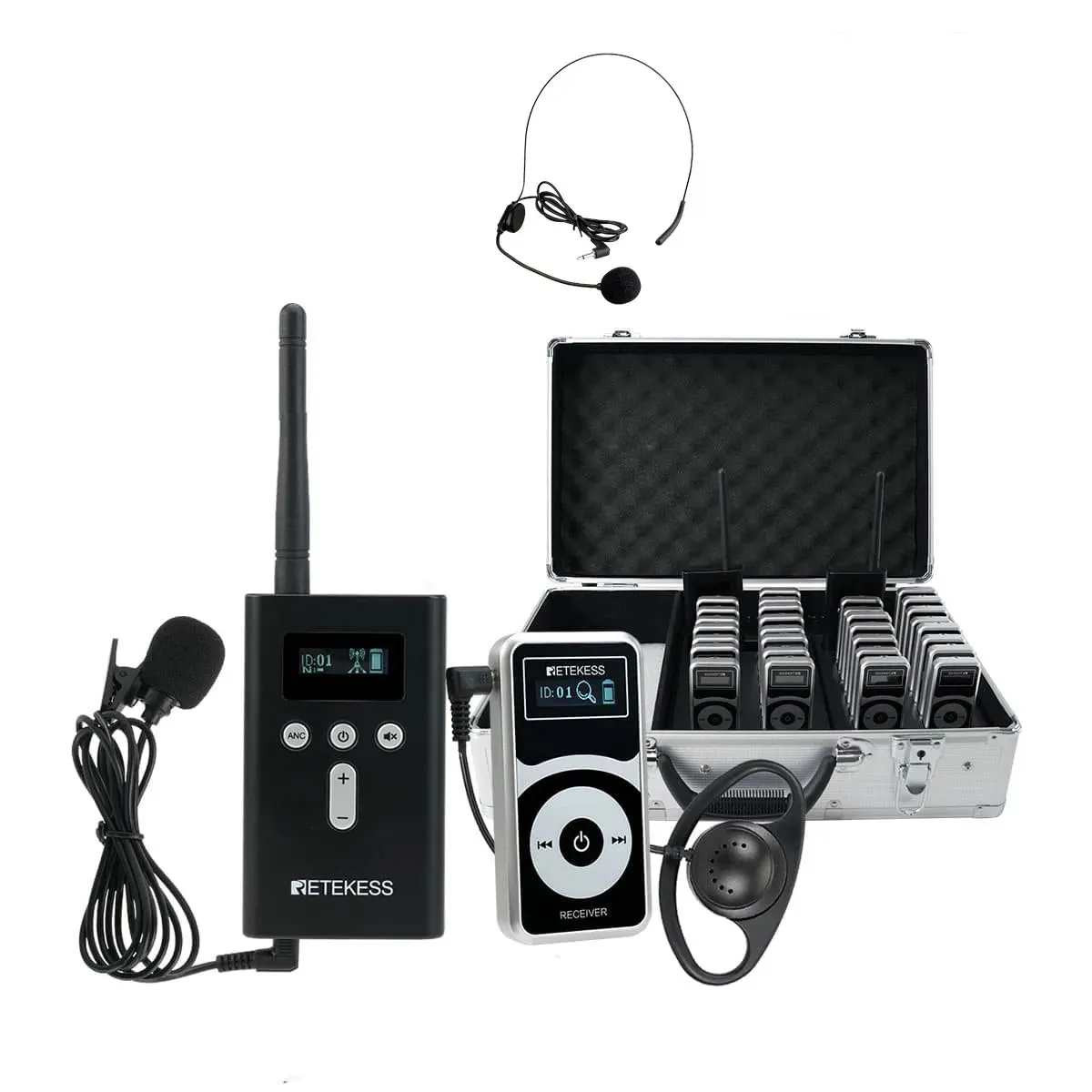
| Under 10 | Equipment may be unnecessary. Consecutive, or a single portable system such as TT106S |
| 10–30 | One FM system with a dedicated receiver per listener —TT117 |
| 30–100 | Receiver pool scaled to the target-language cohort, plus spares |
| 100–200 | Console-based system with line feed —TT119 plus T130T |
| 200+ or parallel rooms | Channel-rich architecture —TT116 with 50 channels |
Two sizing rules that prevent most shortfalls:
- Size receivers to the target-language cohort, not to total registrations. If 400 people attend and 120 need Spanish, you need about 120 receivers, not 400. Over-ordering is common and expensive; see How Many Receivers Do You Actually Need.
- Add 10–15% spares. Batteries die mid-session, ear hooks break, and one receiver always gets handed to someone who did not register for the language. The spare pool is what makes a session run without an interruption.
Channel count is a ceiling you hit earlier than you expect. One language occupies one channel. Two languages and a relay already consumes three. If you run parallel sessions in separate rooms, each room's language set needs its own channel plan — and adjacent rooms need frequency coordination, or listeners in Room A will hear Room B.
Factor 4 — Venue, Acoustics and Mobility
This factor decides audio quality more than any product specification does.
| Venue condition | What it does to interpretation | What to do |
|---|---|---|
| Hard surfaces, long reverb | Interpreters hear reflected sound, not the speaker | Get a line feed from the mixing console |
| High ambient noise | Listener fatigue sets in early; accuracy perception drops | Line feed plus closed-back earphones |
| No available line output | Interpreter works from a room mic and translates the room | Negotiate XLR/AUX/RCA access at contract stage |
| Parallel session rooms | Channel bleed and RF interference | Frequency coordination plan across rooms |
| Outdoor or mobile (tours, site visits) | Mains power unavailable; range matters | Portable system with battery life suited to the whole day —T130P at 14–54 hours |
| Historic or protected buildings | Cabling restrictions; no booths permitted | Vehicle-mounted or portable systems rather than fixed install |
The single highest-return action in this entire article: arrange a line feed from the front-of-house mixing console to the interpreter console. It costs nothing if the outputs exist, removes room acoustics from the audio path entirely, and improves both the interpretation quality and the reusability of any recording. Retekess interpreter consoles including the TT119 accept XLR, AUX, RCA, and USB precisely so this feed can come from the board.
If the venue's audio provider will not or cannot provide it, that is a signal to discuss at contract stage rather than on the day.
Factor 5 — Duration, Rotation and Fatigue
Interpretation is cognitively expensive, and this factor is why projects that look correctly staffed still fail by hour five.
| Session length | Interpreter staffing | Notes |
|---|---|---|
| Under 30 minutes | One interpreter | Comfortable for most pairs |
| 30–60 minutes | One interpreter, with a break after | Approaching the rotation limit |
| 1–3 hours | Two interpreters per language, rotating | Matches the 20–30 minute rotation cycle professionals use |
| Full day | Two or more per language, plus scheduled relief | Plan meal and rest breaks into the agenda, not around it |
| Multi-day | Rotating roster across days | Battery and charging logistics become the operational risk |
Why the 20–30 minute rotation exists: simultaneous interpreting requires listening and speaking at the same time, and quality degrades measurably under sustained load. Professional practice is to rotate interpreters within a booth. This is not a luxury item — a single interpreter on a four-hour plenary is a content-quality decision, and the audience is the one who absorbs it.
Multi-day logistics deserve their own line in the budget. Charging 120 receivers overnight takes planning, outlet capacity, and a place to do it. Systems with long battery windows — the T130P at 14–54 hours — reduce the nightly operational load, which matters more on day three than day one.
Factor 6 — Regulation: Frequency, Confidentiality and Accessibility
This is the factor most guides omit, and the one with the longest tail of consequences.
6a. Frequency licensing
Wireless audio operates in regulated spectrum. The allocation differs by country, and the same product's legal status differs with it.
| Band | Where it is commonly used or restricted |
|---|---|
| 72–76 MHz | Legal in the US and Canada — not in the EU |
| 863–865 MHz | The EU general short-range band |
| 470–694 MHz | Conditions vary by country; often coordinated with broadcast allocations |
| 823–832 MHz | Channel 38 range in parts of Europe |
| 2.4 GHz | Widely licence-exempt, but shares spectrum with Wi-Fi and degrades under congestion |
| 174–223 MHz | Country-specific allocation conditions |
The practical risk: buying a system in one market and deploying it in another without checking the allocation can mean operating an unlicensed transmitter. That is a regulatory matter, not a technical one, and it cannot be resolved by adjusting gain — the wrong version of a product is still the wrong version. If you are buying, state the destination country at order so the compliant version ships. Full breakdown: Frequency Compliance for Wireless Audio.
6b. Confidentiality
Ask what leaves the room.
- A closed RF system transmits between your own devices and produces no cloud record unless you create one.
- An app or cloud platform processes audio through third-party infrastructure, which raises data-handling, retention, and consent questions.
- A hybrid setup has both, so the question becomes which content goes where.
For board-level, legal, and medical content, this consideration often outranks cost. If your organization operates under an NDA or handles personal data, decide the architecture before choosing hardware.
6c. Accessibility and local language law
Obligations here are jurisdiction-specific, evolving, and frequently misquoted in vendor content — including, we should note, by parties with an interest in the answer. Several AI interpretation platforms cite a 50-participant threshold under EU accessibility rules; we could not verify that against the directive text and it should not be relied upon without local legal advice.
Two things can be said without overreaching:
- If you operate in a regulated sector, accept public funding, or run public-facing events, schedule a periodic accessibility review rather than treating it as a one-time question.
- Local language law is separate from accessibility law. Some jurisdictions impose requirements on consumer-facing and commercial communications that are unrelated to accessibility. In France, for example, French language law adds its own requirements for commercial content. Raise this with counsel before committing to a multilingual publication plan, not after.
Treat all of Factor 6 as a legal review item. It is listed here because it belongs in the decision framework, not because equipment suppliers can resolve it for you.
The Six-Factor Scorecard
Fill this in for your own project before talking to suppliers. It takes ten minutes and saves entire conversations.
| Factor | Your answer | What it rules in / out |
|---|---|---|
| 1. Mode | Simultaneous / Consecutive / Whispered / Relay | Whether equipment is needed at all |
| 2. Language pairs | Pairs, direction, relay needed? Interpreter availability? | Interpreter count and channel count |
| 3. Audience | Target-language cohort size; total attendees; rooms | Receiver count and transmitter architecture |
| 4. Venue | Line feed available? Reverb/noise? Parallel rooms? Mobile? | Audio design and RF planning |
| 5. Duration | Session length; days; charging plan | Interpreter rotation and power logistics |
| 6. Regulation | Destination country; confidentiality level; accessibility obligations | Which frequency version; whether a cloud platform is permissible |
Reading your own scorecard: if Factor 2 shows no available interpreter for your worst language pair, the mode decision is made for you regardless of what Factors 3 and 5 suggest. If Factor 6 shows confidential content, a cloud platform is off the table before cost is discussed. The most constrained factor wins — that is the whole point of running the six in order.
Common Combinations and What They Imply
| Project profile | Typical configuration |
|---|---|
| Corporate all-hands, 2 languages, 200 in a room | Simultaneous, 2 interpreters per language, console TT119 or T130T, receivers for the target cohort |
| Bilingual church service, 150 congregation | Simultaneous via FM, 1–2 interpreters, TT117 or TT118 with receiver pool, volunteer-friendly operation |
| Medical conference, 6 languages, 400 delegates | Simultaneous with booth, ISO-compliant audio path, relay for rare pairs, multi-channel architecture via TT116 |
| Museum or factory guided tour, mixed groups | Portable system or AI channel —TT136 where no interpreter is available |
| Legal deposition, 2 languages, 6 people | Consecutive, no equipment, one specialist interpreter, verbatim record |
| Multi-day festival, parallel stages | Channel planning across venues, long-battery devices, receivers sized per stage |
FAQ
What should I consider when choosing a type of interpretation?
Six factors: delivery mode (simultaneous, consecutive, whispered, relay), language pairs and whether a relay or specialist interpreter is needed, audience size and channel count, venue acoustics and line-feed availability, session duration and interpreter rotation, and regulation — frequency licensing, confidentiality requirements, and accessibility obligations. Always work through them in that order, because each one narrows the next.
How do I choose between simultaneous and consecutive interpretation?
Audience size and time pressure decide it. Simultaneous for 50+ listeners or three or more languages, where the agenda cannot absorb double the session length. Consecutive for small, high-stakes dialogue — negotiations, depositions, medical consultations — where accuracy matters more than schedule and no equipment is needed.
How many interpreters do I need per language?
One for sessions under about 30 minutes. Two or more per language for sessions over an hour, rotating on the 20–30 minute cycle professional practice uses, because simultaneous interpreting degrades under sustained cognitive load. For a full day, plan two per language plus scheduled relief.
Do I need equipment if everyone speaks English?
No. If your attendees can follow the working language, language is not your constraint. Interpretation equipment exists to serve attendees who cannot, and it is worth confirming that distinction from registration data before buying anything.
What frequency band should I choose?
The one legal in the country of use. 72–76 MHz is legal in the US and Canada and not in the EU; 863–865 MHz is the EU general band; 470–694 MHz and 823–832 MHz have country-specific conditions; 2.4 GHz is widely licence-exempt but shares spectrum with Wi-Fi. State the destination country when ordering so the compliant version ships.
Can we use cloud-based interpretation platforms for confidential events?
Ask what leaves the room first. A closed RF system produces no cloud record unless you create one; a platform processes audio through third-party infrastructure. For board-level, legal, and medical content, that architecture question usually outranks cost.
What is the most commonly skipped step?
Arranging a line feed from the front-of-house mixing console to the interpreter. It costs nothing when the outputs exist, removes room acoustics from the audio path, and improves both live interpretation quality and the reusability of any recording — and it is usually discovered to be unavailable on the day rather than at contract stage.


![[18th Anniversary] 18 Years of Echoing Excellence: Making Communication Easier, Connecting Trust Beyond Borders](https://res.retekess.com/z_file/20260716/retekess-brand-story-making-communication-easier_20260716151044_7682.jpg)
![[18 Years in Wireless Communication] Silent Disco Systems Anniversary Celebration: Top-Selling Headphones & Event Mechanics Revealed!](https://res.retekess.com/z_file/20260713/18-years-in-wireless-communication-silent-disco-systems-anniversary-celebration_20260713175011_5749.webp)
![[Anniversary Carnival] Ding-dong! 18th Anniversary Mega Sale on Guest Paging & Calling Systems: Full Reveal of 12+ Products & Promo Rules!](https://res.retekess.com/z_file/20260713/18th-anniversary-mega-sale-on-guest-paging-calling-systems_20260713175257_0295.webp)
![[Retekess 18th Anniversary Teaser] Tour Guide System Exclusive Perks: Sneak Peek at Event Dates & Mechanics!](https://res.retekess.com/z_file/20260713/retekess-18th-anniversary-tour-guide-system-exclusive-perks--2-_20260713180135_6435.webp)
Follow Us
Pay With


 Google
 Amazon
Comments (0)