
Table of Contents
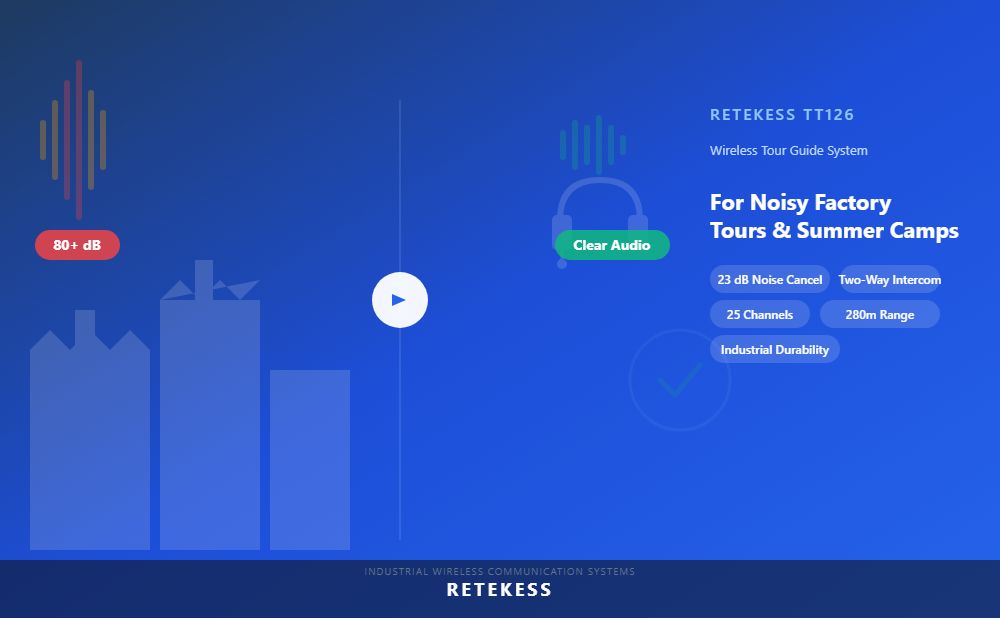
How to Choose a Wireless Tour Guide System for Noisy Factory Tours & Summer Camps
- Retekess
- Jul 24, 2026
High ambient noise and channel interference can disrupt a factory tour or field trip. Tour operators, camp directors, and study-tour leads need more than standard audio equipment. This guide breaks down what actually matters when selecting a wireless tour guide system for chaotic environments.
The 3 problems every wireless tour guide system must solve in 2026
If you're shopping for a tour guide system for factory tours, summer camps, school study trips, or large youth groups, you already know the three failure modes that turn a great day into a liability:
Noise floor > 80 dB. Factory floors, machine shops, bottling plants, food processing lines, and large HVAC-equipped venues routinely sit between 80–95 dB. If your headset can't passively attenuate ambient noise and actively reject it on the mic path, students will hear a muffled wash instead of the lecture.
Large group size (20–50+ people). Study tours and summer camps rarely run in groups of 10. A transmitter that pairs with only a fixed number of receivers is a deal-breaker.
Crosstalk between nearby classes. This is the silent killer. When two or three groups are running tours in the same building — a common scenario at tech parks, museums, and university-hosted STEM camps — a single-channel system means Class A hears Class B's guide. Parents notice. Teachers lose trust.
The right wireless tour guide system solves all three at once. Let's break down the features that matter.
7 non-negotiable features for a wireless tour guide system in noisy, group-heavy environments
1. True two-way (full-duplex) communication
A one-way tour guide system means the guide talks; the group listens. That's fine for a quiet museum. It's a disaster in a teaching environment. With a study-tour or summer-camp group, students need to ask questions, point out things they spotted, and confirm safety instructions. Look for a system that supports full-duplex two-way intercom — when one student presses to talk, both the main guide and the other students can hear the question instantly.
2. Active noise-canceling headset with >20 dB attenuation
For factory tours, passive ear-cup attenuation is non-negotiable. Aim for a headset rated for at least 20 dB NRR (Noise Reduction Rating)—anything less, and 85 dB of background machinery noise will still bleed into the audio. Bonus points if the system has adjustable mic gain so the guide can dial down sensitivity in extremely loud zones.
3. 12+ selectable channels to isolate parallel groups
Channel count is your defense against crosstalk. Running three classes at once requires three isolated channels—plus extra headroom for busy venues. Look for a system with at least 12 selectable channels to ensure clean, interference-free audio. The best systems on the market offer 25 channels (US version) or 12 channels (EU version) on a clean license-free ISM band.
4. Range that covers an actual industrial site
Marketing claims of "1000 m range" are usually line-of-sight in an open field. Real factory tours involve concrete walls, steel mezzanines, and metal-clad machinery. Look for an open-air rating of 250–300 m—this typically yields 80–100 m of reliable coverage around walls and machinery.
5. Long battery life + bulk charging
A tour day is 6–10 hours. Your main transmitter should last at least 8 hours, and receivers should comfortably run 10+ hours. Even better: a 24-slot or 45-slot contact-charging case so you can drop every unit in at the end of the day and have them fully topped up by morning, no USB cables to plug in one by one.
6. Industrial-grade durability
Factory tour equipment gets dropped, scuffed, rained on, and shoved into backpacks. A consumer-grade plastic shell will crack within a month. Look for reinforced housings, secure belt clips or lanyards, and an operating temperature range that covers outdoor summer-camp conditions (typically -10 °C to 50 °C / 14 °F to 122 °F).
7. Easy enough for a 16-year-old camp counselor to operate
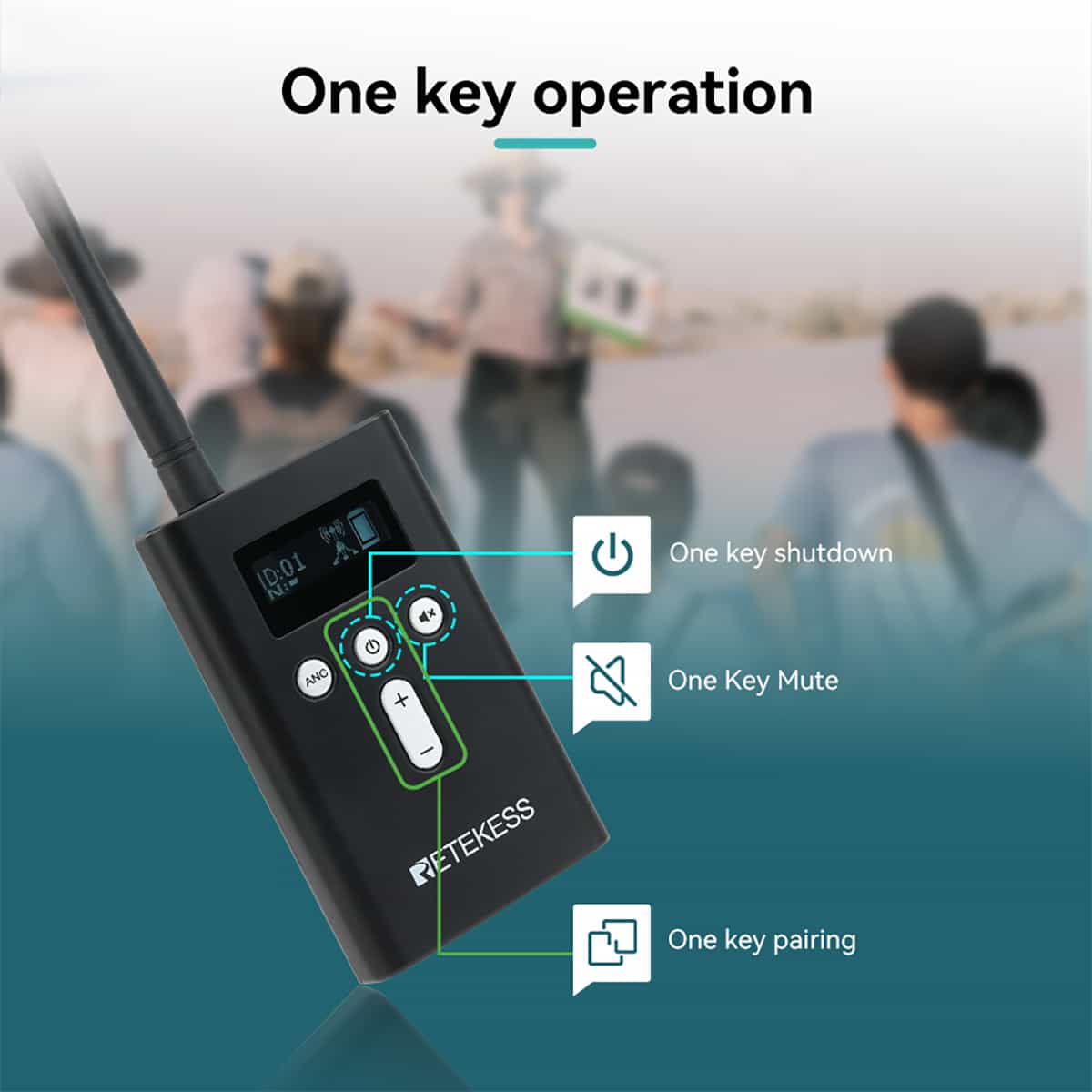
One-touch pairing, automatic channel memory, and a one-touch mute button for the main guide. It should work straight out of the box. Just power it on—no apps, no software updates, and no IT team needed.
Skip the comparison headache
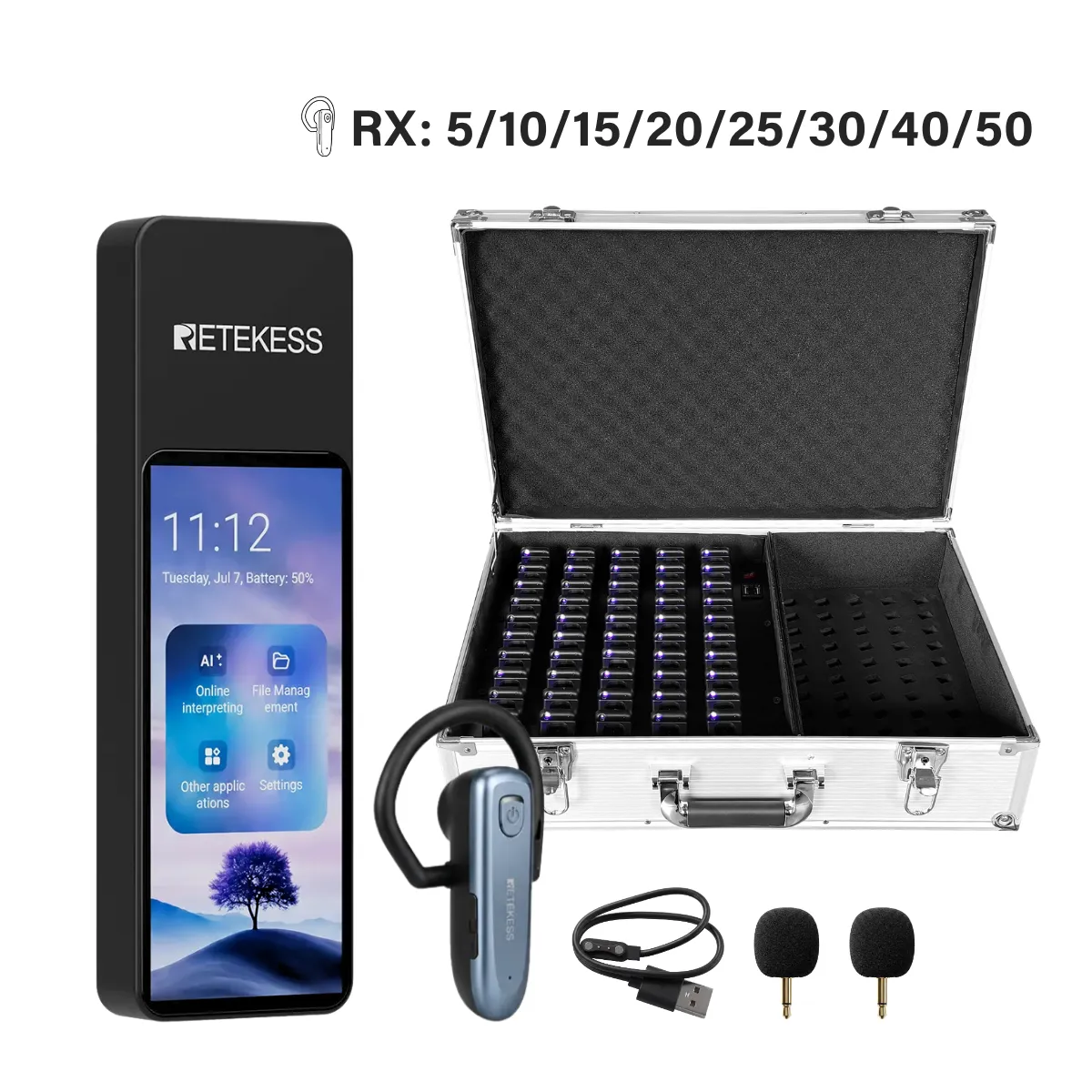
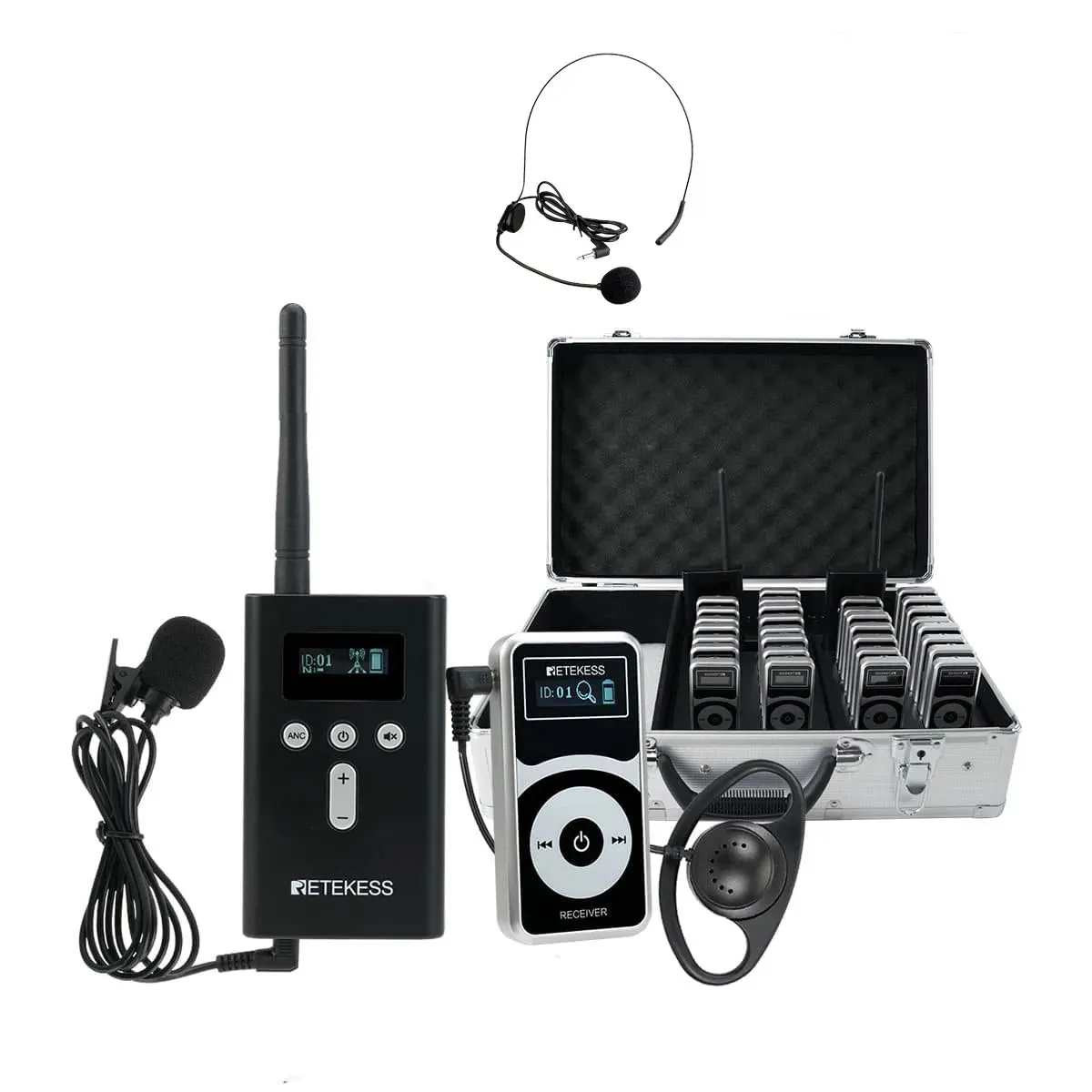
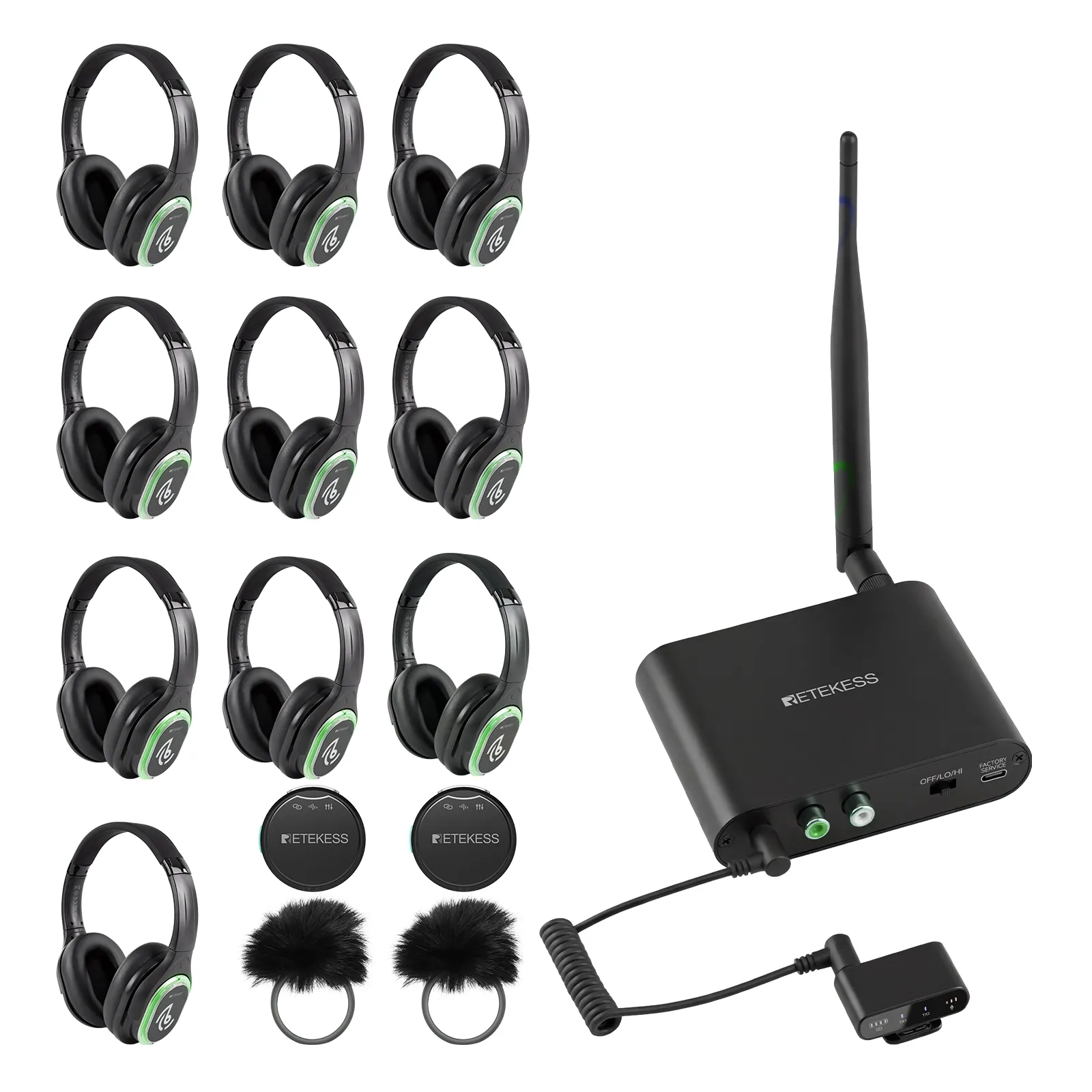
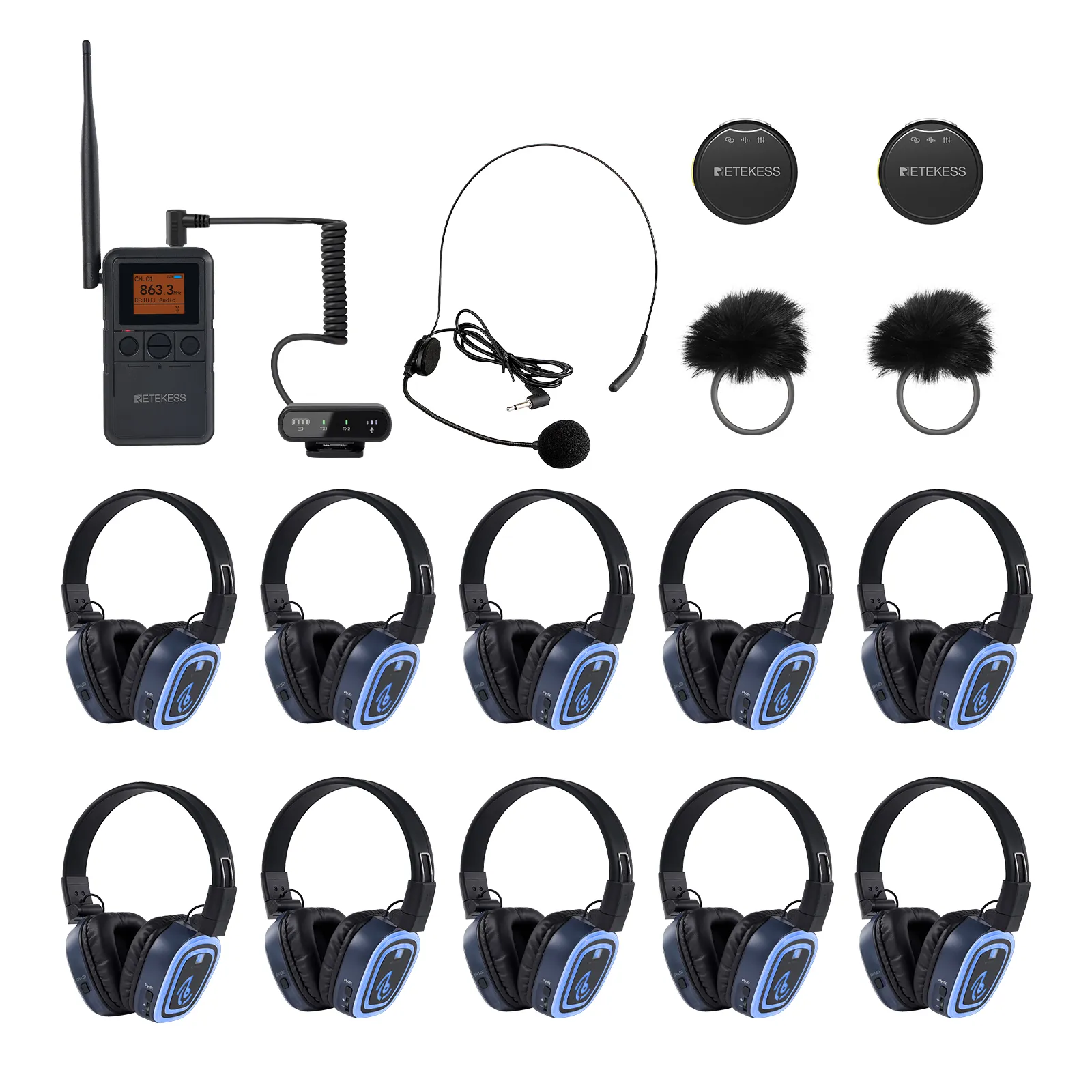
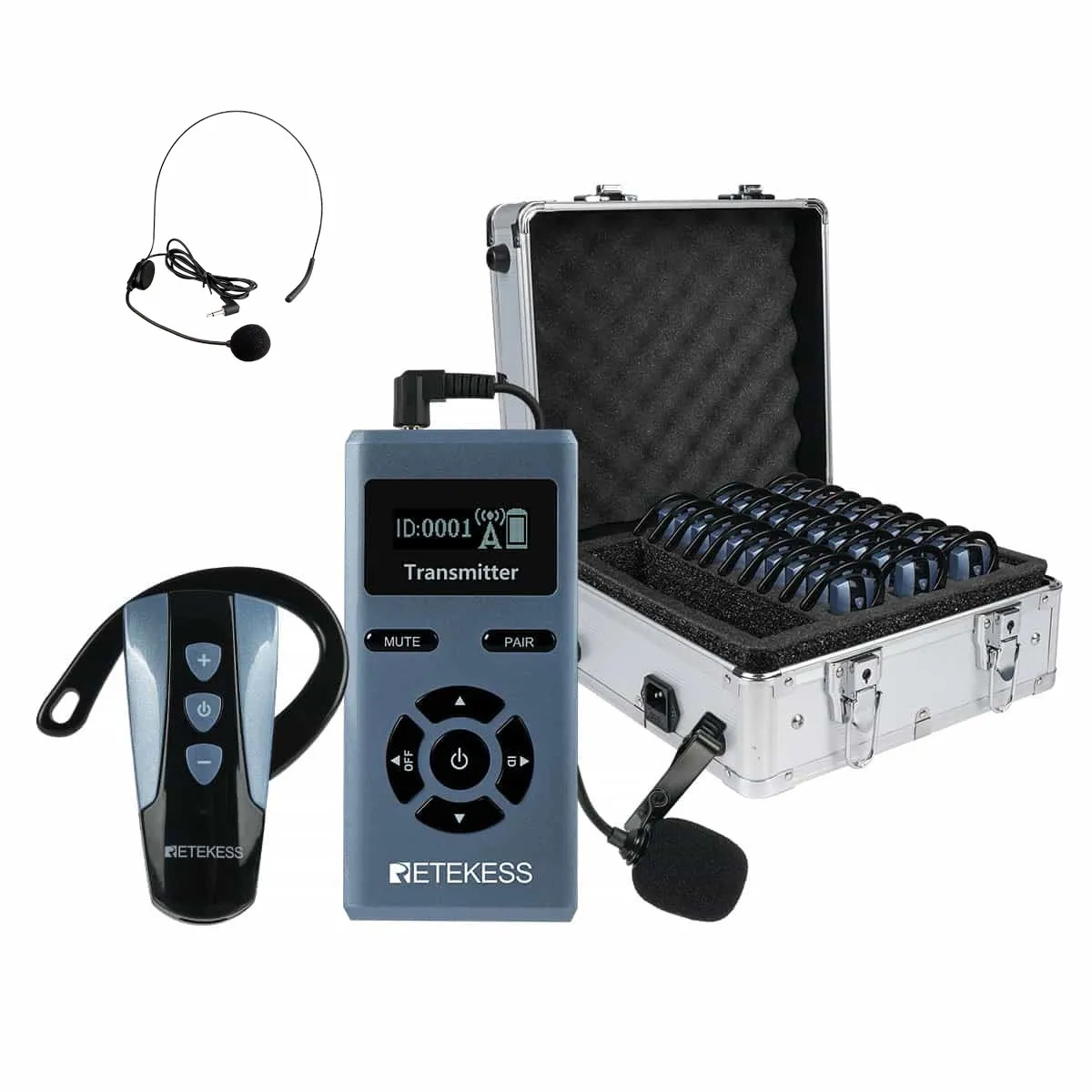
The Retekess TT126 checks every box above — 23 dB noise-canceling headset, 25 channels, two-way intercom, 280 m range, 10–70 hr battery, 24-slot charging case, and industrial durability. Pre-bundled kits for 11, 16, 21, 24, and 47 users.
View TT126 Kits & Pricing →
Why the Retekess TT126 is our top pick for noisy factory tours and summer camps
The Retekess TT126 is purpose-built for the exact scenario you're dealing with — a noisy industrial environment, a large youth group, and the operational reality of running multiple tours in parallel. Here's how it lines up against the 7 must-have features:
| Feature | TT126 Specification | Why it matters for you |
|---|---|---|
| Communication mode | Full-duplex two-way intercom | Students can ask questions; guide hears and responds instantly. Group hears both sides. |
| Noise cancellation | 23 dB noise-reducing headset + adjustable mic gain (1–7) | Effectively blocks out 80–90 dB factory floor noise; lower the gain further in extreme environments. |
| Channels | 25 channels (US) / 12 channels (EU) | Run 3–6 parallel classes in the same building with zero crosstalk. |
| Range | 280 m (918 ft) line-of-sight / 250 m open visual | Covers a full factory floor, museum wing, or outdoor camp site. |
| Battery life | Main: 10 hr · Sub: 10–70 hr | Lasts an entire tour day; bulk-charge overnight. |
| Charging | 24-slot or 45-slot contact-charging case / 16-slot base | Drop-and-go batch charging — no cables, no plugging in one by one. |
| Durability | Industrial-grade housing, aluminum charging case, -10 °C to 50 °C operating range | Survives daily factory use, drops, and outdoor camp conditions. |
| Ease of use | One-touch pairing, auto channel memory, one-touch mute, auto-off after 20 min idle | Set up in 60 seconds; works for any camp counselor or substitute teacher. |
| Group size | Unlimited expansion; kits from 10 to 45 sub-units + multiple main transmitters | Scales from a single classroom to a 200-person STEM camp. |
Three TT126 features that directly solve your top pain points
Pain point 1 — "My students can't hear me over the machinery."
The TT126 ships with a 23 dB noise-reducing headset that physically blocks factory noise before it reaches the ear. Combined with digital wireless transmission, the guide's voice comes through clear and intelligible even when standing next to a running CNC mill or injection-molding press.
"Even standing next to heavy equipment, the headphones effectively block most background noise while keeping voices clear and natural." — Verified buyer
Pain point 2 — "I'm running 2–4 classes at the same time and they're picking up each other's guides."
The TT126 offers 25 selectable channels on the US ISM band (902–928 MHz). Assign each group a dedicated channel at the start of the day to keep them isolated throughout the program—no crosstalk, no channel jumping, and zero hassle.
Pain point 3 — "It's a 45-student camp and I can't hand-hold a 10-person receiver fleet."
With kits pre-configured for up to 1 main + 45 sub-transmitters (and unlimited additional pairing), and a 45-slot charging case, you set the system up once, drop it in the case at the end of the day, and grab a fully charged fleet every morning. One-touch pairing means a new counselor can be trained in under five minutes.
TT126 specifications at a glance
| Parameter | Main Transmitter | Sub-Transmitter |
|---|---|---|
| Frequency (US) | 902–928 MHz | 902–928 MHz |
| Frequency (EU) | 823–832 / 863–865 MHz | 823–832 / 863–865 MHz |
| Channels (US / EU) | 25 / 12 | 25 / 12 |
| Transmit power | 25 dBm max | — |
| Sensitivity | — | -97 dBm |
| SNR | ≥ 70 dB | — |
| Frequency response | 20 Hz – 5 kHz | 20 Hz – 5 kHz |
| Range | 250–280 m (line of sight) | — |
| Battery | 2500 mAh lithium | 2500 mAh lithium |
| Runtime | 10 hours | 10–70 hours |
| Charging time | 5–6 hours | 5–6 hours |
| Charging method | USB-C / contact case | USB-C / contact case |
| Operating temp | -10 °C to 50 °C | -10 °C to 50 °C |
| Weight (US / EU) | 191 g / 190 g | 182 g / 183 g |
Real-world scenarios where the TT126 shines
Scenario 1: STEM study tour at a manufacturing plant
You have 30 high-schoolers, an 88 dB factory floor, and a 90-minute window to teach them how an injection-molding cell works. The TT126's 23 dB noise-canceling headset cuts the machinery roar down to a comfortable listening level. When a student asks a question, the entire group hears the answer — no "wait, what did she say?"
Scenario 2: Multi-track summer-camp program at a university
You're running 4 simultaneous tours through a science museum: Biology, Robotics, Chemistry, and Physics. Assign each group a unique TT126 channel. The kids roam independently, hear their own guide perfectly, and never cross wires with the parallel classes in the next hall.
Scenario 3: VIP client visit at a beverage bottling line
The line foreman can't stop the line, the filling machines are loud, and the client is standing 50 m away. The TT126's two-way intercom lets the client ask a follow-up question and get an instant answer — without the tour having to break formation or shout across the floor.
Frequently asked questions
Q: How many channels do I need to avoid crosstalk between classes?
A: For a venue hosting 3–4 parallel tour groups, you need at least 12 selectable RF channels; for larger events or multi-day operations, 25 channels is the safer choice. The Retekess TT126 offers 25 channels (US version) and 12 channels (EU version), which comfortably isolates several classes running in the same building.
Q: What decibel rating do I need for an 80–90 dB factory?
A: Aim for a passive noise-reduction rating of at least 20 dB, combined with active mic-side noise rejection and adjustable mic gain. The TT126's 23 dB noise-reducing headset is designed specifically for this range, and the 1–7 mic gain adjustment lets the guide fine-tune for extreme noise zones.
Q: Can students actually ask questions with this system?
A: Yes — the TT126 is a true full-duplex two-way system. When a student presses the mic button on their sub-transmitter, both the main guide transmitter and all other sub-transmitters in the group can hear the question immediately, in real time.
Q: How large a group can one guide handle?
A: The TT126 main transmitter can pair with an unlimited number of sub-transmitters. Pre-built kits ship with 10, 15, 20, 22, 42, or 45 sub-units, and you can add extra receivers separately for larger study tours. For very large events you can also run multiple main transmitters in parallel.
Q: How long does the battery last? How do I charge a whole fleet?
A: The main transmitter runs up to 10 hours, and sub-transmitters run 10–70 hours depending on usage. For overnight bulk charging, choose the 24-slot charging case (works with 21–24 unit kits) or the 45-slot charging case (for the 47-unit kit). Both use contact charging — no cables to plug in.
Q: Is there a warranty or trial period?
A: Yes. Retekess offers a 30-day no-reason return, a 3-year warranty on the system, and free demo testing (a refundable deposit is required) so you can validate the system in your actual venue before committing to a full kit.
Conclusion: pick a tour guide system built for the chaos, not the brochure
A wireless tour guide system for factory tours and summer camps isn't a piece of consumer electronics — it's mission-critical safety and communication equipment. The wrong choice leaves students unable to hear safety briefings and instructors shouting themselves hoarse. The right choice disappears into the background and lets the tour do its job.
The Retekess TT126 hits the rare combination of industrial-grade noise cancellation, true two-way intercom, 25-channel isolation, and unlimited group scaling — all at a price point that fits an operating budget, not a capital-expense committee. For any tour operator, camp director, or study-tour organizer running groups in 80 dB+ environments, it's the system we'd buy.
Leave a Reply


![[18th Anniversary] 18 Years of Echoing Excellence: Making Communication Easier, Connecting Trust Beyond Borders](https://res.retekess.com/z_file/20260716/retekess-brand-story-making-communication-easier_20260716151044_7682.jpg)
![[18 Years in Wireless Communication] Silent Disco Systems Anniversary Celebration: Top-Selling Headphones & Event Mechanics Revealed!](https://res.retekess.com/z_file/20260713/18-years-in-wireless-communication-silent-disco-systems-anniversary-celebration_20260713175011_5749.webp)
![[Anniversary Carnival] Ding-dong! 18th Anniversary Mega Sale on Guest Paging & Calling Systems: Full Reveal of 12+ Products & Promo Rules!](https://res.retekess.com/z_file/20260713/18th-anniversary-mega-sale-on-guest-paging-calling-systems_20260713175257_0295.webp)
![[Retekess 18th Anniversary Teaser] Tour Guide System Exclusive Perks: Sneak Peek at Event Dates & Mechanics!](https://res.retekess.com/z_file/20260713/retekess-18th-anniversary-tour-guide-system-exclusive-perks--2-_20260713180135_6435.webp)
Follow Us
Pay With


 Google
 Amazon
Comments (0)