
Table of Contents
Church and Cathedral Tours: How to Maintain Silence While Delivering Crystal-Clear Audio to Large Groups
- Retekess
- Jul 24, 2026
This is what a properly designed UHF digital tour guide system makes possible in churches, cathedrals, and heritage sites where silence is not just preferred — it's required. In this article, we'll break down exactly why these spaces present unique acoustic challenges, why traditional audio solutions fall short, and how the Retekess T130U Digital UHF Tour Guide System is engineered to solve every one of them.
The Unique Acoustic Challenge of Sacred Spaces
Churches and cathedrals are among the most acoustically hostile environments for spoken-word communication. This isn't hyperbole — it's physics. Three structural factors conspire against clear audio delivery:
1. Reverberation from Vaulted Ceilings and Stone Walls
The soaring stone vaults that make cathedrals visually breathtaking also create reverb times of 4 to 8 seconds — far beyond the 1.5-second threshold where speech becomes intelligible. A single spoken word echoes and re-echoes, layering over itself until it becomes an indecipherable wash of sound. This is why unaided speaking in a cathedral feels like trying to talk underwater.
2. Multi-Source Interference
Heritage sites often host multiple tour groups simultaneously. If three guides are speaking in different areas of the same cathedral, their voices overlap and create a chaotic audio environment. Visitors can't distinguish their guide's commentary from the neighboring group's — and worshippers seeking quiet meditation are disturbed by the combined noise.
3. Silence Compliance Requirements
Unlike museums or factories, churches are living places of worship. Many cathedrals explicitly require tour groups to maintain low volume — some enforce "whisper-only" policies, while others restrict tours to designated hours to avoid conflicting with services. A tour guide system that requires the guide to speak loudly to reach the back of a 60-person group is, by definition, non-compliant with these requirements.
"A cathedral is not a museum gallery. It is a living sanctuary — a space for worship, meditation, and centuries of layered history. The moment a tour guide raises their voice, the sacred quiet evaporates."
Why Traditional Audio Solutions Fail in Churches
Before we discuss the solution, let's understand why the common alternatives don't work:
| Solution | Fatal Flaw in Churches | Result |
|---|---|---|
| Loudspeakers / PA systems | Projects sound into the entire space | Disturbs worshippers; amplified echo makes audio worse |
| WiFi-based audio apps | 2.4 GHz signal blocked by stone walls | Dropouts, latency, limited range in stone interiors |
| Bluetooth receivers | 30m range; 2.4 GHz; 1-to-1 pairing only | Cannot serve large groups; interference from other Bluetooth devices |
| Analog VHF/UHF systems | Picks up ambient noise and echo | Audio clarity degrades in reverberant spaces |
| Digital UHF (T130U) | None of the above | Whisper input → crystal-clear output, zero interference |
The pattern is clear: each alternative either violates silence requirements (PA systems), fails on signal penetration (WiFi/Bluetooth), or degrades audio quality in reverberant environments (analog RF). The only technology that solves all three problems simultaneously is digital UHF modulation.
The UHF Digital Solution: Whisper-Level Audio, Cathedral-Quality Clarity
What Is UHF and Why Does It Matter for Church Tours?
UHF (Ultra High Frequency) refers to the radio frequency range between 300 MHz and 3 GHz. Tour guide systems typically operate in the 790–928 MHz sub-band. Here's why this frequency range is the gold standard for church and cathedral tours:
Better wall penetration: UHF signals at ~900 MHz pass through stone, brick, and concrete far more effectively than 2.4 GHz WiFi/Bluetooth signals. Stone walls that completely block WiFi barely attenuate UHF.
No WiFi/Bluetooth crossover: Since UHF operates in a completely different frequency band, there's zero interference from the WiFi networks, Bluetooth devices, and mobile phones that densely populate modern church visitor centers.
Greater range per watt: UHF achieves longer transmission distances with less power, which translates to smaller, lighter devices and longer battery life.
Digital Modulation: The Difference Between Analog Noise and Digital Clarity
Here's the technical distinction that matters most in reverberant spaces: analog RF systems transmit the exact waveform captured by the microphone — including every echo, ambient noise, and i
nterference signal that reaches it. If a cathedral's reverb enters the mic, that reverb is transmitted directly to every receiver.
Digital modulation converts audio into encoded binary data before transmission. The receiver decodes this data and reconstructs clean audio. Echo, ambient noise, and interference that would corrupt an analog signal are eliminated by the encoding process. This is why a digital UHF system can deliver whisper-level input at cathedral-quality clarity — the encoding strips out the acoustic contamination before it ever reaches the listener's ear.
Retekess T130U: The UHF Tour Guide System Built for Sacred Spaces
The Retekess T130U is a digital UHF tour guide system specifically engineered to overcome the challenges we've outlined. Let's examine each feature through the lens of church and cathedral tour requirements:
4-Level Microphone Gain
The transmitter mic offers 4 levels of gain adjustment — enabling true whisper-mode operation. The guide speaks softly, and the system amplifies cleanly for the group without projecting sound into the sacred space.
50 Channels (US) / 19 (EU)
Up to 50 tour groups can operate simultaneously in the same cathedral on different channels with zero audio crossover. Each group hears only their own guide's commentary.
40-Hour Receiver Battery
Receivers run for 40 continuous hours on a single charge. The transmitter operates for 8 hours (and supports charging while in use). All-day touring without midday charging breaks.
200m / 656ft Range
UHF signals at 902–928 MHz (US) or 823–832/863–865 MHz (EU) penetrate stone walls and arches effectively. Cover every corner of the cathedral — from nave to transept to crypt.
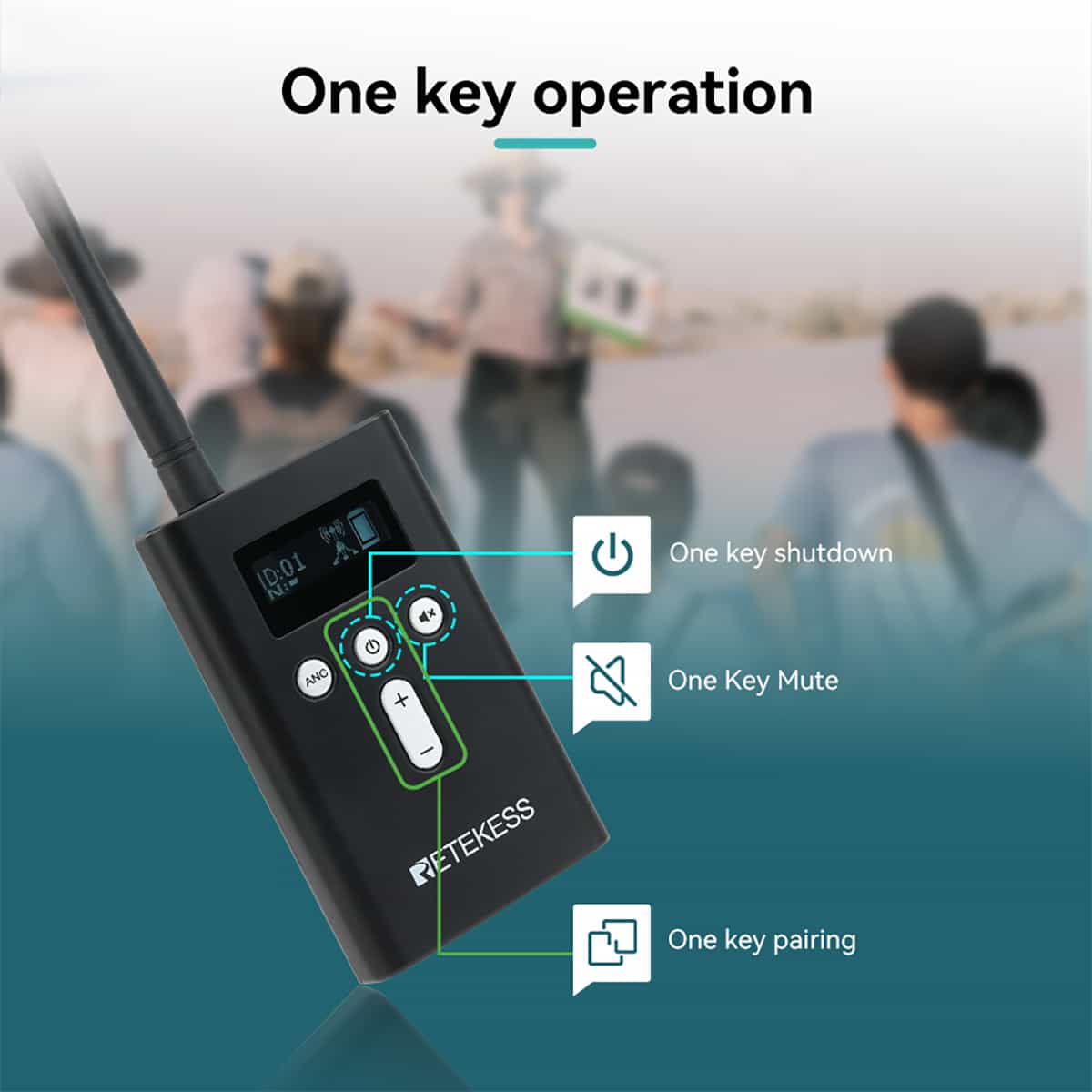
Transmitter Mute Function
One press on the transmitter silences all receivers instantly. Perfect for pausing commentary during prayers, organ performances, or moments of reflection — no fumbling to quiet 30 devices individually.
One-Click Power Off
At tour end, the guide powers off all receivers simultaneously from the transmitter. No chasing down devices, no wasted battery from receivers left on accidentally.
Whisper Mode: 4-Level Mic Gain for Low-Volume Commentary
This is the feature that makes the T130U essential for church tours. Most tour guide systems assume the guide will speak at normal volume. In a cathedral, that's unacceptable.
The T130U's transmitter microphone provides 4 levels of gain adjustment, allowing the guide to calibrate input sensitivity based on ambient conditions and visitor feedback. At the lowest gain setting, the guide can genuinely whisper — and the digital encoding ensures that whisper arrives at every receiver as clear, intelligible audio. The visitors, meanwhile, control their own receiver volume across 10 levels, so each person fine-tunes their listening comfort without affecting anyone else.
50 Channels for Simultaneous Tours
Large cathedrals — think St. Peter's Basilica, Canterbury Cathedral, or the Cologne Dom — often host 5 to 10 tour groups at the same time during peak visitor hours. With only 1–4 channels available on analog or Bluetooth systems, groups must stagger their tours, reducing throughput and revenue.
The T130U's 50 channels (US version) eliminate this bottleneck entirely. Each group locks onto a unique channel, and the digital encoding ensures zero audio bleed between channels. The one-click auto-pairing feature means groups don't waste time on manual channel assignment — the system remembers previously paired channels for instant reuse.
200m Range — Cover Every Corner of the Cathedral
A major cathedral can span 150+ meters from entrance to apse, with side chapels, crypts, and cloisters extending further. The T130U's 200m transmission range ensures the guide's signal reaches every receiver, even when visitors scatter across the nave to examine individual monuments or altars.
More importantly, UHF at ~900 MHz penetrates stone walls that would completely block 2.4 GHz signals. This means the guide can continue narrating seamlessly as the group moves from the main sanctuary into a stone-walled side chapel or down into the crypt — no dropouts, no signal loss.
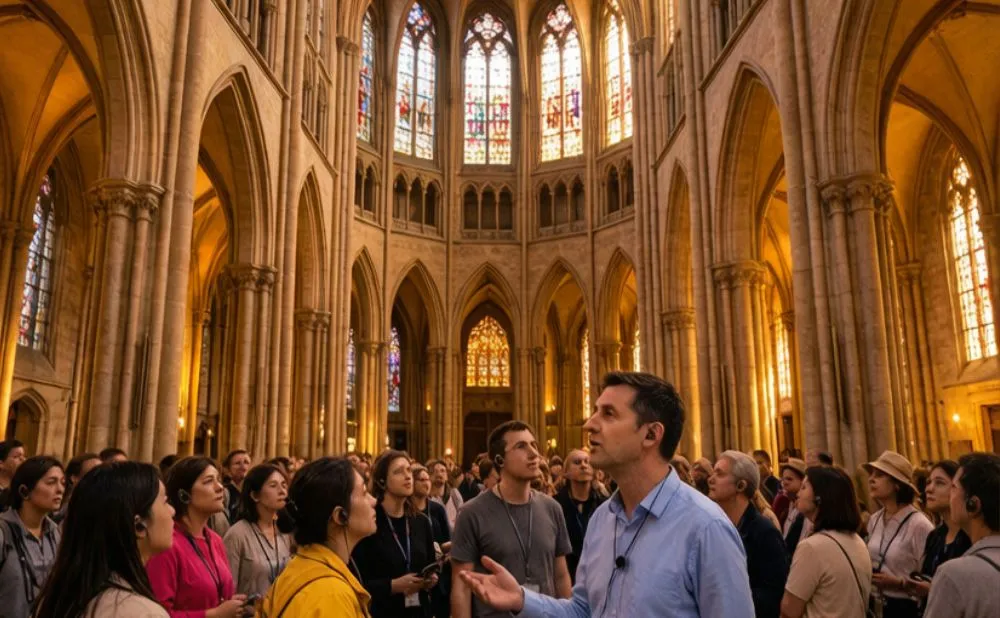
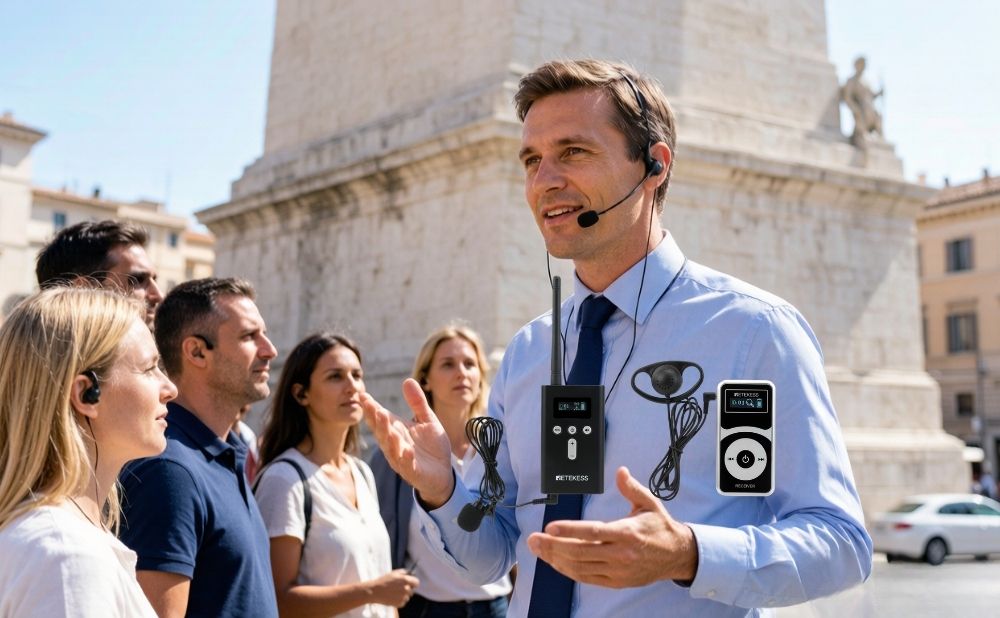
Professional tour guide inside a historic cathedral wearing Retekess T130U wireless transmitter, speaking at whisper volume to a group of 30 tourists wearing compact receivers with earphones
A guide using the T130U whispers commentary while 30 visitors hear every word through their personal receivers — the cathedral remains undisturbed.
How the T130U Works in a Real Cathedral Tour
Let's walk through a typical ca
thedral tour workflow with the T130U to see how the features translate into operational reality:
Step 1: Setup (2 minutes)
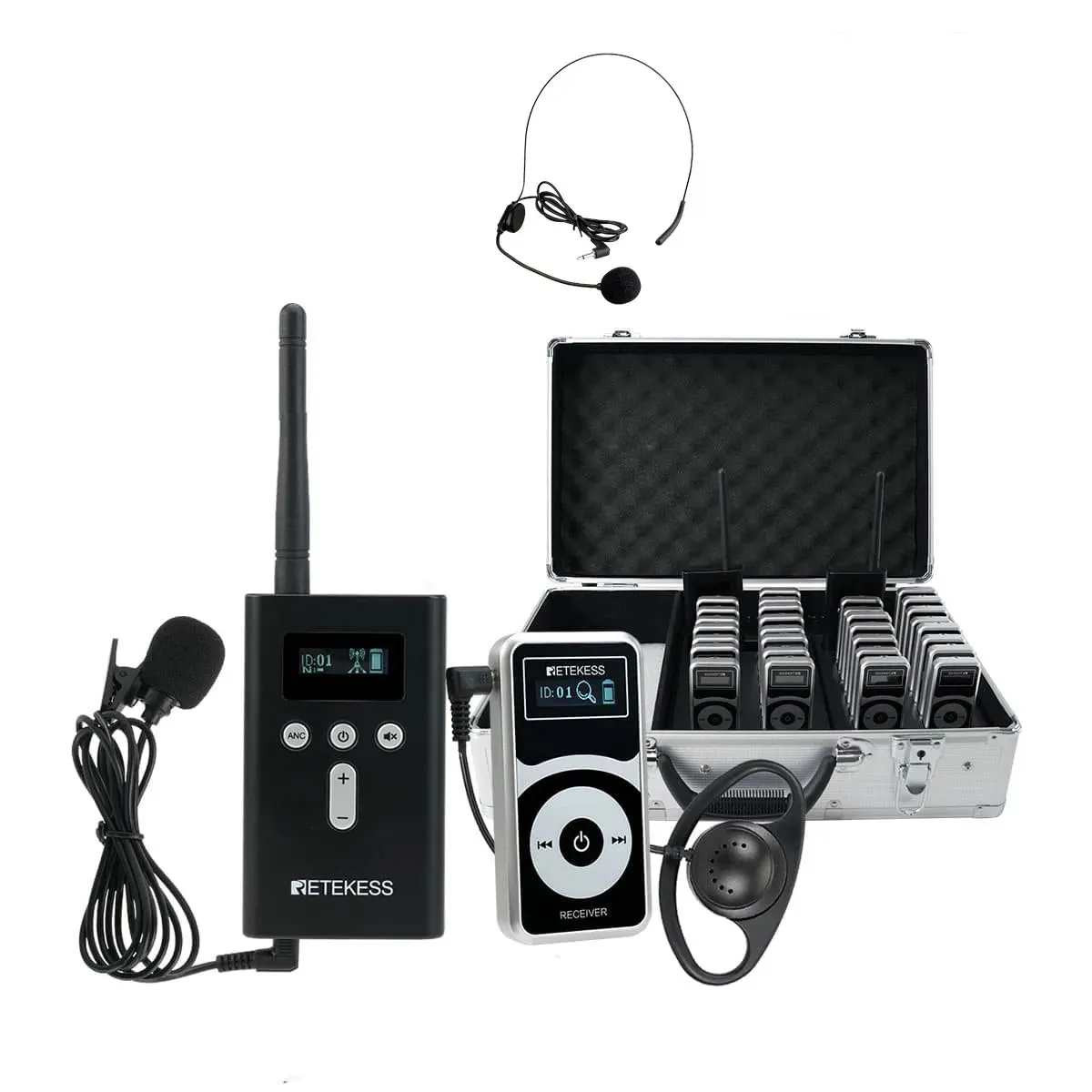
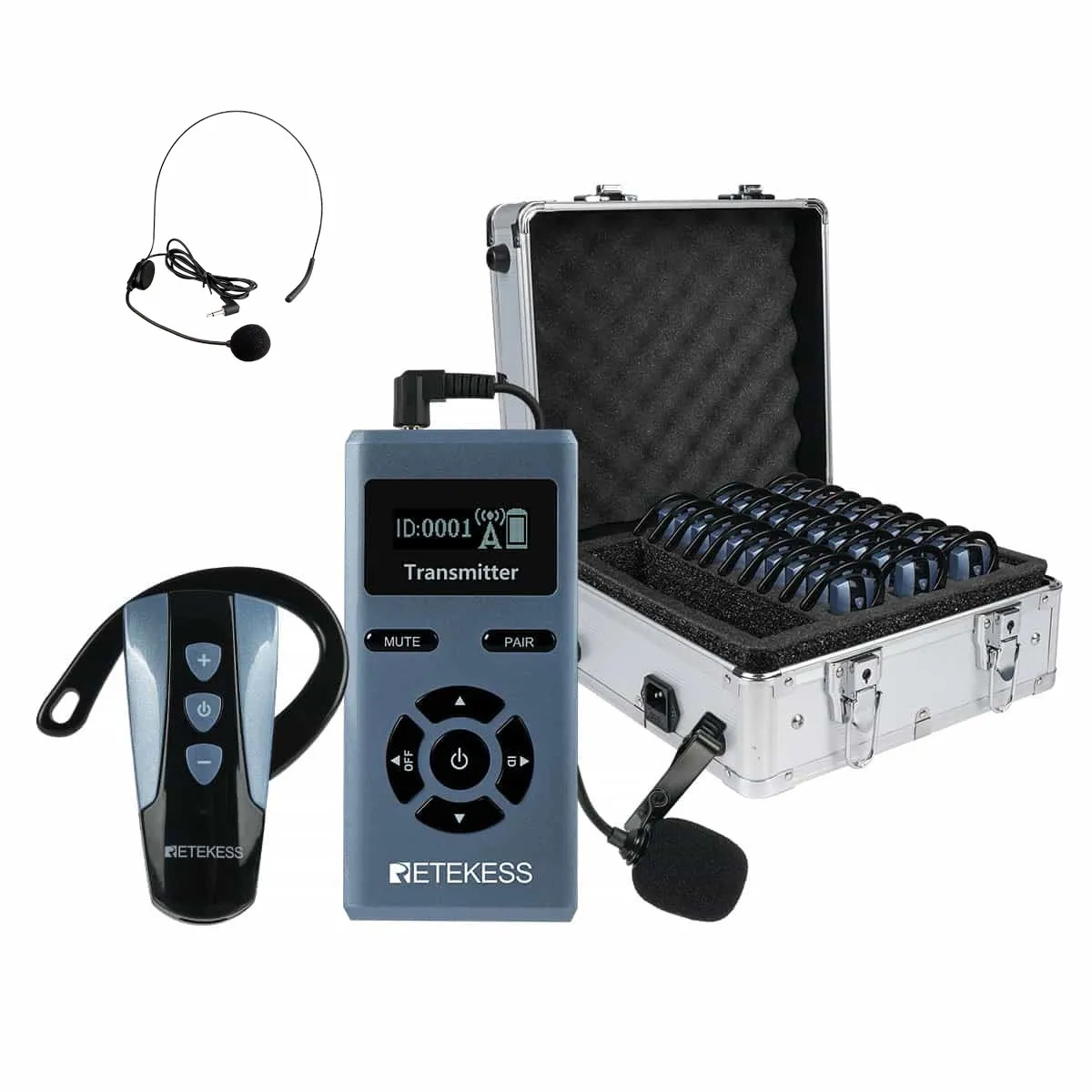
The guide removes the transmitter from the 32-slot or 60-slot charging case, attaches the lapel microphone, and selects a channel. One press of the auto-pairing button synchronizes all receivers to the same channel instantly. Receivers with lanyards are distributed to visitors — each unit weighs just 38 grams and clips unobtrusively to the chest.
Step 2: Whisper Commentary
The guide sets the mic gain to level 1 (whisper mode) and begins the tour. Speaking in a soft, measured voice, they narrate the cathedral's history, architecture, and significance. Each visitor adjusts their own receiver volume — the 10-level range accommodates everyone from hard-of-hearing seniors to young visitors who prefer lower volume.
Step 3: Sacred Moment Pauses
When the tour reaches a side chapel still used for daily prayer, the guide presses the mute button on the transmitter. All 30 receivers go silent simultaneously. The group observes the chapel in respectful quiet. When the guide is ready to resume, one press unmutes all receivers.
Step 4: Multi-Space Navigation
The group moves from the nave through a stone archway into the cloisters. Despite passing through thick stone walls, the UHF signal maintains continuous transmission — no dropouts, no need for the guide to stop and reposition. The 200m range covers the entire cathedral complex.
Step 5: Tour End (30 seconds)
At the conclusion, the guide presses the one-click power-off button on the transmitter. All 30 receivers shut down simultaneously. Visitors return their devices, which are placed back into the charging case. The auto-power-off feature (20 minutes of no signal = automatic shutdown) provides a safety net for any receiver that isn't collected promptly.
Comparison: Why Digital UHF Beats WiFi and Bluetooth in Churches
| Feature | WiFi Audio Apps | Bluetooth Systems | Digital UHF (T130U) |
|---|---|---|---|
| Frequency Band | 2.4 GHz | 2.4 GHz | 902–928 MHz (US) / 823–865 MHz (EU) |
| Stone Wall Penetration | Poor — signal blocked | Poor — 30m max range | Strong — 200m rated range |
| Interference Resistance | Low — WiFi congestion | Low — Bluetooth overlap | High — separate band, digital encoding |
| Simultaneous Groups | 1 (requires app server) | 1 (1-to-1 pairing) | 50 (US) / 19 (EU) channels |
| Whisper-Mode Support | No — mic gain fixed | No — mic gain fixed | Yes — 4-level gain adjustment |
| Receiver Battery Life | Phone battery (varies) | 6–10 hours typical | 40 hours |
| Requires Smartphone? | Yes — app download required | Varies | No — standalone receiver |
| Setup Complexity | High — app, WiFi, pairing | Medium — per-device pairing | Low — one-click auto-pair |
| Audio Processing | Compressed (latency risk) | Compressed (latency risk) | Digital encoding (zero latency, noise elimination) |
The verdict is clear: for church and cathedral tours specifically, digital UHF is the only technology that satisfies all three requirements — silence compliance, stone-wall signal penetration, and multi-group interference isolation — simultaneously.
Retekess T130U — Key Specifications |
|
|
Technology: Digital UHF modulation
|
Frequency (US): 902–928 MHz
|
|
Frequency (EU): 823–832 / 863–865 MHz
|
Channels (US): 50
|
|
Channels (EU): 19
|
Range: 200m / 656ft
|
|
Transmitter Battery: 8 hours (2000mAh)
|
Receiver Battery: 40 hours (600mAh)
|
|
Transmitter Weight: 71g
|
Receiver Weight: 38g
|
|
Mic Gain Levels: 4
|
Receiver Volume Levels: 10
|
|
SNR: -87dB
|
Distortion: 0.01%
|
|
Input Options: MIC, Bluetooth, AUX
|
Warranty: 3 years
|
Frequently Asked Questions
Q: Can I use the T130U in a church without disturbing worshippers?
A: Yes. The T130U's 4-level microphone gain adjustment allows the guide to speak at whisper volume. Visitors control their own receiver volume, so only they hear the commentary — no sound escapes into the sacred space. The transmitter mute function enables instant silence during prayers or moments of reflection.
Q: Will the T130U be affected by WiFi or Bluetooth signals in a modern church?
A: No. The T130U operates on the UHF frequency band (902–928 MHz for the US version; 823–832/863–865 MHz for the European version), which is entirely separate from WiFi (2.4 GHz) and Bluetooth (2.4 GHz) bands. This eliminates cross-frequency interference — a critical advantage in churches with visitor WiFi, audio streaming systems, and hundreds of Bluetooth-enabled smartphones.
Q: How many tour groups can operate simultaneously in the same cathedral?
A: Up to 50 groups (US version) or 19 groups (EU version) can operate simultaneously on different channels without any audio crossover or interference. Each group's channel is digitally encoded, ensuring that receivers only decode audio from their assigned transmitter.
Q: What is the transmission range of the T130U inside a stone cathedral?
A: The T130U has a rated transmission range of 200 meters (656 feet). UHF signals at ~900 MHz penetrate stone walls and arches more effectively than higher-frequency alternatives like WiFi or Bluetooth, though actual range may vary based on building
density and wall thickness. In practice, the system covers the entire footprint of most major cathedrals without signal loss.
Q: Do visitors need a smartphone to use the system?
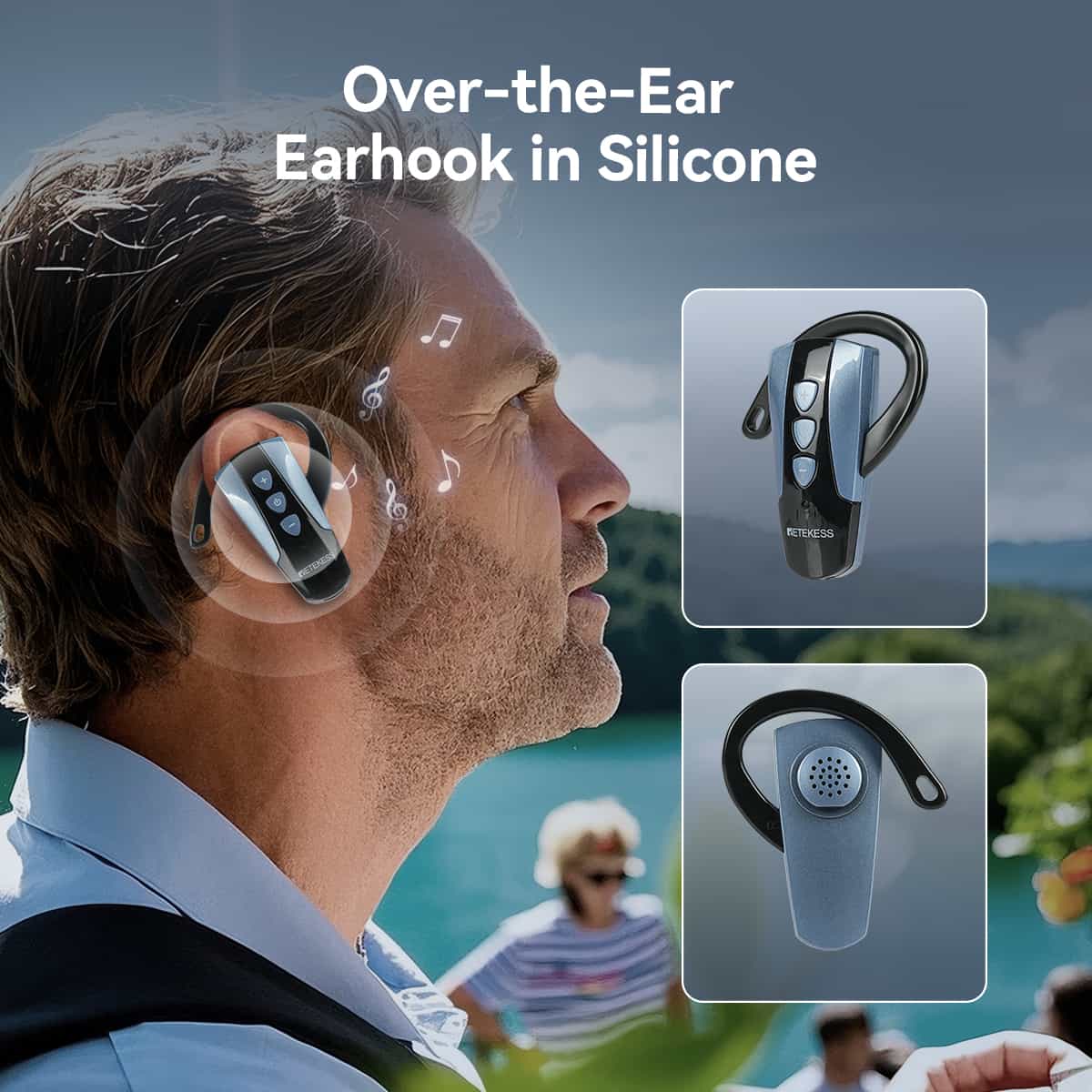
A: No. The T130U uses standalone receiver units with earhook earphones. Visitors simply wear the receiver on a lanyard and adjust their personal volume. There's no app to download, no WiFi to connect to, and no smartphone required — making it accessible to all ages and tech comfort levels, including elderly visitors who may not use smartphones.
Q: What charging options are available for managing large groups?
A: The T130U supports three charging solutions: a 16-slot charging base for small groups, a 32-slot aluminum charging case (charges up to 34 devices simultaneously), and a 60-slot aluminum charging case (charges up to 64 devices simultaneously). All use contact-based charging — simply place devices into their slots. No cables to plug in individually.
Ready to Elevate Your Cathedral Tour Experience?
The Retekess T130U delivers whisper-quiet commentary that respects sacred spaces while ensuring every visitor hears every word. Backed by a 3-year warranty and 30-day return policy.
Explore the T130U →
Final Thoughts: Silence Is Not a Limitation — It's an Opportunity
The most memorable cathedral tours aren't the ones where the guide shouts over the echo. They're the ones where the guide whispers and every visitor hears perfectly — where the technology disappears into the experience, and the sacred space remains undisturbed.
Digital UHF technology doesn't just accommodate silence requirements — it transforms them into a competitive advantage. Whisper-mode tours offer a more intimate, respectful, and immersive experience than any loud-speaker alternative. They allow you to run tours during regular visiting hours without conflict with worship. They let you host more simultaneous groups without audio chaos. And they generate better reviews, repeat visits, and higher per-visitor revenue.
The Retekess T130U is engineered for exactly this scenario. Its 4-level whisper-mode gain, 50-channel multi-group capacity, 200m stone-penetrating range, and 40-hour receiver endurance represent a system designed not just for tour guiding — but for sacred-space tour guiding.
If your church, cathedral, or heritage site demands silence while requiring clarity, the T130U isn't just a good option. It's the right one.
Leave a Reply


![[18th Anniversary] 18 Years of Echoing Excellence: Making Communication Easier, Connecting Trust Beyond Borders](https://res.retekess.com/z_file/20260716/retekess-brand-story-making-communication-easier_20260716151044_7682.jpg)
![[18 Years in Wireless Communication] Silent Disco Systems Anniversary Celebration: Top-Selling Headphones & Event Mechanics Revealed!](https://res.retekess.com/z_file/20260713/18-years-in-wireless-communication-silent-disco-systems-anniversary-celebration_20260713175011_5749.webp)
![[Anniversary Carnival] Ding-dong! 18th Anniversary Mega Sale on Guest Paging & Calling Systems: Full Reveal of 12+ Products & Promo Rules!](https://res.retekess.com/z_file/20260713/18th-anniversary-mega-sale-on-guest-paging-calling-systems_20260713175257_0295.webp)
![[Retekess 18th Anniversary Teaser] Tour Guide System Exclusive Perks: Sneak Peek at Event Dates & Mechanics!](https://res.retekess.com/z_file/20260713/retekess-18th-anniversary-tour-guide-system-exclusive-perks--2-_20260713180135_6435.webp)
Follow Us
Pay With


 Google
 Amazon
Comments (0)