
Table of Contents
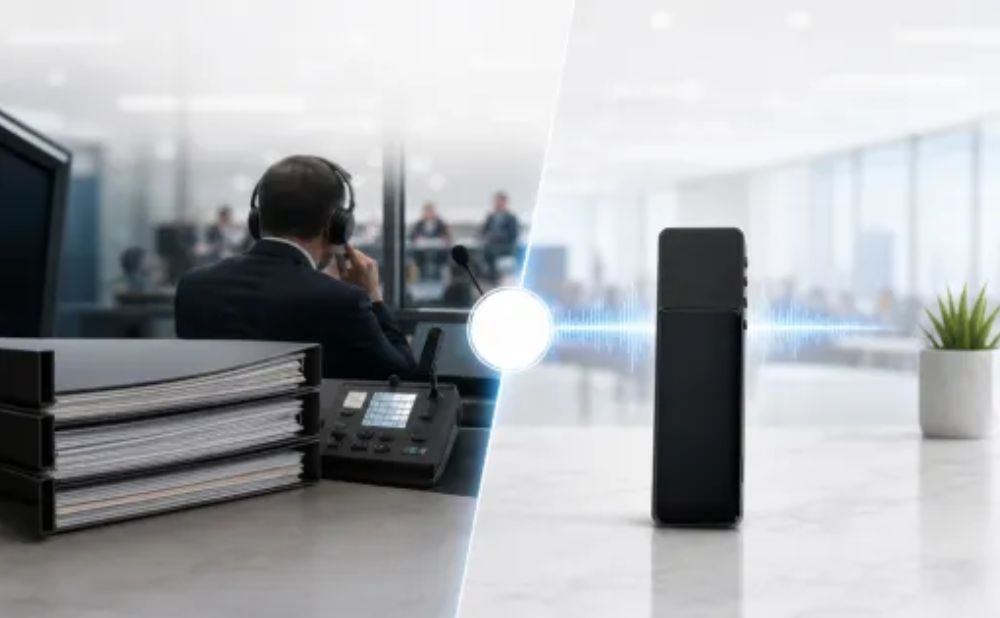
The $8,200 Interpreter Bill That Could Have Been Avoided: AI Translation vs Human Interpreters
- Retekess
- Sep 7, 2026
For most businesses, a single-day corporate factory tour or regional industry forum costs between $4,000 and $8,200 for professional human simultaneous interpretation services. That figure is not an outlier—it is the market standard.
At the same time, the AI language translator market is already valued at $7.6 billion in 2025 and is projected to reach $55 billion by 2035, growing at over 21% annually. Organizations are quietly re-examining a decades-old assumption: that professional human interpretation is the default setting for every cross-language meeting.
The reality is more nuanced. Human interpreters remain essential for high-stakes legal, medical, and diplomatic settings. For daily operations—supplier training, safety briefings, cross-border plant tours, and multilingual tours—an AI translation device for meetings now delivers coverage that is fast, consistent, and operationally scalable. The question has shifted from "Which is better?" to "Which scenario fits which solution?"
This guide answers exactly that. Below is a five-dimension breakdown of cost, availability, language coverage, on-site logistics, and institutional memory, followed by a scenario matching table your team can use today.
Quick Answer: What Is the Cost per Hour of AI Translation vs Traditional Interpreters?
If you are evaluating a single event, here is the shorthand version.
|
Cost Factor |
Traditional Human Interpreters |
AI Translation Device |
|
Effective hourly rate |
$125–$375 per hour (dual-team equivalent) |
$15–$50 per hour of active use |
|
Minimum booking |
Full day (6–8 hours) |
Metered by the hour |
|
Language pairs |
Limited by certified talent pool |
Typically 100–120+ languages |
|
Setup time |
Weeks for rare language pairs |
Minutes |
|
Best fit |
Legal, medical, diplomatic precision |
Factory tours, training, routine meetings |
The human rate reflects interpreter salary benchmarks plus structural overhead: dual-person teams, booth rental, travel, and equipment logistics. The AI rate reflects pure usage metering with no minimums.
For the full cost architecture, read on.
Simultaneous Interpretation Cost Breakdown
Before comparing solutions, it is worth understanding why simultaneous interpretation cost is structured the way it is. The pricing is not arbitrary; it reflects genuine structural constraints.
Interpreter Salary and Day-Rate Economics
If you have ever asked how much do interpreters cost, the answer depends heavily on certification level and geography.
ZipRecruiter's June 2025 data shows U.S. remote interpreters earn $25.24–$38.70 per hour on average. Certified simultaneous interpreters, however, typically charge $500–$1,500 for a standard 6–8 hour full-day assignment. That translates to an effective rate of roughly $60–$250 per hour for the individual interpreter.
But professional standards mandate two interpreters per language for sessions longer than 60 minutes to prevent cognitive fatigue. That means a single-language setup already starts at $1,000–$3,000 per day before equipment or travel is added.
The Hidden Cost Stack
A single day of interpretation routinely balloons into a five-figure expense because of fixed overhead:
- Dual-interpreter requirement for sessions over one hour
- Booth rental and wireless receiver logistics
- Travel allowances and per-diem for non-local talent
- Prep time (interpreters often require materials days in advance)
- Scarcity premium for rare language pairs or short-notice bookings
- Scale that to a 500-person, five-language event, and the total routinely exceeds $16,000—often climbing past €50,000 for complex multi-day programs.
What Is the Cost per Hour of AI Translation vs Traditional Interpreters?
For organizations running recurring global meetings, the math becomes decisive.
A traditional dual-interpreter team for one language pair costs roughly $1,000–$3,000 per day. Divided across an 8-hour session, that is $125–$375 per effective hour—and that figure assumes you can fill the full day. If you only need two hours of Polish-to-Thai coverage, you still pay the full day rate because the talent pool is too small to support fractional bookings.
By contrast, modern AI-powered translation tools operate on a radically different economic model. Usage is metered by the hour, not by the event. A real-time translation device used for factory training or regional trade shows typically runs at an equivalent of $15–$50 per hour of active translation, with no minimum block. For organizations running weekly multilingual stand-ups or monthly supplier audits, the operational savings run 60–90% compared to human-only workflows.
The cost advantage is not about replacing expertise; it is about matching the tool to the task. A routine engineering review does not carry the same liability profile as a contract negotiation. Paying a premium for the latter makes sense. Paying the same premium for the former is a structural inefficiency.
Five-Dimension Breakdown: Languages Translation Tool vs. Human Interpreter
1. Cost Architecture — From Event Pricing to Usage Metering
Human interpretation is priced like a bespoke professional service because, in many ways, it still is. The simultaneous interpretation cost reflects years of training, certification, and physical limits (cognitive fatigue requires rotation).
An AI translation device for meetings inverts that model. There is no per-diem, no flight, no booth, and no cancellation fee. For a manufacturing firm with plants in Eastern Europe and Southeast Asia, eliminating relay chains and day-rate minimums changes the economics of cross-border operations entirely.
2. Availability Gap — From Calendar Hunting to 24/7 Readiness
Human interpreters are bound by time zones, vacation calendars, and international conference cycles. For event organizers, the chronic anxiety is rarely "Can we find an interpreter?" but rather "Can we find one on our specific date?"
AI ecosystems remove this constraint. They do not get jet-lagged, do not require six-week lead times, and do not cancel because of a family emergency. Salt Technologies AI reports that 85% of Fortune 500 firms use AI tools in some capacity as of 2026, with real-time translation among the fastest-growing adoption categories.
3. Language Ceiling — Why 24 Official Languages Still Leave You Stranded
Perhaps the most stubborn limitation of human interpretation is language coverage. The EU has 24 official languages, but the number of qualified conference interpreters for certain pairs—say, Thai to Finnish or Vietnamese to Polish—is effectively zero. Organizations are forced into relay setups: Thai to English to Finnish, requiring two separate two-person teams. One cancellation breaks the entire chain.
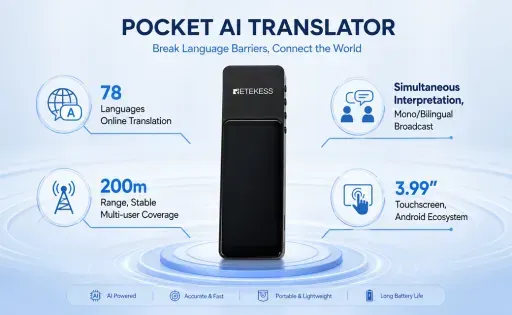
A 120 language translator device resolves this barrier. Supporting real-time translation across 120 languages, it eliminates multi-person relay workflows. Its auto voice recognition detects spoken languages and switches translation targets automatically. This seamless function fits multilingual tours, cross-border training, and factory sites where speakers alternate languages—an advantage human interpretation teams cannot match logistically.
4. On-Site Experience — From Booth Infrastructure to Pocket-Size Deployment
Human interpretation changes the physics of a meeting. Speakers unconsciously slow down, simplify sentences, and insert pauses to accommodate the interpreters. Attendees wear bulky receiver headsets tethered to infrastructure that requires technicians, frequency management, and line-of-sight logistics.
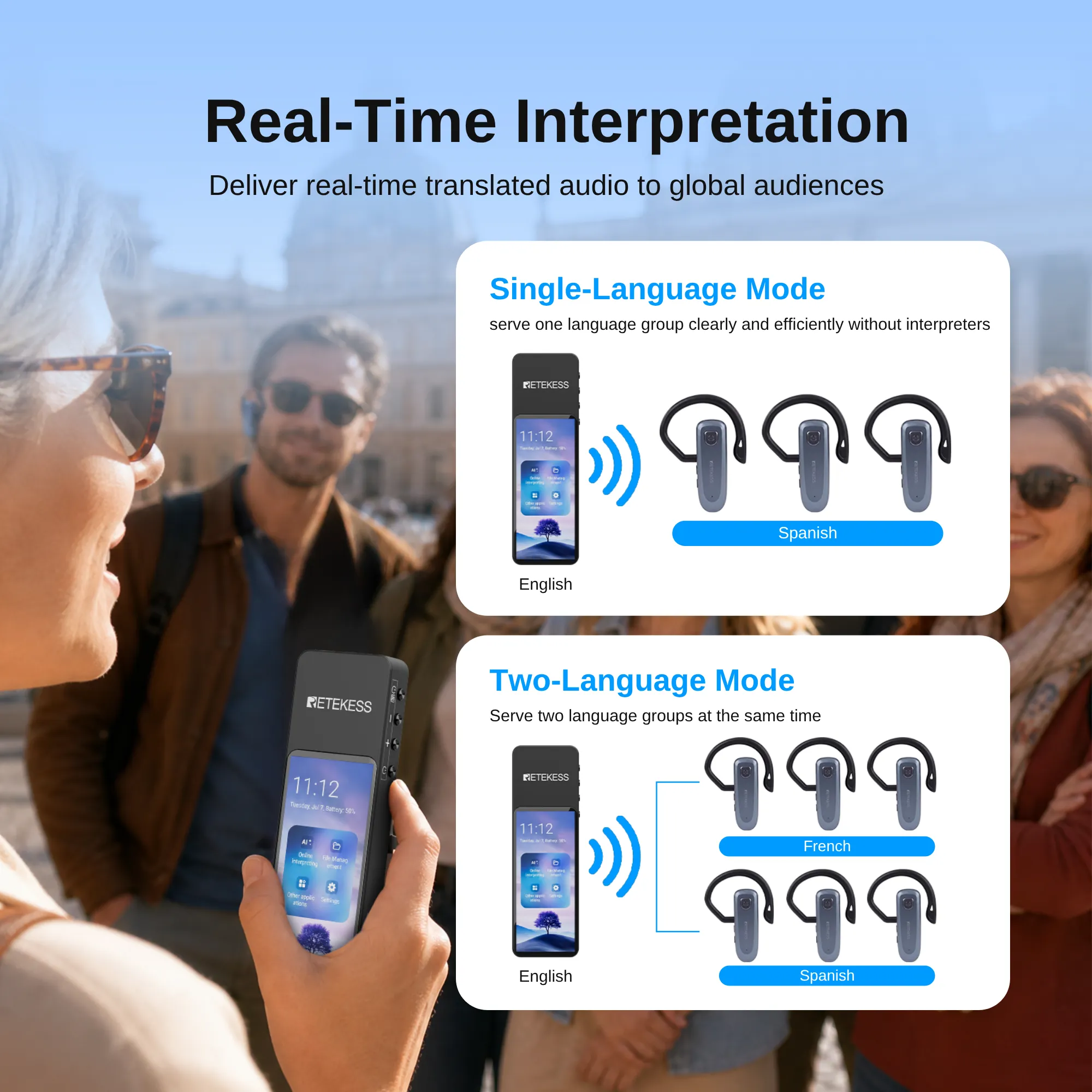
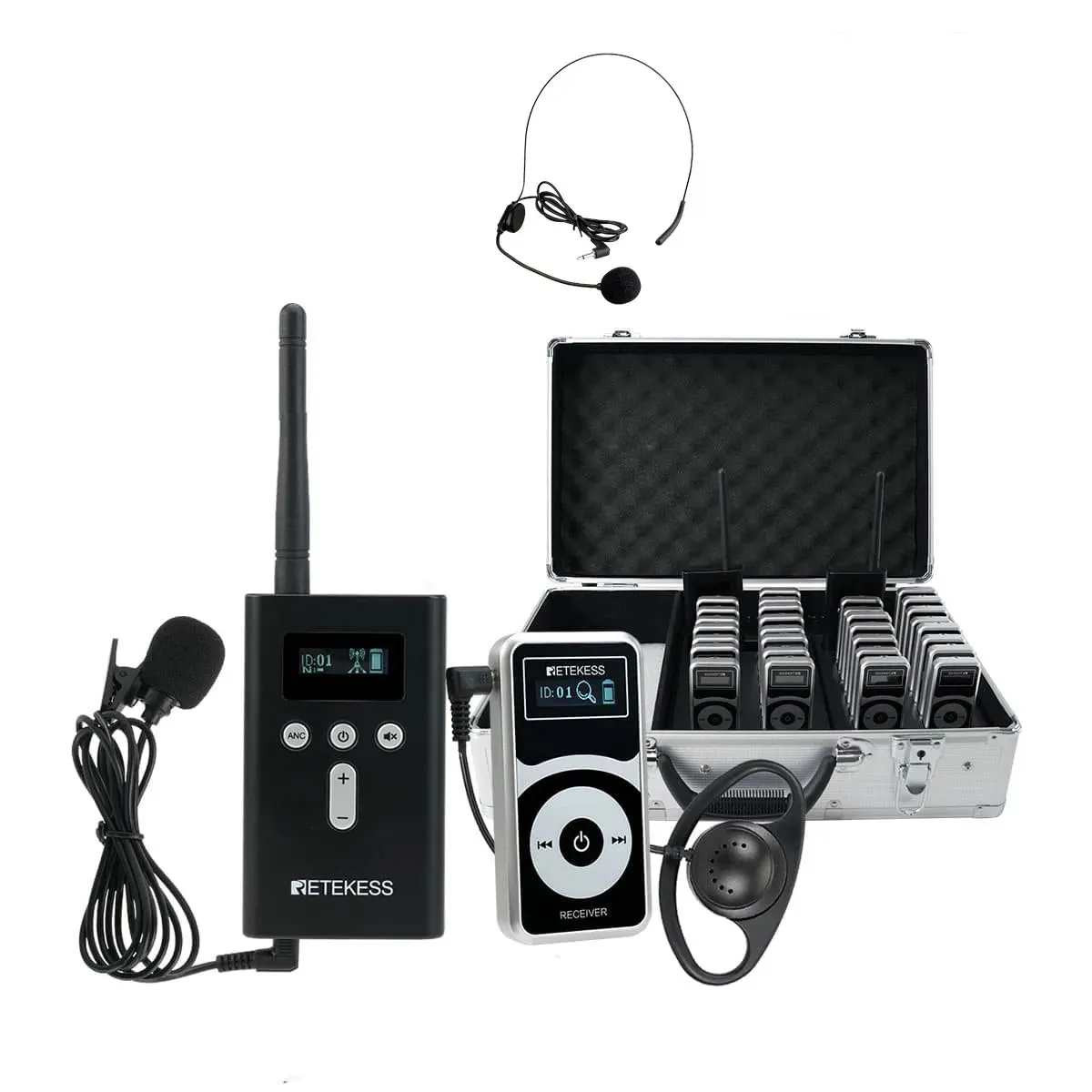
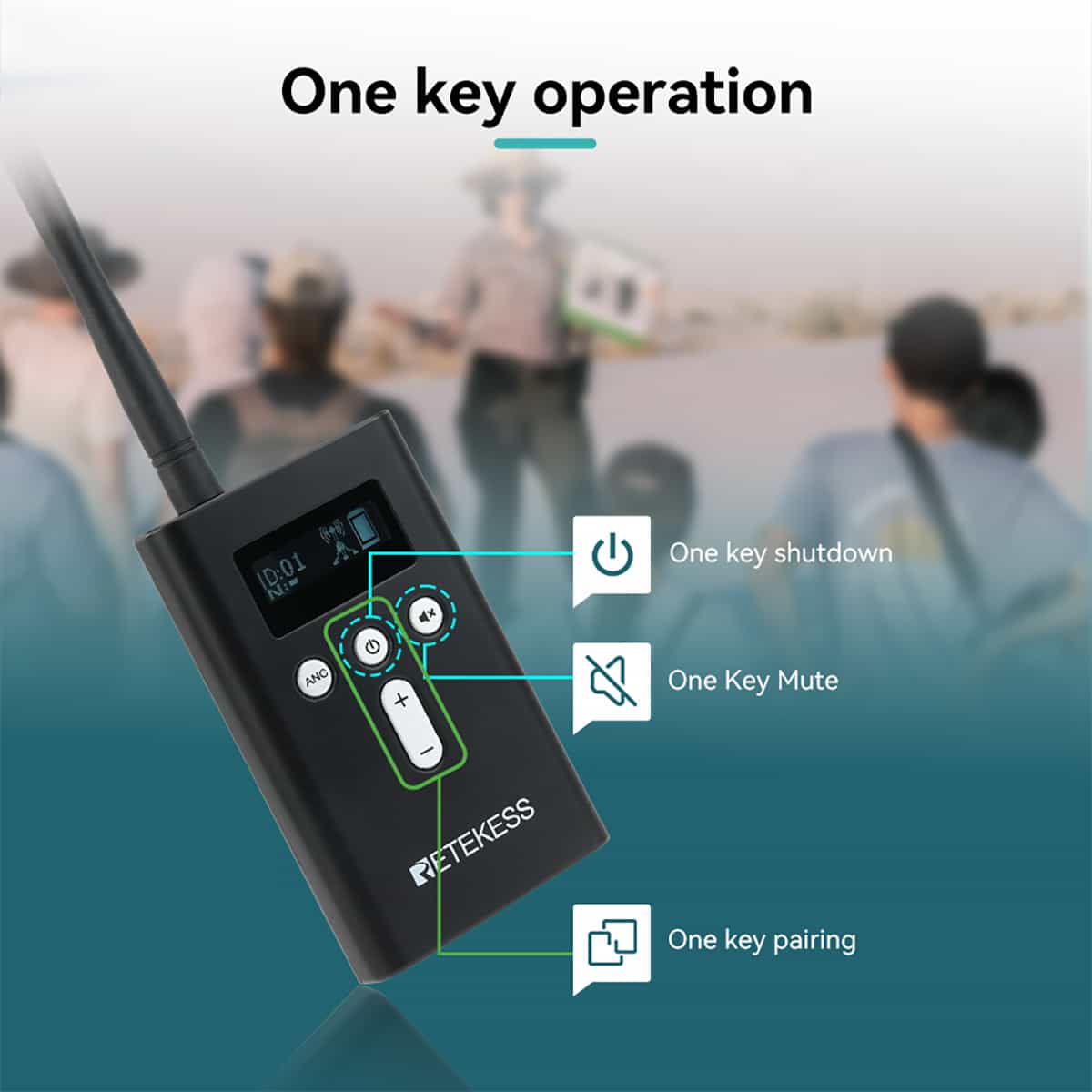
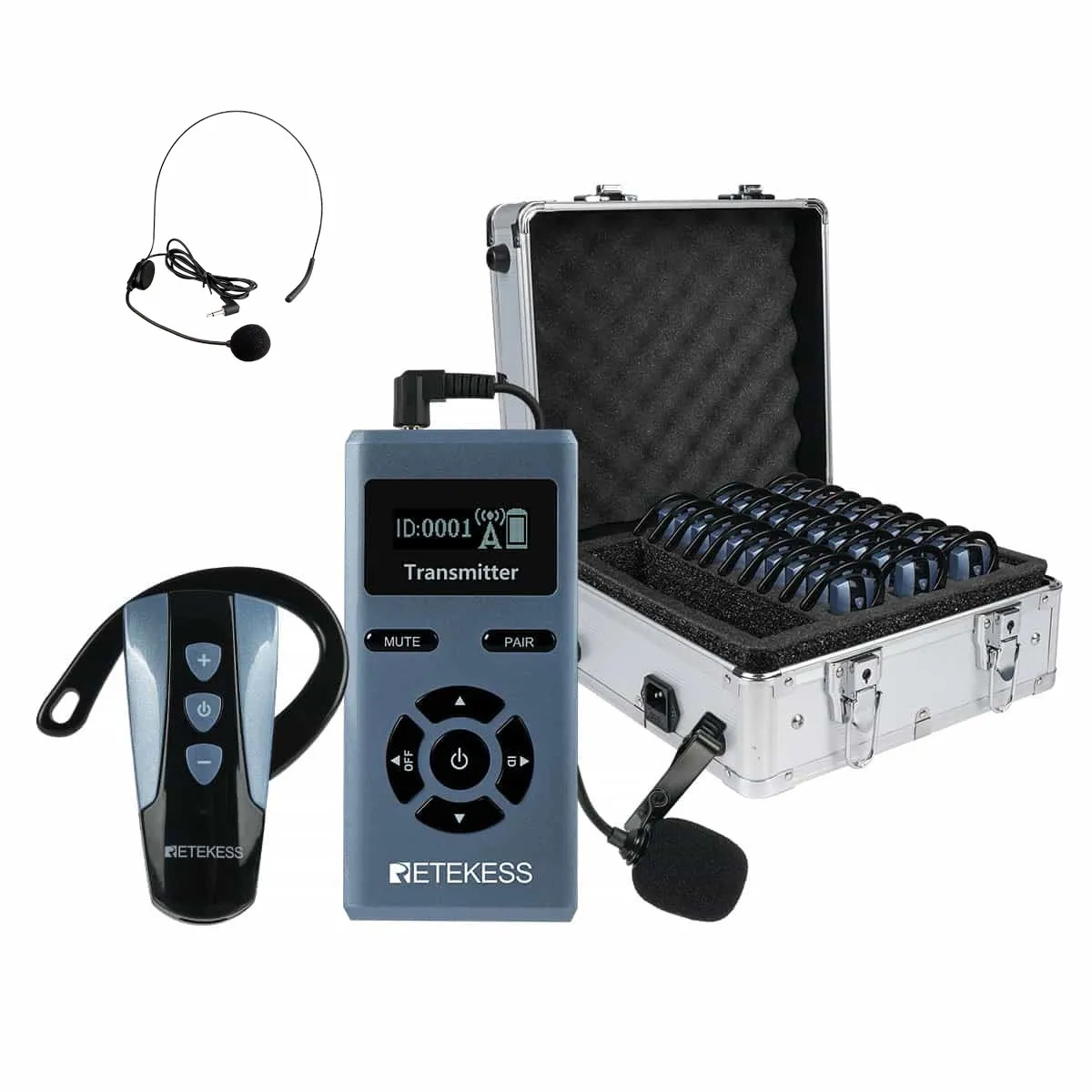
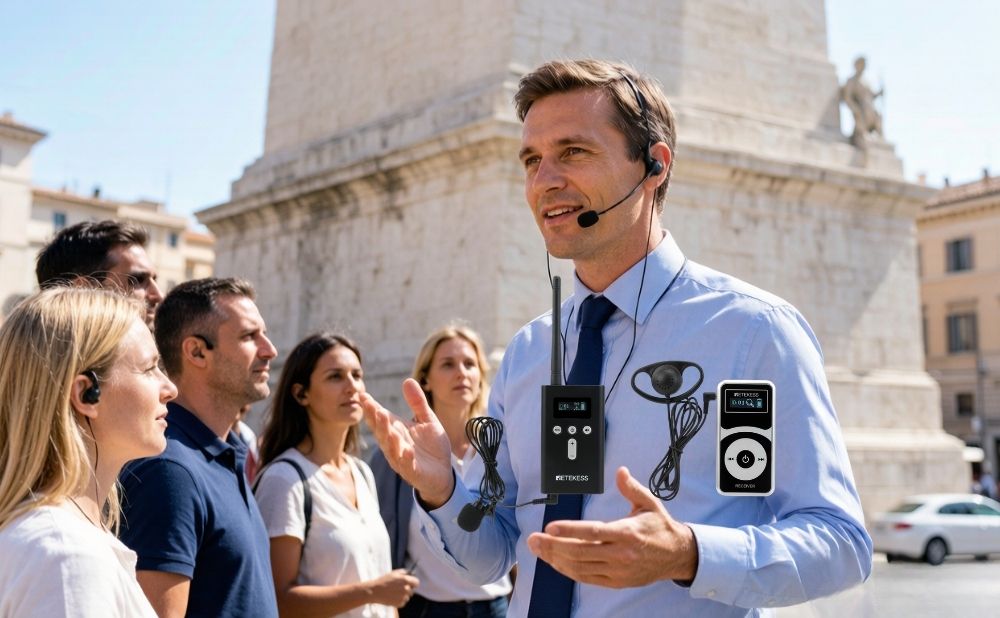
A modern real-time translation device changes the deployment profile. Compact transmitters stream simultaneous translation straight to audience earphones or phones, with single/dual-language broadcast modes. For example, a German speech can stream live Arabic on one channel and saved English summaries on another.
Gone are bulky full-size interpreting booths—this gear fits in a shoulder bag. Event planners benefit from fewer on-site staff, faster venue setup, and a smooth, uninterrupted attendee experience.
5. From Translation to Institutional Memory
AI translation cannot fully match human interpreters for all scenarios. Mistranslation in legal, medical, or diplomatic settings may lead to severe consequences. Certified human interpreters offer unmatched cultural expertise, tonal judgment, and professional accountability.
Still, most routine corporate communication carries minimal risk: engineering meetings, supplier training, safety briefings, and product demos only demand fast, consistent multilingual coverage. Here, AI's near-comparable performance and far lower cost make it the operationally sound choice. The session output can also be logged, summarized, and archived—creating institutional memory that live human interpretation does not automatically produce.
Who Is Actually Making the Switch?
The migration is not theoretical. European Works Council coordinators are renegotiating agreements to allow AI-assisted interpretation for routine updates while reserving human teams for legally sensitive votes. Conference organizers in Barcelona and Berlin are deploying hybrid models: human interpreters for keynote stages, AI-powered tools for breakout sessions and networking lounges.
Manufacturing firms with plants in Eastern Europe and Southeast Asia are eliminating relay chains entirely by adopting direct multilingual hardware on the factory floor. In one typical deployment, a compact transmitter system is used for weekly safety briefings across six languages—something that would have required three separate human teams under the old model.
The pattern is consistent: human interpreters are retreating to the high-stakes perimeter, while AI handles the operational core.
Scenario Boundary: AI Translation vs Human Interpreters
Modern AI translation does not replace human interpreters completely. It undertakes mass daily, low-threshold scenarios to cut redundant costs, while human experts retain high-precision professional contexts.
|
Scenario Type |
Recommended Solution |
Core Reason |
|
Diplomatic summits, legal & medical conferences, high-precision negotiations |
Professional Human Interpreters |
Require domain accuracy, tonal nuance, and rigorous liability coverage |
|
Factory tours, cross-border staff training, regional trade shows |
Automatic Translation Device |
Low simultaneous interpretation cost, flexible deployment, mixed-language adaptation |
|
Multinational tours, museum multilingual guidance, tourism |
Tour Guide Translation System |
Bilingual broadcast + auto language recognition for fluid tourist scenarios |
For enterprises and event operators, spending thousands of dollars on human interpreter services for every daily multilingual activity is unnecessary budget strain. Professional human interpreters are essential for top-level, rigorous scenarios. Most commercial, training, and tourism scenarios only need flexible, stable, and cost-effective AI-powered translation tools.
Conclusion
That $8,200 interpreter invoice was not really a bill for translation. It was a bill for structural scarcity, for geographical concentration, for the physical limits of human cognition, and for a workflow that treats every multilingual conversation as a bespoke event.
The organizations that avoid this bill are not settling for inferior communication. They are simply recognizing that a languages translation tool capable of 120+ language coverage, adaptive speech recognition, and seamless on-site deployment is no longer a futuristic novelty—it is the new baseline for global operations.
For teams managing multilingual training, international site visits, or cross-border production lines, solutions that pair broad language simultaneous interpretation with AI-generated session summaries represent the new operational baseline. The question has shifted from "Can we afford AI translation?" to "Can we still afford not to?"
Frequently Asked Questions About AI Translation vs Human Interpreters
What is the cost per hour of AI translation vs traditional interpreters?
Traditional simultaneous interpretation with dual interpreters effectively costs $125–$375 per hour. An AI translation device for meetings runs at roughly $15–$50 per hour of active use, with no minimum booking block. For recurring multilingual meetings, AI typically reduces interpretation spend by 60–90%.
How much do interpreters cost for a full-day corporate event?
Certified simultaneous interpreters charge $500–$1,500 per 6–8 hour day, and professional standards require two interpreters per language for sessions over 60 minutes. That means a single-language setup starts at $1,000–$3,000 before booth rental, travel, or equipment. Interpreter salary benchmarks and structural scarcity drive these rates.
When should we use an AI translation device instead of human interpreters?
An AI translation device for meetings fits routine corporate scenarios—factory tours, supplier training, safety briefings, and product demos—where speed and consistency matter more than legal liability. Reserve human interpreters for diplomatic, legal, and medical settings that demand tonal nuance and certified accountability.
Can one device really cover 120 languages?
Yes. A 120 language translator device receives spoken input, detects the source language automatically, and outputs real-time translation across all supported pairs. This eliminates relay chains for rare combinations like Thai-to-Finnish, which human teams often cannot staff.
What infrastructure is needed to deploy a real-time translation device on-site?
A modern real-time translation device streams audio directly to attendee receiver earphones via a compact transmitter. It requires no interpreting booth, no technician, and no line-of-sight frequency management—setup fits in a shoulder bag and takes minutes rather than hours.
Is the Retekess TT136 suitable for factory tours and trade shows?
Yes. The TT136 functions as a portable automatic translation device with auto voice recognition and broad language coverage. It is designed for mixed-language environments where speakers alternate languages, making it well-suited for factory tours, cross-border training, and regional trade show floors.
Leave a Reply


![[18th Anniversary] 18 Years of Echoing Excellence: Making Communication Easier, Connecting Trust Beyond Borders](https://res.retekess.com/z_file/20260716/retekess-brand-story-making-communication-easier_20260716151044_7682.jpg)
![[18 Years in Wireless Communication] Silent Disco Systems Anniversary Celebration: Top-Selling Headphones & Event Mechanics Revealed!](https://res.retekess.com/z_file/20260713/18-years-in-wireless-communication-silent-disco-systems-anniversary-celebration_20260713175011_5749.webp)
![[Anniversary Carnival] Ding-dong! 18th Anniversary Mega Sale on Guest Paging & Calling Systems: Full Reveal of 12+ Products & Promo Rules!](https://res.retekess.com/z_file/20260713/18th-anniversary-mega-sale-on-guest-paging-calling-systems_20260713175257_0295.webp)
![[Retekess 18th Anniversary Teaser] Tour Guide System Exclusive Perks: Sneak Peek at Event Dates & Mechanics!](https://res.retekess.com/z_file/20260713/retekess-18th-anniversary-tour-guide-system-exclusive-perks--2-_20260713180135_6435.webp)
Follow Us
Pay With


 Google
 Amazon
Comments (0)