
Table of Contents
Conference Interpretation Systems: Cost, Reliability & How to Choose
- Retekess
- Sep 18, 2026
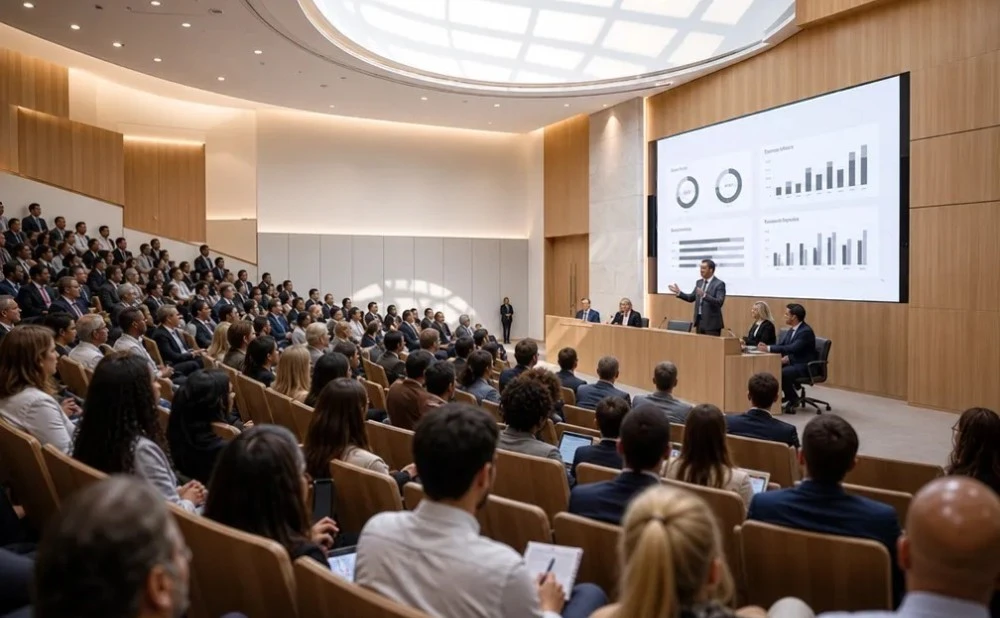
Multilingual communication is now a routine need for global companies. From all-hands meetings and employee training to product launches and international conferences, many corporate events bring together audiences who speak different languages.
Choosing a corporate conference interpretation system is about more than audio equipment. Companies need to solve two separate challenges: translation and audio distribution. Translation converts the original speech into another language, while audio distribution delivers that translated content to the right listeners.
Once these functions are viewed separately, it becomes easier to compare traditional interpretation systems, UHF wireless solutions, and AI-powered translation. The most cost-efficient option is not always the cheapest—it is the system that best fits the event’s language needs, audience size, venue setup, and reliability requirements.
Why Multilingual Corporate Events Are Difficult to Scale
A small bilingual meeting can often be handled with a few interpreters and basic audio equipment. Large corporate events are different.
As the number of languages and participants increases, companies must manage multiple interpretation channels while ensuring that each audience group receives the correct audio. At the same time, the system needs to remain reliable throughout presentations, training sessions, and Q&A periods.
For example, a global employee conference may involve several language groups and hundreds of attendees. The interpretation system must therefore address more than language conversion. It must provide consistent audio distribution, manageable equipment deployment, and enough capacity for the audience.
This becomes even more important when the same company holds multilingual training sessions repeatedly. A system that takes significant time and technical resources to install at every event can create operational costs beyond the initial equipment purchase.
Where Traditional Conference Interpretation Systems Become Expensive
Traditional simultaneous interpretation systems can provide a structured solution for large conferences, but their total cost includes more than transmitters and receivers.
Depending on the venue and system design, expenses may include:
|
Cost Area |
Typical Considerations |
|
Equipment |
Transmitters, receivers, control equipment |
|
Cabling |
Audio and communication connections |
|
Installation |
System setup and configuration |
|
Technical Support |
On-site technicians and troubleshooting |
|
Logistics |
Equipment transportation and handling |
|
Venue Preparation |
Power, tables, interpretation areas and connections |
|
Reconfiguration |
Adjustments when layouts or room arrangements change |
The more complicated the infrastructure, the more preparation may be required before participants enter the room.
For companies that organize multilingual events regularly, this raises an important question: Can the audio distribution layer be simplified without changing the way professional interpretation is performed?
This is where wireless interpretation becomes an alternative architecture.
Two Ways to Build a Multilingual Corporate Communication System
There are two fundamentally different approaches that companies can consider.
Option 1: Human Interpretation + UHF Wireless Audio Distribution
The first approach keeps professional human interpretation at the center of the workflow while simplifying how the translated audio reaches participants.
The basic architecture is:
Speaker → Human Interpreter → UHF Transmitter → Wireless Receivers → Audience
In this model, the wireless system does not perform the translation. The interpreter listens to the speaker and provides the translated speech. The UHF system then distributes that audio wirelessly to the audience.
This distinction is important because it defines what the system is actually solving: reliable audio distribution rather than automatic translation.
No Internet Required
One of the main characteristics of a UHF wireless interpretation system is that audio transmission does not depend on an internet connection.
For a corporate conference, this can simplify deployment when the venue's network is limited, heavily used, or not intended to support the interpretation workflow.
The system can operate as a local wireless audio network, allowing participants to receive the interpreter's channel without relying on cloud-based translation services.
This makes UHF wireless distribution particularly relevant when professional interpreters are already available and the main challenge is getting their translated audio to a large audience.
Designed for Large-Group Audio Distribution
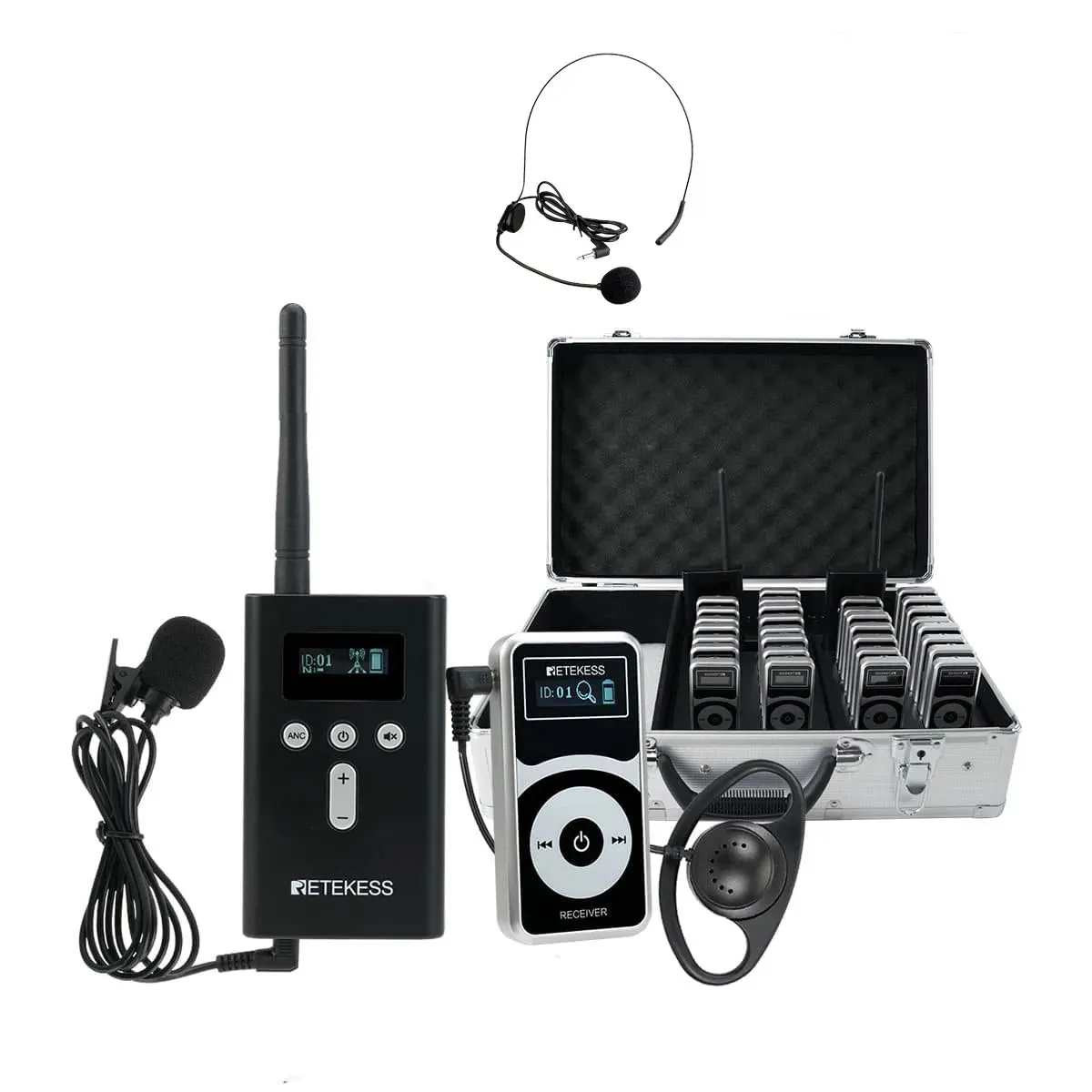
A wireless transmitter can distribute the interpreter's audio to multiple receivers, allowing the audience to listen through individual receiving devices.
For large meetings, the architecture can therefore scale primarily by adding receivers for additional participants rather than redesigning the entire audio path.
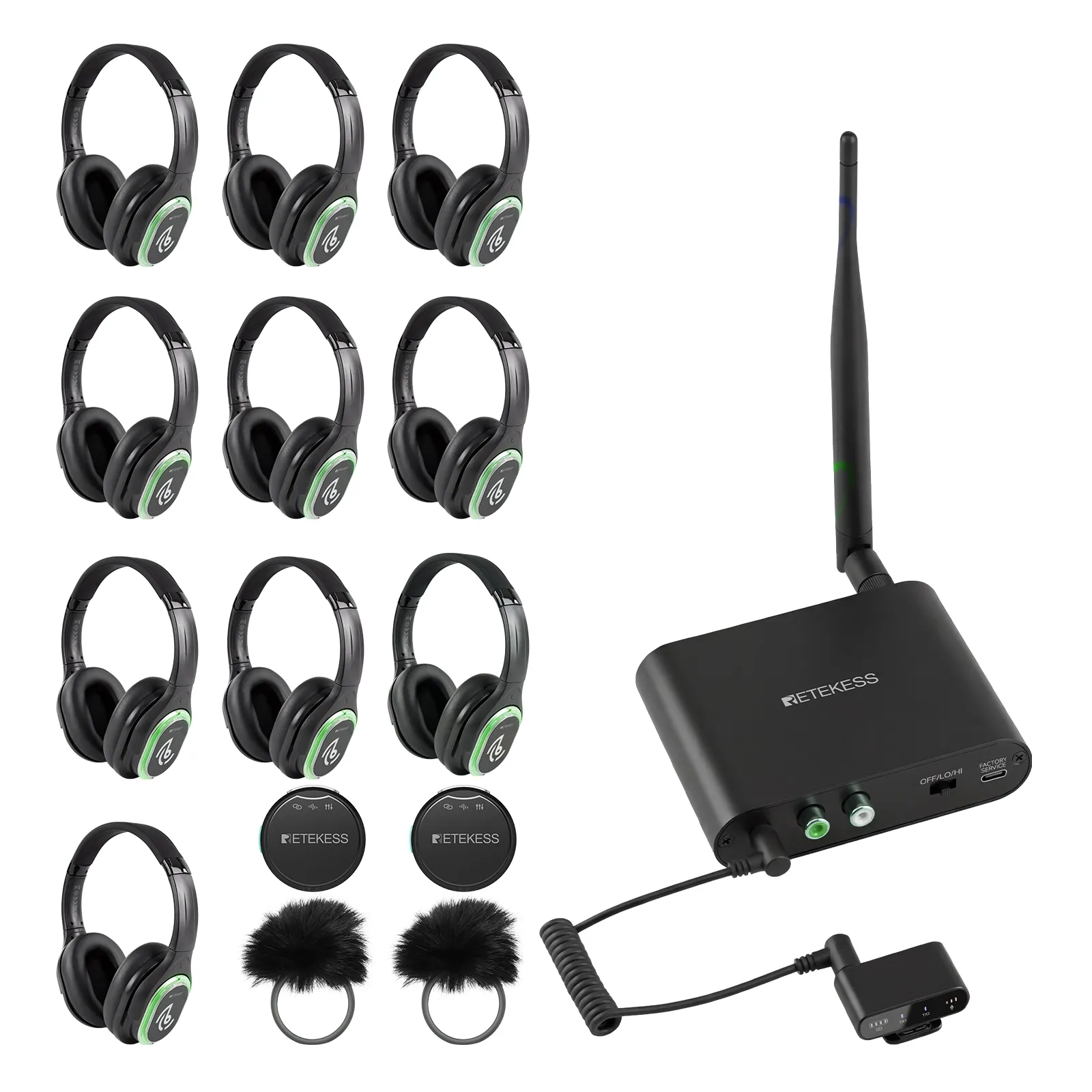
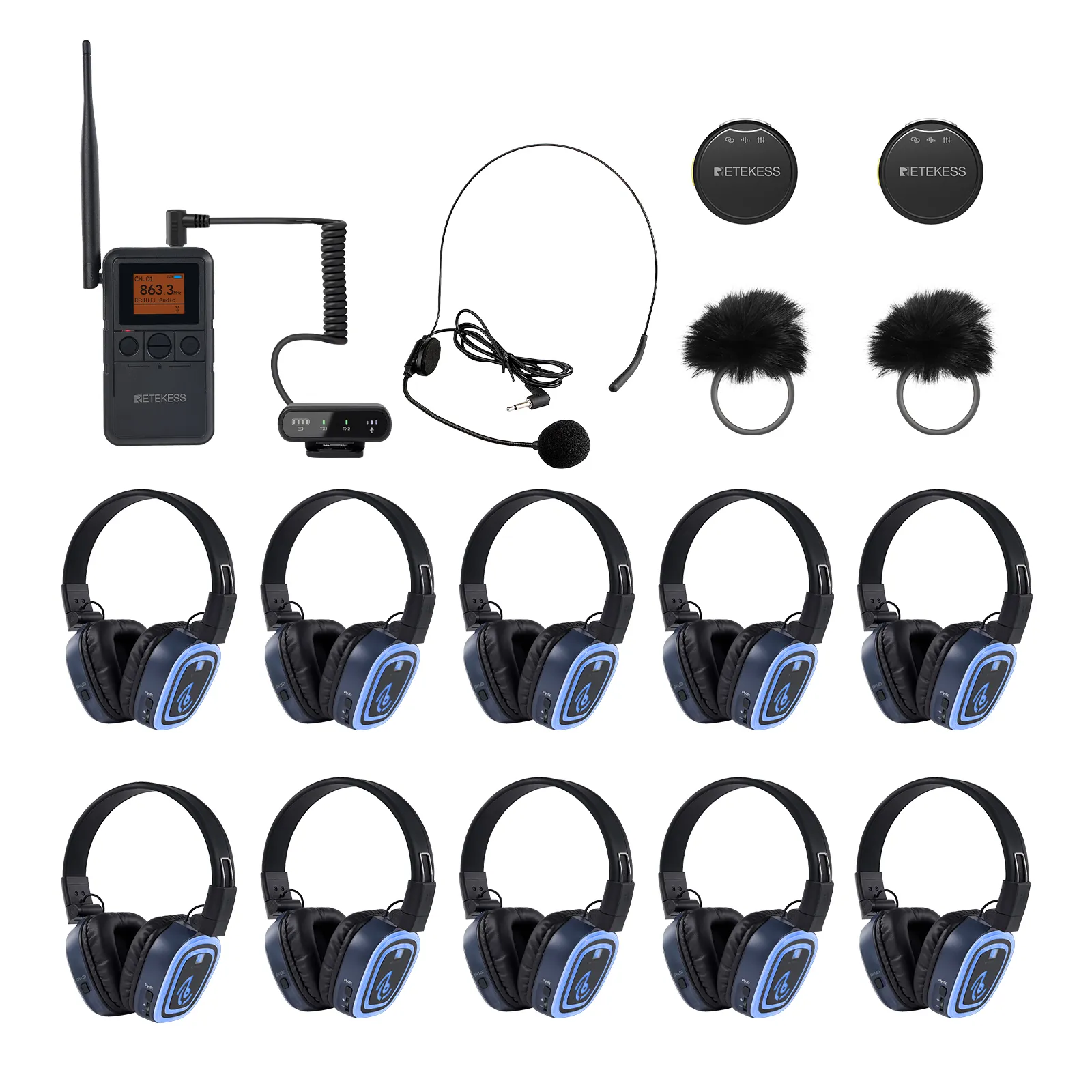
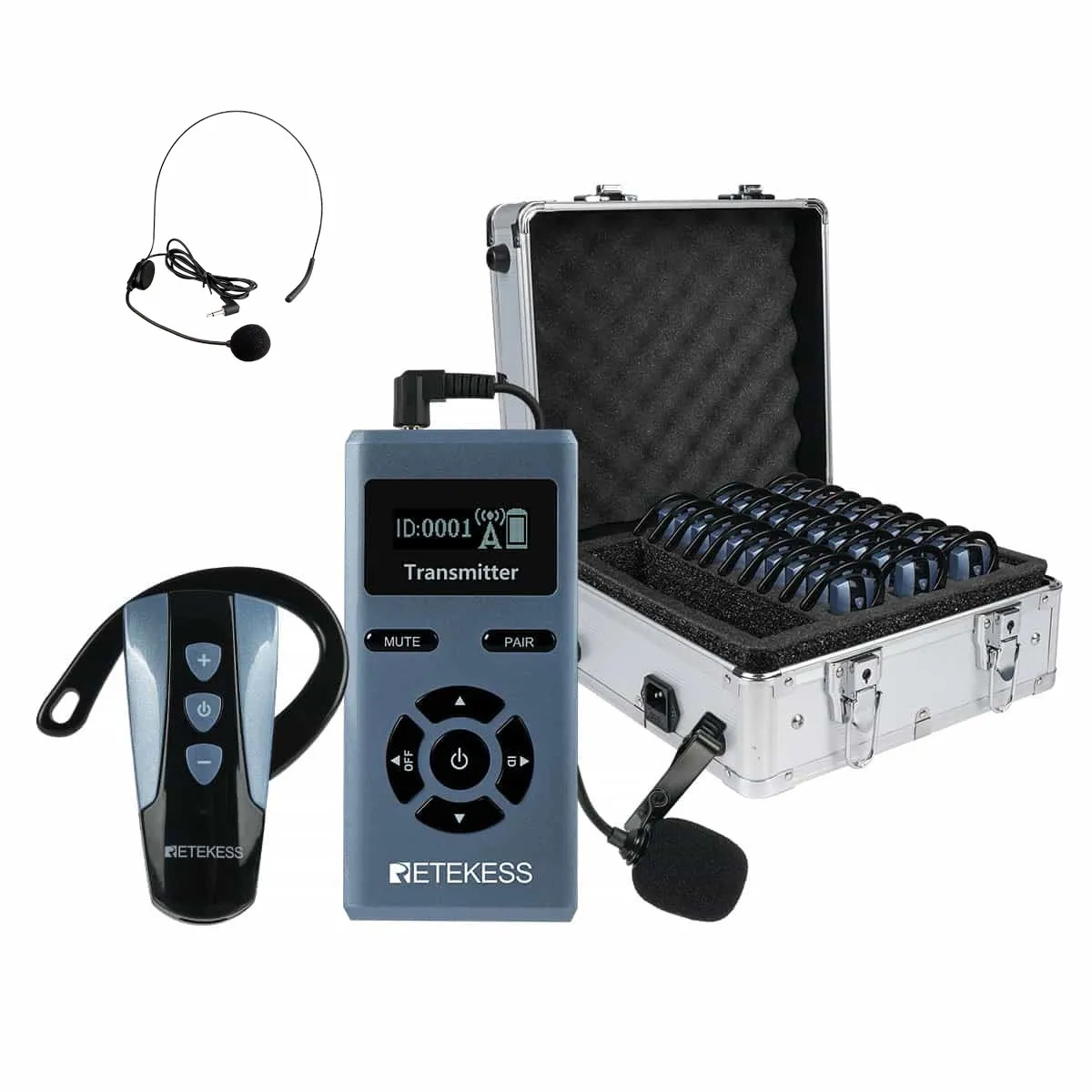
Retekess T130T can serve as examples of this type of UHF-based interpretation workflow. Rather than replacing the interpreter, they support the transmission and distribution of interpreted audio across a group.
For corporate meetings, training sessions, and other multilingual events, this approach is particularly relevant when the language channels are relatively fixed and the company needs stable local audio distribution.
Option 2: AI-Powered Automatic Translation
AI translation addresses a different problem.
Instead of relying on a professional interpreter to convert speech, an AI-powered translation device processes the speech and generates translated output automatically.
The workflow can be represented as:
Speaker → AI Translation → Translated Output → Participants
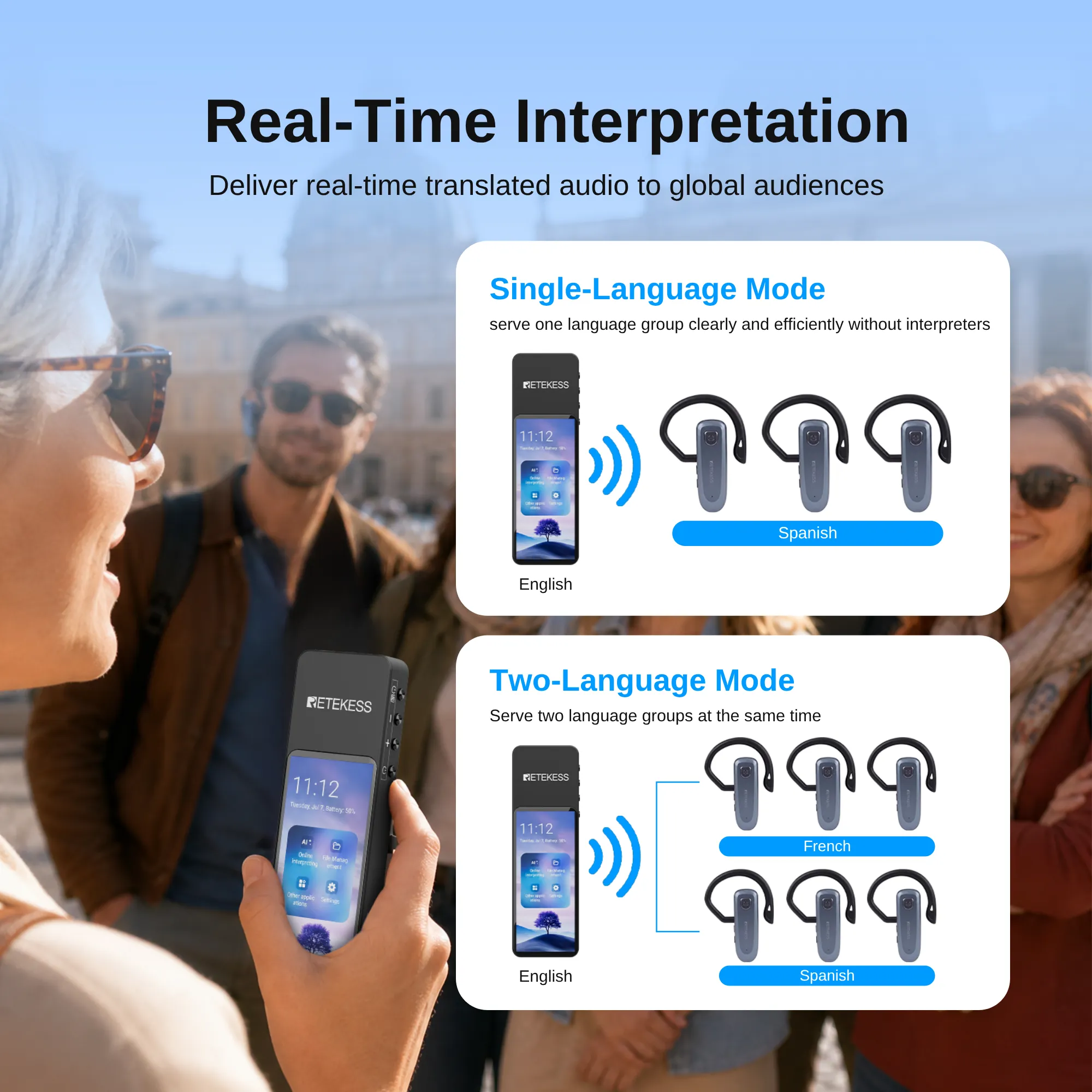
This approach can reduce the need to arrange professional interpreters for every multilingual interaction, particularly when the language requirements are unpredictable or when participants need direct cross-language communication.
Flexible Language Support
AI translation becomes useful when companies need to work across many languages or frequently changing language combinations.
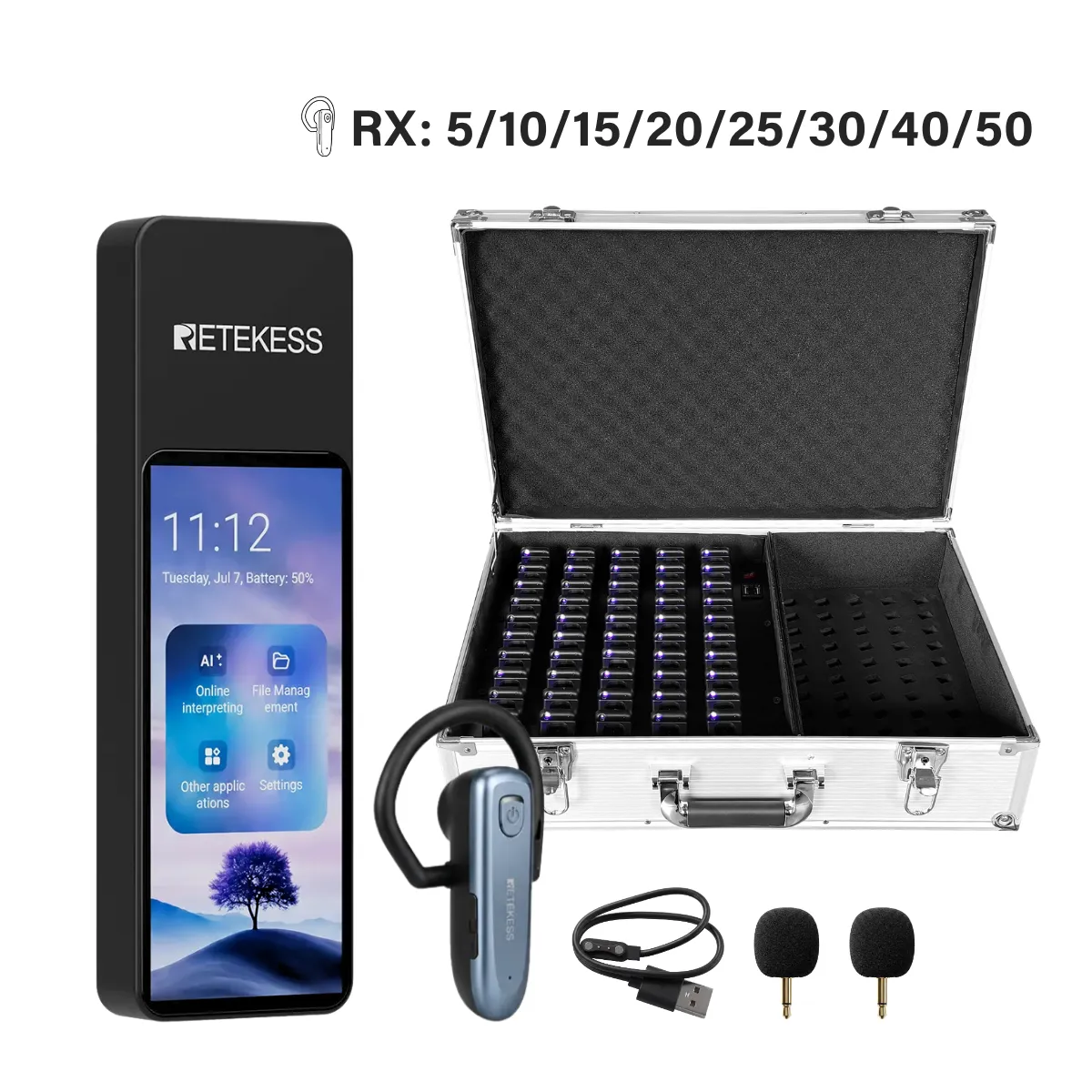
Retekess TT136, for example, is designed around online automatic translation. It supports 120+ languages, bilingual output, and real-time multilingual conversation.
This makes an AI translation device relevant to smaller workshops, international discussions, temporary training situations, and other environments where flexibility may be more important than building a dedicated interpretation infrastructure.
Internet Is Part of the Architecture
There is also an important trade-off.
Unlike a UHF interpretation system that can distribute interpreter audio without internet access, online AI translation depends on an internet connection for its translation service.
Therefore, companies considering AI translation should evaluate the venue's Wi-Fi and internet reliability as part of the system design.
How to Choose the Right Interpretation Architecture
The right solution depends less on the technology itself and more on how the event is organized.
|
Event Requirement |
Human Interpretation + UHF Wireless |
AI-Powered Translation |
|
Professional interpreters are available |
✓ Suitable |
Not required |
|
Hundreds of participants need translated audio |
✓ Suitable |
Depends on deployment |
|
Fixed language groups |
✓ Suitable |
Suitable |
|
Many changing language combinations |
Limited by interpreter availability |
✓ Suitable |
|
Internet is unavailable or unreliable |
✓ Suitable |
Requires internet |
|
Automatic translation is required |
— |
✓ Suitable |
|
Two-way multilingual conversation |
Limited |
✓ Suitable |
|
Repeated conferences or training |
✓ Reusable |
Suitable depending on use case |
When the Priority Is Reliable Audio Distribution
If a company already works with professional interpreters and the main challenge is delivering their translated audio to a large audience, a UHF wireless interpretation system can provide a straightforward architecture.
This approach is particularly relevant for large corporate conferences, global training programs, and recurring events where the language channels are known in advance. Because the audio transmission does not require an internet connection, the system can operate independently of the venue's network.
In this case, the technology supports the interpretation workflow rather than replacing the interpreter:
Professional Interpreter → UHF Transmission → Multiple Receivers → Audience
When the Priority Is Language Flexibility
If the company does not have professional interpreters, needs to support many languages, or expects participants to communicate directly across languages, AI-powered translation addresses a different requirement.
AI translation can be useful when language combinations change frequently or when arranging interpreters for every interaction would be difficult. However, online AI translation depends on internet connectivity, so network availability becomes part of the system planning.
The workflow is therefore different:
Speaker → AI Translation → Translated Output → Participants
A Practical Decision Framework for Corporate Events
Before purchasing a corporate conference interpretation system, ask five questions:
- How many participants will attend?
Larger audiences place greater demands on audio distribution and equipment management. - How many languages are required?
A fixed number of language channels may favor a structured interpretation workflow, while constantly changing languages may increase the value of AI translation. - Who will provide the translation?
If professional interpreters are already part of the event, a wireless distribution system can support their work. If not, automatic translation becomes another option. - How reliable is the internet connection?
UHF audio distribution does not require internet connectivity, while online AI translation does. - Will the system be reused?
For recurring corporate meetings and training programs, reusable equipment can be evaluated based on its cost across multiple events rather than a single event.
Conclusion
Choosing a large corporate conference interpretation system is ultimately a question of matching technology to communication requirements.
For large events with professional interpreters, fixed language groups, and a need for stable audio distribution without internet dependency, human interpretation combined with UHF wireless transmission provides one practical architecture.
For flexible multilingual communication where automatic translation, broad language coverage, or two-way conversation is more important, AI-powered translation provides a different approach, provided that reliable internet access is available.
The key is not to ask which technology has more features. Instead, start with the communication problem:
Who translates? How is the translated audio distributed? Does the system depend on the internet? How many people need it? And will the equipment be used again?
When these questions are answered first, companies can build a multilingual communication system that balances cost, reliability, deployment complexity, and long-term usability.

![[18th Anniversary] 18 Years of Echoing Excellence: Making Communication Easier, Connecting Trust Beyond Borders](https://res.retekess.com/z_file/20260716/retekess-brand-story-making-communication-easier_20260716151044_7682.jpg)
![[18 Years in Wireless Communication] Silent Disco Systems Anniversary Celebration: Top-Selling Headphones & Event Mechanics Revealed!](https://res.retekess.com/z_file/20260713/18-years-in-wireless-communication-silent-disco-systems-anniversary-celebration_20260713175011_5749.webp)
![[Anniversary Carnival] Ding-dong! 18th Anniversary Mega Sale on Guest Paging & Calling Systems: Full Reveal of 12+ Products & Promo Rules!](https://res.retekess.com/z_file/20260713/18th-anniversary-mega-sale-on-guest-paging-calling-systems_20260713175257_0295.webp)
![[Retekess 18th Anniversary Teaser] Tour Guide System Exclusive Perks: Sneak Peek at Event Dates & Mechanics!](https://res.retekess.com/z_file/20260713/retekess-18th-anniversary-tour-guide-system-exclusive-perks--2-_20260713180135_6435.webp)
Follow Us
Pay With


 Google
 Amazon
Comments (0)