
Table of Contents
Museum Multilingual Audio Guide Systems: Whisper Tour, AI Translation, or Self-Guided?
- Retekess
- Sep 18, 2026
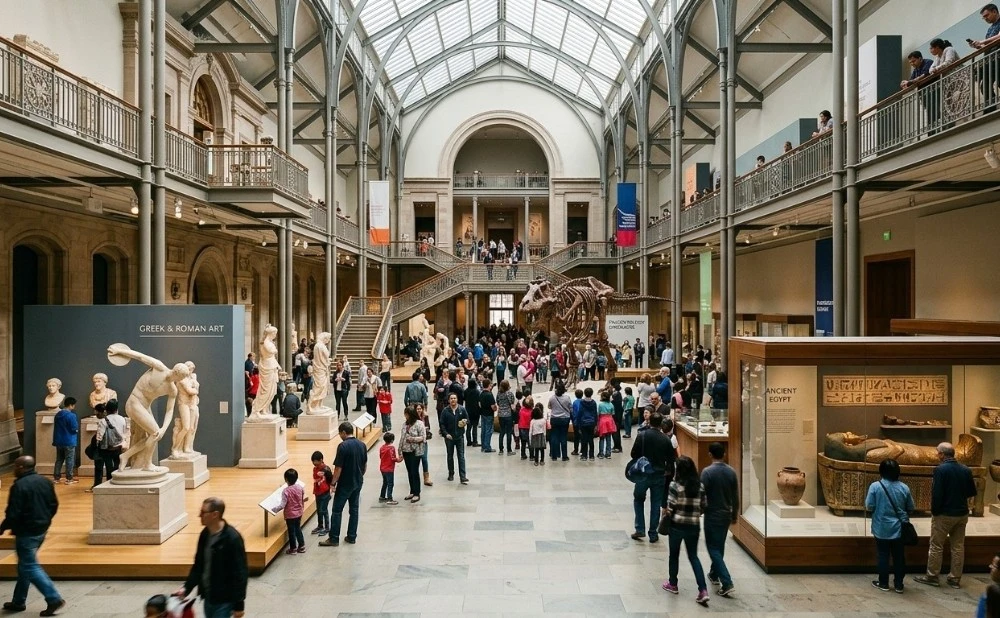
More than one in five people aged five and older in the United States speaks a language other than English at home, according to the U.S. Census Bureau’s American Community Survey, and the American Alliance of Museums has cited shares approaching half the population in cities such as New York and Los Angeles. Museums have absorbed that. The engagement data makes the cost of ignoring it concrete: Smartify’s 2025 analysis of 42 million visitor sessions found that people listen to audio content in their own language for roughly 17 minutes on average, compared with under 11 minutes in a language that is not theirs. Japanese visitors spent 31 minutes with Japanese content and just 7 minutes with everything else.
The conclusion most institutions draw is “we need multilingual audio.” That conclusion is right and useless at the same time, because “multilingual” describes three entirely different services — delivered by three entirely different kinds of hardware. Buying the wrong one is the most common, and most expensive, mistake in museum audio procurement.
The only question that matters: is a human actually speaking?
Strip away the marketing language and every multilingual museum scenario falls into one of three operating models. The deciding variable is not group size, budget, or how many languages appear on your wish list. It is whether a person is talking in real time.
|
Model |
Who speaks? |
What the visitor actually needs |
Language solution |
|
1. Live docent, single-language group |
A staff docent, in person |
To hear them clearly at a normal volume |
No translation — clean wireless audio |
|
2. Live speaker, mixed languages |
A docent, curator, or host |
To hear that person in their own language, now |
Real-time interpretation |
|
3. No docent, self-paced visit |
Nobody — content is pre-produced |
To pull up the right stop, in their language, at their own pace |
Pre-recorded multilingual audio |
Group size is a red herring. A 40-person school group that shares one language is a Model 1 problem. A four-person donor tour spanning Japanese and English is a Model 2 problem. A single visitor walking the permanent collection is a Model 3 problem — and three hundred visitors doing the same thing is still a Model 3 problem.
Model 1 — Live docent, one language: the job is clarity, not translation (T130P)
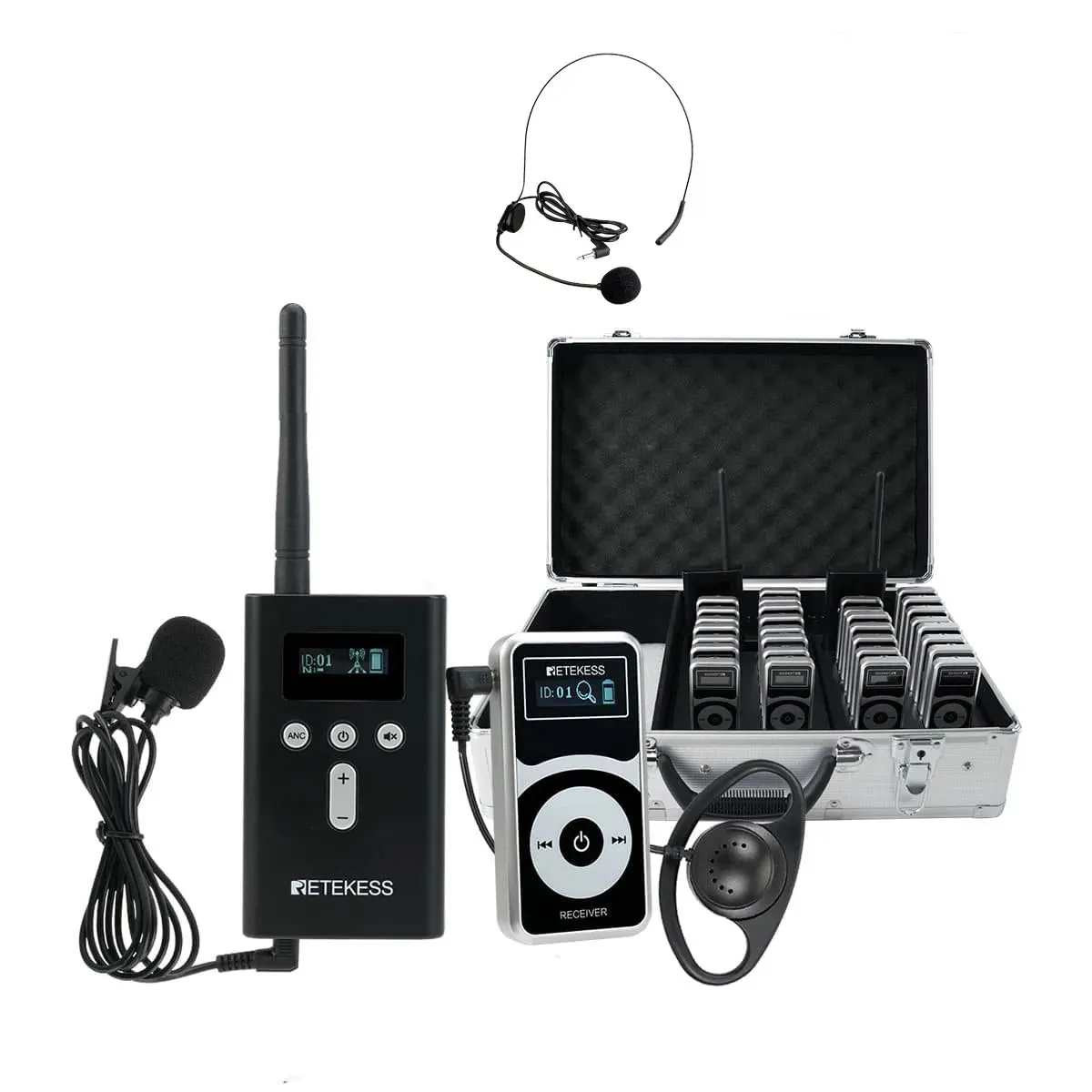
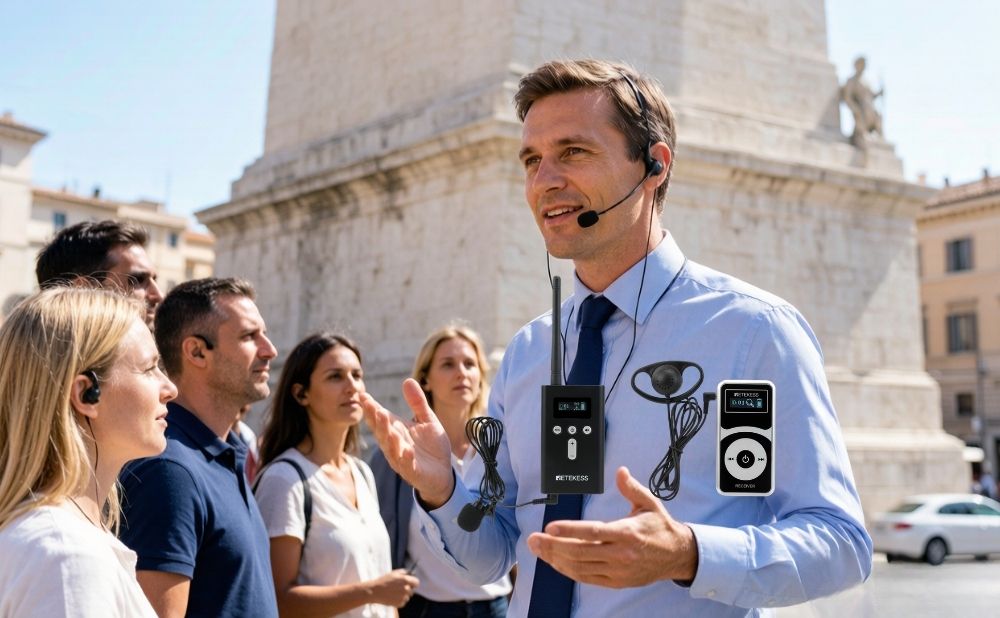
The driver here is not language at all. It is noise policy. As institutions tighten rules on amplified speech in galleries, a docent who once projected across a room now has to speak at conversational level — which means every group member needs a personal receiver. That is the entire job: get one voice into thirty ears, quietly. The Retekess T130P/T131P whisper tour guide system is built for exactly that.
Specifications that matter on the gallery floor:
- 49 independent channels — a special exhibition can run three Mandarin groups, two English groups, and one French group in the same hall on the same afternoon with zero cross-talk.
- 195–216 MHz transmission — a far lower frequency than 2.4 GHz, which is why the signal holds up better through thick masonry and dense crowds in historic buildings.
- 160 m / 524 ft open-area range — covers large gallery halls, sculpture courtyards, and outdoor heritage sites without drop-outs.
- DSP noise cancellation with 1–4 adjustable levels, 80 dB typical signal-to-noise ratio, and under 0.3% distortion — keeps a soft-spoken docent intelligible when ambient conversation noise runs high.
- 20 hours on the transmitter (4200 mAh) and 36 hours on the receiver (1200 mAh) — a full touring day with no mid-shift charging.
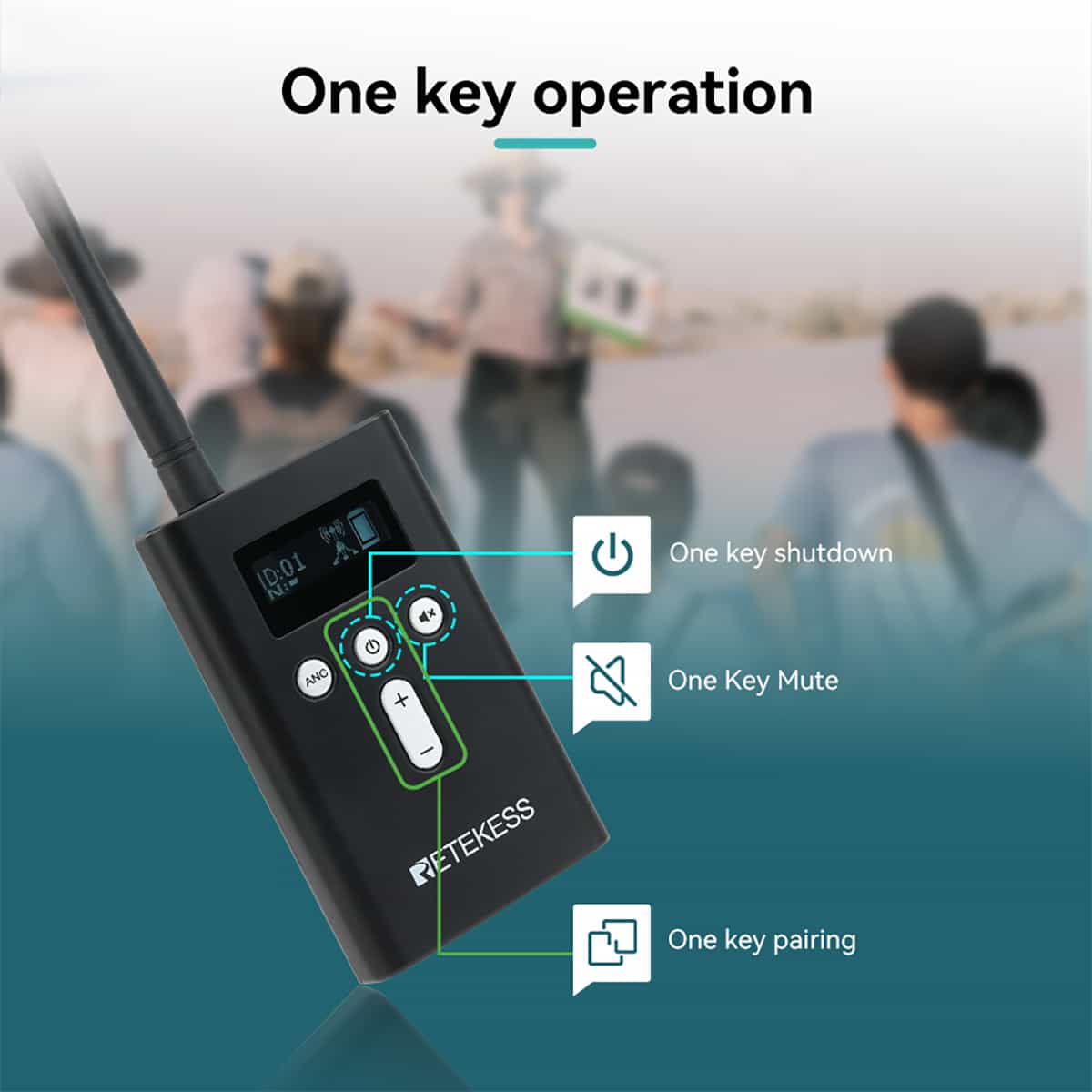
- One-touch pairing, one-touch mute, long-press batch shutdown, and channel memory after power-off. A docent with a group waiting should not be configuring radios.
- Type-C or contact charging, with 16-, 32-, and 64-slot cases — thirty receivers go into a case, not into thirty cables.
- AUX input on the transmitter — play pre-recorded audio or background music through the same receivers when a stop calls for it.
The T130P does not translate anything. That is not a gap; it is the point. When the docent and the group already share a language, translation hardware adds cost, network dependency, and setup time in exchange for nothing.
Model 2 — Live speaker, mixed languages: the job is real-time interpretation (TT136)
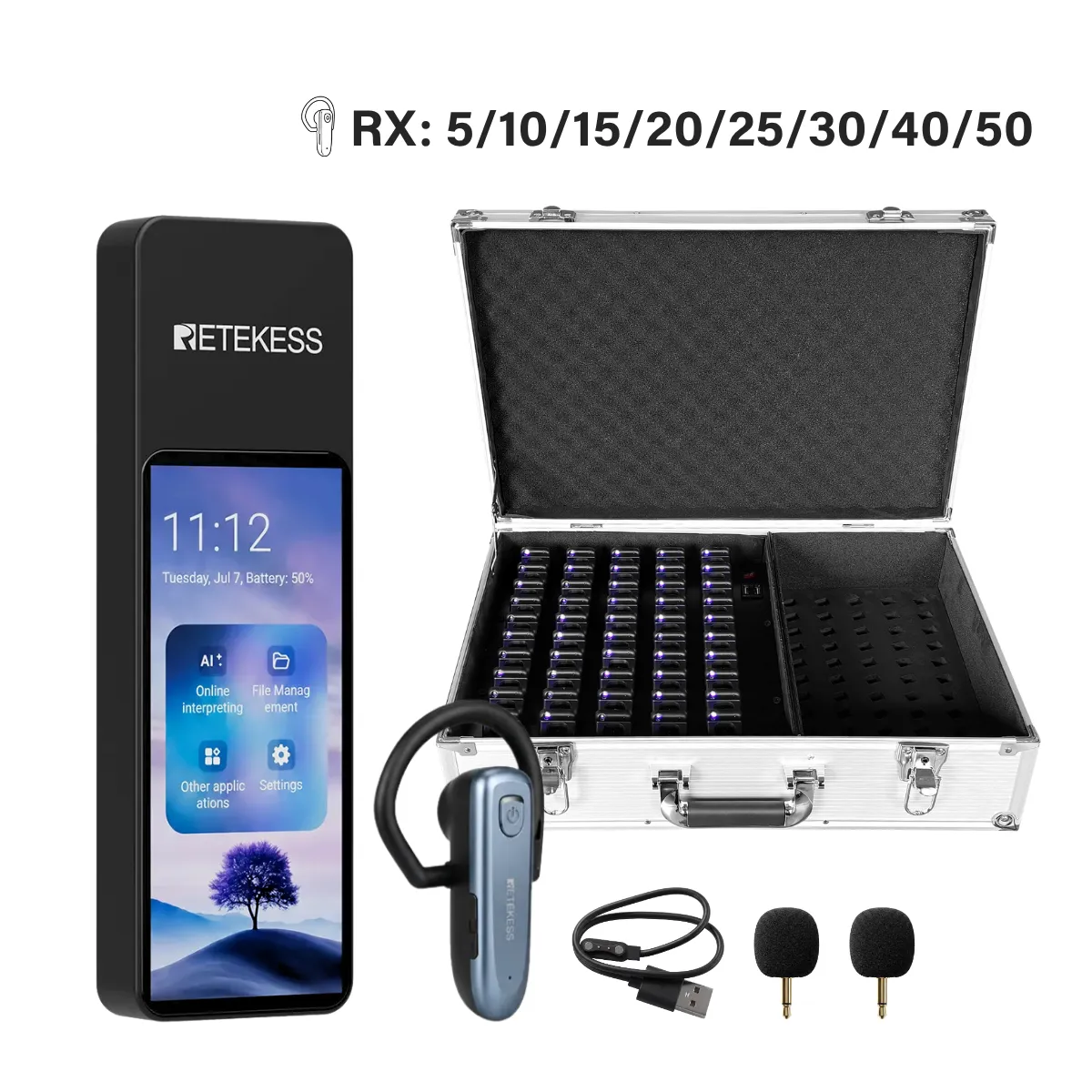
This is what most people mean by “museum translation,” and it is the narrowest of the three. It applies when a human is speaking and the audience does not all speak that human’s language: a curator-led walkthrough with international press, a donor tour, a mixed-language student group, a bilingual opening remark. The Retekess TT136 handles it.
Specifications that matter here:
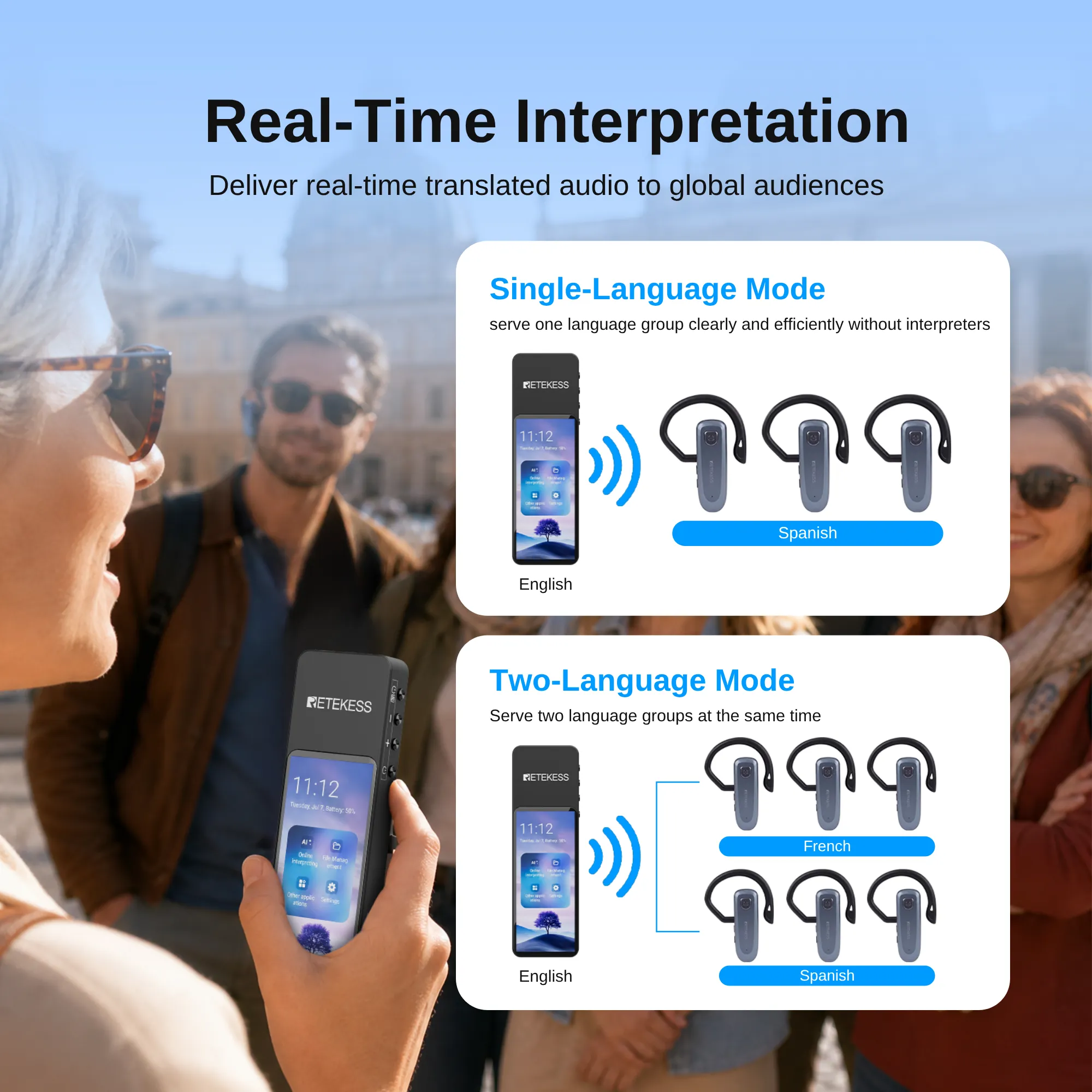
- 120+ languages in the international version — 79 general-purpose languages, 81 speech-recognition languages, and 84 languages for translation and playback, with ongoing updates.
- Dual-channel simultaneous broadcast — the speaker presets up to two target languages and both go out at once; listeners switch receiver channels to follow the one they need.
- Recognition of up to 10 spoken languages in a single session — useful when questions come back from the floor in several languages.
- Two-way group translation — two language groups follow the same tour, each on its assigned channel, with the current speaker holding the transmitter.
- 18 g open-ear ear-hook receivers that fit either ear — light enough for long wear, and they leave the ear canal open so visitors still catch room announcements.
- 4 GHz transmission with automatic pairing, 150–200 m / 492–656 ft range, and 0–9999 selectable channels.
- 20 hours on the transmitter, 13 hours on the receiver, and 3.5 hours to a full charge.
- A 3.99-inch HD touchscreen on the transmitter for language and channel control.
- AI recording, playback, local storage, and AI summary — usable for staff training and post-tour content review.
- 30- and 50-slot charging cases with UV disinfection, which matters when receivers are reissued all day.
One caveat belongs in every procurement conversation: real-time AI translation is a networked, pay-as-you-use service. The TT136’s one-to-many mode — straight audio distribution with no translation — works without internet. Plan connectivity the same way you plan power.
Model 3 — No docent, self-paced: the job is pre-recorded multilingual content (TT128)
This is the model most visitors actually experience, and the one most often mislabelled as “translation.” Nothing is translated in real time. Content is written, recorded, reviewed, and loaded once, then played back on demand in whichever language the visitor selects.
That distinction has a practical payoff: content quality stays under your control. A native-speaker editor can review every script before it ships — exactly what museum writing needs, and what live machine translation cannot fully guarantee.
Specifications that matter for self-guided deployment:
- 41 supported languages. Industry analysis of tourist-heavy museums suggests six languages typically cover 60–70% of international visitors, with the remaining third fragmented across twenty or more groups at 0.5–3% each — the TT128 is built to reach that long tail.
- 16 GB of internal storage holding up to 455 hours of audio — the permanent collection plus special exhibitions, with room for multiple storytelling tracks.
- Manual sequence-number input — visitors type a stop number and hear that content, in whatever order they choose to walk.
- Two looping modes: single loop for visitors who linger at one object, repeat-all for visitors who want the full route.
- 1500 mAh battery with roughly 40 hours of playback and a 4-hour full charge — devices go back into the case at closing, not mid-afternoon.
- Low-battery alerts, so a visitor is warned before a device dies mid-gallery rather than after.
- 16 volume levels — workable in a noisy temporary exhibition and a quiet permanent gallery alike.
- 60 g, 52 × 102 × 14.5 mm, 3.5 mm headphone jack, 20 Hz–20 kHz response, under 1% distortion.
- Type-C or contact charging with a 45-port charging case for bulk daily turnover.
The TT128 is also the only one of the three that removes staffing from the equation entirely: no docent schedule, no interpreter, and no network dependency on the gallery floor.
Matching the system to the exhibition
|
Venue / scenario |
Dominant model |
Recommended system |
|
Permanent collection galleries |
Self-paced visitors dominate |
TT128 primary; T130P for scheduled docent walks |
|
Special and temporary exhibitions |
Curatorial insight drives ticket value |
T130P for docent tours; TT128 for independent visitors |
|
Openings, press and donor tours |
Live speaker, mixed languages |
TT136 |
|
School and student groups |
One language, noise-policy pressure |
T130P |
|
VIP and behind-the-scenes tours |
Small groups, sometimes multilingual |
TT136 (T130P if single-language) |
|
Outdoor heritage sites, sculpture parks |
Long distances, full-day use |
T130P for guided routes; TT128 for self-guided trails |
|
Travelling exhibitions |
Content travels, staff does not |
TT128 |
A five-question checklist before you buy
- Is a person speaking? If no, you need pre-recorded content (TT128). If yes, keep going.
- Does everyone in the group share the speaker’s language? If yes, you need whisper distribution (T130P). If no, you need real-time interpretation (TT136).
- How many languages must be live at once? TT136 broadcasts two target languages simultaneously.
- How long is the working day? Match battery to your longest shift, not your average one — 36 hours on a T130P receiver versus 13 hours on a TT136 receiver changes your midday charging plan.
- Do you need the content afterwards? TT136 records and summarises; TT128 stores finished productions.
FAQ
Is a whisper tour guide system the same as a translation system?
No. A whisper system such as the T130P transmits one voice to many receivers without changing the language. Translation changes the language. If your docent and your visitors already share a language, you need the first, not the second.
Can one device cover both live tours and self-guided visitors?
Not well. Live tours need a transmitter and a speaker; self-guided visits need stored content and no speaker. That is why the T130P and TT128 are separate products rather than two modes on one device.
Does the TT136 work without internet?
The one-to-many audio distribution mode works without internet. Real-time AI translation is a networked, pay-as-you-use service, so plan connectivity accordingly.
How many languages should a museum audio guide actually offer?
Enough to serve the visitors already in the building. Six languages typically cover 60–70% of international visitors at a tourist-heavy museum, with the remainder spread across twenty or more smaller language groups. The TT128 supports 41 languages for self-guided content; the TT136 covers 120+ for live situations.
Why does language change engagement so much?
Because listening in a second language costs attention. Smartify’s 2025 visitor data showed roughly 17 minutes of listening in a visitor’s own language versus under 11 minutes in another — and 31 minutes versus 7 minutes for Japanese visitors specifically.
How many receivers can one transmitter support?
Both the T130P and the TT136 scale by adding receivers; the count is not fixed by the transmitter. Kits run from small sets up to 50-person TT136 configurations and T130P configurations with 60-plus receivers and 64-slot charging cases.
Can guided tours and self-guided visitors run in the same gallery at the same time?
Yes. The T130P operates on 195–216 MHz, the TT136 on 2.4 GHz, and the TT128 plays locally without transmitting, so the three do not interfere.
The bottom line
Retekess builds a system for each one: T130P for docent-led tours where clarity is the whole problem, TT136 for live situations where languages genuinely differ, and TT128 for self-paced visits where the content is already written. Most institutions end up with two of the three.
Not sure which combination fits your floor plan, language mix, and visitor volume? Retekess provides free customised solutions and demos based on venue type, audience size, and language needs.



![[18th Anniversary] 18 Years of Echoing Excellence: Making Communication Easier, Connecting Trust Beyond Borders](https://res.retekess.com/z_file/20260716/retekess-brand-story-making-communication-easier_20260716151044_7682.jpg)
![[18 Years in Wireless Communication] Silent Disco Systems Anniversary Celebration: Top-Selling Headphones & Event Mechanics Revealed!](https://res.retekess.com/z_file/20260713/18-years-in-wireless-communication-silent-disco-systems-anniversary-celebration_20260713175011_5749.webp)
![[Anniversary Carnival] Ding-dong! 18th Anniversary Mega Sale on Guest Paging & Calling Systems: Full Reveal of 12+ Products & Promo Rules!](https://res.retekess.com/z_file/20260713/18th-anniversary-mega-sale-on-guest-paging-calling-systems_20260713175257_0295.webp)
![[Retekess 18th Anniversary Teaser] Tour Guide System Exclusive Perks: Sneak Peek at Event Dates & Mechanics!](https://res.retekess.com/z_file/20260713/retekess-18th-anniversary-tour-guide-system-exclusive-perks--2-_20260713180135_6435.webp)
Follow Us
Pay With


 Google
 Amazon
Comments (0)