
Table of Contents
How Does Simultaneous Interpretation Equipment Work? (Plain-English Guide)
- Retekess
- Sep 14, 2026
Walk into any UN press briefing, European Parliament session, or modern bilingual church service and you'll witness something that feels almost like magic: a speaker talks in one language, and the audience hears the words in their own language at the same moment — not a sentence later, not a paragraph later, but in lock-step.
The "magic" is actually a very ordinary chain of hardware. Once you see the chain, you'll understand why some interpretation setups cost $300 and others cost $30,000, and which level is right for your event.
This guide walks you through the chain in plain English. No engineering degree required.
The Big Picture: 4 Things Must Happen in Sequence
For simultaneous interpretation to work, four things have to happen almost simultaneously:
-
The speaker's voice has to be captured cleanly.
-
That voice has to be delivered to the interpreter (almost) live.
-
The interpreter has to translate and re-speak into their own microphone.
-
That translated audio has to be broadcast on a separate channel that listeners can pick with a receiver.
That's it. Every interpretation system on the market — from a $300 FM church kit to a $30,000 ISO-compliant Bosch booth — does these four things. The differences are in how cleanly, how securely, and at what scale.
Step 1: Capturing the Speaker's Voice
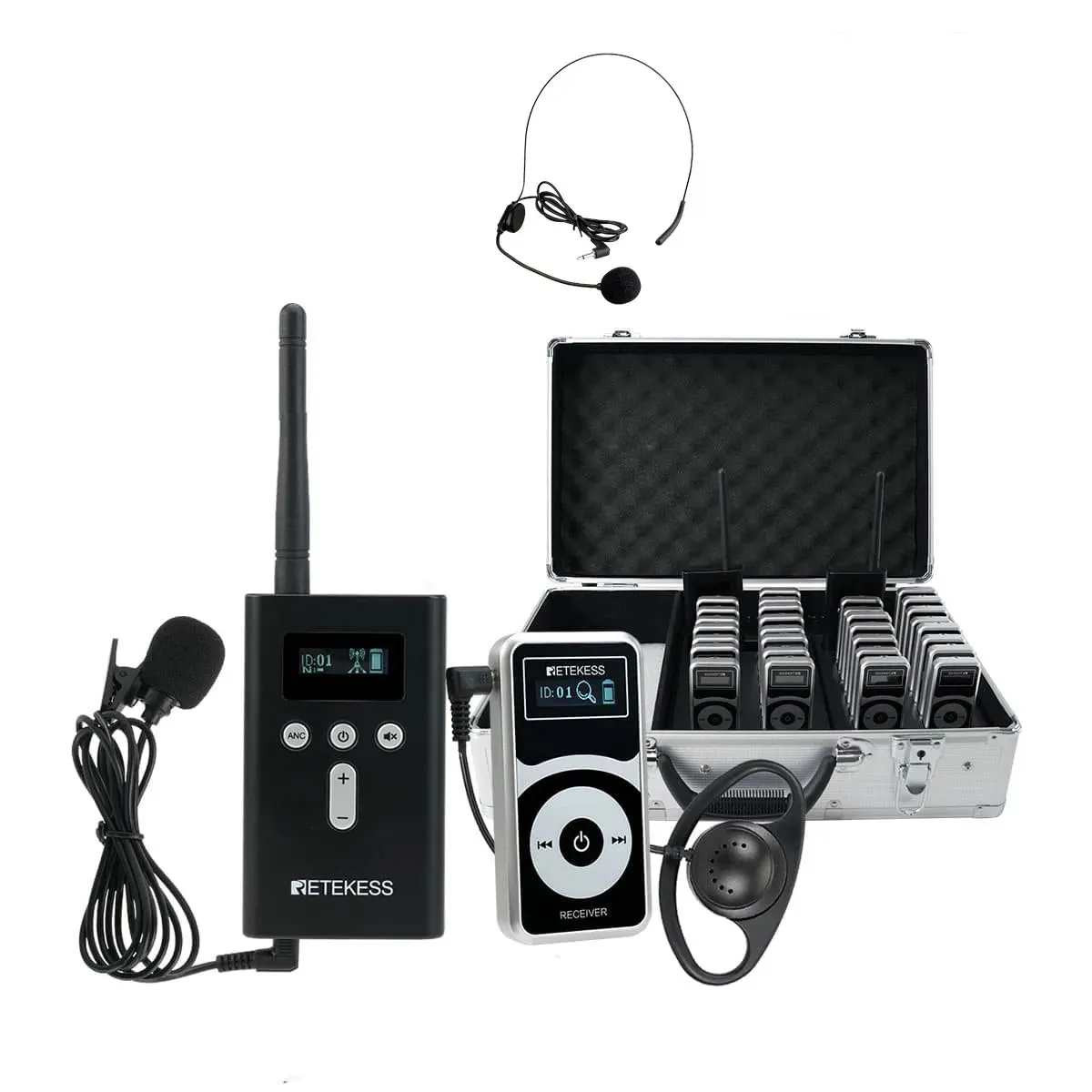
The chain starts with a microphone on the speaker (or the speaker's podium). For most setups, this is a wireless lavalier or a podium gooseneck mic.
What you want here is clarity, not volume. Interpretation is fatiguing, and a noisy feed makes the interpreter's job 10× harder. That's why professional setups often use directional gooseneck mics on conference tables — they pick up the speaker and reject room noise.
In a church setting, a clip-on lavalier mic on the pastor usually works well. In a conference, delegate consoles or podium mics do the job. In a tour or factory, a headset mic keeps the guide's hands free.
The microphone feeds a transmitter (either a body-pack on the speaker or a fixed unit at the podium).
Step 2: Getting That Voice to the Interpreter
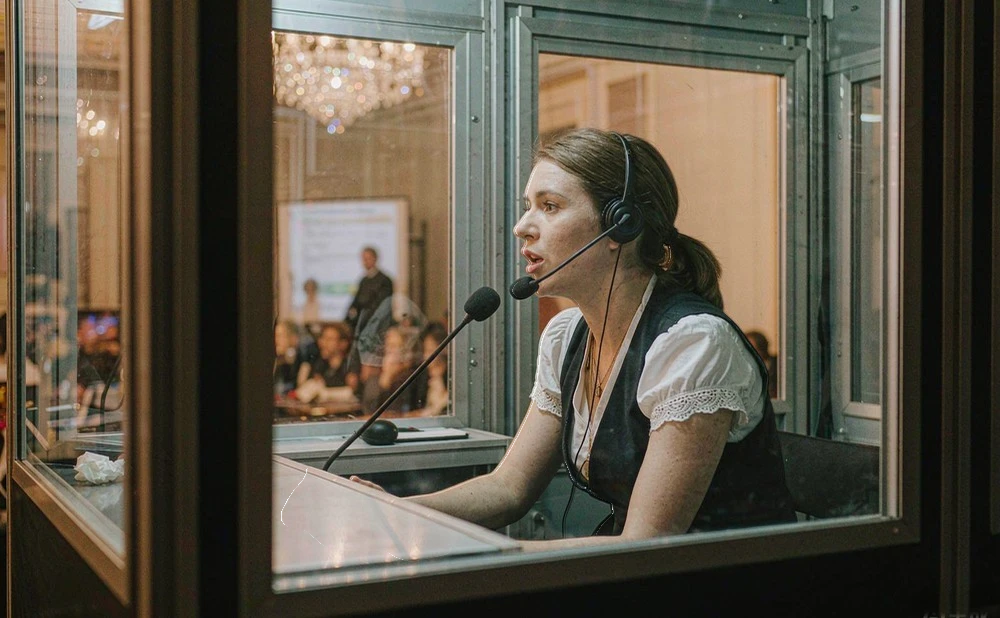
Once captured, the speaker's audio needs to reach the interpreter. In a professional conference, the interpreter sits in a soundproof booth, wearing closed-back headphones, listening to the speaker on a dedicated channel.
In a smaller setup (a church, a school meeting, a factory tour), the interpreter may simply sit in the audience with a wireless receiver tuned to the speaker's channel. That's a "simultaneous-whisper" setup, and it works fine for groups under 100.
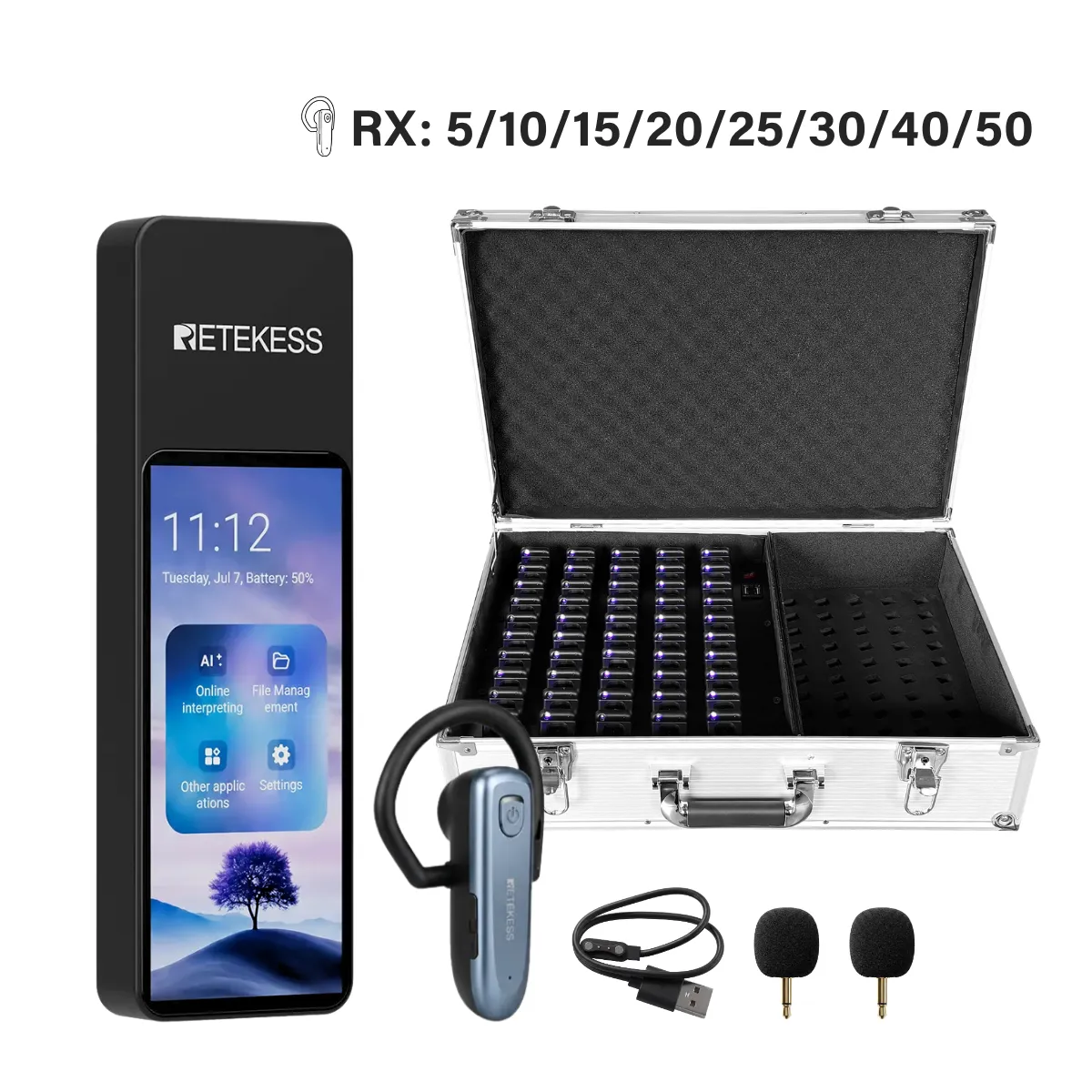
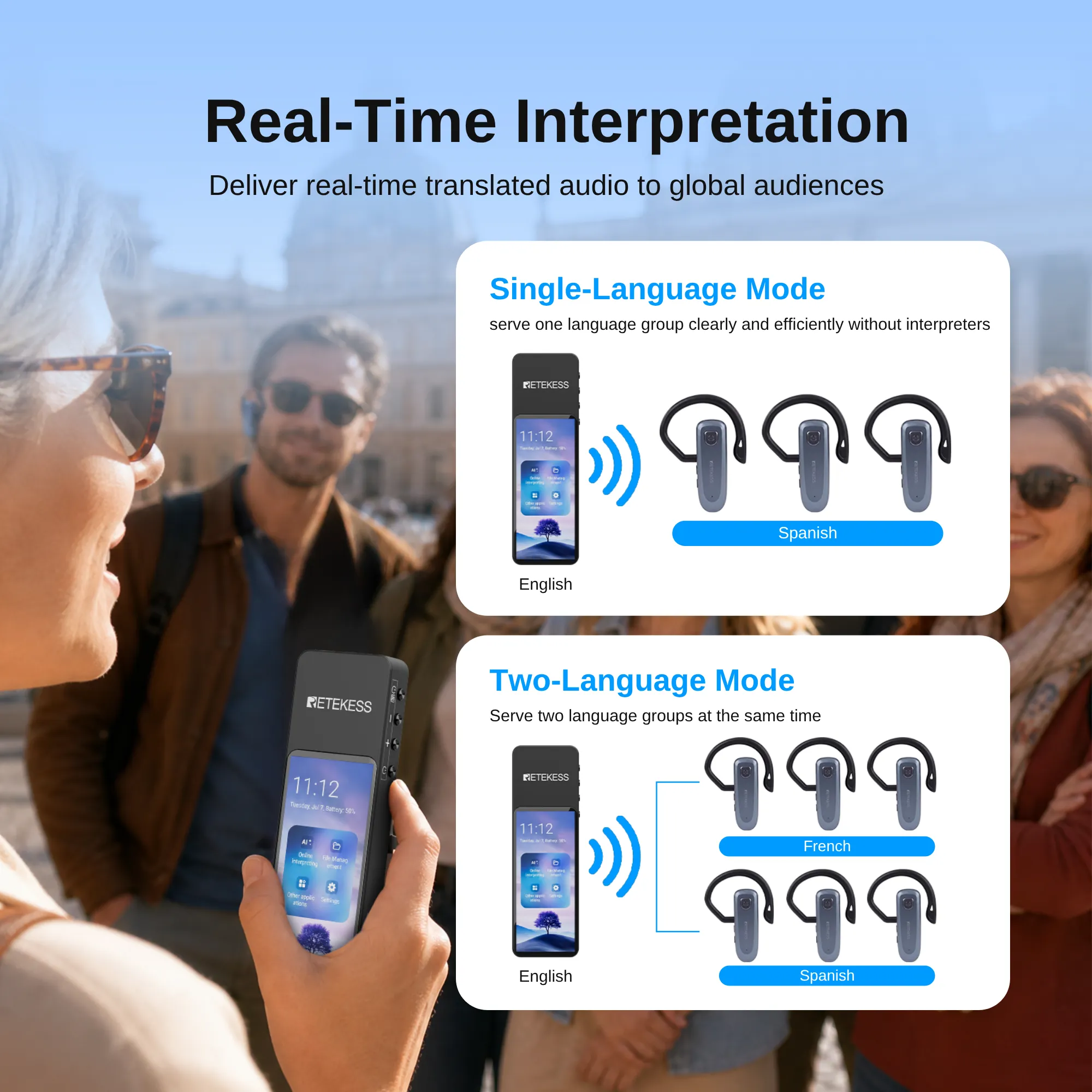
In an AI-powered audio translation system like the Retekess TT136, AI technology streamlines the traditional interpretation workflow. The speaker's audio is captured in real time, processed through the dedicated translation technology, and instantly transmitted across dedicated channels to listeners' receivers with sub-second latency—delivering seamless, multi-language support without requiring an on-site human interpreter.
The latency here is the make-or-break metric:
|
Setup |
Typical Latency |
Best For |
|
Pro interpreter in booth |
2–5 seconds |
Conferences, summits |
|
Whisper interpreter in audience |
3–8 seconds |
Churches, small meetings |
|
AI translation (on-device) |
1–3 seconds |
Tours, factories |
|
AI translation (cloud-based) |
3–8 seconds |
Casual cross-language conversations |
A 2-second delay feels natural. A 10-second delay starts feeling awkward.
Step 3: The Interpreter Translates and Re-Speaks
If you're using a human interpreter, this is where their craft matters most. They listen to the speaker in language A, translate mentally, and speak into their own microphone in language B.
The interpreter's microphone feeds the interpreter console — a piece of hardware that lets them:
-
Mute their cough
-
Switch between incoming channels (when there are multiple speakers)
-
Adjust their outgoing volume
-
Send a "floor" signal (their voice) or the "relay" (another interpreter's voice) to listeners
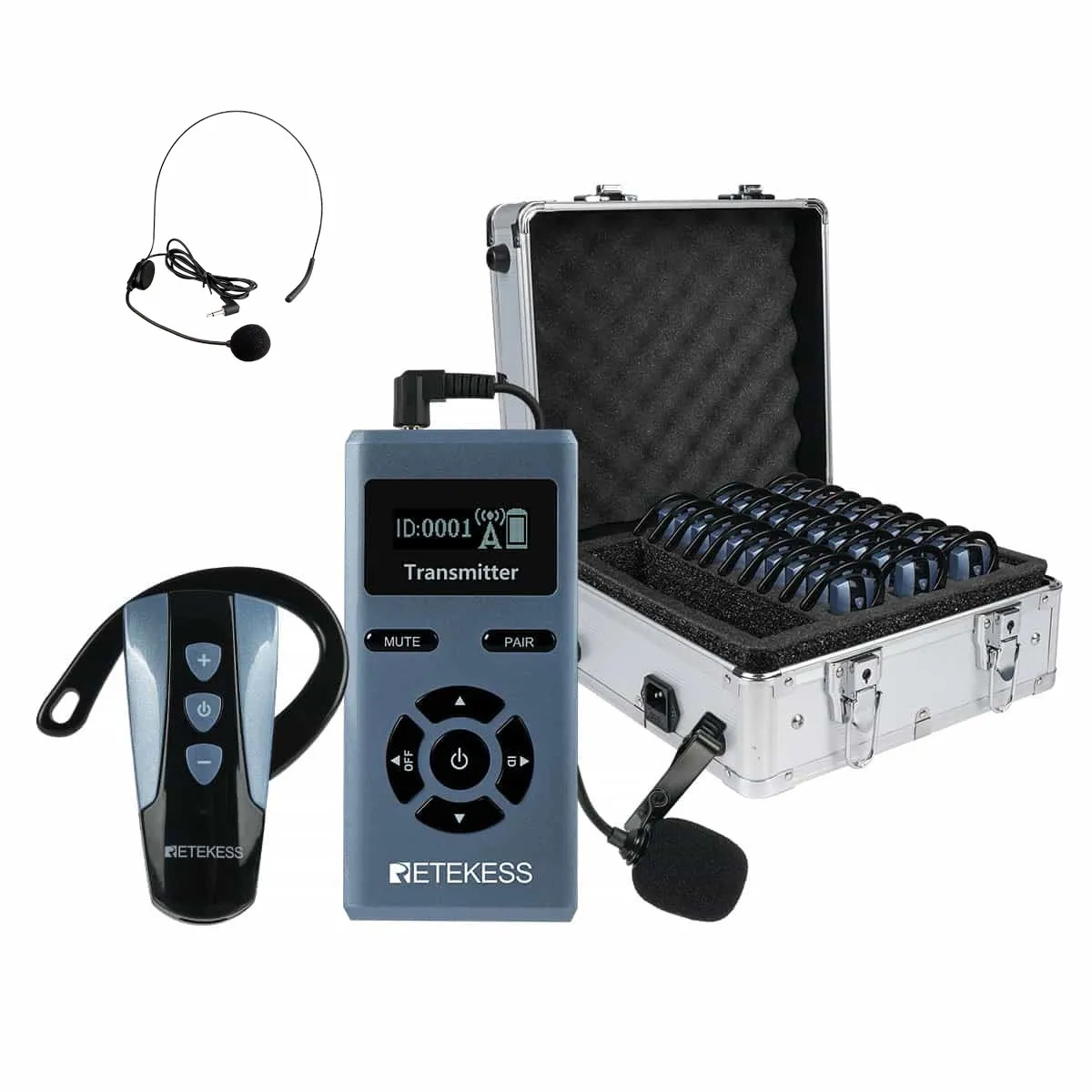
The Retekess TT119 is an example of an interpreter console: it accepts XLR, AUX, RCA, and USB input, supports 17 channels, and is designed for exactly this relay-and-broadcast workflow.
If you're using AI, this whole step is replaced by the model's inference engine.
Step 4: Broadcasting to the Audience on a Separate Channel
The interpreter's voice goes to a transmitter that broadcasts on a different channel from the speaker. Listeners wear receivers and pick the channel matching their language.
This is where the equipment type matters most:
-
FM systems broadcast on radio frequencies — receivers anywhere in range hear the signal
-
Infrared systems broadcast on light waves — receivers must have line-of-sight
-
2.4 GHz digital systems broadcast on the WiFi-adjacent band — receivers pick up the digital stream
-
AI systems like the Retekess TT136 handle the full workflow: the AI engine generates the real-time translation, and the transmitter seamlessly broadcasts the translated audio across designated channels for each language group.
Listeners get one of two things:
-
A dedicated receiver with an earphone (most common — works for everyone, no smartphone needed)
-
A smartphone app (used by AI earbud brands like Timekettle — works only if everyone has a phone and the right app)
For audiences over 40 years old (churches, factory workers, nonprofits), dedicated receivers win every time. The dial is one button; the app is 12 taps.
Why "Channels" Matter
Every interpretation system uses channels to separate languages. If your speaker uses English on channel A and Spanish interpretation is on channel B, your French listeners can tune to channel C — assuming your system supports it.
-
Entry-level FM kits like the Retekess TT117 and TT118 support 17 channels, which is plenty for a bilingual church or meeting.
-
Mid-range systems like the TT119 also support 17 channels but with pro XLR/RCA inputs.
-
AI systems like the TT136 operate in dual-channel broadcast mode (two AI-translated target languages).
-
High-end conference consoles support 30+ channels, often with relay between interpreter booths, but they come with a high price tag.
For most churches, tour operators, and small conferences, 2–4 channels is all you'll ever use. The extra channels are insurance.
What About Latency, Quality, and Reliability?
Three things determine whether a system "just works" in real-world conditions:
-
Latency — the delay between speaker and listener. Aim for under 5 seconds. Cloud AI translation occasionally spikes higher; on-device AI stays low.
-
Audio quality — how intelligible the broadcast is. Look for systems with at least 50 Hz–7 kHz response (covers spoken voice well) and noise-canceling microphones on the speaker side.
-
Interference resistance — FM systems can pick up radio noise; IR systems are immune but need line-of-sight; digital 2.4 GHz systems are robust; AI systems (like the TT136) rely on stable network connectivity for real-time processing.
The right pick depends on your venue. A factory floor full of motors is a nightmare for FM; IR or 2.4 GHz is better. An outdoor tour in the rain wants 2.4 GHz with weatherproof receivers. A church basement with thick concrete walls is fine for FM but tough for IR.
FAQ
Q: Can interpretation equipment work without an interpreter?
A: Yes, if you use an AI translation device like the Retekess TT136. It translates 120 languages on-device within 2–3 seconds. For legal, medical, or formal diplomatic work, you still want a human interpreter.
Q: Do listeners all need their own receiver?
A:Yes. In both simultaneous interpretation and mobile tour systems, every listener needs their own individual receiver to hear the translated audio clearly. Receivers can be purchased individually or as part of a complete kit package.
Q: How long does setup take?
A: A 2-channel FM church system can be set up in 15 minutes by one person. A pro conference booth takes 2–4 hours with a technician. AI systems like the TT136 are typically plug-and-play in 5–10 minutes.
Q: What's the difference between simultaneous and consecutive interpretation?
A: Simultaneous happens in real time (interpreter speaks while the speaker is still talking). Consecutive waits for the speaker to finish a thought, then interprets.






![[18th Anniversary] 18 Years of Echoing Excellence: Making Communication Easier, Connecting Trust Beyond Borders](https://res.retekess.com/z_file/20260716/retekess-brand-story-making-communication-easier_20260716151044_7682.jpg)
![[18 Years in Wireless Communication] Silent Disco Systems Anniversary Celebration: Top-Selling Headphones & Event Mechanics Revealed!](https://res.retekess.com/z_file/20260713/18-years-in-wireless-communication-silent-disco-systems-anniversary-celebration_20260713175011_5749.webp)
![[Anniversary Carnival] Ding-dong! 18th Anniversary Mega Sale on Guest Paging & Calling Systems: Full Reveal of 12+ Products & Promo Rules!](https://res.retekess.com/z_file/20260713/18th-anniversary-mega-sale-on-guest-paging-calling-systems_20260713175257_0295.webp)
![[Retekess 18th Anniversary Teaser] Tour Guide System Exclusive Perks: Sneak Peek at Event Dates & Mechanics!](https://res.retekess.com/z_file/20260713/retekess-18th-anniversary-tour-guide-system-exclusive-perks--2-_20260713180135_6435.webp)
Follow Us
Pay With


 Google
 Amazon
Comments (0)