
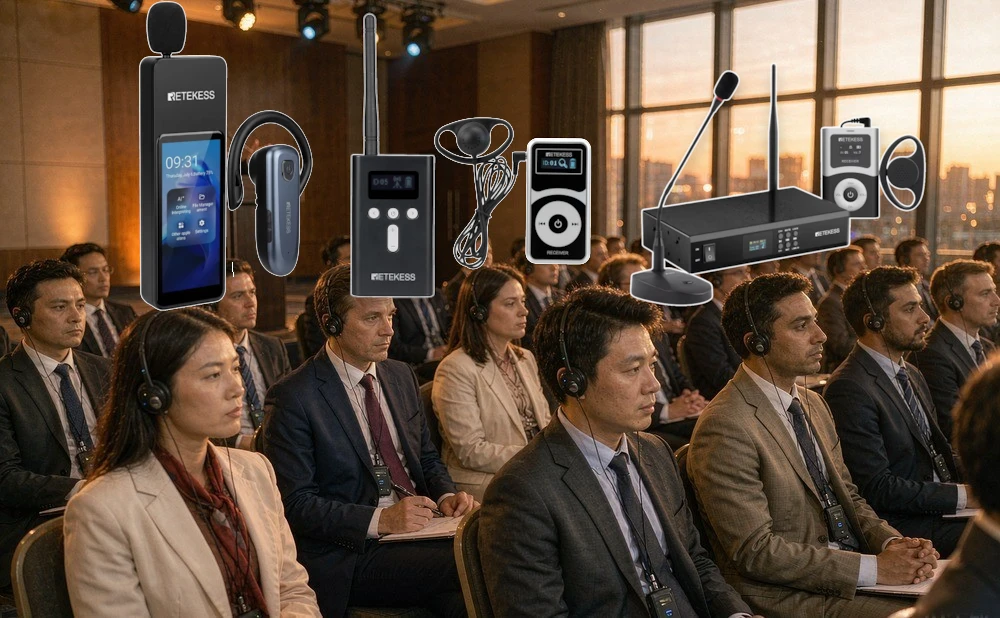
Group size determines the overall configuration of the translation system, including the number of receivers, transmitter types, channel requirements, battery management solutions, and room for future expansion.
The Five Questions That Actually Size Your System
|
Question |
Why it changes the answer |
|
How many listeners at peak? |
Sets the receiver count. Always size to your busiest day, not your average day. |
|
How many languages at once? |
Each language needs its own channel — and usually its own interpreter. |
|
Is the venue fixed, or do people move? |
Fixed rooms suit table-top transmitters. Walking tours and factory floors need handheld, battery-powered units. |
|
Do you have an interpreter? |
With an interpreter, choose a simultaneous interpretation system. Without one, choose an AI translation device. |
|
How far do listeners spread out? |
Range requirements from 80 m to 250 m narrow the technology choice quickly. |
Quick Match: Group Size to Recommended System
|
Audience size |
Typical setting |
Recommended Models |
AI Translation Recommendations |
|
5–10 people |
Small bilingual meeting, private tour, one-to-one plant visit |
TT117 + TT118 FM TT106S or T130P |
TT136 AI translation kit |
|
10–20 people |
Church service, classroom, small conference room |
TT106S , T130P TT117 + TT118 FM |
|
|
10–30 people |
Walking tour, multi-site church, community event |
TT106S, T130P TT117 + TT118 FM |
|
|
20–50 people |
Mid-size conference, court hearing, growing congregation |
T130T + T131T TT118 + TT119 TT117 + TT118 FM |
|
|
50–200 people |
Large conference, convention, multi-language summit |
5–10 People: The Starter Tier
At this size the temptation is to improvise — a phone speaker, a free translation app, someone repeating the sentence. It works until it doesn't: the room gets noisy, the terminology gets technical, or the visitor is a paying client and improvisation starts to look unprofessional.
There are two realistic options:
-
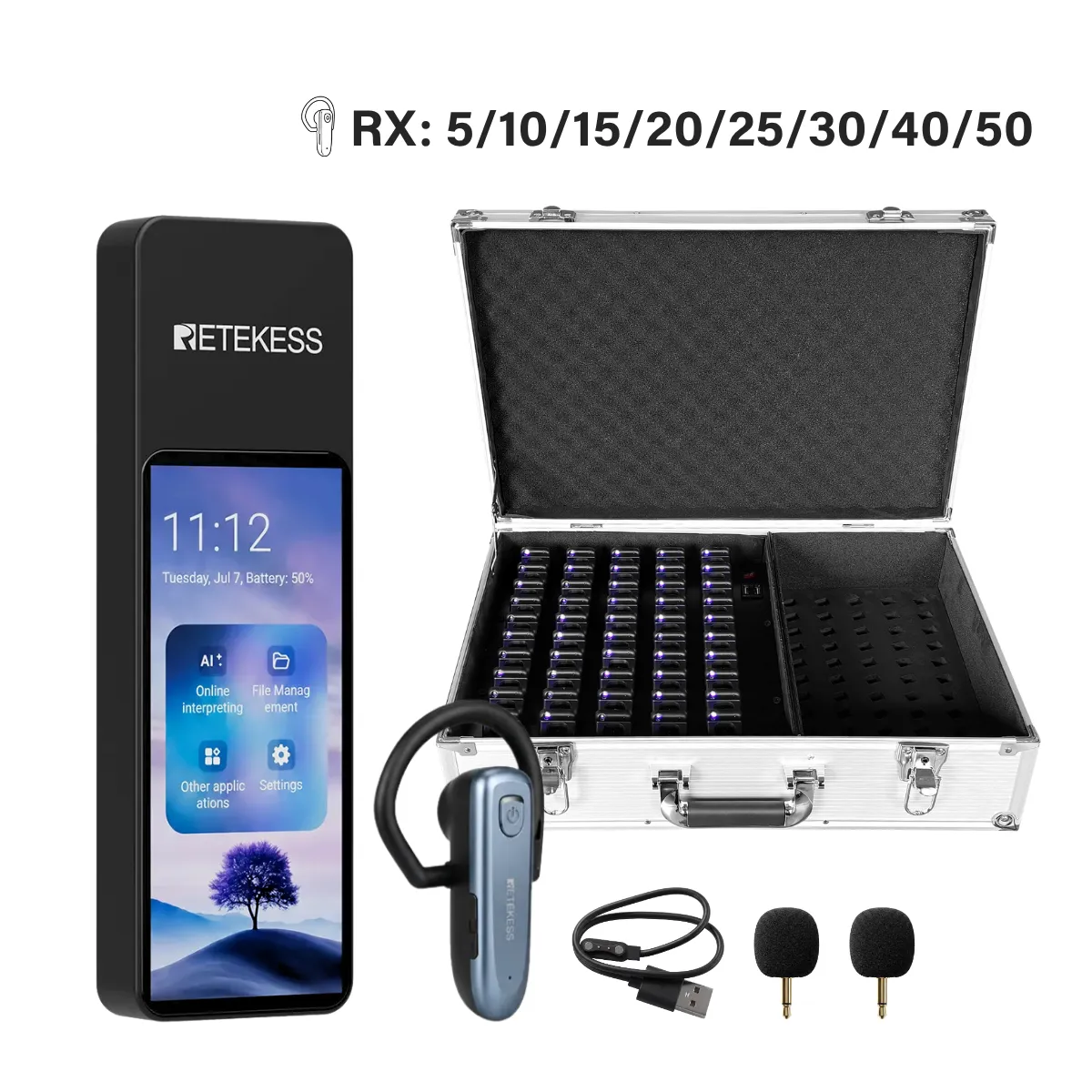
No interpreter available — TT136. The speaker talks naturally and listeners hear their own language through earhook receivers. It covers 120+ languages, reaches 200 m, requires no app for the listener, and bills by the second so you pay only for translation you actually use.
-
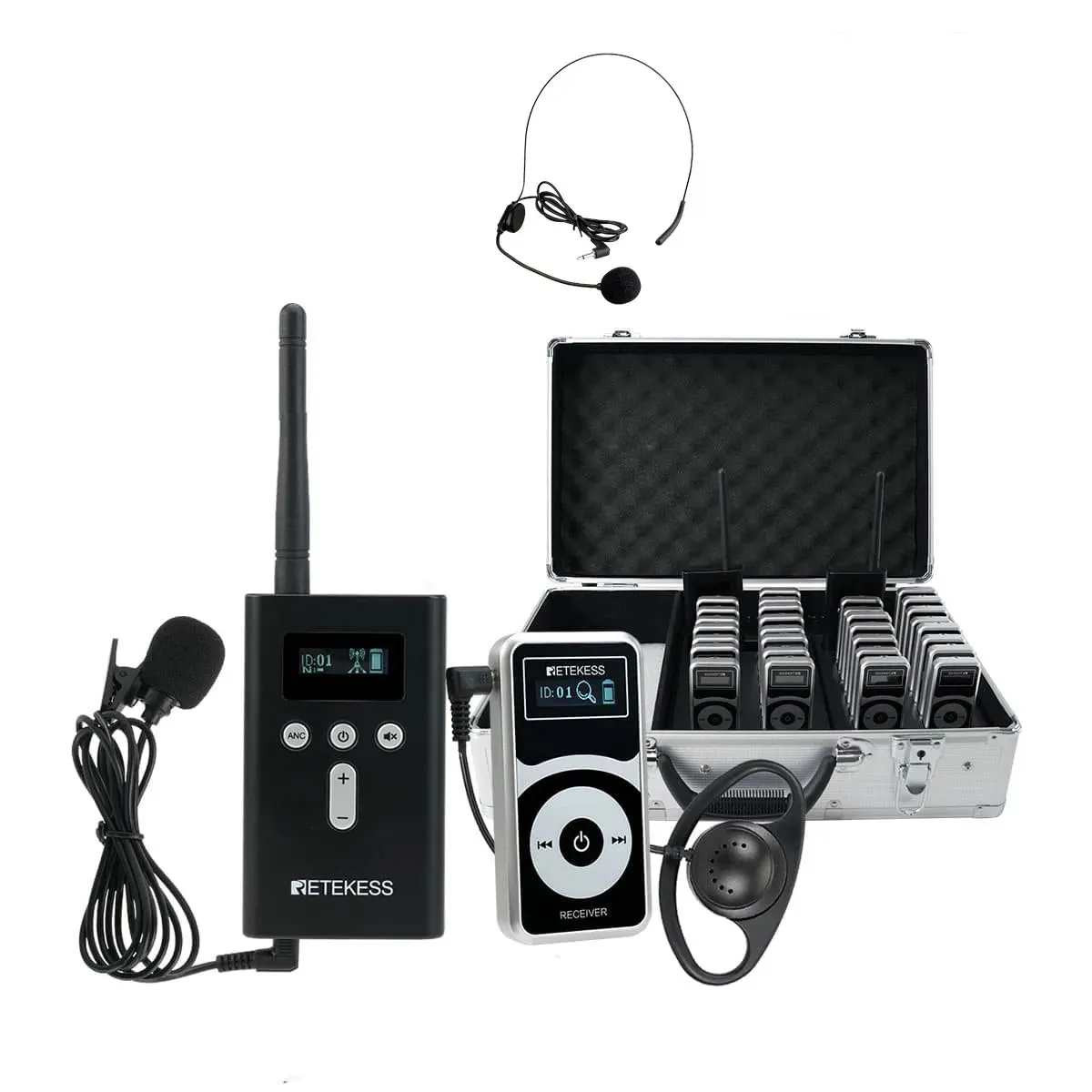
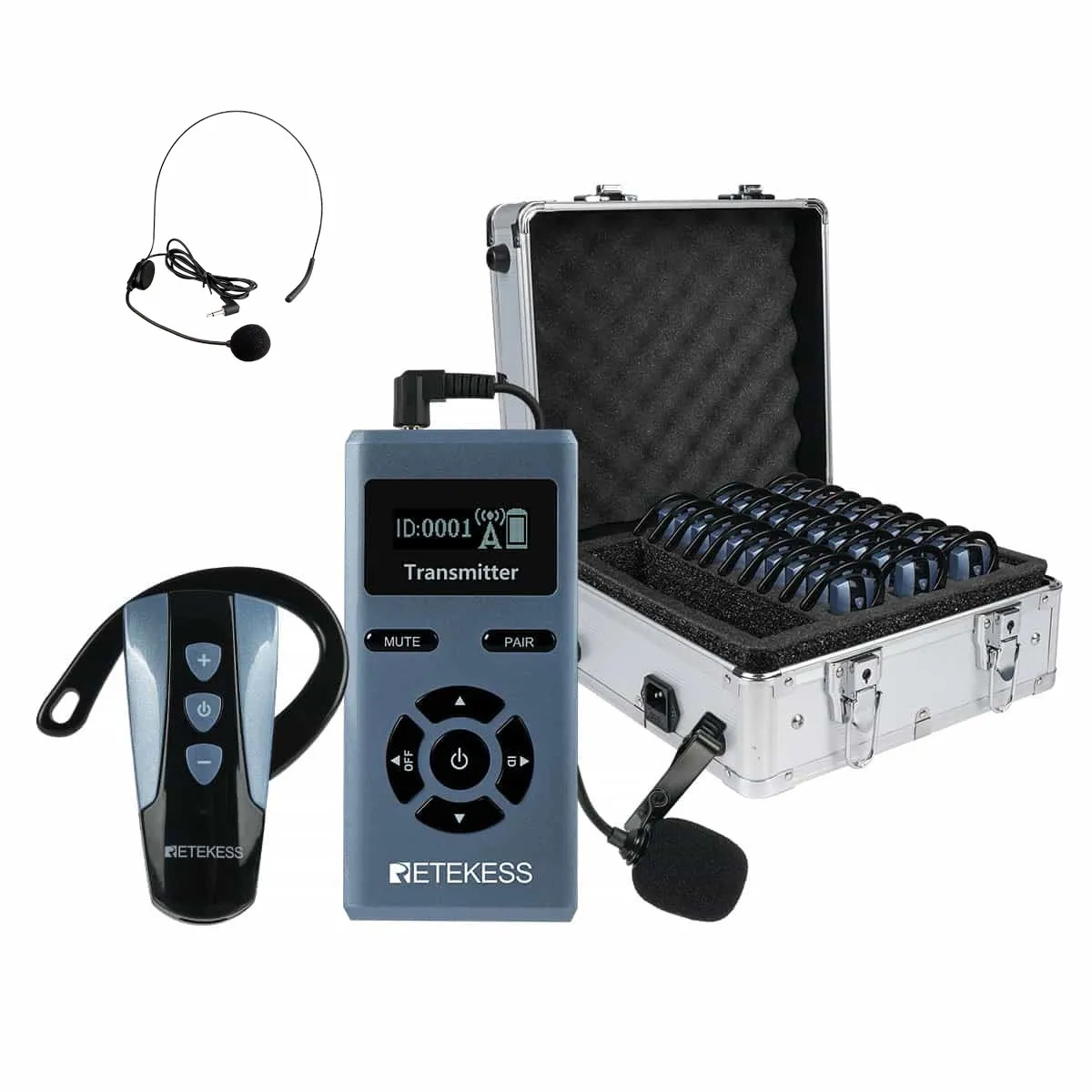
A volunteer or staff interpreter is available — an entry TT117 + TT118 FM kit from $299.99, with 6 channels and 80 m of range.
Sizing tip: buy two spare receivers. At this tier, one failed unit removes 10–20% of your capacity.
10–20 People: Churches, Classrooms and Small Conferences
This is the most searched size band and the easiest to get wrong, because it sits exactly between 'a portable kit will do' and 'we need a proper installation'.
T130T + T131T is built for it: UHF transmission, up to 250 m of range, 7–12 channels, DSP noise reduction, a table-top transmitter powered from DC 5V with lithium-battery receivers, and an interpreter monitor.
The interpreter monitor matters most at this size. It lets the interpreter select an external incoming audio source and use a headset microphone to listen to the floor language — without needing a separate interpreter console or external headphone amplifier. Volume control sets the incoming level, and a mute button handles the coughs and pauses every live session produces.
Sizing tip: if the room is fixed and you have mains power, table-top wins. If you move between rooms, choose a handheld model instead — a table-top transmitter stays behind.
20–30 People: The Mobile Tier
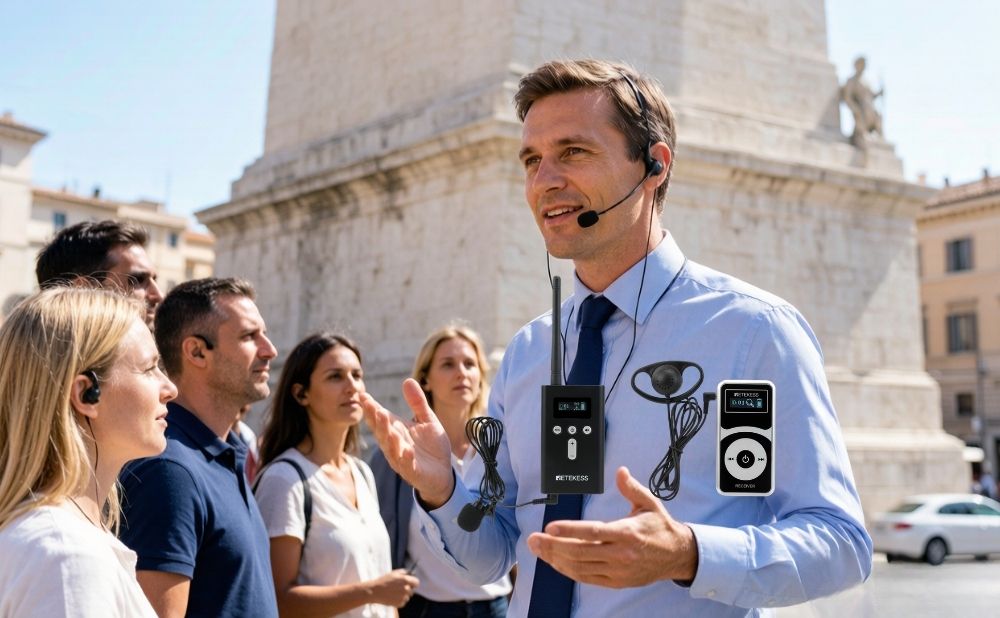
Once people are standing up and moving, the specification that matters is no longer range or channel count. It is whether the transmitter can travel. Four Retekess systems compete here:
|
Model |
Channels |
Range |
Tech |
Why choose it |
|
T130P + T131P |
7 |
160 m |
195–216 MHz |
Fully mobile with intelligent noise reduction — the quality choice for walking groups. |
|
TT117 + TT118 |
6 |
80 m |
72–76 MHz FM |
The budget-conscious option for meetings, churches, schools and community events. |
|
TT106S |
3 |
200 m |
2.4–2.485 GHz |
An extremely lightweight ear-hook receiver — the pick when the receiver must be almost unnoticeable. |
Sizing tip: mobile groups lose people around corners. Buy roughly 10% more receivers than headcount.
50+ People: Conference Scale
At conference scale the constraint stops being the audience and becomes the language plan. TT118 + TT119 handles it with a table-top FM transmitter, 6 channels, 120 m of range, AC power and an interpreter monitor — and critically, it transmits to an unlimited number of receivers.
That means you add receivers as attendance grows and never replace the transmitter. A 50-person event this year and a 150-person event next year are the same purchase plus more receivers.
One exception: a walking group of 50 — a bus tour, a festival site, a plant walkthrough — should use a high-count handheld kit or TT136 instead, because a fixed 120 m transmitter does not follow a moving crowd.
50+ People: Conference Scale
At conference scale, the constraint stops being the audience and becomes the language plan. The Retekess T130T + T131T handles it with a table-top UHF transmitter, 7–12 channels, 250 m of range, DC 5V power and an interpreter monitor — and critically, it transmits to an unlimited number of receivers.
That means you add receivers as attendance grows and never replace the transmitter. A 50-person event this year and a 150-person event next year are the same purchase plus more receivers.
One exception: a walking group of 50 — a bus tour, a festival site, a plant walkthrough — should use a high-count handheld kit or TT136 instead, because a fixed-position setup does not follow a moving crowd.
When There Is No Interpreter at Any Size
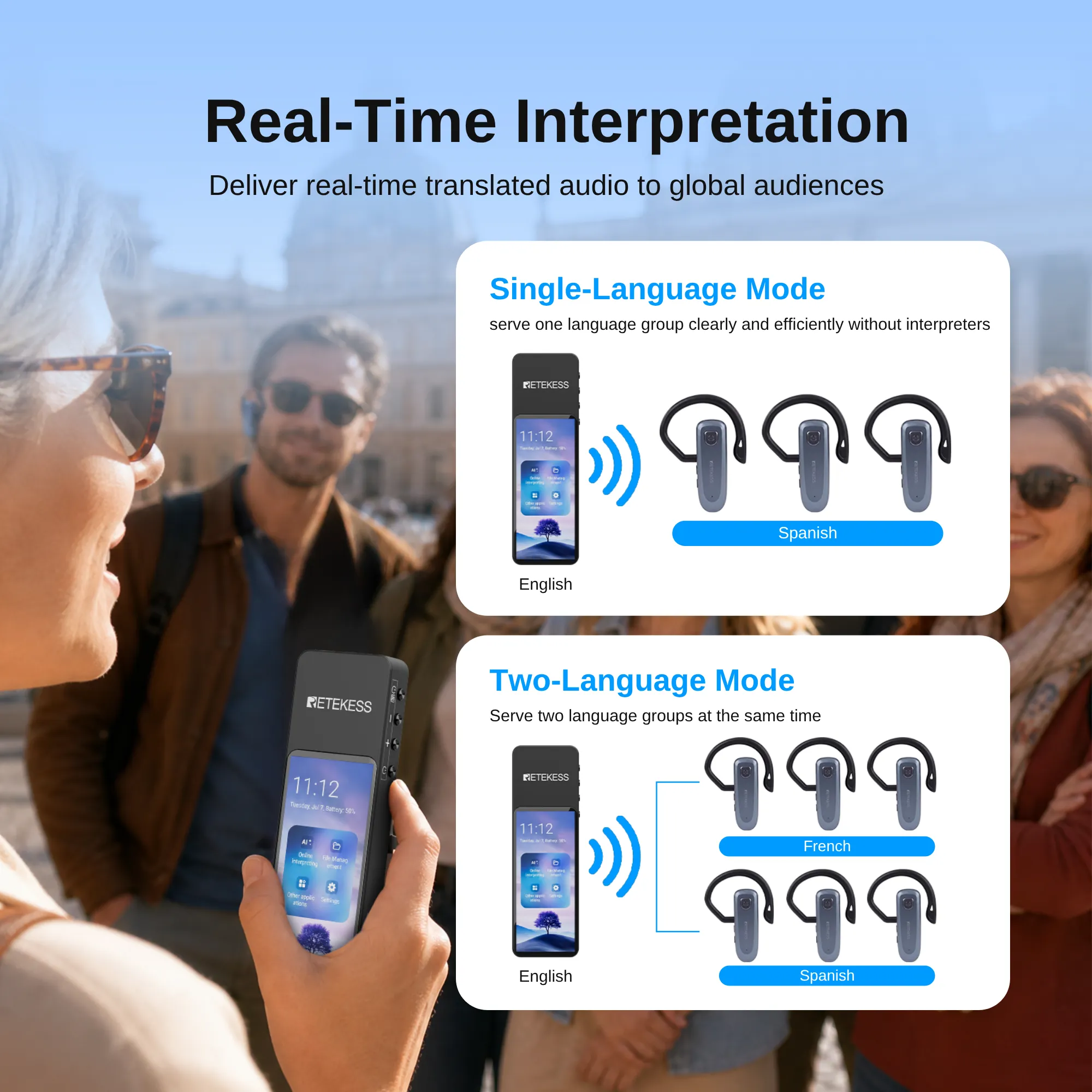
TT136 removes the interpreter variable entirely, which changes how you size. The workflow is four steps:
-
Connect to Wi-Fi or a mobile hotspot.
-
Select translation mode and set the source and target languages.
-
Speak naturally into the TT136 transmitter.
-
Listeners hear the translation through their earhook receivers.
It covers 120+ languages, reaches 200 m over FHSS 2.4G, and uses pay-as-you-go billing with transparent records of usage, costs and remaining credits — 100 hours of translation credits are included with purchase. Whether you are running a 5-person factory walkthrough or a 50-person city tour, the variable becomes receiver count, not language capability.
Full Specification Comparison
|
Model |
Group size |
Channels |
Range |
Tech |
Interpreter monitor |
Transmitter |
Power |
Price |
Best for |
|
TT117 + TT118 |
10–30 |
6 |
80 m |
72–76 MHz FM |
No |
Handheld |
Replaceable AA |
$299.99–$799.99 |
Budget-conscious small-to-medium meetings, churches, schools, community events |
|
TT118 + TT119 |
20–200 |
6 |
120 m |
72–76 MHz FM |
Yes |
Table-top |
AC transmitter, battery receivers |
$569.99–$4,099.99 |
Fixed-venue large conferences, churches, courtrooms, seminars |
|
T130T + T131T |
10–20 |
7–12 |
250 m |
UHF |
Yes |
Table-top |
DC 5V transmitter, lithium receivers |
$499.99–$799.99 |
Fixed-venue meetings, large conferences, churches, courtrooms |
|
T130P + T131P |
10–30 |
7 |
160 m |
195–216 MHz |
No |
Handheld |
Lithium |
$389.99–$1,199.99 |
Fully mobile multi-site events, churches, schools, community events |
|
TT116 |
10–30 |
4–8 |
200 m |
UHF |
No |
Handheld |
Replaceable BL-5C |
$309.99–$865.99 |
Extended runtime; churches, schools, community events |
|
TT106S |
10–30 |
3 |
200 m |
2.4–2.485 GHz |
No |
Handheld |
Lithium |
$289.99–$999.99 |
Where an extremely lightweight receiver is needed |
|
TT136 |
Any (by receiver count) |
120+ languages |
200 m |
FHSS 2.4G |
No interpreter needed |
Handheld |
Lithium |
From $549.99 |
No-interpreter international factory tours, multilingual tours, schools, business receptions |
FAQ
How many receivers do I need for a 20-person group?
Twenty, plus two spares. The transmitter is never the limit — a single transmitter serves an unlimited number of receivers.
Can one system serve a 10-person weekday class and a 50-person Sunday service?
Yes. Buy receivers for fifty and choose a transmitter with channel headroom. The same hardware covers both.
Do I need one transmitter per language?
Yes. Interpreters need a transmitter to broadcast their translations, with each language assigned to a dedicated channel. Each channel requires an interpreter—unless you are using the TT136, a device that supports simultaneous output for two languages.
What is the cheapest way to start?
TT106S from $289.99 if you have an interpreter, or TT136 from $549.99 if you do not. Both are handheld.



![[18th Anniversary] 18 Years of Echoing Excellence: Making Communication Easier, Connecting Trust Beyond Borders](https://res.retekess.com/z_file/20260716/retekess-brand-story-making-communication-easier_20260716151044_7682.jpg)
![[18 Years in Wireless Communication] Silent Disco Systems Anniversary Celebration: Top-Selling Headphones & Event Mechanics Revealed!](https://res.retekess.com/z_file/20260713/18-years-in-wireless-communication-silent-disco-systems-anniversary-celebration_20260713175011_5749.webp)
![[Anniversary Carnival] Ding-dong! 18th Anniversary Mega Sale on Guest Paging & Calling Systems: Full Reveal of 12+ Products & Promo Rules!](https://res.retekess.com/z_file/20260713/18th-anniversary-mega-sale-on-guest-paging-calling-systems_20260713175257_0295.webp)
![[Retekess 18th Anniversary Teaser] Tour Guide System Exclusive Perks: Sneak Peek at Event Dates & Mechanics!](https://res.retekess.com/z_file/20260713/retekess-18th-anniversary-tour-guide-system-exclusive-perks--2-_20260713180135_6435.webp)


 Google
 Amazon
Comments (0)