
Table of Contents
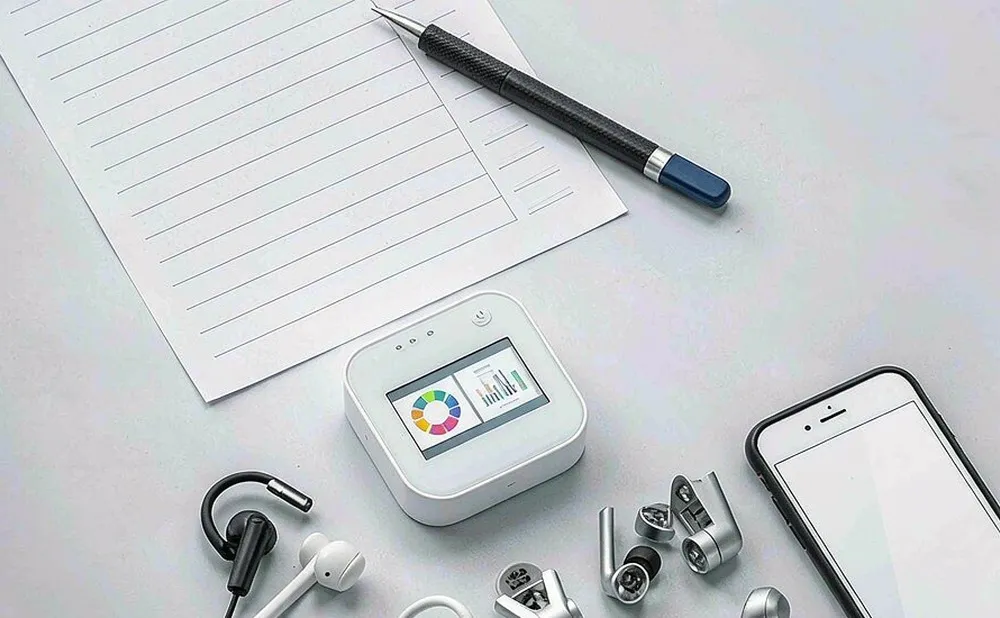
How to Choose the Best AI Translator Device in 2026: A 10-Point Buyer Checklist
- Retekess
- Oct 12, 2026
By the time you are searching for the best AI translator device, you have already decided translation matters. The remaining risk is not whether to buy — it is buying the wrong architecture. Most disappointing purchases in this category are not bad products; they are good products pointed at the wrong job.
Work through these ten questions in order. Each one eliminates part of the market, and by question five you will usually be down to a single class of device.
Question 1: How Many People Must Hear at Once?
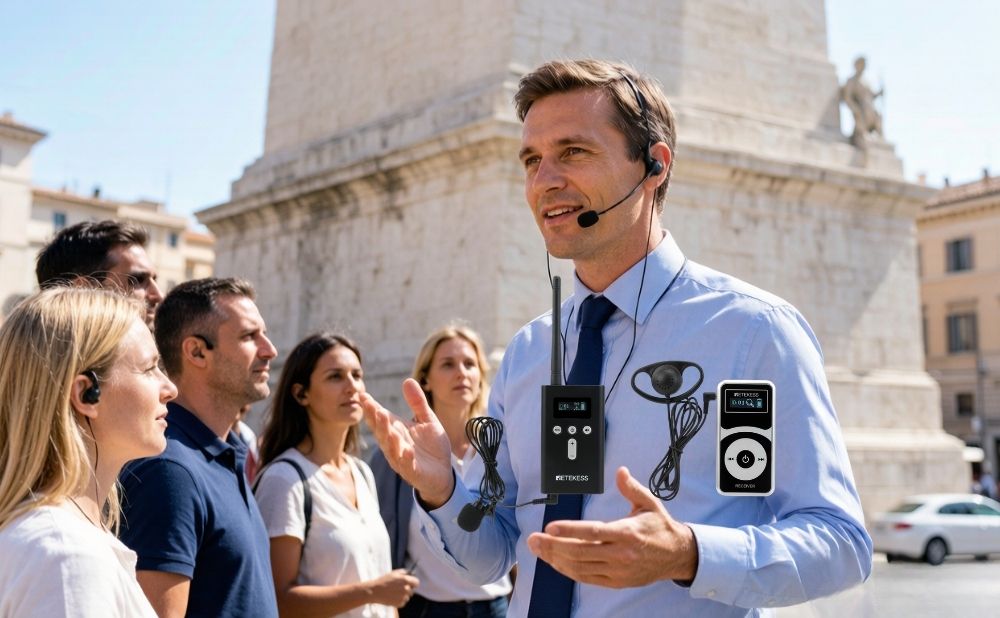
This is the question that decides everything, and the one buyers most often skip. One listener means earbuds, an app or a handheld. Five or more listeners means a transmitter-and-receiver broadcast system. There is no overlap between these two worlds and no product that does both well, despite what marketing copy implies.
Rule of thumb: if the number of listeners is greater than the number of people who will speak, you need broadcast.
|
Listeners |
Architecture |
Why |
|
1 - 2 |
App, earbuds or handheld |
Private, portable, cheap per person |
|
3 - 5 |
Broadcast or several handhelds |
Awkward zone; broadcast is usually cheaper and cleaner |
|
5 - 50 |
Portable broadcast kit |
One transmitter, unlimited receivers |
|
50 - 500 |
Broadcast kit with large charging case, or venue installation |
Fleet logistics dominate the decision |
Question 2: How Many Languages at the Same Time, and in Which Direction?
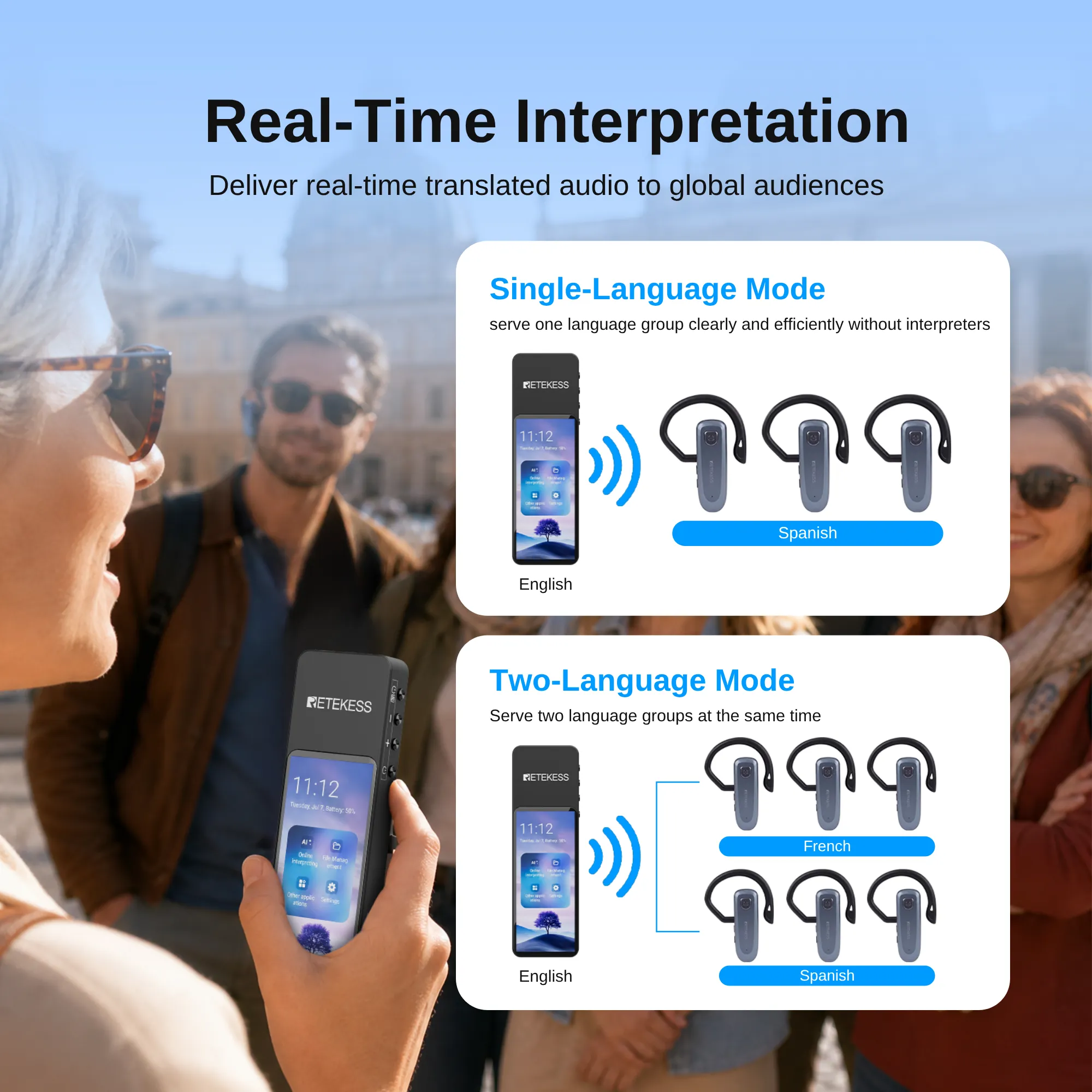
"Supports 120 languages" describes a library, not a capability. What you need to know is how many languages can run simultaneously, and whether translation flows one way or both ways.
- One target language: any broadcast system handles this.
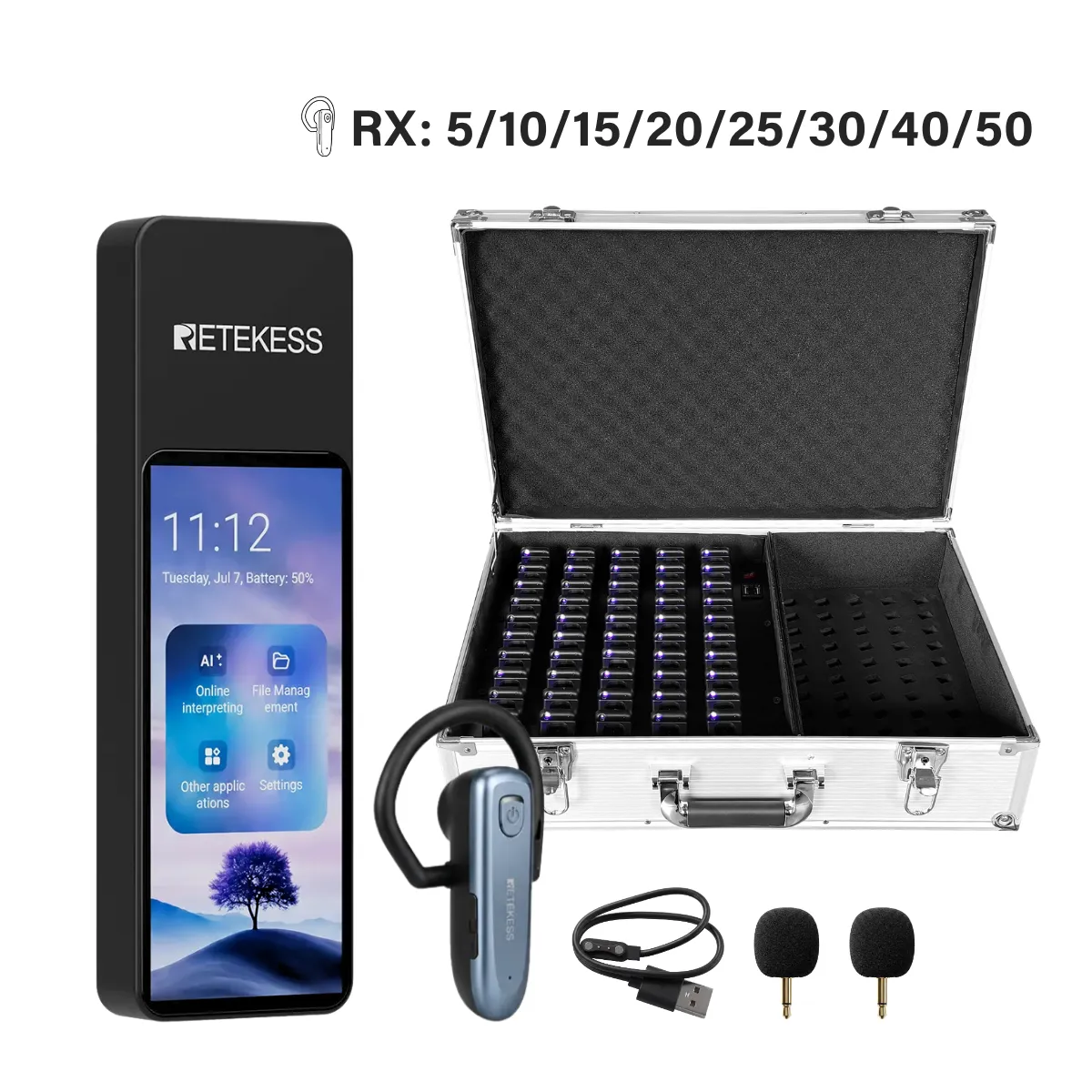
- Two target languages at once: you need bilingual broadcast, such as the TT136.
- Three or more simultaneously: you are into multi-channel interpretation territory — TT117, TT118 or TT119 with interpreters.
- Two-way conversation: you need dual-channel two-way, or an interpreter.
Also confirm your specific pair. Mainstream European and Asian pairs are strong; rare pairs are not, regardless of what the box says.
Question 3: Online, Offline, or Both?
Neural translation in the cloud is materially more accurate than anything running on-device today. That means the real question is not "does it work offline" but "how will I get it online".
- Venue Wi-Fi: fine if you control it and can test in advance.
- Phone hotspot: the standard fallback for mobile guiding and outdoor sites.
- Device with built-in data: useful for handheld translators used across borders.
- Preloaded offline content: a genuine safety net for narration, weaker for live conversation.
Ask the vendor plainly: what happens when the network drops? A system that degrades to preloaded content is very different from one that goes silent.
Also ask whether translation time is metered. Some systems, including the TT136, use a translation-time credit model that the purchaser tops up — a predictable cost, but one you should budget rather than discover.
Question 4: What Is Your Latency Budget?
Latency tolerance depends entirely on whether people are talking back.
|
Use |
Acceptable end-to-end latency |
Consequence if exceeded |
|
Narration, sermon, lecture |
3 - 5 s |
Tolerable; most listeners barely notice |
|
Guided tour with occasional questions |
2 - 3 s |
Noticeable but workable |
|
Business negotiation, Q&A |
1 - 2 s |
Conversation becomes stilted above this |
|
Professional simultaneous interpretation |
Near real time |
Requires a human; AI is not there |
Watch for designs that relay audio through a phone and back over Bluetooth. Those routinely land in the five to ten second range, which is fine for a museum and unusable for a negotiation.
If question four lands you in the last row — a human interpreter working in real time — the hardware branch is a dedicated simultaneous interpretation system such as the Retekess T130T desktop transmitter with T131T receivers: UHF transmission with up to 820 ft of open-area range, DSP noise reduction on the interpreter voice, and 19 channels (EU version) or 50 channels (US version) so several interpreter teams can run at once in the same venue.
Question 5: How Loud Is the Venue?
Capture, not translation, is the first thing to fail in noise. If your venue has machinery, traffic, wind, crowds or live music, microphone design outranks every other specification.
- Quiet indoor: any system works.
- Moderate ambient noise: a close-talking transmitter microphone is essential.
- Industrial noise: choose a system with noise-reducing headsets or receivers — T130P is specified at roughly 23 dB of reduction.
- Outdoor and open sites: prioritise range and stability — TT116 offers 50 channels and roughly 200 m.
Test in the actual venue before you commit. A five-minute test on a real machine beats any spec sheet.
Question 6: Who Operates It, and How Much Setup Time Do They Have?
The person running your translation at 8 a.m. on a Sunday is probably a volunteer, a guide or a teacher. Design for them.
- Can one person set the whole system up in under ten minutes?
- Does the listener experience involve one action or five?
- Are channels auto-matched, or does every receiver need manual tuning?
- Is there a mute key for the interpreter or speaker?
- What is the failure mode, and is it recoverable without support?
Question 7: Will the Audience Use a Smartphone?
If your audience includes elderly congregants, children, visitors who do not want to install an app, or sites with no signal, remove every app-dependent option immediately. Physical receivers also avoid the privacy question that arises when parents, patients or parishioners are asked to run a translation app on a personal device.
This single answer eliminates phone-relay and earbud architectures for a large share of church, school and senior-tour buyers.
Question 8: Hygiene and Shared Use
If the same receivers are handed to different people every day, in-ear designs are the wrong answer. Look for non-in-ear open ear-hook receivers, wipeable surfaces, and a charging case that also sanitises — the TT136 30-slot and 50-slot cases include UV.
Also check receiver weight. Around 13 g with left or right wearability is the difference between a receiver people keep on and one they take off.
Question 9: Charging, Storage and Fleet Logistics
The least glamorous question and the one that decides whether the kit survives a season.
- Centralised charging case with a slot count above your peak group size.
- Storage and transport that keeps transmitter and receivers together.
- Battery type: replaceable cells shorten turnaround between back-to-back groups.
- Spare receivers — assume a small loss rate on public deployment.
- Range and channel count for multi-group sites: 2.4 GHz with 0 - 9999 channels and roughly 150 - 200 m covers most outdoor and industrial sites.
- Receiver turnaround for fixed venues: the T131T receiver runs up to 40 hours per charge, refills in about 3 hours, and charges by USB-C or contact pin — so a daily-charged fleet never waits.
Question 10: Total Cost of Ownership
Compare the three realistic paths over a year of your actual event frequency.
|
Path |
Upfront |
Per event |
20 events per year |
Best when |
|
Human simultaneous interpreter |
$0 |
$4,000 - $8,200 per day per language pair |
$80,000+ |
High-stakes, rare, regulated content |
|
Rental of interpretation equipment |
$0 |
$300 - $500 plus interpreter fees |
$6,000 - $10,000 plus fees |
Fewer than about 8 events per year |
|
Buy a portable group translation kit |
One-time kit cost |
Charging, translation time credit, wear |
Kit cost plus low running cost |
Recurring weekly or monthly multilingual events |
The break-even usually falls between eight and twelve events. If you are renting more often than that, or paying an interpreter to cover routine operational sessions, ownership is cheaper — and it removes the booking lead time, which for interpreter scheduling is commonly four to eight weeks.
The Scorecard: Your Answers to the Right Device
|
If your answers are... |
Choose |
Because |
|
1 - 2 listeners, quiet, mainstream pair, everyone has a phone |
App or AI translation earbuds |
Cheapest and most discreet for one-to-one |
|
5 - 500 listeners, 1 - 2 languages, no interpreter on staff |
Retekess TT136 |
AI translation plus one-to-many broadcast; bilingual output; no app on the listener side |
|
Group, two-way conversation between two language groups |
Retekess TT136 two-way dialogue mode |
Blue and green channels let both sides speak and hear |
|
Group, you have a volunteer interpreter |
Retekess TT117 |
Multi-channel value system with the controls an interpreter expects |
|
Meeting or conference, interpreter at a desk |
Retekess TT118 / TT119 |
Desktop console with interpreter monitor and mute key |
|
Fixed venue, interpreter at a desk, several languages at once |
Desktop UHF simultaneous interpretation: 820 ft range, 19 - 50 channels for 7 - 15 interpreter teams, XLR / LINE IN / Bluetooth inputs |
|
|
Loud factory or plant, 10 - 30 people |
T130P or TT116 |
Roughly 23 dB noise reduction, long range, 50 channels, large charging case |
|
Translation not needed, just clear audio for a big group |
TT106S or T130P |
Lower cost per receiver for monolingual guiding |
|
High-stakes, regulated, rare language pair |
Human interpreter with TT118 / TT119 support |
Certified accuracy where a mistranslation is unacceptable |
Five Buying Mistakes to Avoid
- Buying earbuds for an audience. Scale is the failure, not translation quality.
- Comparing language counts instead of simultaneous language capability.
- Ignoring the microphone because the spec sheet emphasises the engine.
- Forgetting the operator. A system your volunteers cannot set up will not get used.
- Buying for the biggest event you might host instead of the weekly event you actually run — then scaling receivers later.
FAQ
What is the best AI translator device for a small church?
If you have no interpreter, the TT136: it covers the sermon without requiring anyone to install an app, which matters for older members. If you have a volunteer interpreter, TT117 is the lower-cost route and gives that volunteer proper channel and mute controls.
How much does the best AI translator device cost?
Consumer earbuds run roughly $100 - $350 per person, handhelds $250 - $600, and portable group kits are a one-time purchase that scales with receiver count. Compare against $4,000 - $8,200 per day for a professional interpreter before deciding.
Do I need one device per person?
With earbuds, yes. With a broadcast system, no — you need one transmitter for the speaker plus one lightweight shared receiver per listener, which is why broadcast wins on cost as soon as the group is larger than a handful.
Can I start small and expand?
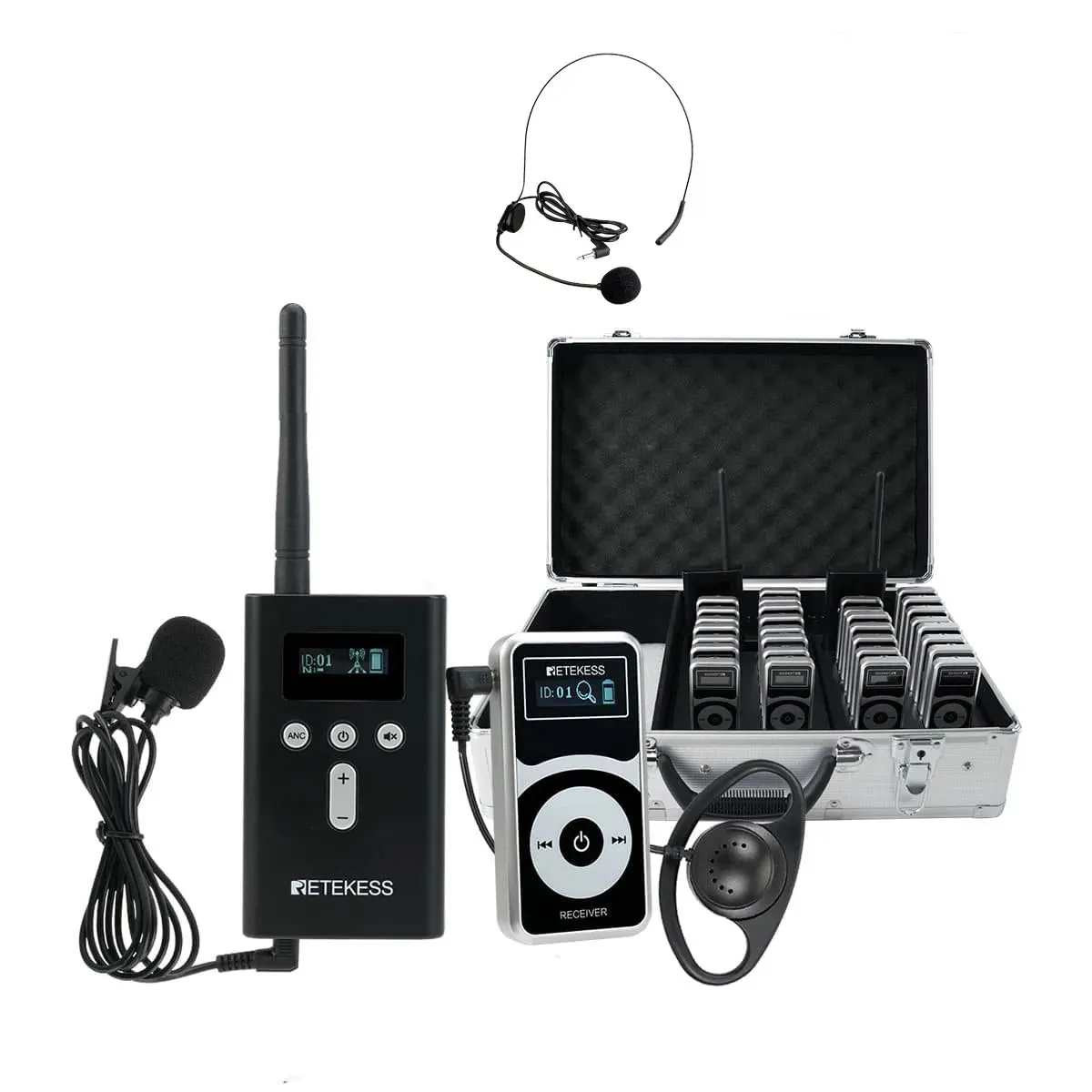
Yes. Start with a transmitter and enough receivers for your typical group, then add receivers and a larger charging case as demand grows. TT106S works as a low-cost expansion set.
How long does setup take?
A portable broadcast kit should be under ten minutes including handing out receivers. If a vendor cannot commit to that, ask why.
Conclusion
The best AI translator device in 2026 is whichever one survives your answers to questions 1, 5, 7 and 10: how many listeners, how much noise, whether they will use a phone, and what the year actually costs. Everything else is refinement.
For most group scenarios — tours in Italy and Spain, multilingual worship in North America, plant visits, school parent nights — that answer is the Retekess TT136. Where an interpreter is present, TT117, TT118 and TT119 are the professional tooling — and for a fixed venue running several interpreter teams at once, the T130T desktop system with T131T receivers is the dedicated simultaneous interpretation answer. Where the only problem is noise, T130P and TT116 are the cheaper fix.
Leave a Reply
![[18th Anniversary] 18 Years of Echoing Excellence: Making Communication Easier, Connecting Trust Beyond Borders](https://res.retekess.com/z_file/20260716/retekess-brand-story-making-communication-easier_20260716151044_7682.jpg)
![[18 Years in Wireless Communication] Silent Disco Systems Anniversary Celebration: Top-Selling Headphones & Event Mechanics Revealed!](https://res.retekess.com/z_file/20260713/18-years-in-wireless-communication-silent-disco-systems-anniversary-celebration_20260713175011_5749.webp)
![[Anniversary Carnival] Ding-dong! 18th Anniversary Mega Sale on Guest Paging & Calling Systems: Full Reveal of 12+ Products & Promo Rules!](https://res.retekess.com/z_file/20260713/18th-anniversary-mega-sale-on-guest-paging-calling-systems_20260713175257_0295.webp)
![[Retekess 18th Anniversary Teaser] Tour Guide System Exclusive Perks: Sneak Peek at Event Dates & Mechanics!](https://res.retekess.com/z_file/20260713/retekess-18th-anniversary-tour-guide-system-exclusive-perks--2-_20260713180135_6435.webp)
Follow Us
Pay With


 Google
 Amazon
Comments (0)