
Table of Contents
International Translation Day 2026: Theme, Date, and What Being Understood Requires
- Retekess
- Sep 30, 2026
Don't miss Retekess translation equipment event! — Shop Now!

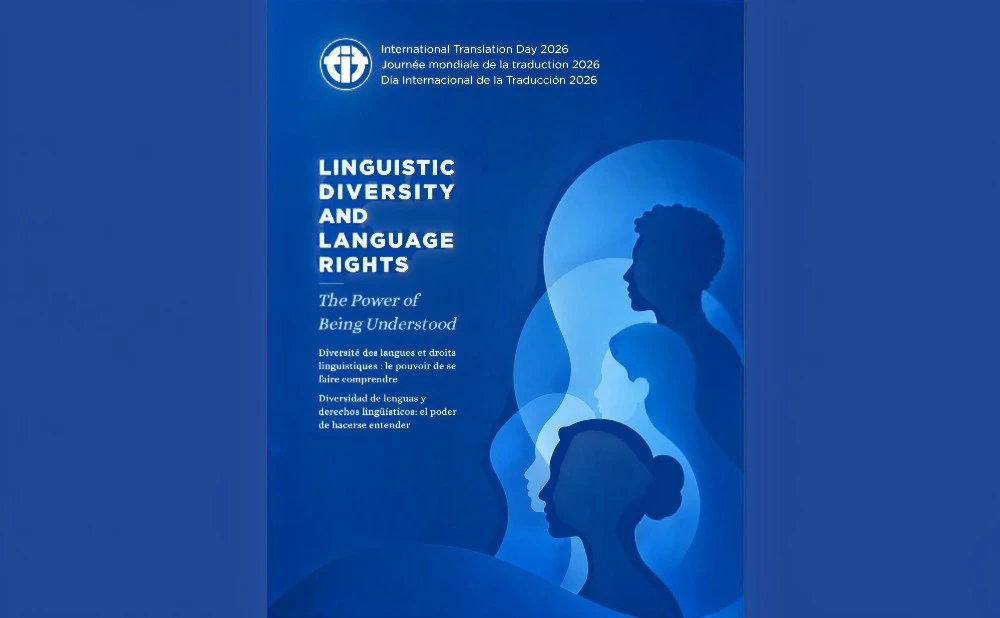
When is International Translation Day 2026, and what is this year's theme? It falls on Wednesday, 30 September 2026, and the theme set by the International Federation of Translators (FIT) is "Linguistic Diversity and Language Rights: The Power of Being Understood." The date marks the feast day of Saint Jerome, who translated most of the Bible into Latin in the fourth century and became the patron saint of translators. FIT established the day in 1991; the United Nations gave it official status in May 2017 with General Assembly resolution 71/288.
That is the part most coverage of the day stops at. This article goes one step further, because the 2026 theme contains a claim that is easy to agree with and hard to deliver on. Being understood is not a sentiment. It is an outcome that has to be produced — on a specific date, in a specific room, with a specific number of people in it. And that is where most well-intentioned language policies quietly fail.
International Translation Day 2026 at a Glance
| Item | Detail |
|---|---|
| Date in 2026 | Wednesday, 30 September 2026 |
| 2026 theme | Linguistic Diversity and Language Rights: The Power of Being Understood |
| Theme set by | International Federation of Translators (FIT) |
| Day established | 1991, by FIT |
| UN recognition | May 2017, UN General Assembly resolution 71/288 |
| Why 30 September | Feast day of Saint Jerome, patron saint of translators |
| Professions honoured | Translators, interpreters, terminologists |
| FIT 2026 event | Free international webinar, 29 September, 14:00 Paris time (online, Zoom) |
| Where to read the official wording | FIT International Translation Day 2026 |
Why 30 September? Saint Jerome, FIT, and a UN Resolution
The date is older than the observance by about sixteen centuries.
Jerome of Stridon completed his Latin translation of the Bible — the Vulgate — in the late fourth century AD, working from Hebrew and Greek sources. His feast day in the Western Christian calendar is 30 September, which is why translators ended up with a patron saint and, eventually, a day. His method is also a reason the profession still argues about itself: Jerome insisted on working from original sources rather than from existing translations, a position that later became a defining principle of translation theory.
The modern observance began in 1991, when FIT — founded in 1953 and now representing associations of translators, interpreters and terminologists across roughly 60 countries — proposed 30 September as International Translation Day. For 26 years it was an industry day without international legal standing. Then, on 24 May 2017, the UN General Assembly adopted resolution 71/288, "Role of language professionals in connecting nations and fostering peace, understanding and development," which formally declared 30 September International Translation Day. The resolution was notable for naming all three professions — translators, interpreters and terminologists — and for framing language access as a condition of the UN's own multilingual operation rather than a courtesy.
One consequence of the UN's involvement is easy to miss. Language access stopped being purely a professional matter and became a rights matter. That shift is what the 2026 theme is built on.
What the 2026 Theme Actually Asks For
"Linguistic Diversity and Language Rights: The Power of Being Understood" is three claims stacked together, and they are not the same claim.
| Theme element | What it asserts | What it implies in practice | Where it usually breaks |
|---|---|---|---|
| Linguistic diversity | Many languages deserve support, not only widely spoken ones | Coverage decisions are inclusion decisions | Machine translation quality is strongly tied to how much training data a language has; low-resource languages get materially worse output |
| Language rights | Access to information, justice, education, healthcare and public services in a language you understand | A right written down is not a right exercised | The paperwork exists in the right language; the conversation does not |
| The power of being understood | Comprehension, not delivery, is the endpoint | You have to verify understanding, not just provide translation | Nobody checks whether the listener actually followed it |
FIT's own framing, as reported in coverage of the 2026 theme, is that language rights are effectively realised through translation — the right exists on paper, and translation is what converts it into access. That sentence is doing more work than it first appears to. It means translation is not a service layered on top of a right. It is the mechanism by which the right becomes real.
It also means the failure mode is specific. When a hospital provides a translated consent form but no interpreter for the conversation in which the consent is discussed, the right has been partially delivered. FIT's 2026 framing covers both halves, and the second half is the one that gets dropped.
Language rights have a legal floor already
This is not an aspirational concept. The International Covenant on Civil and Political Rights, Article 14(3), guarantees anyone facing a criminal charge the right to be informed of the charge in a language they understand and to have the free assistance of an interpreter if they cannot understand or speak the language used in court. Similar provisions appear in EU law on criminal proceedings and in national disability-access legislation, where communication access is treated as an accessibility obligation rather than a nicety.
For event organizers, the practical takeaway is narrower than the legal one: if your gathering is where someone learns about their rights, their benefits, their diagnosis, their child's schooling, or their employment terms, translation at your event is not a hospitality decision.
Where Language Rights Stop Being Abstract
The most useful way to think about the 2026 theme is as a stack of four levels. Most organizations that believe they have handled language access have handled level 2 and stopped.
| Level | What is delivered | Typical owner | Failure rate observed in practice |
|---|---|---|---|
| 1. The right itself | A policy, statute or mandate stating that access must be provided | Legal / compliance | Rarely fails on paper |
| 2. Written translation | Documents, signage, forms, slides in the target language | Communications | Partially fails — usually covered for the largest language group only |
| 3. Live interpreting | A human interpreter rendering speech in real time | Procurement / event team | Often skipped as too costly or too hard to arrange |
| 4. Audio reaching the ear | Each listener actually receives the interpreted channel clearly, at their seat | Technical / AV | Frequently skipped entirely |
Level 4 is the one almost nobody budgets for, and it is the one that determines whether levels 1 through 3 matter. An interpreter working into a room with no distribution system can serve a handful of people leaning in. She cannot serve 200.
That is the gap this article is about. Not whether language rights are a good idea — the industry settled that in 2017 — but what physically has to be in the room for them to function.
What the Evidence Says About Being Understood
Three pieces of evidence are worth holding onto because they cut in different directions.
| Finding | Source and design | Grade | What it means for a live event |
|---|---|---|---|
| Simultaneous delivery took 12.72 minutes vs 18.24 minutes for the next-fastest method across scripted clinical scenarios (p = 0.002) | Harvard-affiliated study of interpreting modes | A (peer-reviewed) | Real-time delivery compresses agendas by roughly 30% versus turn-taking methods, over and above its comprehension benefits |
| Interpreter accuracy in consecutive mode measured 95–98%, versus 83–87% in simultaneous mode | Deb Russell, University of Alberta, court and ASL interpreting research | A (peer-reviewed) | Simultaneous is faster but measurably less accurate. It is chosen for schedule reasons, not precision reasons — a fact worth stating plainly |
| Patients reported no significant difference in perceived quality between on-site and remote interpreting; clinicians strongly preferred on-site | Ruiz et al. 2025, BMJ Open Quality 14(2):e003227, 303 patients and 19 clinicians | A (peer-reviewed) | The person receiving the message notices less than the person delivering it. Do not use "attendees seemed fine" as your quality check |
Two of these are uncomfortable for anyone selling real-time equipment, including us. Consecutive interpreting is more accurate than simultaneous. Attendees often cannot tell the difference between good and mediocre provision. Both are true, and the reason conferences still buy simultaneous systems is the first row: the schedule. A three-hour multilingual session delivered consecutively takes close to four.
Stating this is not a concession. It is the condition under which the rest of the article is credible.
Where AI Helps, and Where It Does Not
FIT's position on AI is not rejection. It is a scope limit, and it is specific: automated systems serve widely spoken languages far better than smaller ones, and a fluent sentence is not necessarily a correct sentence. Both halves matter.
| Situation | AI translation | Human interpreter | Why |
|---|---|---|---|
| Factory tour with an investor group, no interpreter available | Workable | Not obtainable at short notice | Content is bounded, errors are recoverable, no rights attached |
| City tour with visitors from five countries | Workable | Prohibitively expensive for five language pairs | One-to-many, low stakes, conversational register |
| Court hearing, police interview, medical consent | Not acceptable | Required | Rights, liability and precision; Article 14(3) exists for this reason |
| Multilingual church service with an available volunteer interpreter | Secondary role | Preferred | Congregational trust and theological nuance are the product |
| International conference keynote with Q&A | Not sufficient alone | Required | Q&A is unpredictable and reputationally exposed |
| Low-resource language pair | Verify carefully before relying on it | Required | AI quality tracks training-data volume, which is exactly what these languages lack |
The honest summary: AI translation has expanded who can be served at all, not who can be served well enough for legal or clinical purposes. Those are different achievements, and conflating them is how organizations end up in trouble.
Seven Ways to Mark 30 September 2026
None of these require a budget approval, and the middle three are the ones that change how you operate afterwards.
- Read the theme in full. FIT's 2026 page is short. The FIT webinar on 29 September (14:00 Paris time) is free and includes speakers from WIPO and several universities.
- Credit the people who do it. If your organization uses interpreters or translators regularly, name them. The profession's defining complaint is invisibility.
- Audit your own documents. Ask which of your public-facing documents exist only in your default language, and who that excludes. This is the single action FIT most directly asks for.
- Audit your next event, not the last one. Count the languages your attendees actually speak, not the ones you assume. Seven signs your event needs interpretation equipment is a scoring sheet built for exactly this.
- Check the seating, not just the language list. Where will the person who needs the translation physically sit, and what will they hear there? Level 4 in the stack above.
- Ask the frequency question before you buy or rent anything. Covered in the next section. It is a legal question, and it cannot be fixed after purchase.
- Decide now what "understood" would look like. One question at registration. One question at the door. A right that is never verified is a right that is assumed.
Making It Real in the Room
International Translation Day is a good moment to close the gap between level 2 and level 4, because the equipment question is usually easier than people expect. It splits on a single question: do you have an interpreter, or not?
| If you have | The requirement is | The route |
|---|---|---|
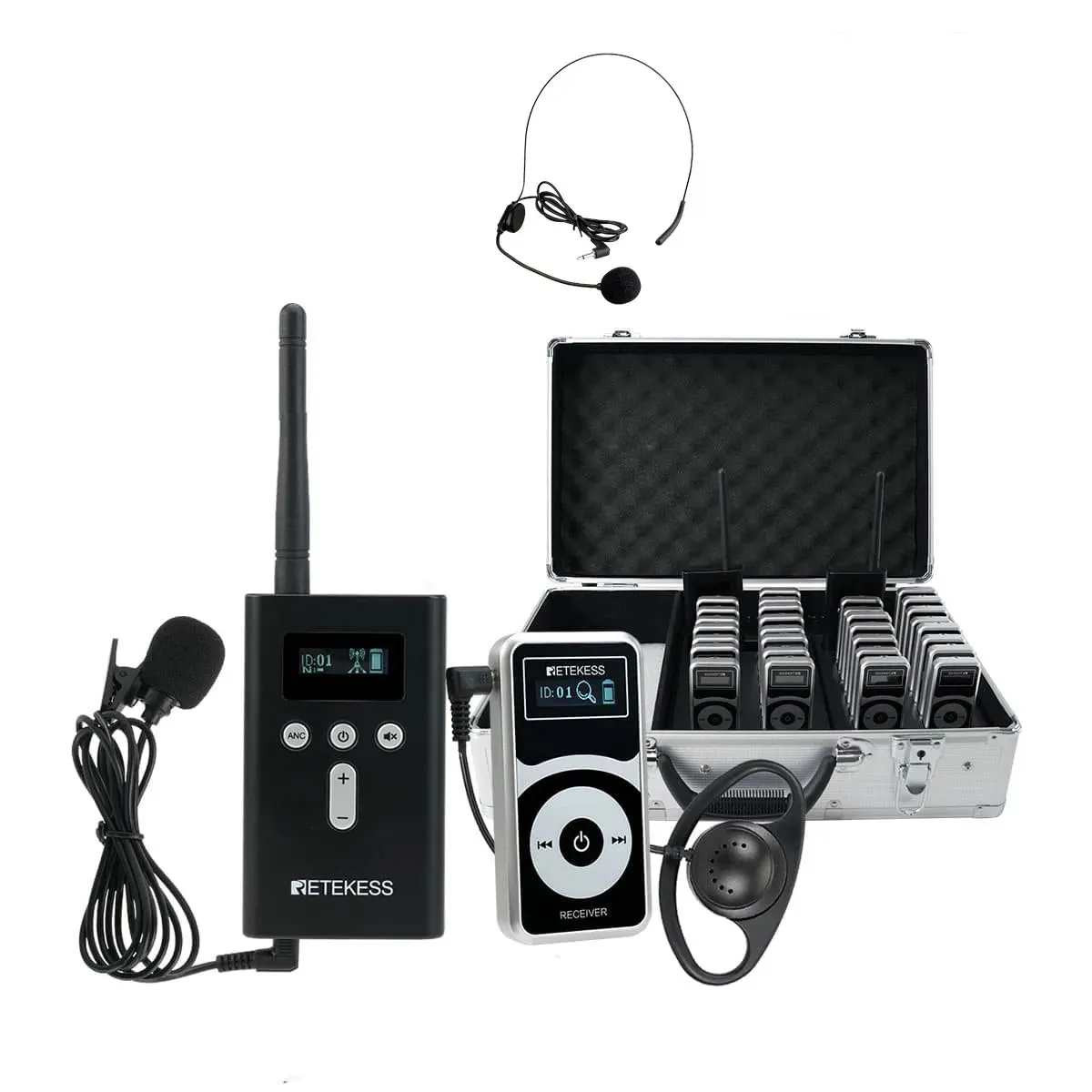
| One or more interpreters, fixed venue, 20–200 listeners | Distribute interpreted channels to every seat, and let the interpreter monitor the floor feed | Human simultaneous interpretation system, table-top transmitter |
| An interpreter, moving group, 10–30 listeners | Portable transmission, no cabling | Human simultaneous interpretation system, handheld transmitter |
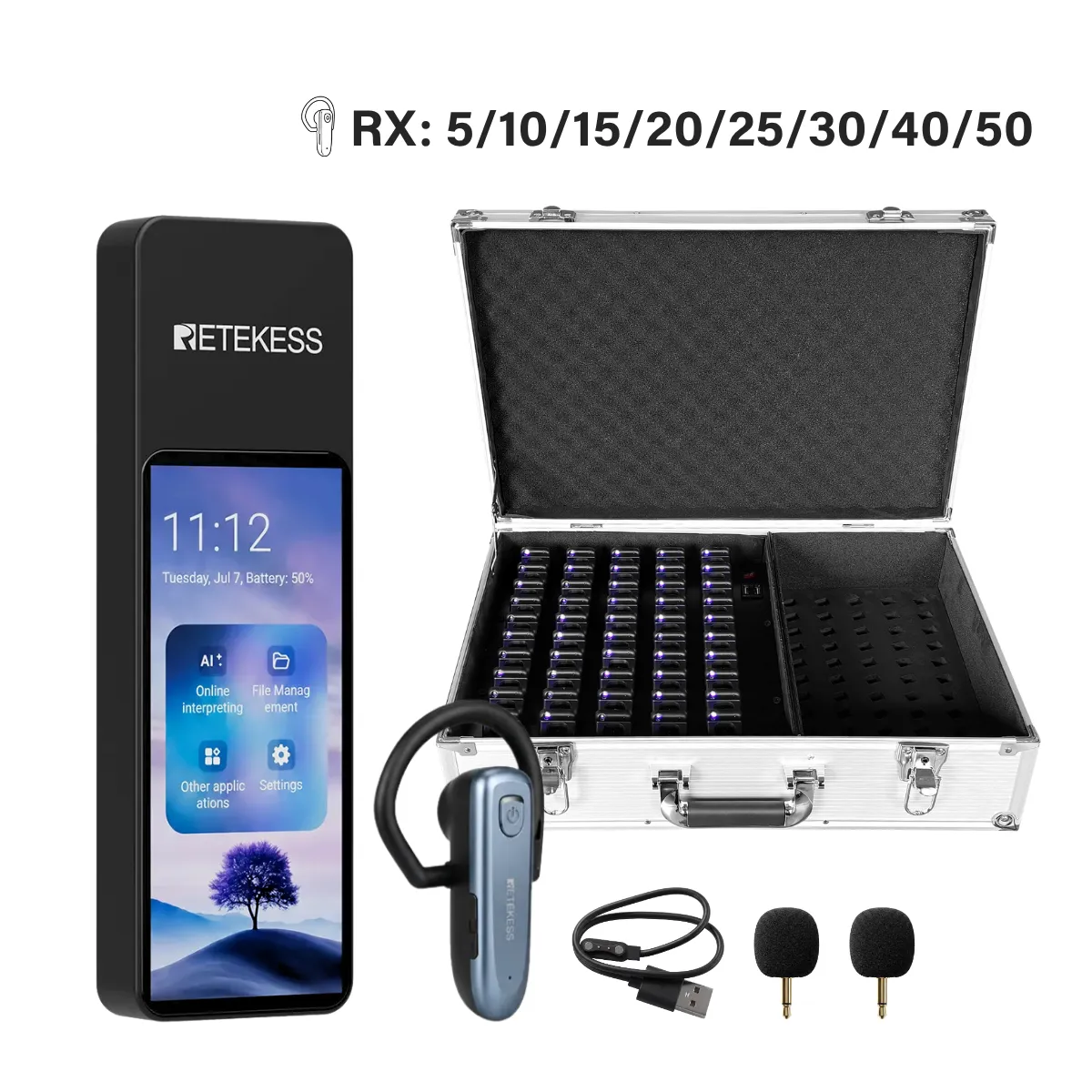
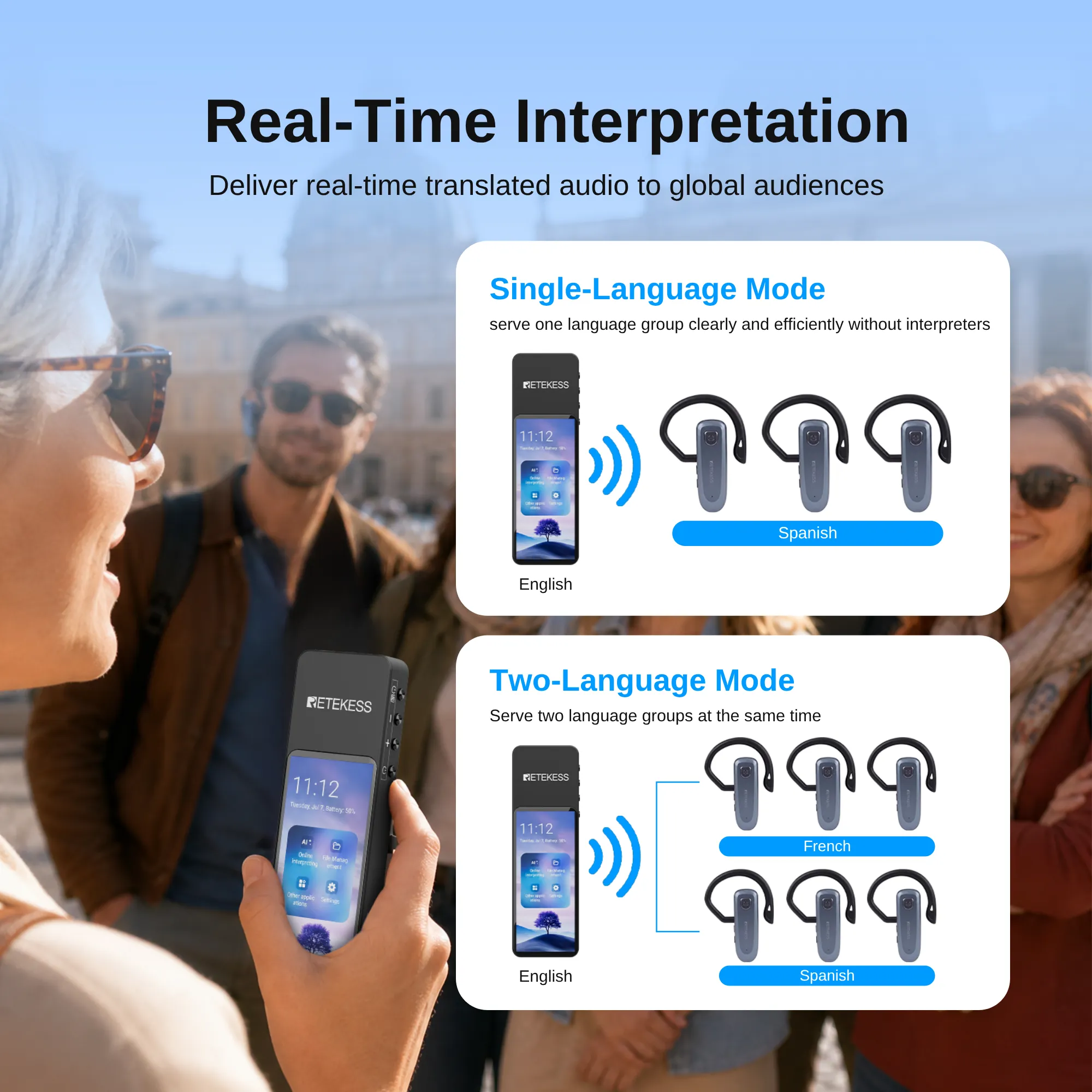
| No interpreter, and none available | Produce a translated feed directly from the speaker's voice | AI real-time translation device |
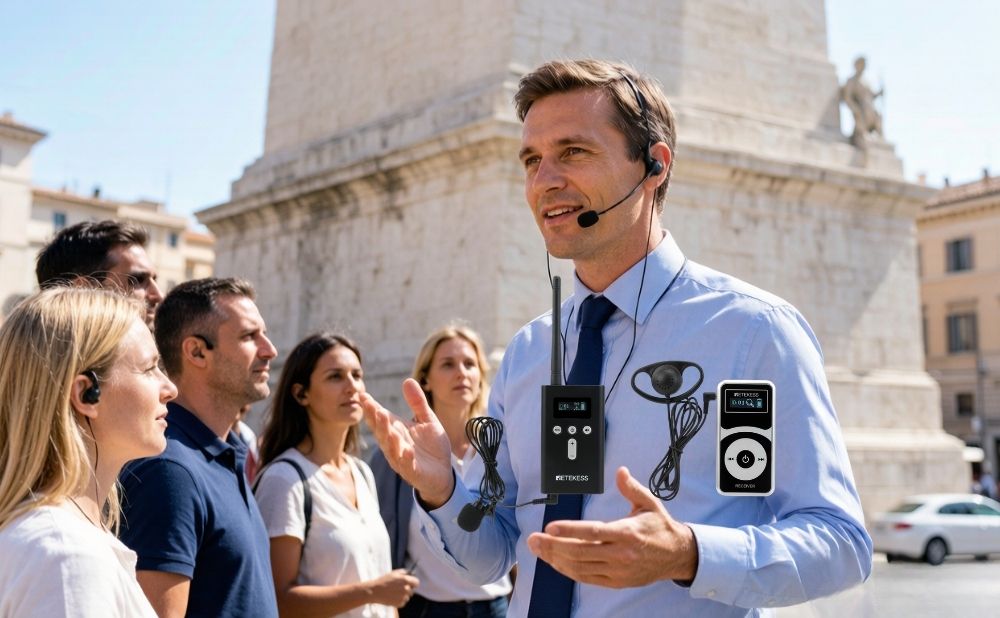
| No interpreter, but a tour guide or presenter who speaks one language | One-to-many translation without adding staff | AI real-time translation device |
If you are working out which of those applies, the simultaneous interpretation and AI translation systems page lays out both routes side by side, with the full specification table. The short version, with specifications as listed on that page:
| Model | Interpreter needed | Channels / languages | Range | Frequency / tech | Interpreter monitor | Form factor | Listed price |
|---|---|---|---|---|---|---|---|
| TT117 + TT118 | Yes | 6 channels | 80 m | 72–76 MHz FM | No | Handheld | 799.99 |
| TT118 + TT119 | Yes | 6 channels | 120 m | 72–76 MHz FM | Yes | Table-top | 4,099.99 |
| T130T + T131T | Yes | 7–12 channels | 250 m | UHF | Yes | Table-top | 799.99 |
| T130P + T131P | Yes | 7 channels | 160 m | 195–216 MHz | No | Handheld | 1,199.99 |
| TT116 | Yes | 4–8 channels | 200 m | UHF | No | Handheld | 865.99 |
| TT106S | Yes | 3 channels | 200 m | 2.4–2.485 GHz | No | Handheld | 999.99 |
| TT136 | No | 120+ languages | 200 m | FHSS 2.4G | n/a | Handheld | from $549.99 |
Three rows in that table are the ones people actually ask about:
- TT118 + TT119 is the only system on the list with an interpreter monitor — the interpreter hears the original floor audio through the same unit she transmits from, which removes a patch cable and about fifteen minutes of setup. It is also the widest-coverage human system at 120 m.
- T130T + T131T carries the most channels (7–12) and the longest range (250 m), which matters when you are running four or more languages into a large hall.
- TT136 is the only row that does not need an interpreter at all. It translates the speaker's voice into up to 120 languages and delivers it to listeners' receivers, billed by the second rather than by the day. It is not a replacement for a human interpreter in the settings listed in the AI table above. It is what you use when the alternative is no translation at all.
That distinction is the whole point of honouring both routes on this day. Professional interpreters and the equipment that carries their work belong to the same effort, and so does the device that serves a group nobody was going to staff an interpreter for.
The Question Almost Nobody Asks Before Ordering
Wireless audio is regulated, and the legal bands are not the same everywhere. This is the most expensive thing on the list to get wrong, because the failure is not technical — it is a device that works perfectly and is illegal to operate.
| Market | Commonly licensed / licence-exempt bands for this class of device | Bands that are not legal here |
|---|---|---|
| United States | 72–76 MHz, 216–217 MHz, plus licence-exempt 2.4 GHz | 863–865 MHz (EU allocation) |
| European Union / UK | 863–865 MHz, 2.4 GHz, and UHF assignments that vary by country | 72–76 MHz is not permitted |
| Other markets | Country-specific; several follow either the FCC or ETSI pattern | Must be checked individually |
The practical risk is concrete: a 72–76 MHz system bought for use in France, Germany or the UK is a 72–76 MHz system you cannot switch on. The reverse applies to 863–865 MHz equipment in the US.
So before ordering, tell the supplier three things — the country of use, the venue type, and how many languages. If a supplier ships without asking, that is the signal. It is also a question worth asking on 30 September, while your team is already thinking about language access.
Frequently Asked Questions
When is International Translation Day 2026?
Wednesday, 30 September 2026. It is observed on the same date every year, chosen to mark the feast day of Saint Jerome.
What is the International Translation Day 2026 theme?
"Linguistic Diversity and Language Rights: The Power of Being Understood," set by the International Federation of Translators. FIT frames language rights as being realised through translation rather than merely declared.
Is International Translation Day a UN observance?
Yes. The UN General Assembly declared 30 September International Translation Day in May 2017 through resolution 71/288. FIT had observed the date since 1991.
Who does the day honour?
Translators, interpreters and terminologists. FIT and the UN resolution both name all three, which is unusual for an observance and worth preserving in your own messaging.
How do organizations usually mark it?
Member associations run discounts and events; language service companies run webinars; freelancer platforms run promotions. FIT's own 2026 activity is a free webinar on 29 September. The more durable version is an internal audit of which languages your organization actually serves.
Does language access require equipment, or just an interpreter?
Both, for groups above roughly a dozen people. An interpreter produces the translation; a distribution system is what gets it to each listener's ear. Without the second, the first serves the people sitting nearest.
Can AI translation replace an interpreter at an event?
Not where rights, clinical decisions or legal exposure are involved — see the table above. It can serve groups that would otherwise receive no translation at all, which is a different and genuinely useful outcome.
What should I check before buying interpretation equipment?
Country of use, number of languages, listener count, and venue acoustics. The first one is a legal question rather than a technical one.
One Thing Worth Doing This Week
→ Compare simultaneous interpretation and AI translation systems



![[18th Anniversary] 18 Years of Echoing Excellence: Making Communication Easier, Connecting Trust Beyond Borders](https://res.retekess.com/z_file/20260716/retekess-brand-story-making-communication-easier_20260716151044_7682.jpg)
![[18 Years in Wireless Communication] Silent Disco Systems Anniversary Celebration: Top-Selling Headphones & Event Mechanics Revealed!](https://res.retekess.com/z_file/20260713/18-years-in-wireless-communication-silent-disco-systems-anniversary-celebration_20260713175011_5749.webp)
![[Anniversary Carnival] Ding-dong! 18th Anniversary Mega Sale on Guest Paging & Calling Systems: Full Reveal of 12+ Products & Promo Rules!](https://res.retekess.com/z_file/20260713/18th-anniversary-mega-sale-on-guest-paging-calling-systems_20260713175257_0295.webp)
![[Retekess 18th Anniversary Teaser] Tour Guide System Exclusive Perks: Sneak Peek at Event Dates & Mechanics!](https://res.retekess.com/z_file/20260713/retekess-18th-anniversary-tour-guide-system-exclusive-perks--2-_20260713180135_6435.webp)
Follow Us
Pay With


 Google
 Amazon
Comments (0)