
Table of Contents
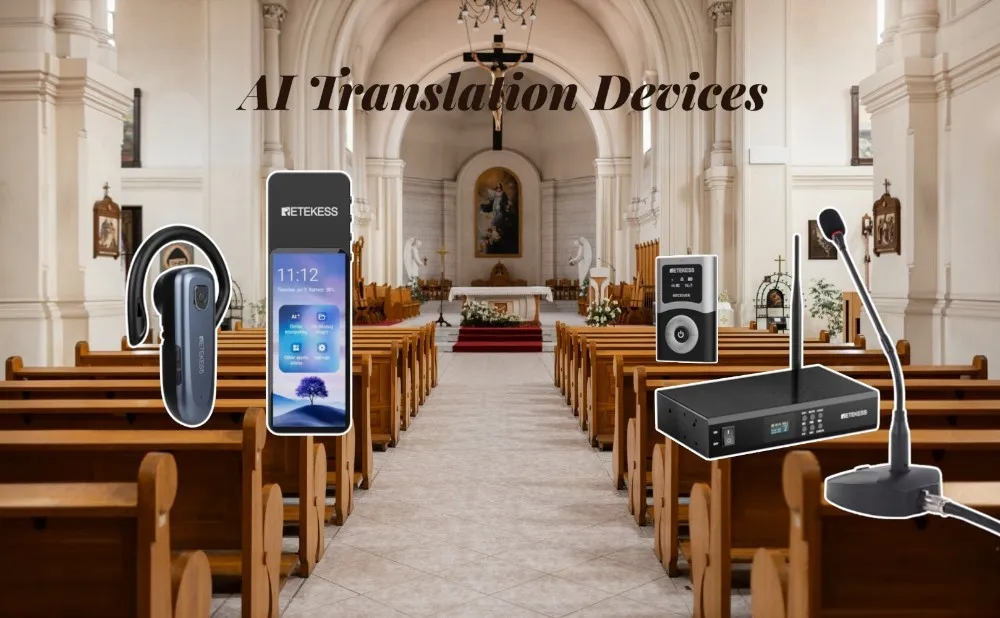
AI Translation Devices: What the Tests Found
- Retekess
- Sep 29, 2026
The Problem With How “Translation Device” Gets Reviewed
Search for an AI translation device today and most of what you find is a review of earbuds or a pocket translator. Those reviews are useful, and some are genuinely rigorous. But they all describe the same product shape: two people, one phone, one conversation happening in a single room.
When a review concludes that AI translation only works on short, clean sentences between two people, that is a real finding — but it is a finding about one-to-one personal gadgets. It is not a verdict on translation devices as a category. The category is bigger than the gadget, and the parts that get reviewed least are the parts that are actually deployed most: one speaker addressing a room, a tour group, a factory floor or a congregation.
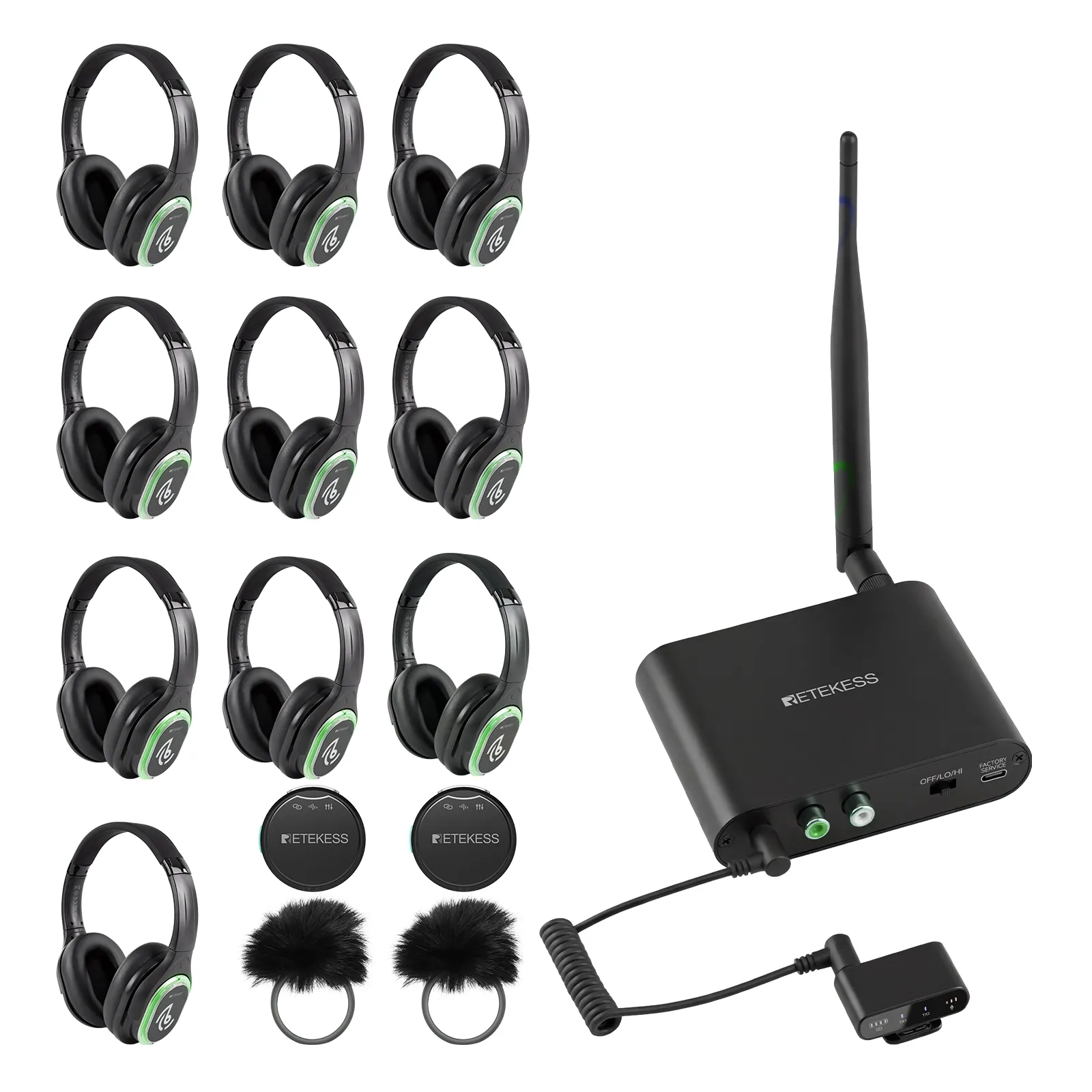
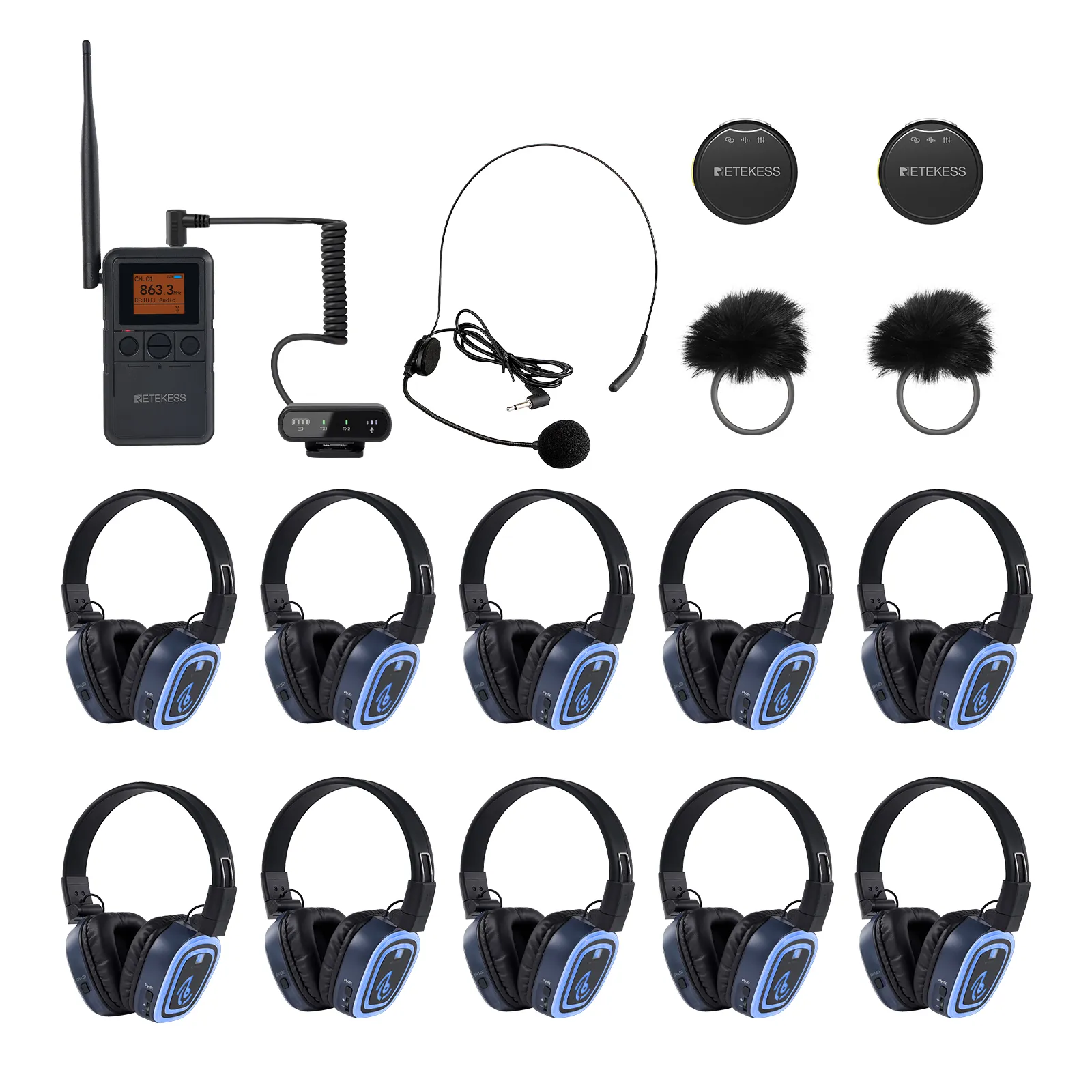
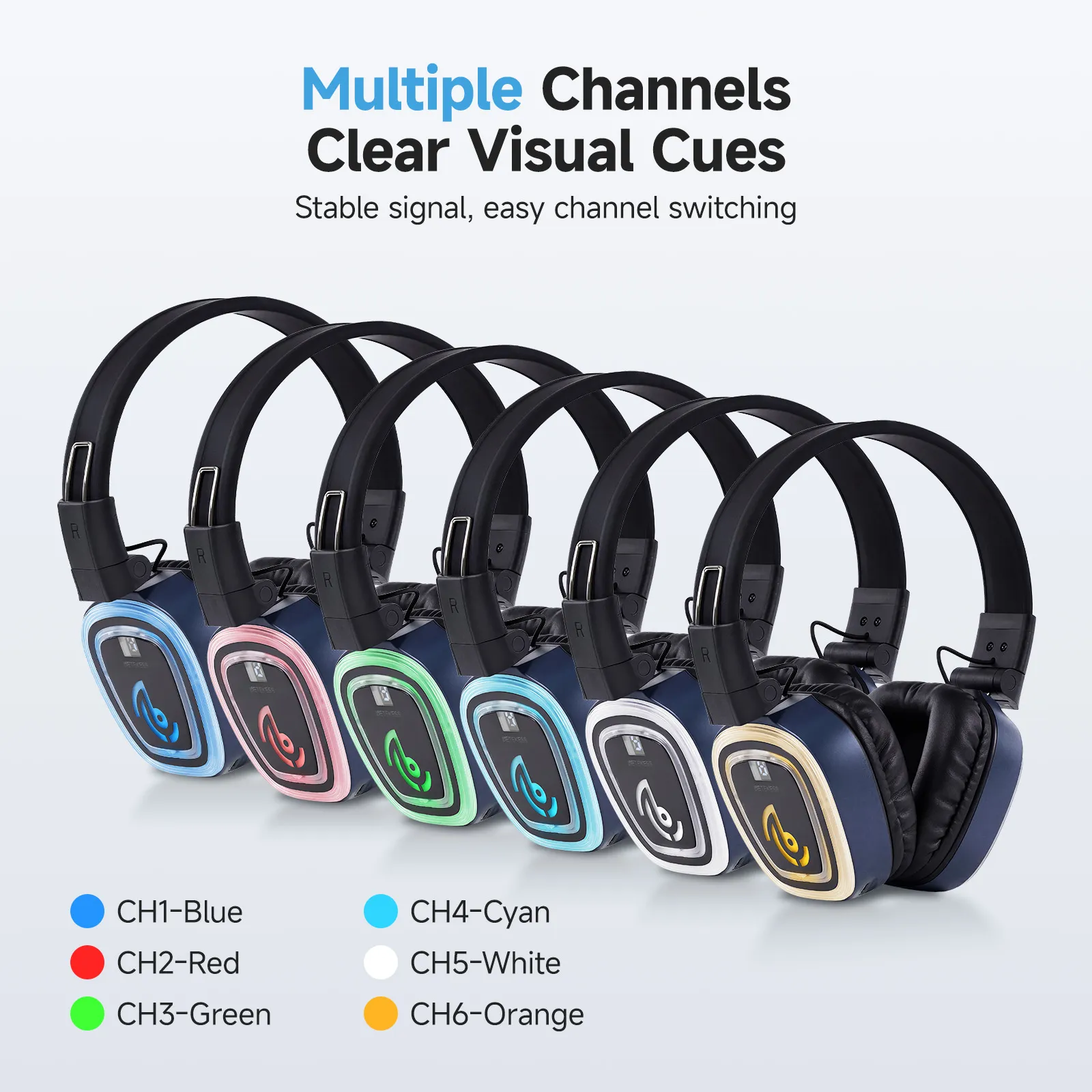
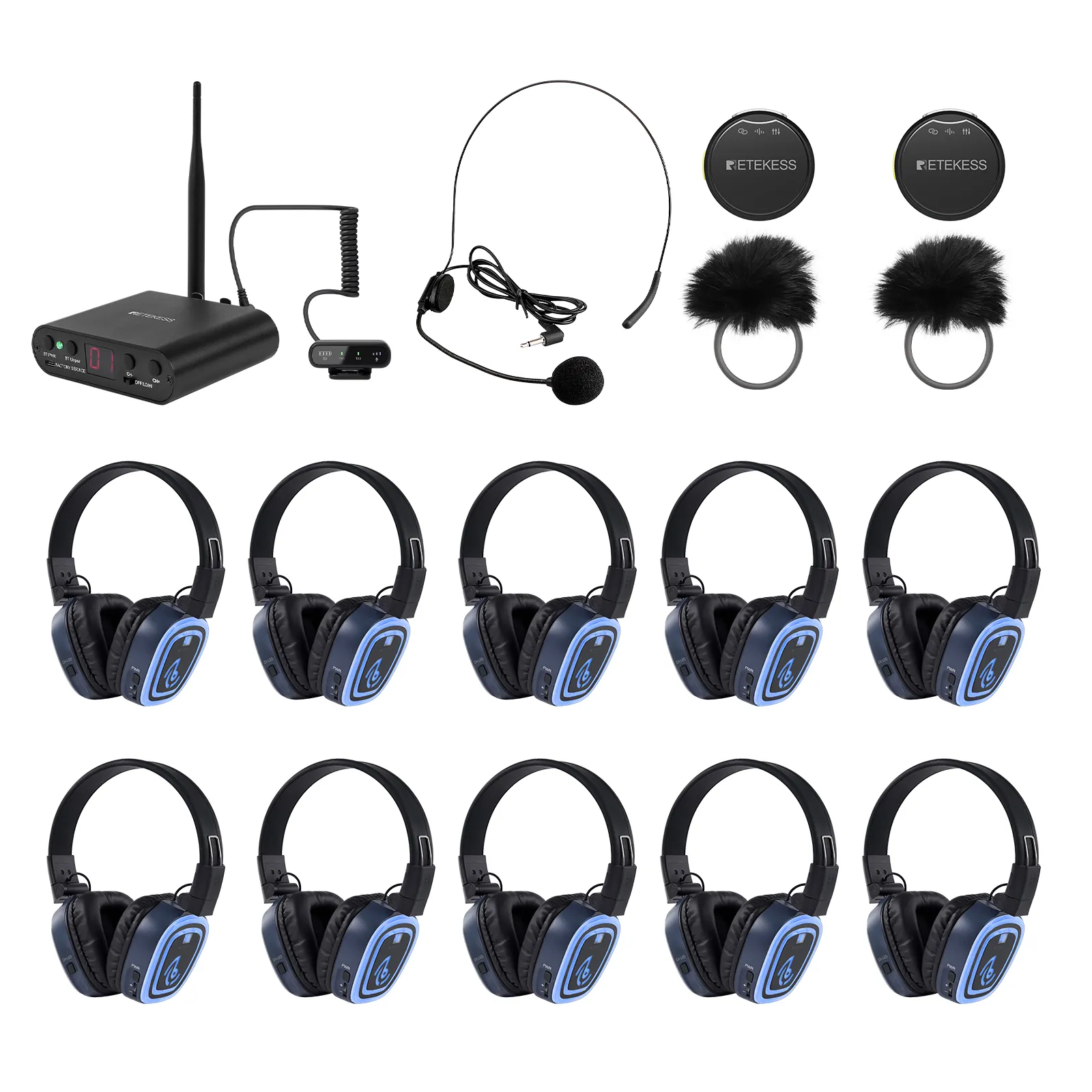
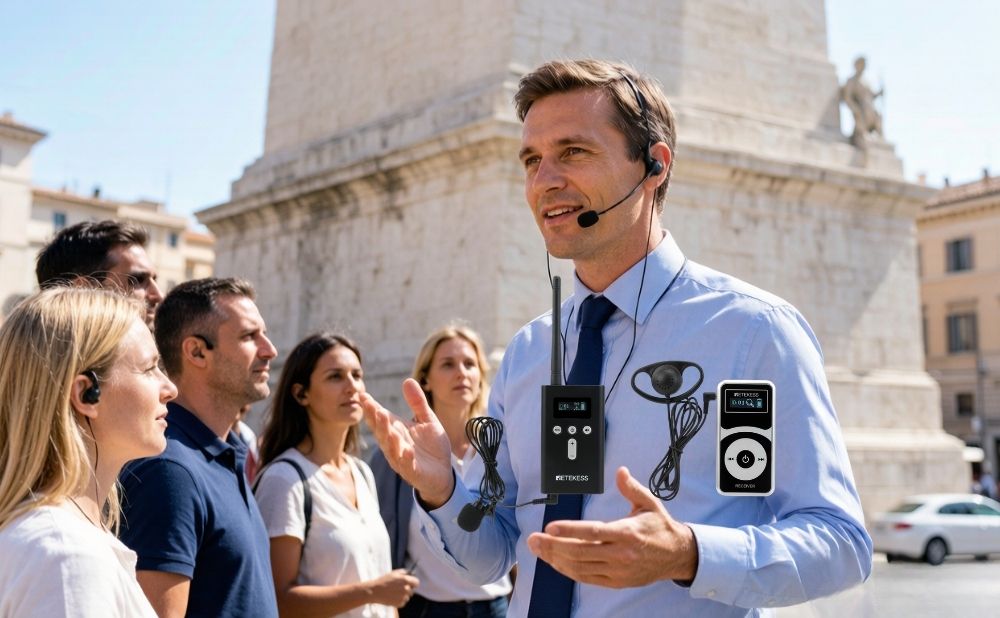
A speaker-led multilingual group listening through dedicated receivers — the use case most translation device reviews never test.
Three Families of Translation Devices, Not One
Before comparing accuracy numbers, it helps to separate the hardware into the three families that actually exist in the market. Most confusion about AI translation devices comes from comparing family one against family three and concluding that one of them failed.
| Family | What it does | Typical hardware | Language engine | Who buys it |
|---|---|---|---|---|
|
One-to-one personal translation devices |
Two people speak; each hears the other's language in turn |
Earbuds, pocket translators, or a phone running an app |
Machine translation (AI) |
Travellers, front-desk staff, clinicians, individuals |
|
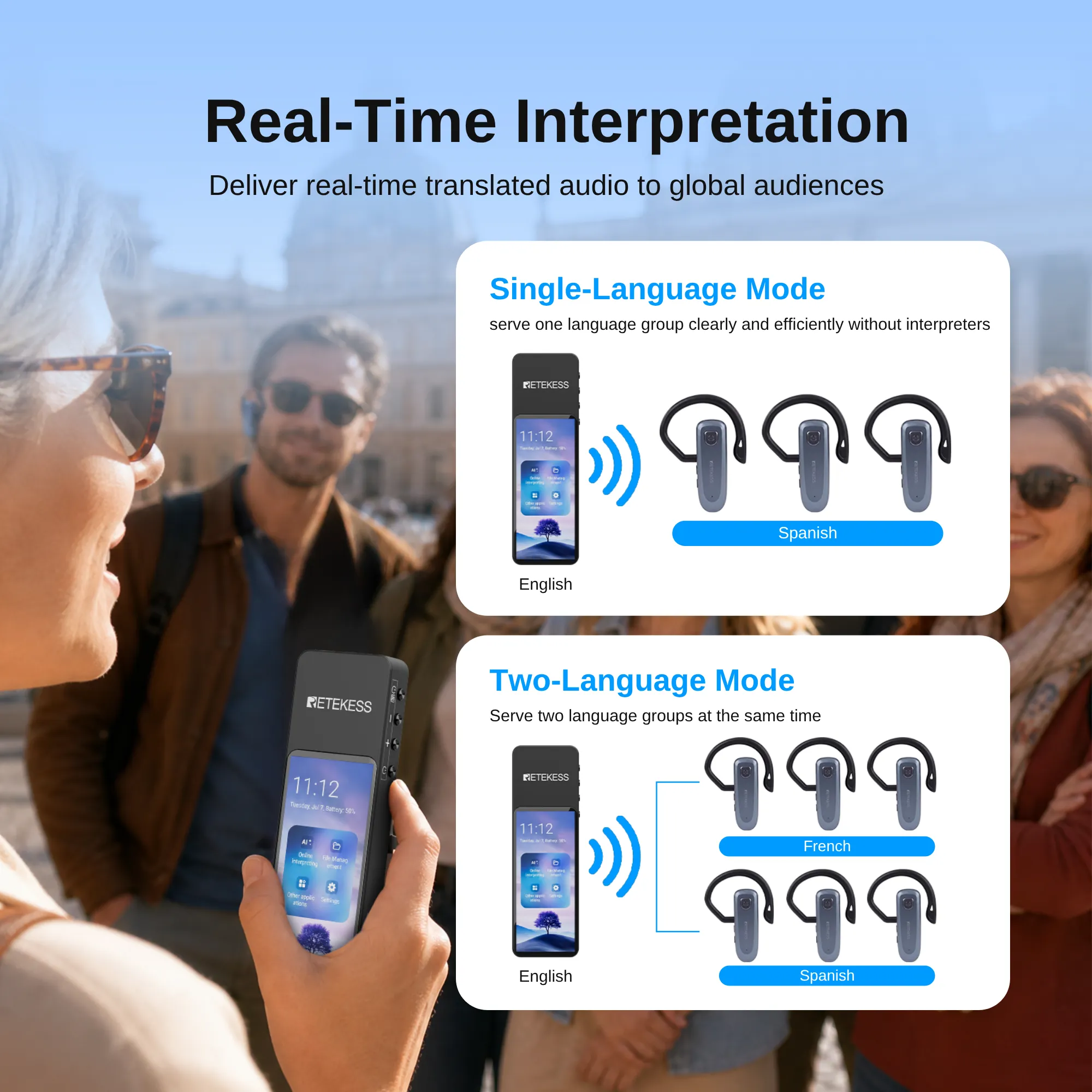
One speaker talks naturally; many listeners each hear their own language at the same time |
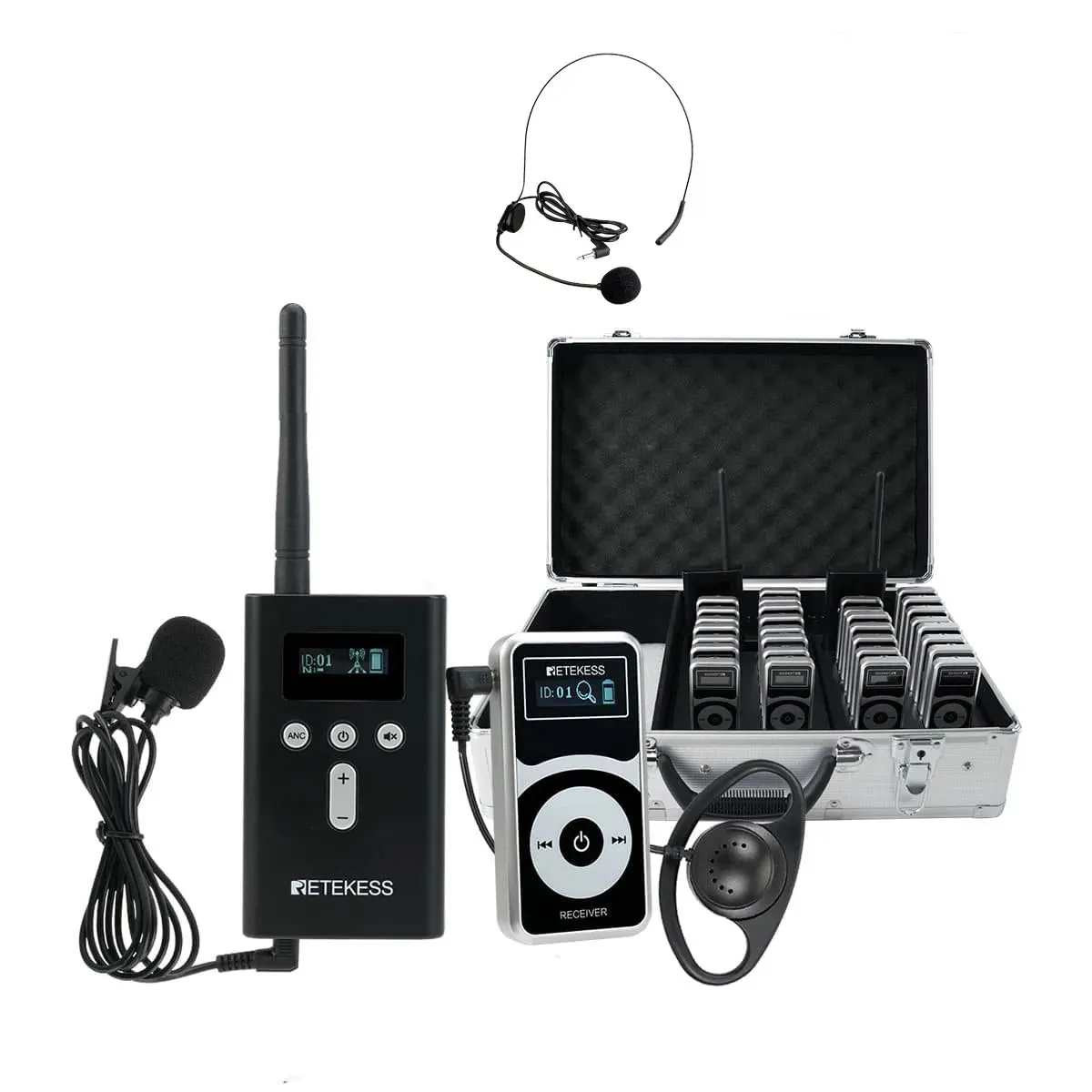
A dedicated transmitter with a close microphone, plus one receiver per listener |
Machine translation (AI) |
Tour operators, manufacturers hosting visits, schools, churches, event teams |
|
|
A human interpreter listens to the floor language and delivers the target language; the system distributes it to every listener |
Transmitter, interpreter position, one receiver per listener, one channel per language |
Human interpreter |
Conferences, courts, worship services, government, high-stakes meetings |
The second family is the one that barely gets reviewed, and the third is the one that most AI-versus-human articles forget to mention at all — even though a human interpreter still needs simultaneous interpretation equipment to reach anyone beyond the front row.
What Published Tests Found About AI Translation Devices
The most-cited hands-on tests of consumer translation devices — earbuds and pocket handhelds in the $40–$500 range, tested across Russian, Chinese and French — arrived at a consistent set of findings:
- Short, clearly delivered, written-style sentences translated close to perfectly.
- Accuracy dropped sharply on longer, conversational, idiomatic sentences.
- Devices frequently missed the first second or two of an utterance — the speech recogniser effectively had to warm up before it started capturing.
- Speech was cut off mid-sentence when the speaker paused, because the device assumed a pause meant the turn was over.
- The same sentence translated differently when repeated.
- Synthesised speech was fast and robotic, and had to be replayed to be understood.
- Domain terminology was mishandled — a particular problem in medical contexts, where some Latin terms should not be translated at all.
None of that is wrong, and none of it should be dismissed. It is the most useful evidence we have about how these devices behave in free-flowing two-way dialogue.
Three Failure Modes That Come From the Form Factor, Not the AI
Here is where the analysis usually stops, and where it should not. Several of the most damaging failure modes in those tests are not fundamentally language problems. They are microphone, turn-taking and device-friction problems — and they largely disappear when the same AI engine is put into a speaker-led, one-to-many setup.
| Reported failure | What actually causes it | What changes in a group translation setup |
|---|---|---|
| Missed first seconds of speech | A phone or earbud microphone waking its speech recogniser up only after it detects sound | A dedicated transmitter with a lapel microphone positioned at the speaker's collar, running continuously for the whole session — there is no wake-up moment to miss |
| Speech cut off mid-sentence | Endpoint detection tuned for turn-taking dialogue, which reads a pause as the end of a turn | Speaker-led delivery with continuous transmission; the system is not waiting for the other side of a conversation |
| Pairing failures, apps and accounts | Every listener needs a phone, an app, an account and a successful pairing before anything works | Dedicated receivers pre-paired to the transmitter — the listener puts the receiver on and hears translation, with no phone and no app involved |
| Delay compounding across turns | Speech-to-text, translation and speech synthesis repeated on every turn, in both directions | One-way broadcast: listeners hear in parallel rather than waiting for a round trip to complete |
Note: What does not change: synthesised voice quality and domain-specific terminology remain real limitations in every family of AI translation device. A machine is still weaker than a professional interpreter on nuance, and no honest vendor should claim otherwise.
Two different problems: one-to-one turn-taking between two people, versus one speaker broadcasting to many listeners at once.
Where AI Translation Devices Work Today
The useful question is not “are AI translation devices good yet?” It is “in which situations do they already work?” Based on the failure modes above, the boundary is fairly clear.
|
Scenario |
Verdict |
Why |
|
Guided city tour, museum or heritage site |
Strong fit |
One speaker, prepared content, low consequence if a phrase is imperfect, listeners moving together |
|
Factory visit or plant tour |
Strong fit |
One speaker, controlled route, technical vocabulary can be briefed in advance |
|
Church sermon or worship service |
Good fit |
One speaker with a prepared text; live Q&A and testimonies need more care |
|
School open day, parent meeting, assembly |
Good fit |
One speaker with short question segments; families hear in their own language without installing anything |
|
Conference keynote or product launch |
Good fit with planning |
One speaker; consider a human interpreter plus simultaneous interpretation equipment if the content is commercially or politically sensitive |
|
Business negotiation or contract discussion |
Use with caution |
Turn-taking, idiom and high consequence — the exact conditions where accuracy drops and errors cost money |
|
Medical encounter |
Not for high-stakes content |
Follow established guidance on AI-generated interpreting; symptom-taking, diagnosis and consent should not run on machine translation |
|
Court, deposition or legal proceeding |
No |
Accuracy, confidentiality and compliance requirements exceed what any machine translation device can currently guarantee |
AI Translation Device vs Simultaneous Interpretation: Not Substitutes
Framing this as AI versus human interpreters misses the practical decision. The two are different tools for different halves of the same problem, and plenty of organisations run both.
|
Dimension |
AI translation device (e.g. Retekess TT136) |
Simultaneous interpretation system (e.g. Retekess TT118 + TT119, T130T + T131T) |
|
Who converts the language |
A machine translation engine |
A human interpreter |
|
Language coverage |
120+ languages available instantly |
Limited by the interpreters you can staff — 6 to 12 channels depending on the model |
|
Nuance, idiom and domain terminology |
The weakest area |
The strongest area |
|
Network dependency |
Requires Wi-Fi or a mobile hotspot |
None — audio distribution is entirely local |
|
Staffing |
None required |
One interpreter per language channel |
|
Audience size |
One receiver per listener; scale by adding receivers |
One transmitter serves an unlimited number of receivers |
|
Cost model |
Hardware plus pay-as-you-go translation credits |
Hardware plus interpreter fees |
|
Best for |
Speaker-led explanation across many languages with no interpreter available |
High-stakes, nuance-heavy content where accuracy matters more than language count |
And the point most comparisons skip: when you do bring in a human interpreter, that interpreter still needs simultaneous interpretation equipment to be heard. A translator in the room with no distribution system reaches roughly one person. Choosing AI does not remove the need to understand audio distribution — it only changes who produces the target language.
The Brand Landscape for Translation Devices
A quick orientation to who builds what. This is not a ranking — the right choice depends entirely on which of the three families your use case falls into.
|
Brand / product |
Family |
Approach |
Price position |
Best for |
|
Retekess TT136 |
Group AI translation |
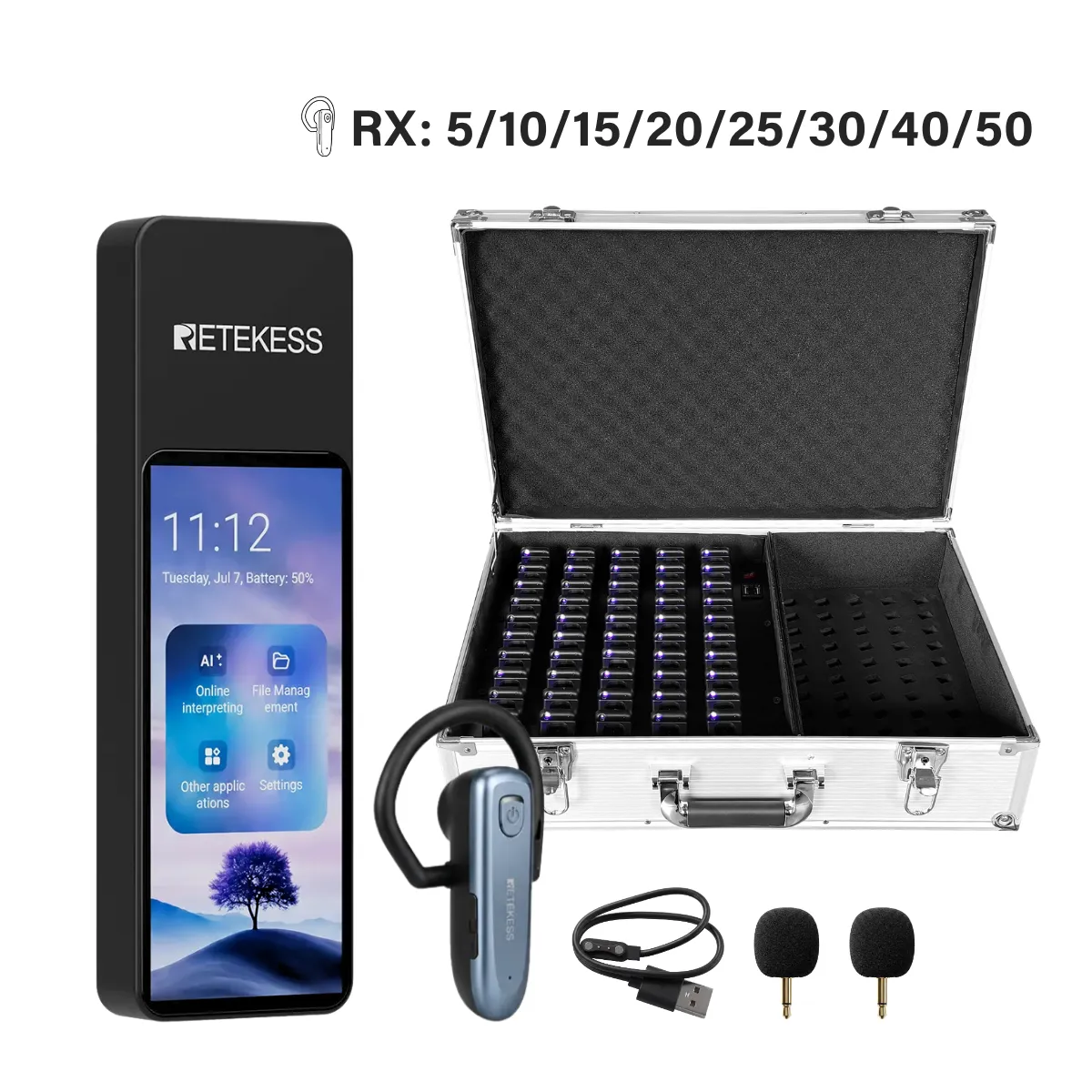
120+ languages, no interpreter and no app, dedicated ear-hook receivers, pay-as-you-go translation credits, 200 m range |
From $549.99 (100 free translation hours included) |
Multilingual tours, factory visits, school events, business receptions |
|
Retekess TT118 + TT119 |
Simultaneous interpretation |
FM, 6 channels, table-top transmitter, interpreter monitor, unlimited receivers, 120 m |
From $569.99 |
Conferences, churches, courtrooms, seminars in fixed venues |
|
Retekess T130T + T131T |
Simultaneous interpretation |
UHF, 7–12 channels, 250 m, DSP noise reduction, interpreter monitor |
From $499.99 |
Large fixed venues needing the longest reach |
|
Retekess TT117 + TT118 |
Simultaneous interpretation |
FM, 6 channels, handheld and battery powered, 80 m |
From $299.99 |
Budget-conscious churches, schools and community events |
|
Timekettle (M3 earbuds, X1 hub) |
Personal AI / multi-person AI |
Earbuds for one-to-one; X1 hub supports up to around 50 participants across 5 languages |
$699–$899 for the hub |
Small meetings and classrooms where each participant carries a terminal |
|
Vox Aura (Vox Group) |
Group AI for tours |
AI smart transmitter broadcasting up to 4 language channels, offline preloaded content, captions to listeners' phones |
B2B, pricing not published |
Large tour operators, cruise lines and destination organisations |
|
BMS Audio TOM ClipR + elysium |
Hybrid hardware plus app |
Transmitter plus each listener's own Android phone; 29+ languages |
B2B, pricing not published |
Groups where every listener has an Android phone — note iOS is not supported and latency is reported at 5–10 seconds |
|
Enersound / Williams Sound |
Simultaneous interpretation |
FM and infrared distribution with human interpreters |
Roughly $395 to $13,864 |
Churches, courts and venues with installed systems |
|
Televic |
Simultaneous interpretation |
Infrared conference interpretation, designed with professional interpreters |
High-end |
Parliaments, conference centres and government installations |
Seven Checks Before You Buy Any Translation Device
|
Check |
What to ask the vendor |
|
Microphone position |
Is the microphone held close to the speaker's mouth, or is it picking up the whole room? |
|
Listener friction |
Does each listener need a phone, an app, an account or a pairing step — or do they simply put a receiver on? |
|
Audience ceiling |
How many people can listen at once, and what does it cost to add ten more? |
|
Offline behaviour |
How many languages work offline, and what happens if the venue's Wi-Fi fails mid-session? |
|
Latency |
Is this a one-way broadcast or a two-way round trip, and how long does each take? |
|
Total cost of ownership |
Hardware plus per-hour interpreter fees, or hardware plus translation credits — which grows faster for you? |
|
Failure mode |
When the device gets it wrong, what happens, and who in the room would notice? |
FAQ
Are AI translation devices accurate enough to use?
For speaker-led explanation using short-to-medium sentences, yes — that is where published tests and field deployments agree. Accuracy falls on long, conversational, idiomatic speech, so match the tool to the speaking style, not just the language pair.
Do AI translation devices work without internet?
It depends on the device. Some consumer translators offer a small offline language set. Group systems vary too — some preload content for offline playback, while most live translation requires Wi-Fi or a mobile hotspot. Always ask what specifically stops working when the network drops.
What is the difference between a translation device and a simultaneous interpretation system?
A translation device converts language with a machine. A simultaneous interpretation system distributes a human interpreter's voice to every listener on a channel. The second still needs hardware even when the translation itself is human.
Can an AI translation device replace a human interpreter?
Not in high-stakes dialogue. In medical, legal and negotiation contexts the cost of a wrong phrase is too high, and guidance bodies advise caution. For guided explanation across many languages with no interpreter available, an AI translation device is often the only practical option — and it works.
How many people can one AI translation device serve?
One receiver per listener. The transmitter is not the limit — on group systems a single transmitter broadcasts to an unlimited number of receivers, so you scale by adding receivers rather than replacing hardware.
Do listeners need a smartphone or an app?
With dedicated-receiver systems such as Retekess TT136, no — listeners wear an ear-hook receiver and nothing is installed. With app-based hybrid systems, listeners usually need their own phone, and some support Android only.
Are AI translation devices suitable for healthcare?
For wayfinding, intake and low-stakes logistics, they can reduce waiting time. For symptom-taking, diagnosis, consent and anything with clinical consequence, follow established guidance and use a qualified medical interpreter.



![[18th Anniversary] 18 Years of Echoing Excellence: Making Communication Easier, Connecting Trust Beyond Borders](https://res.retekess.com/z_file/20260716/retekess-brand-story-making-communication-easier_20260716151044_7682.jpg)
![[18 Years in Wireless Communication] Silent Disco Systems Anniversary Celebration: Top-Selling Headphones & Event Mechanics Revealed!](https://res.retekess.com/z_file/20260713/18-years-in-wireless-communication-silent-disco-systems-anniversary-celebration_20260713175011_5749.webp)
![[Anniversary Carnival] Ding-dong! 18th Anniversary Mega Sale on Guest Paging & Calling Systems: Full Reveal of 12+ Products & Promo Rules!](https://res.retekess.com/z_file/20260713/18th-anniversary-mega-sale-on-guest-paging-calling-systems_20260713175257_0295.webp)
![[Retekess 18th Anniversary Teaser] Tour Guide System Exclusive Perks: Sneak Peek at Event Dates & Mechanics!](https://res.retekess.com/z_file/20260713/retekess-18th-anniversary-tour-guide-system-exclusive-perks--2-_20260713180135_6435.webp)
Follow Us
Pay With


 Google
 Amazon
Comments (0)