
Table of Contents

Multilingual Group Communication Training AI Translation Device
- Retekess
- Aug 8, 2026
Sixty-eight percent of global conference organizers now use real-time AI translation solutions, and over 60% of enterprise translation tasks are handled by AI-assisted tools, according to KUDO's 2025 industry data report. At the same time, the global AI translation platform market is projected to grow from $2.31 billion in 2025 to $9.84 billion by 2034 (Intel Market Research).
For L&D managers, tour operators, and global team leads, this is not a trend to watch — it is a competency to train for. Whether you are running a 50-person cross-functional workshop, a week-long factory visitor program, or a quarterly international delegation, the way you equip your team for multilingual group communication directly determines knowledge retention, safety compliance, and brand trust.
The Real Cost of Human Interpretation for Day-to-Day Group Communication
Many training and operations teams have a default assumption: if it involves multiple languages, we hire a human interpreter. That assumption is straining to keep up with the actual economics of multilingual group communication.
For a single-day corporate factory tour or regional industry forum in Europe or the Americas, professional human simultaneous interpretation services typically run between $4,000 and $8,200 per day. A multinational conference can balloon into a five-figure expense once you add booth rental, wireless receiver logistics, travel allowance, and interpreter prep time.
Why is it so expensive? Three structural reasons:
- Interpreter scarcity is real, not rhetorical. The pool of certified conference interpreters is concentrated in cities like Brussels, Geneva, and London. When the European Parliament holds a plenary session, hundreds of interpreters are booked six months in advance. For a company that needs a Korean-Finnish booth next Tuesday, the answer is often simply: no one is available.
- Hours in a booth are physically capped. Under ISO 23155:2022 and AIIC working standards, two interpreters per language combination are required for sessions longer than 45 minutes, rotating every 20–30 minutes to manage cognitive fatigue. That is not a luxury — it is a quality decision the audience experiences whether or not the organizer intended it.
- Each booth scales the cost linearly. One language pair equals one booth. Adding Mandarin requires a second booth. Adding Korean requires a third. A two-language conference correctly staffed is two interpreters; a four-language conference is eight interpreters in four booths. The numbers compound fast, which is why language count and session length must be locked before equipment is ordered.
AI Translation Devices vs Human Interpreters: A Five-Dimensional Comparison
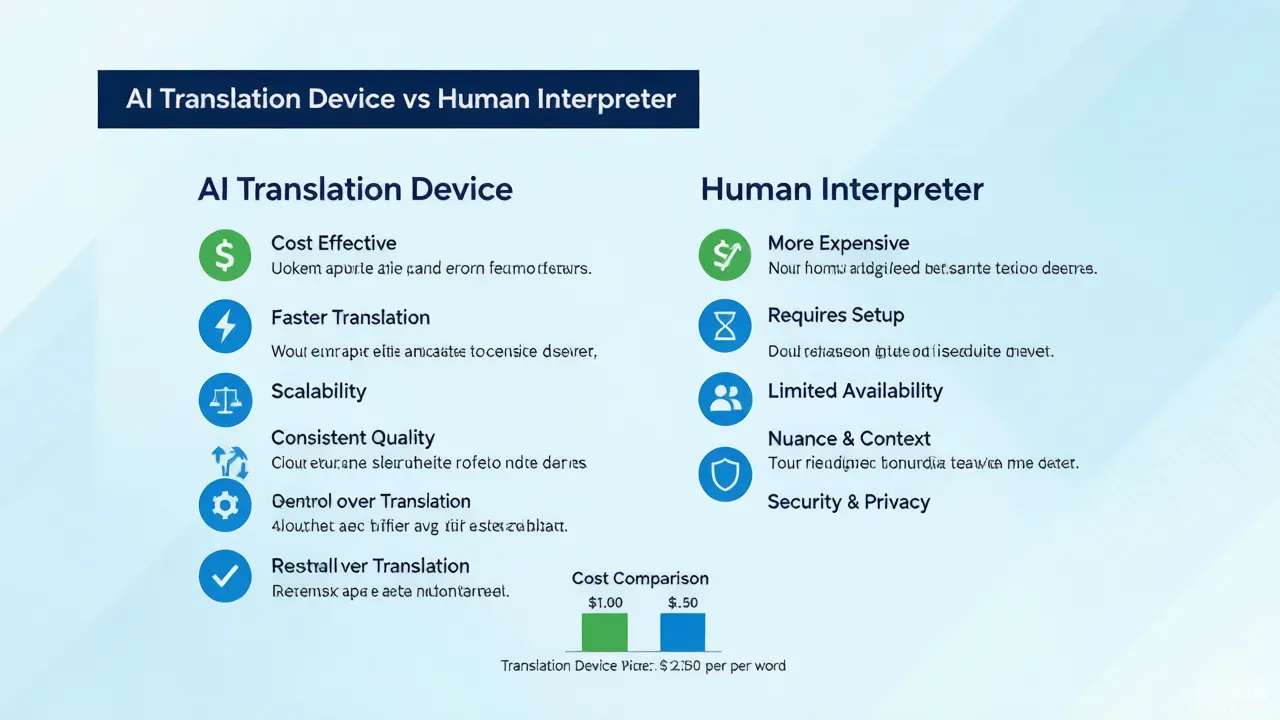
This is not a "machines versus humans" debate. It is a fit-for-purpose decision. Below is the framework used by global L&D and tour operations teams to decide which one serves which scenario.
A side-by-side comparison framework for choosing the right multilingual communication solution.
| Dimension | Human Interpreter | AI Translation Device |
|---|---|---|
| Cost structure | $4,000–$8,200 per day for one language pair; scales linearly with each additional language | One-time hardware investment plus a usage credit model; predictable per-hour cost |
| Setup time | 4–8 weeks for booth booking, interpreter scheduling, glossary prep; on-site setup 2–4 hours | Same-day deployment; devices pair in seconds; ~10 minutes of group orientation |
| Scale & group size | Limited by booth capacity and ISO 23155 rotation standards; one booth per language pair | One transmitter broadcasts to as many receivers as needed; ideal for groups of 5–500 |
| Consistency | Quality varies by interpreter fatigue, jargon, and subject matter expertise | Consistent translation across all sessions |
| Control & data | Subject to interpreter availability; jargon tends to escape to the booth unrecorded | Session recordings, AI summaries, and transcript exports are typically built in |
| Best for | Diplomatic summits, court proceedings, M&A negotiations, and high-stakes sessions with deeply nuanced content | Daily training, factory tours, museum guides, conferences, field operations, and any multilingual group communication at scale |
| Key takeaway: The AI translation device is not replacing the human interpreter — it is replacing the frequency with which teams reach for one. Most corporate training programs, delegation visits, and tour operations do not need a USD 8,200 booth. They need a reliable, on-demand multilingual group communication solution that runs at training-program tempo. |
When an AI Translation Device Actually Wins (And When It Doesn't)
The decision is not about brand loyalty. It is about scenario fit. Below is the practical heuristic used by program managers at multinational organizations.
Choose a human interpreter when:
- The audience is fewer than 30 people and the content is highly nuanced (legal, medical, diplomatic, or crisis communications).
- The session is a black-swan event that cannot be repeated. Cognitive fidelity matters more than cost.
- The language pair is rare (e.g., Basque-to-Japanese) and the AI engine has limited training data.
- You need bidirectional return interpretation between two working languages — done by humans in real time, faster than today's AI.
Choose an AI translation device when:
- You are running a recurring training program where the same content is delivered weekly or monthly.
- The audience is a group of 5 to 500+ in an outdoor, factory, museum, or tour setting.
- The languages are mainstream (English, Spanish, Mandarin, French, German, Japanese, Korean, Arabic, etc.).
- You need a same-day, on-demand deployment without interpreter booking lead times.
- You want built-in recording, transcription, and AI summarization for compliance and training reinforcement.
For most operational use cases — corporate training, factory visits, museum tours, conference side sessions, delegation briefings, VIP tours — the AI translation device is the right tool. Hybrid models are increasingly common: a human interpreter is reserved for the headline summit; the AI translation device handles every parallel workshop, breakout, and tour.
How the Retekess TT136 Powers a True Multilingual Group Communication Solution
The Retekess TT136 AI Translation Tour Guide System is built around the exact scenario this guide describes: recurring, mixed-language group communication where a USD 8,200 interpreter booth is neither practical nor budgetable.
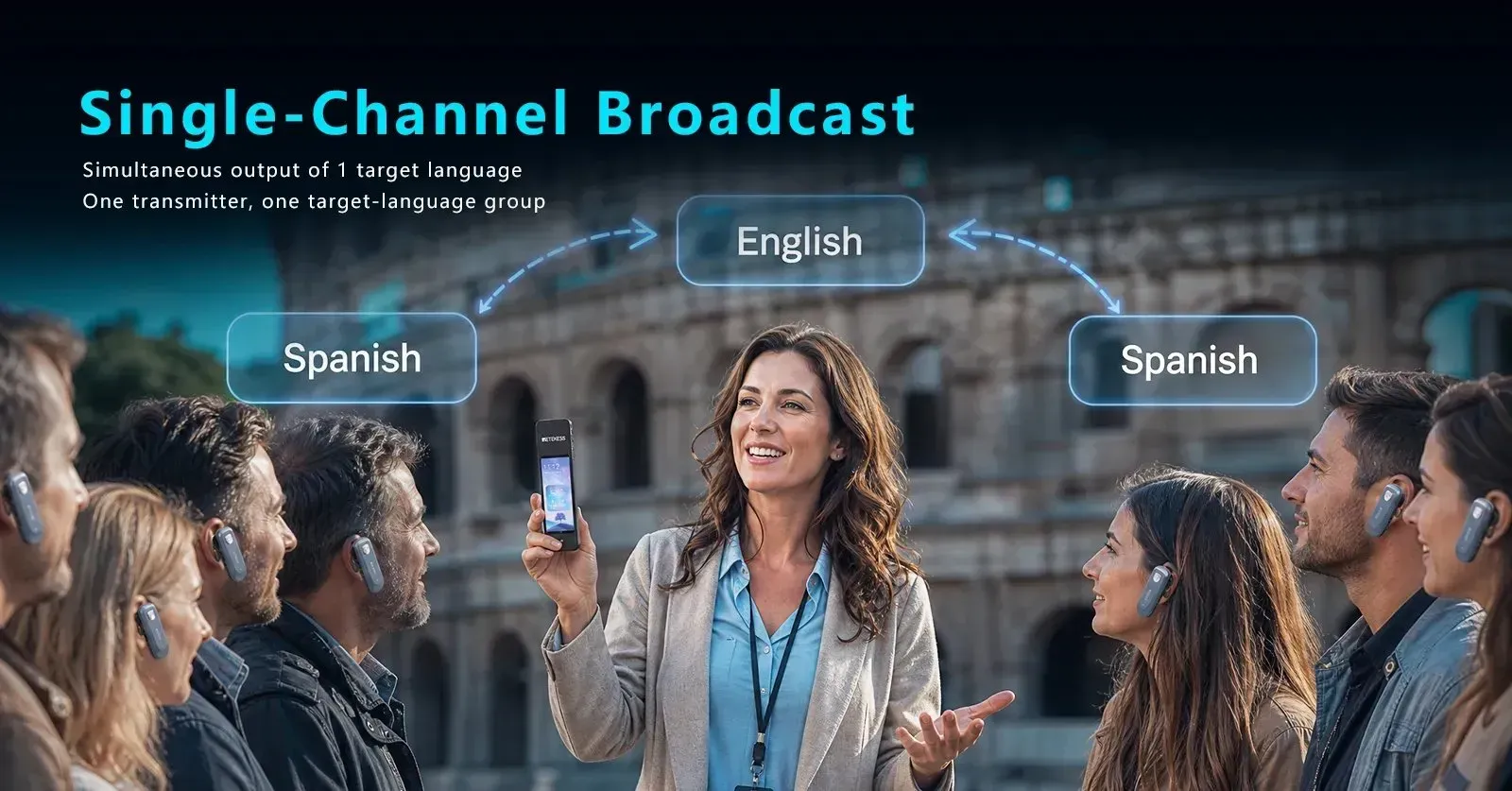
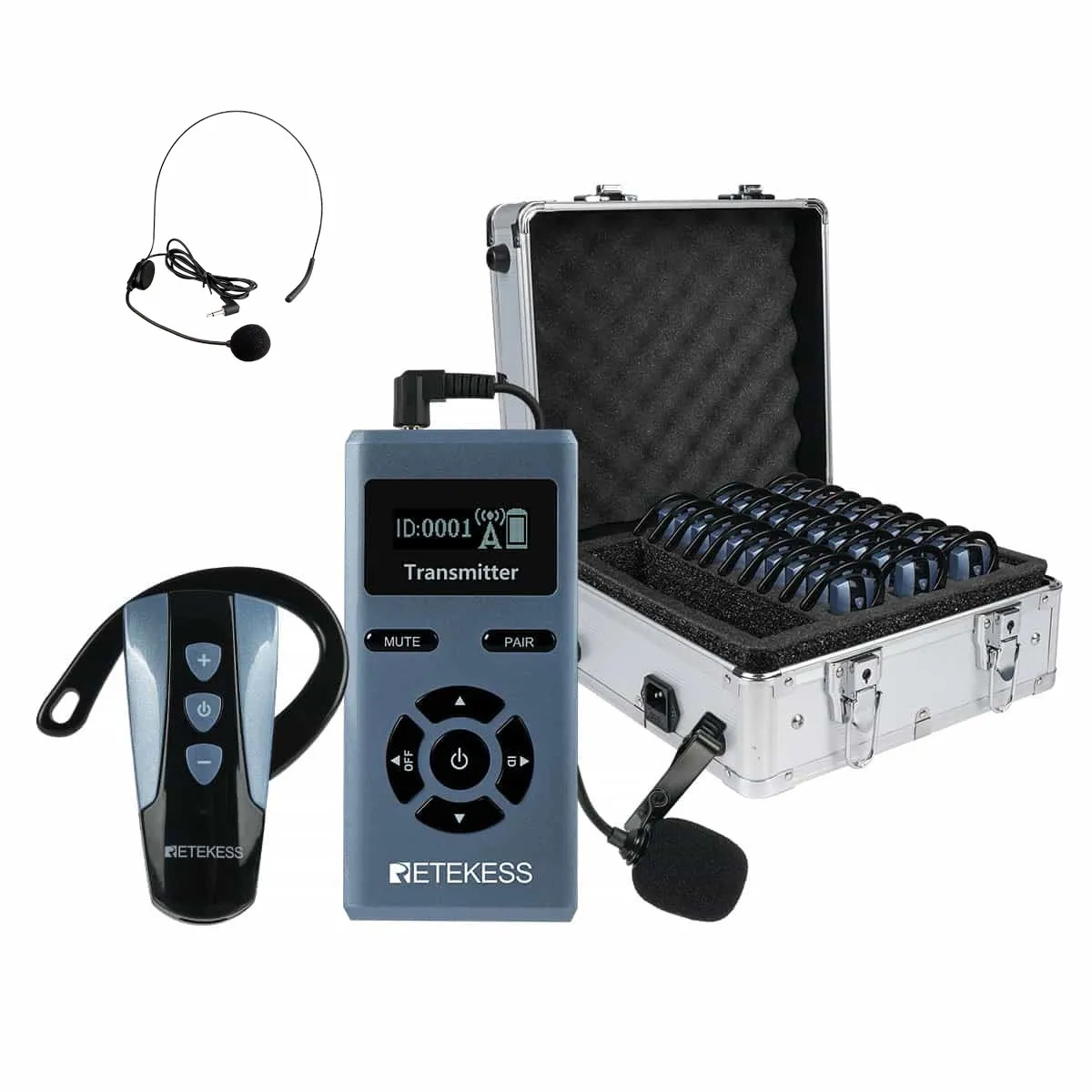
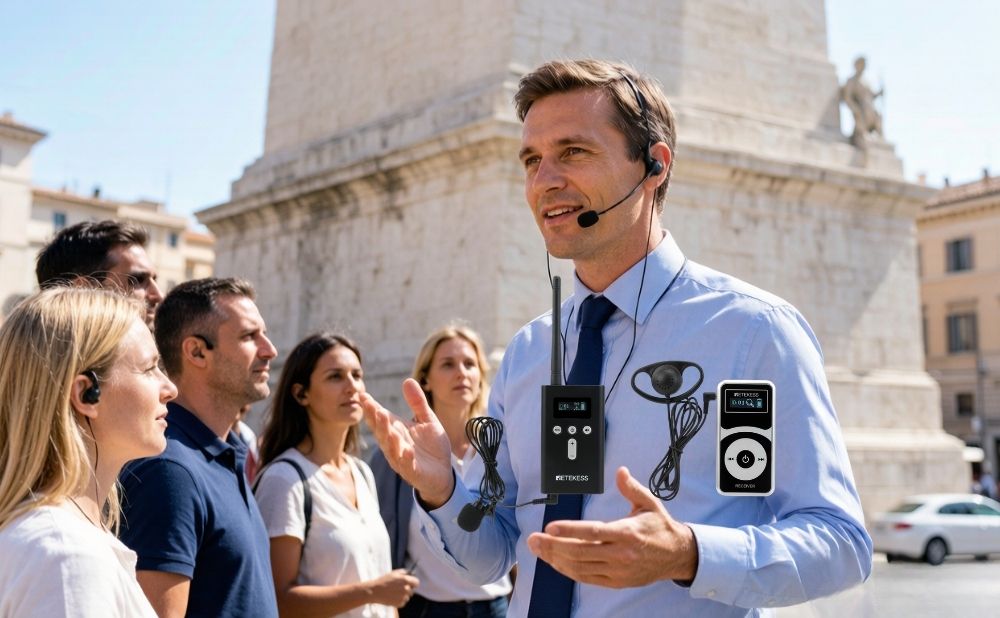
Single-channel broadcast in action: one speaker, one target-language group, full coverage up to 200m.
The TT136 combines AI translation with a wireless tour guide system in one device. Instead of forcing a team to choose between a translator and a tour guide system, one operator can do both.
Core capabilities for multilingual group communication
- 120+ online languages with free-recognition mode. The transmitter auto-detects the speaker's language across a 10-language preset, eliminating the "wrong language button" failure mode common in handheld devices.
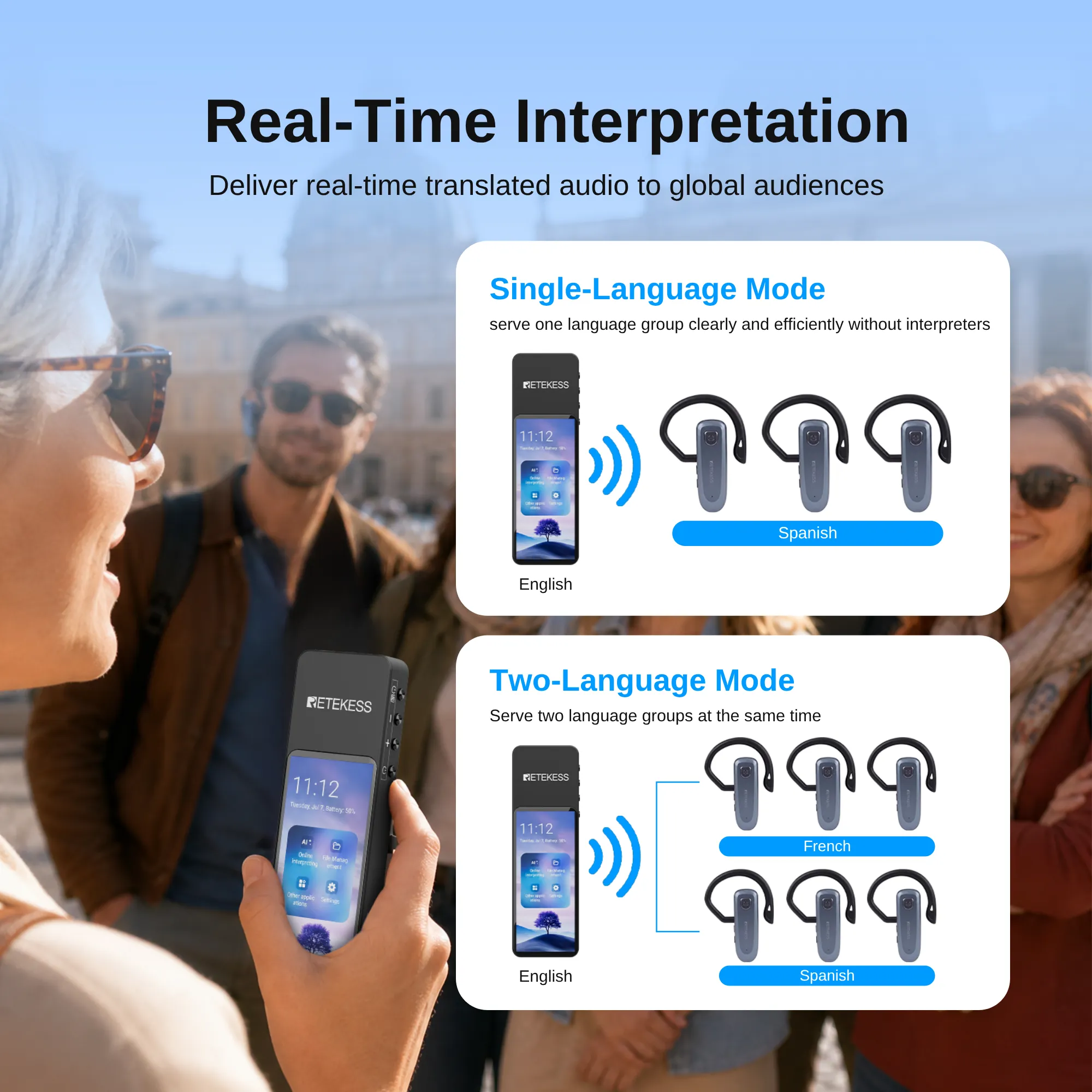
- Two-way group dialogue. For face-to-face meetings between two language groups, the TT136's green-channel / blue-channel separation delivers seamless bidirectional translation. This is the use case where AI translation devices begin to encroach on entry-level human interpretation, especially in factory visits and supplier briefings.
- Dual-language broadcast. One transmitter can output two languages simultaneously, allowing a single guide to serve a mixed-language delegation without splitting the group.
- 2.4GHz wireless transmission, 150–200m range, 0–9999 channels. Stable, anti-interference signal coverage for large outdoor venues, multi-story factories, and museum halls.
- 3.99-inch touchscreen with Android flexibility. Trainers can install mainstream Android apps, run recording and AI summarization, and review transcripts post-session.
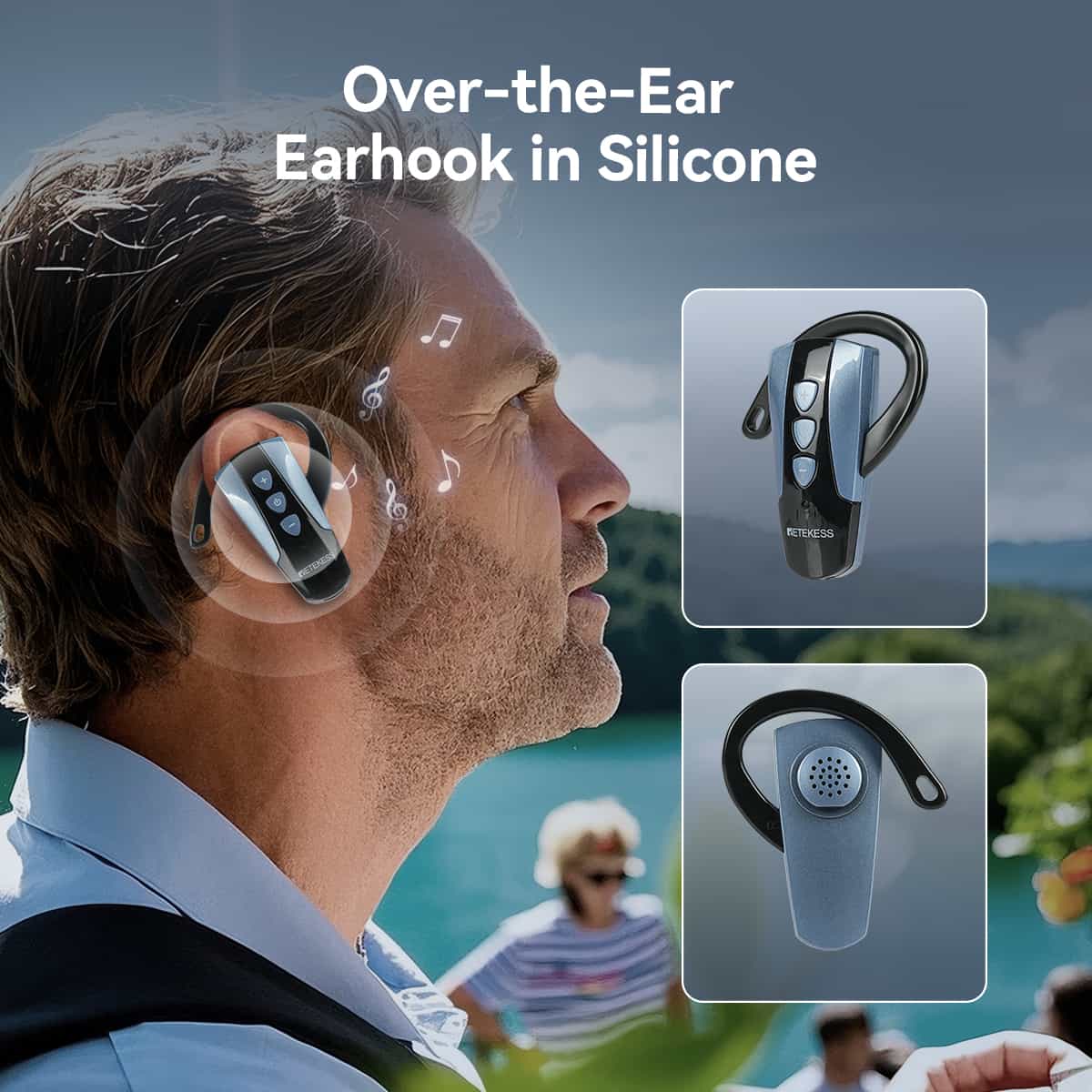
- Open ear-hook receiver (~13g). Reduces ear-canal contact, comfortable for sequential use across multiple trainees, and supports left/right ear wearing.
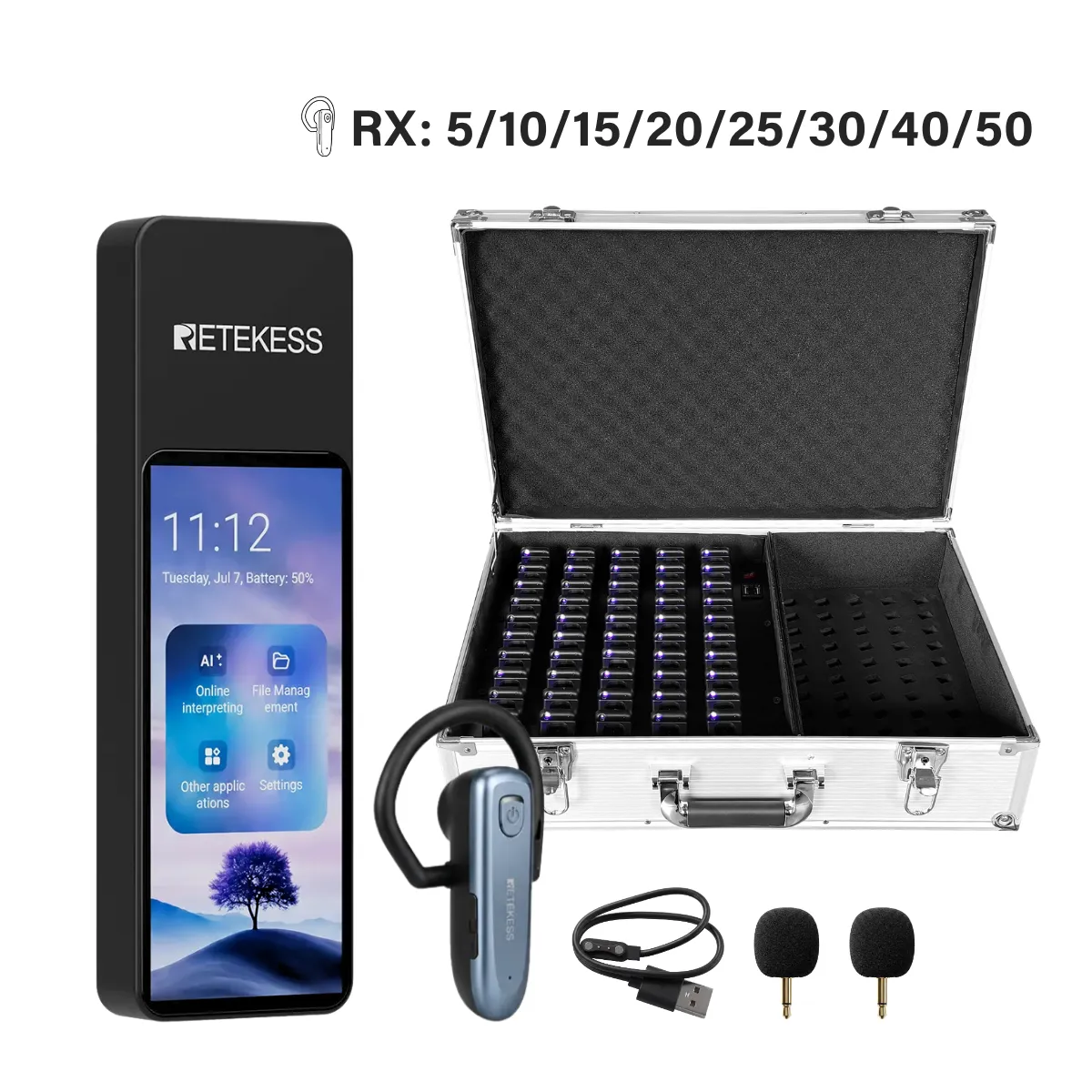
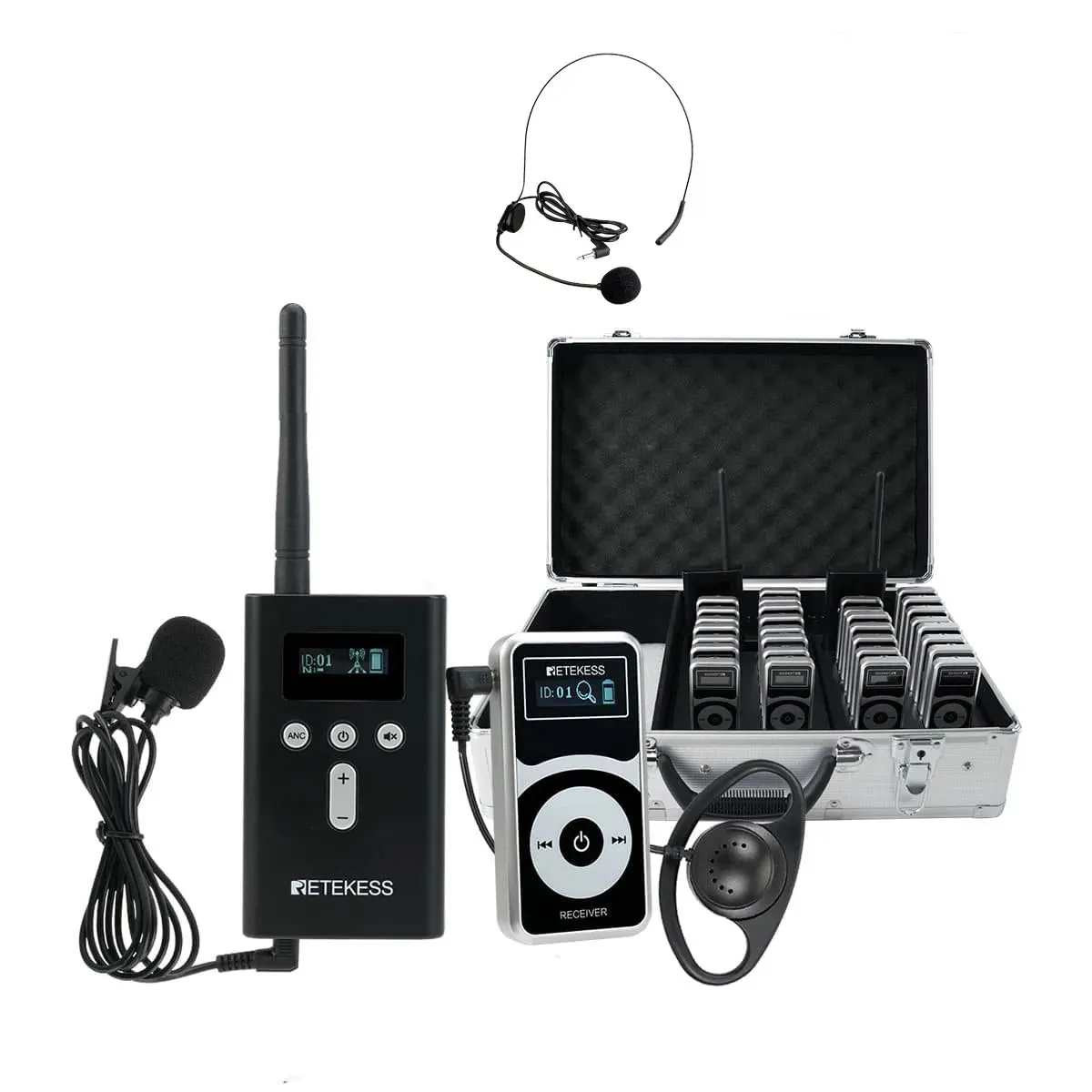
- 30-slot or 50-slot charging case with UV sanitization. Centralized charging, storage, and disinfection in one unit. Designed for L&D teams running daily programs across multiple groups.
The TT136 is not just a hardware purchase. It is a deployment pattern: training managers can build a 5-person kit for a small team, scale to a 50-person set with a 50-slot charging case for a museum or factory, and reuse the same investment across every multilingual training event for years.
Final Thoughts: Make Multilingual Group Communication a Capability, Not a Cost
The default of "hire a human interpreter when you need a multilingual group session" worked when sessions were rare and stakes were high. In 2026, that default fails for the daily reality of training, operations, and tour management. The right move is to build a hybrid communication capability: human interpreters for the rare, high-stakes events; AI translation devices for the recurring, high-frequency, high-volume reality of how teams actually work.
For program managers and L&D leaders ready to move past clunky ad-hoc translation, the TT136 is a practical, field-tested multilingual group communication solution — one investment, many use cases, training-ready out of the box.
Leave a Reply

![[18th Anniversary] 18 Years of Echoing Excellence: Making Communication Easier, Connecting Trust Beyond Borders](https://res.retekess.com/z_file/20260716/retekess-brand-story-making-communication-easier_20260716151044_7682.jpg)
![[18 Years in Wireless Communication] Silent Disco Systems Anniversary Celebration: Top-Selling Headphones & Event Mechanics Revealed!](https://res.retekess.com/z_file/20260713/18-years-in-wireless-communication-silent-disco-systems-anniversary-celebration_20260713175011_5749.webp)
![[Anniversary Carnival] Ding-dong! 18th Anniversary Mega Sale on Guest Paging & Calling Systems: Full Reveal of 12+ Products & Promo Rules!](https://res.retekess.com/z_file/20260713/18th-anniversary-mega-sale-on-guest-paging-calling-systems_20260713175257_0295.webp)
![[Retekess 18th Anniversary Teaser] Tour Guide System Exclusive Perks: Sneak Peek at Event Dates & Mechanics!](https://res.retekess.com/z_file/20260713/retekess-18th-anniversary-tour-guide-system-exclusive-perks--2-_20260713180135_6435.webp)
Follow Us
Pay With


 Google
 Amazon
Comments (0)