
Table of Contents
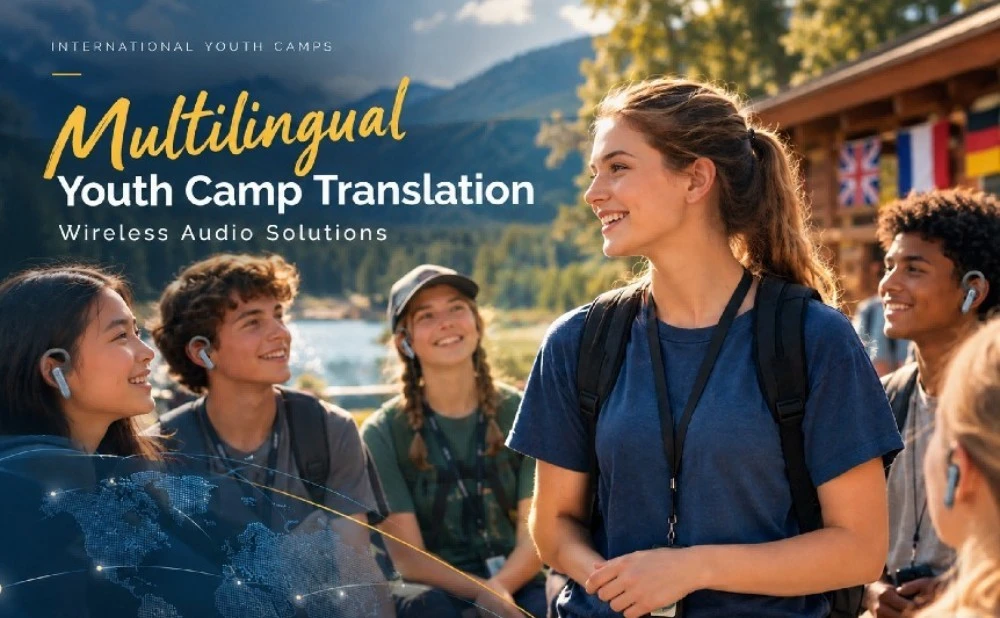
Multilingual Support for International Youth Study Camps: Wireless Audio Solutions
- Retekess
- Oct 6, 2026
The American Camp Association's 2016 enrollment report found that 62 percent of U.S. camps host international campers. Those campers come from 50 countries, with China, France, Spain, England, and Mexico leading the list.
A summer camp at Geneva's College du Leman reported 71 nationalities in summer 2025. Only 13 percent of those campers were native English speakers. Six percent were native French speakers.
Multinational mixing is now standard operating procedure for international youth camps. It is not an exception.
Yet camp staffing ratios typically run one counselor for every six to ten campers. Those counselors manage safety, run activities, and supervise daily life. Almost none of them are trained professional interpreters.
A 2025 study-abroad challenges report found that 68 percent of international students identify language barriers as their primary challenge. The gap between multilingual demand and translation capacity is real, and it is growing.
The Real Communication Challenges
International camps face four distinct language-related problems, each documented in research or industry reports.
Comprehension gaps. A 2026 study at Thailand's Rajamangala University of Technology surveyed international students in cultural workshops. It found that 54 to 68 percent struggled with limited vocabulary. Twenty-nine to 45 percent had pronunciation difficulties. Listening comprehension suffered when speakers used accents or fast speech rates. In a camp setting, these gaps mean a non-native camper understands only a fraction of a group explanation.
Same-nationality cliques. A 2024 study published in Taylor & Francis's Journal of Education and Work conducted in-depth interviews with 15 learners, 11 instructors, and 4 activity leaders at a multilingual teenage study-abroad program. The researchers found that "cliques of compatriots" and insufficient integration in extracurricular activities were the most prominent obstacles to cross-language interaction. Campers naturally gather with people who speak their language, which undermines the international experience camps are selling.
Low information coverage in group settings. Outdoor camp environments are loud. Children's voices, natural ambient sound, and multiple simultaneous activities create background noise of 70 to 85 decibels. A counselor speaking at normal volume has an effective coverage radius of roughly five to eight meters. Campers standing beyond that range miss instructions, activity explanations, and schedule changes.
Safety communication blind spots. Jumbula's camp safety guide lists clear communication systems as a core element of summer camp safety. In a dispersed outdoor setting, verbal safety reminders — "the path ahead is slippery," "gather in ten minutes," "stay away from the water" — reach only the campers closest to the counselor. The rest do not hear them.
Two Approaches, Different Boundaries
Camp operators have two equipment categories to choose from. They solve different problems.
AI Handheld Translation Devices
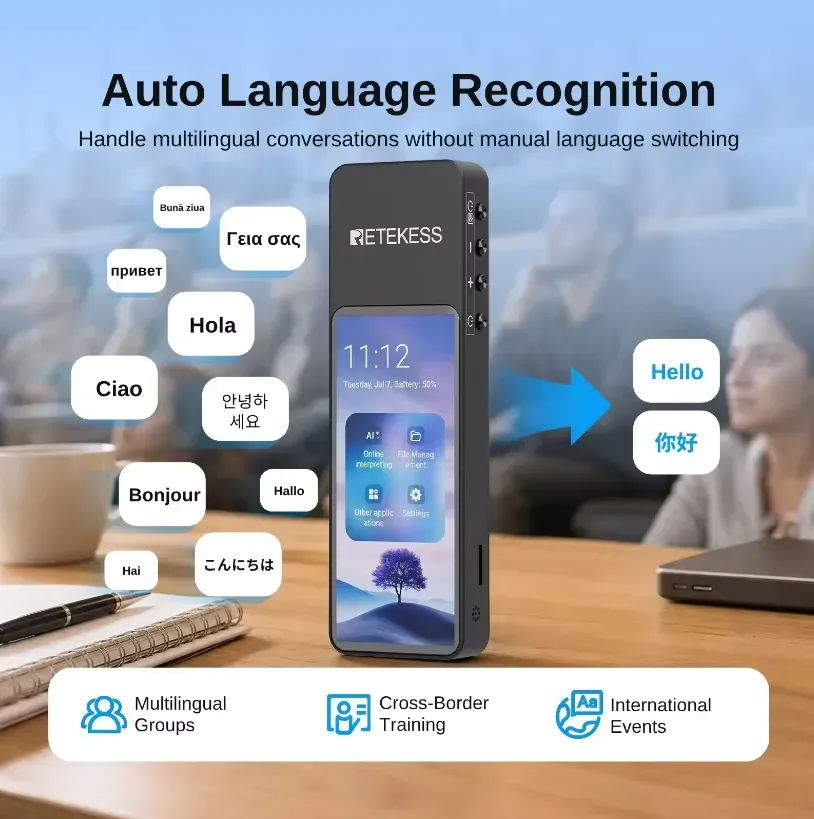
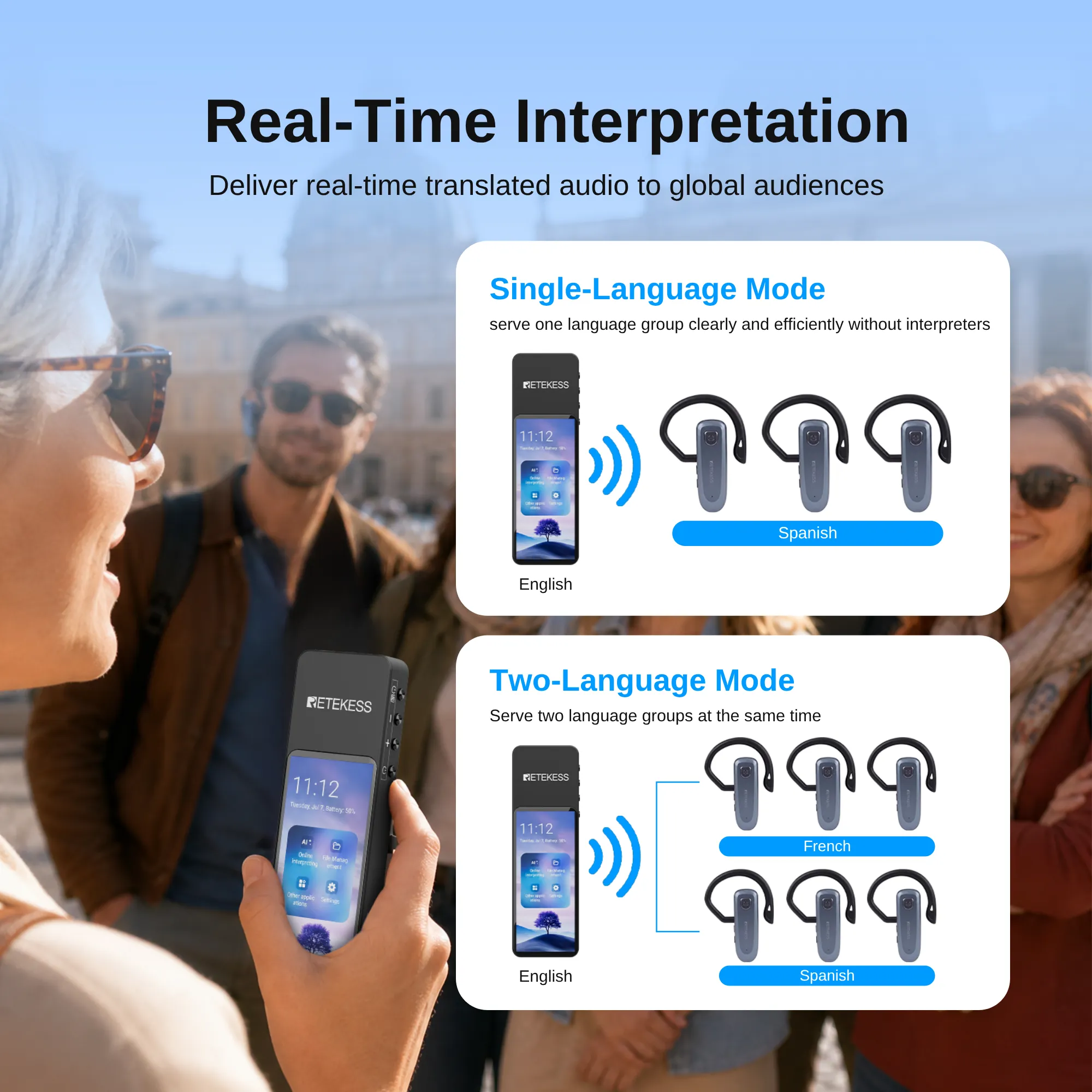
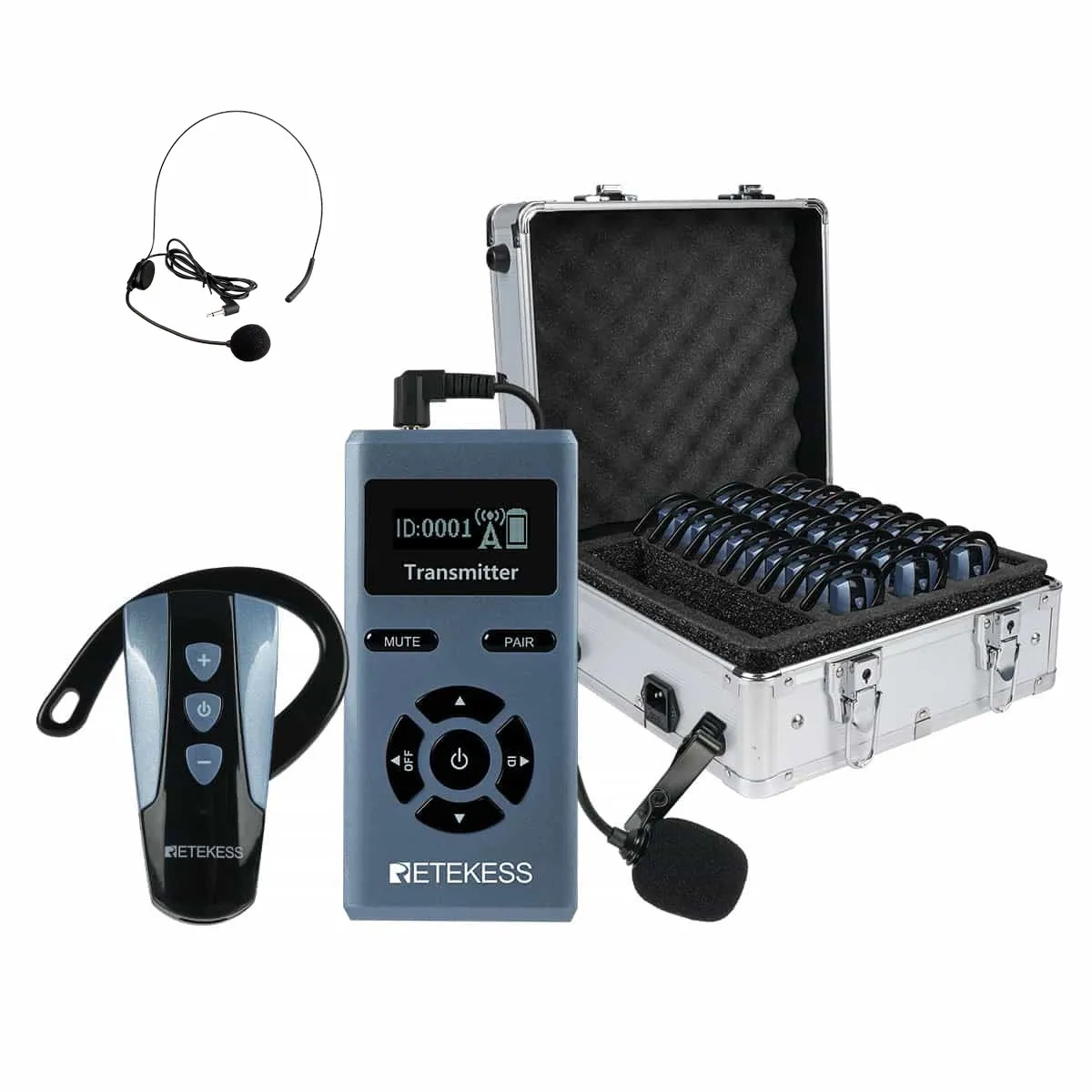
AI translation devices like the Retekess TT136 provide real-time speech-to-speech translation across 120+ languages, powered by Microsoft and Google engines. The TT136 automatically recognizes up to 10 spoken languages and switches translation targets without manual input.
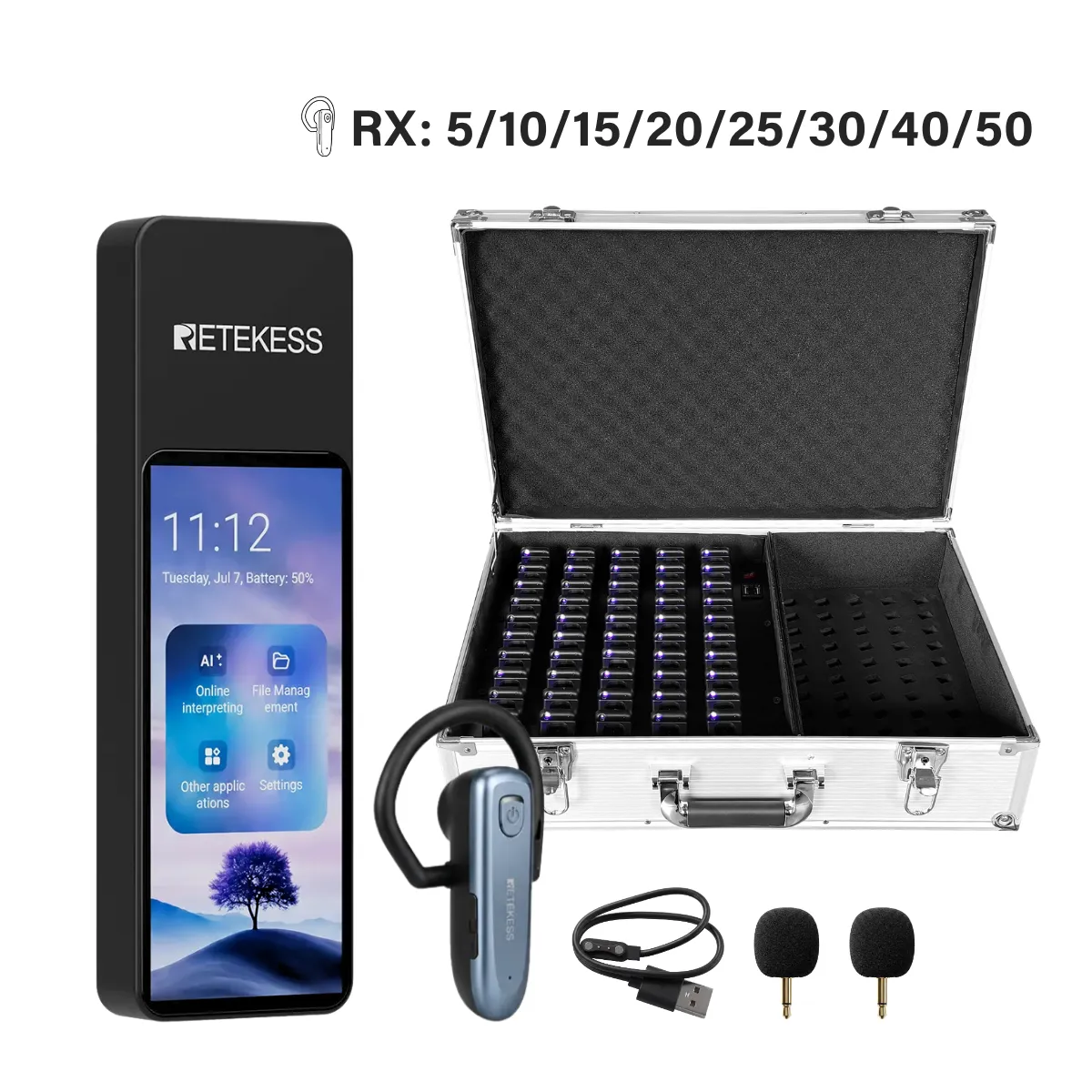
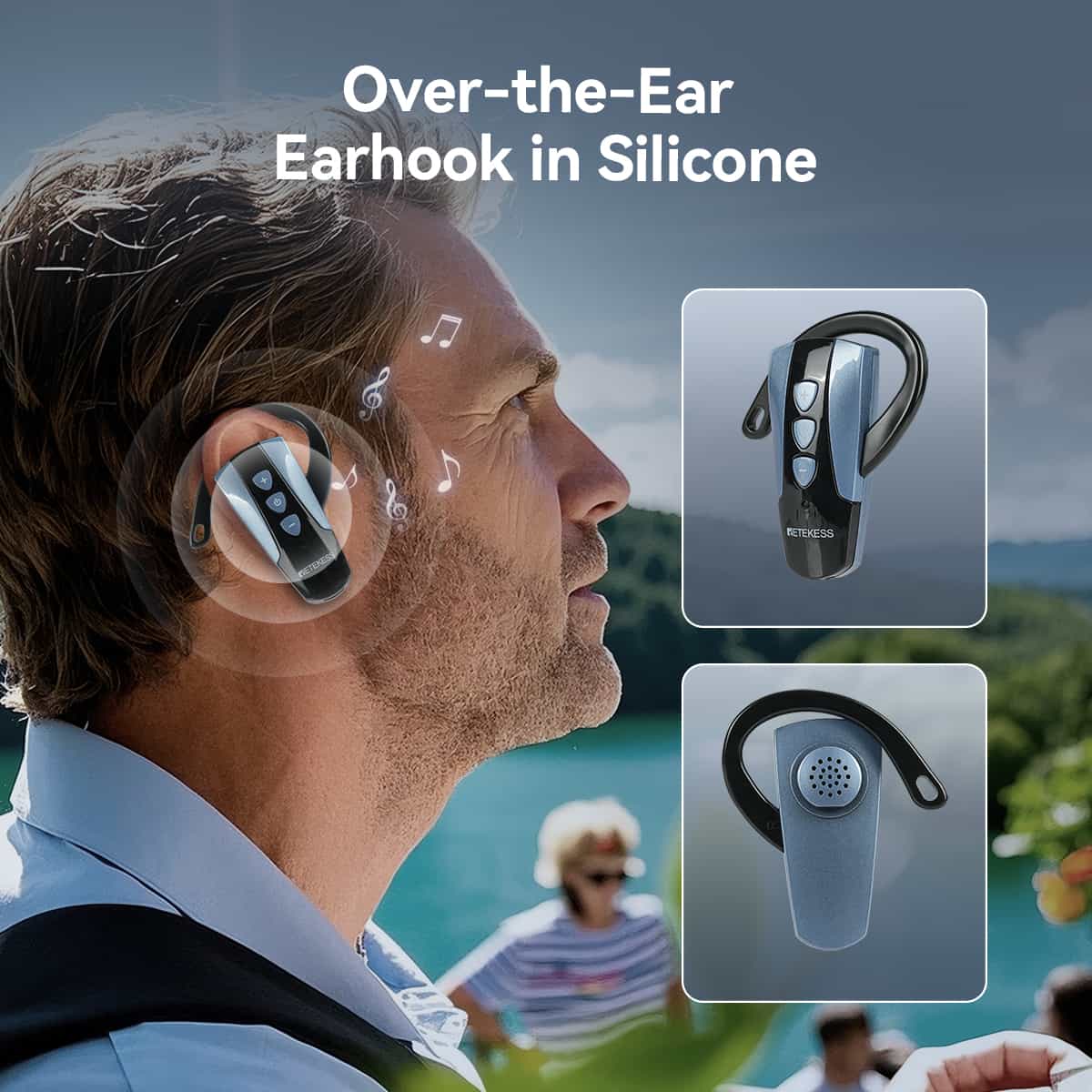
These devices work well for small, mobile groups. A counselor carrying a 155-gram handheld unit can move with the group while translating. Each camper wears a 13-gram earhook receiver. The device also records sessions and generates AI summaries, which helps with post-activity review.
The limitations are real. AI translation requires internet access. Accuracy drops with specialized terminology, cultural references, and heavy accents — a 2026 Visual eNews test found idiom and dialect accuracy around 87 percent, with 14 percent of cultural references translated incorrectly. These devices are not designed for broadcasting to 50 or more people simultaneously.
Wireless Audio Distribution Systems
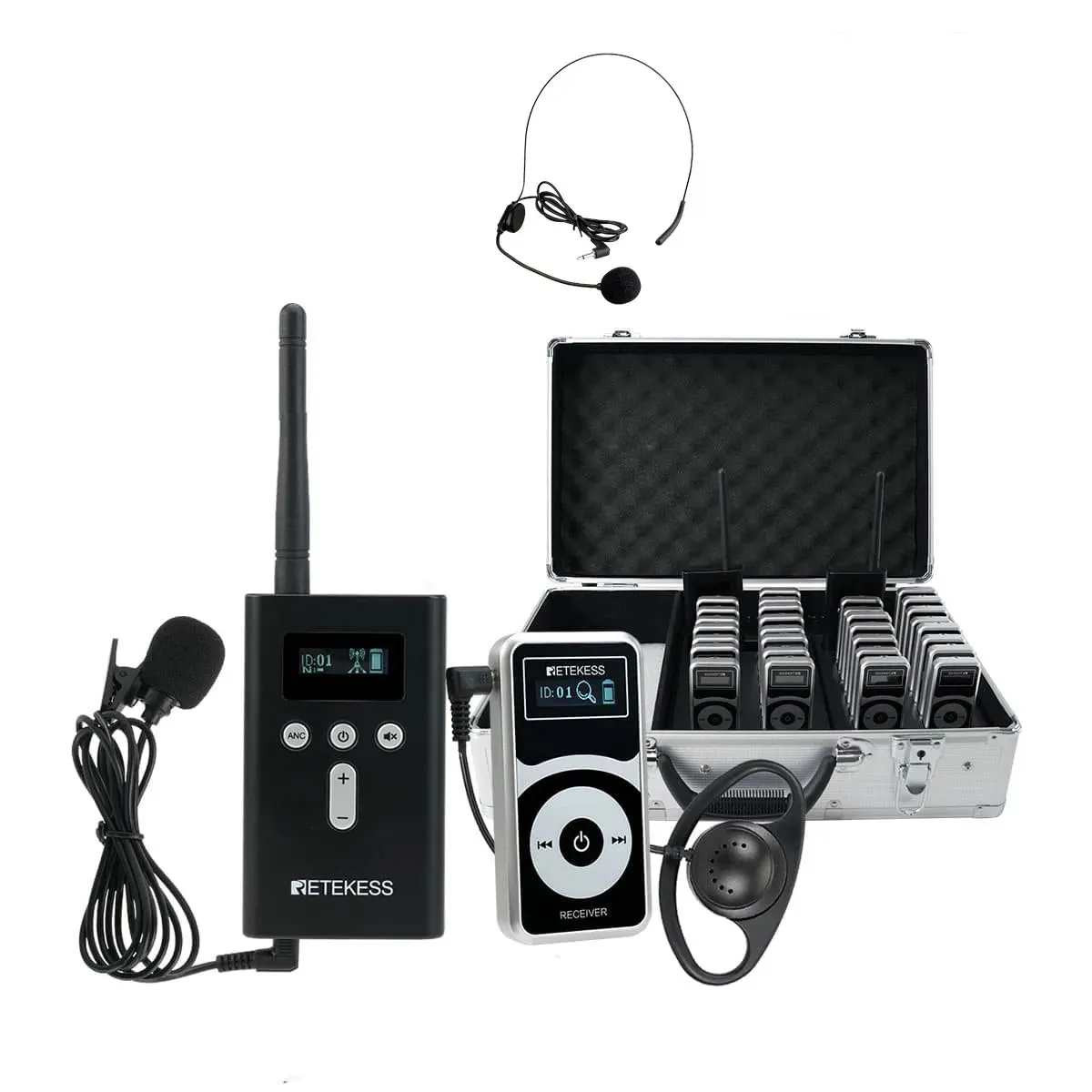
Wireless tour guide systems like the Retekess TT119 and T130P broadcast one speaker's voice to multiple receivers simultaneously. They do not translate. They distribute audio.
The TT119 is a desktop FM system with 17 channels, supporting up to six interpreters working at once. It covers 120 meters and includes a built-in interpreter monitor function. The TT130P is a portable system with 49 channels, 160-meter open-air range, and DSP noise reduction adjustable across four levels.
These systems excel in large assemblies and noisy outdoor environments. The T130P's DSP chip filters ambient noise so the counselor's voice reaches every receiver clearly. Battery life is extensive — 20 hours for the T130P transmitter and 36 hours for receivers.
The limitation is that they require an audio source. Someone must speak into the transmitter. If that source is a human interpreter, the system distributes the translation. If the source is an AI translation device, the system distributes the AI output.
The Boundary
Small, mobile, multi-language dialogue — AI handheld devices. Large assemblies, fixed-location explanations, safety broadcasts, noisy outdoor settings — wireless audio distribution. The two categories complement each other. They do not replace each other.
Five Equipment Selection Criteria
Camp operators should evaluate translation and audio equipment against five operational criteria.
- Portability determines whether campers will actually wear the device.A 13-gram earhook receiver (TT136 system) disappears during a full day of activity. A 49-gram clip-on receiver (T131P, paired with T130P) is still light enough for all-day wear. A 188-gram receiver (TT118, paired with TT119) is heavier and better suited to seated indoor assemblies where campers are not running around. Weight directly correlates with compliance — if it is uncomfortable, campers will take it off.
- Battery life must cover a full camp day.Camp activities typically run from 8:00 a.m. to 9:00 p.m. There is no scheduled charging window. The T130P receiver lasts 36 hours on a single charge. The TT136 earhook receiver lasts 13 hours. The TT118 receiver runs on AA batteries for 10 hours, which means battery swaps are part of the daily routine. Any system requiring mid-day charging will create operational friction.
- Channel count determines how many groups can operate simultaneously.A camp may run five to ten activity groups at once, each needing its own audio channel. The T130P supports 49 channels. The TT119 supports 17 channels, which translates to up to six simultaneous interpreters. Channel capacity is not a theoretical spec — it determines whether multiple groups can use the system at the same time without cross-talk.
- Noise cancellation determines whether audio is intelligible outdoors.Outdoor camp noise routinely reaches 70 to 85 decibels. The T130P's DSP noise-canceling chip, adjustable across four levels, isolates the speaker's voice from background interference before it reaches the receivers. Systems without DSP processing will deliver muffled, unclear audio in the same environment. For outdoor use, noise cancellation is not a premium feature — it is a baseline requirement.
- Operational simplicity determines whether low-age campers can use the device independently.Campers range from age 7 to 17. A device that requires three steps — power on, select channel, wear — will work. A device with complex pairing menus, multiple modes, or small buttons will generate a steady stream of "it's not working" requests that consume counselor time. The best camp equipment is the equipment that works without requiring a manual.
Scenario-Based Equipment Recommendations
Small Group Activities (5–20 Campers)
For small, mobile groups — nature walks, craft workshops, small-group discussions — an AI handheld translation device like the TT136 is the practical choice. The counselor carries the handheld unit. Campers wear 13-gram earhook receivers. The device translates in real time across 120+ languages and automatically recognizes which language is being spoken. The AI summary function records key activity points for later review.
Large Indoor Assemblies (50+ Campers)
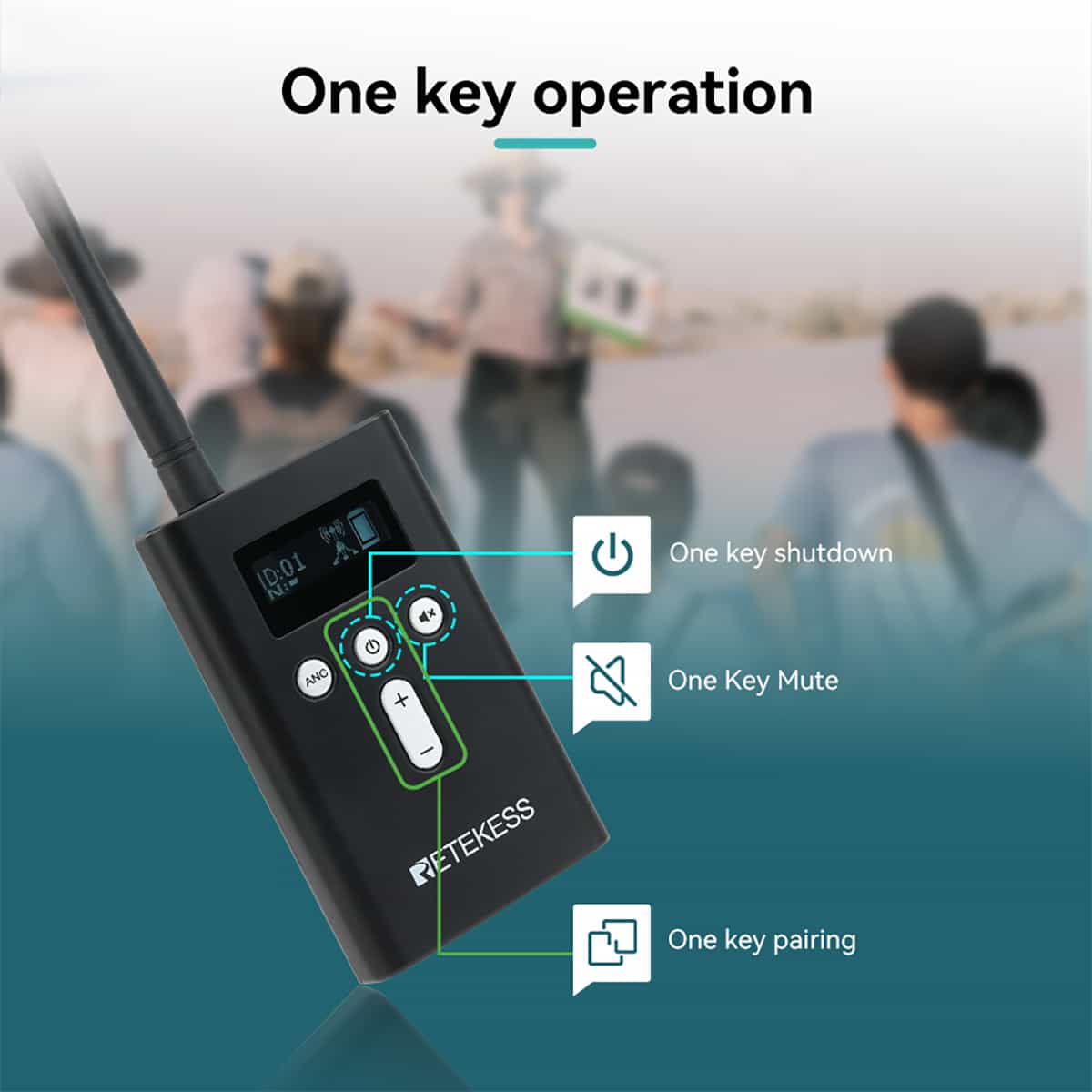
For opening ceremonies, evening programs, and indoor multi-language presentations, the TT119 desktop FM system is designed for this setting. Up to six interpreters can work simultaneously, each on a separate channel. Campers select their language channel on a TT118 receiver. The 120-meter coverage handles large halls. The one-click mute function gives organizers instant control over all receivers.
Outdoor Large-Scale Study Tours
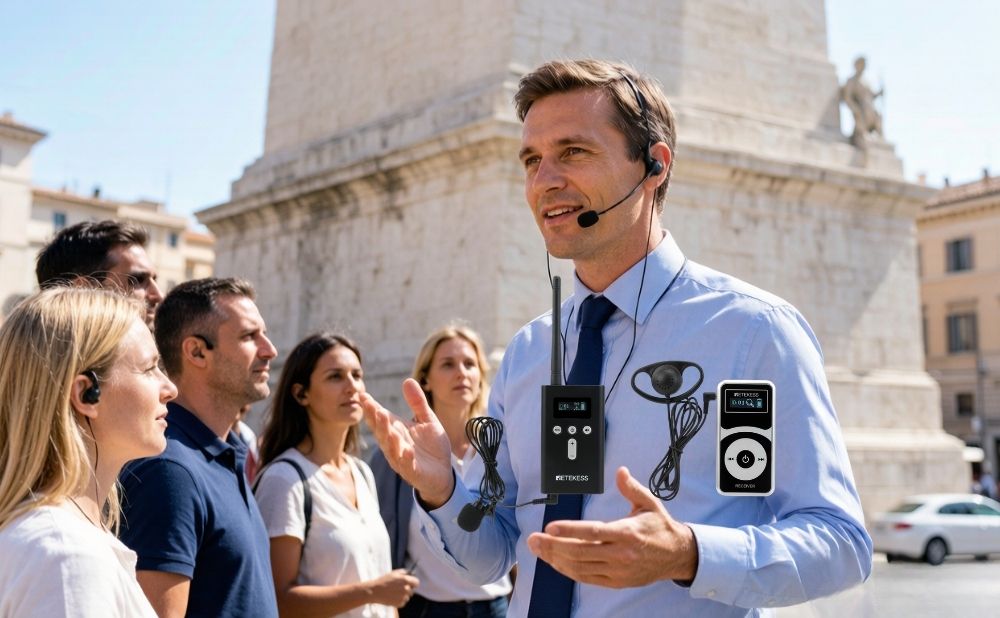
For museum visits, factory tours, and outdoor educational excursions with large groups, the T130P system is the right tool. The 160-meter open-air range covers dispersed groups. The 49-channel capacity allows multiple tour groups to operate in the same facility without interference. The four-level DSP noise cancellation ensures clear audio in noisy exhibition halls and outdoor sites. The 36-hour receiver battery means no mid-tour charging stops. At 49 grams, the T131P receiver is light enough for all-day wear.
Final Thoughts
International youth camps will continue to become more multilingual. The American Camp Association data shows the trend is established. The staffing gap — counselors who manage safety and activities but cannot provide professional translation — will not close on its own.
Wireless audio and AI translation equipment is not a replacement for expensive professional simultaneous interpretation systems. It is a practical tool for camps that operate on real budgets with real staffing constraints. The right equipment matches the activity format — small mobile groups versus large assemblies versus outdoor tours — and it meets the operational criteria of portability, battery life, channel capacity, noise cancellation, and simplicity.
Camps that get this right do not just solve a communication problem. They make the international experience accessible to every camper, regardless of which language they speak at home.
Leave a Reply

![[18th Anniversary] 18 Years of Echoing Excellence: Making Communication Easier, Connecting Trust Beyond Borders](https://res.retekess.com/z_file/20260716/retekess-brand-story-making-communication-easier_20260716151044_7682.jpg)
![[18 Years in Wireless Communication] Silent Disco Systems Anniversary Celebration: Top-Selling Headphones & Event Mechanics Revealed!](https://res.retekess.com/z_file/20260713/18-years-in-wireless-communication-silent-disco-systems-anniversary-celebration_20260713175011_5749.webp)
![[Anniversary Carnival] Ding-dong! 18th Anniversary Mega Sale on Guest Paging & Calling Systems: Full Reveal of 12+ Products & Promo Rules!](https://res.retekess.com/z_file/20260713/18th-anniversary-mega-sale-on-guest-paging-calling-systems_20260713175257_0295.webp)
![[Retekess 18th Anniversary Teaser] Tour Guide System Exclusive Perks: Sneak Peek at Event Dates & Mechanics!](https://res.retekess.com/z_file/20260713/retekess-18th-anniversary-tour-guide-system-exclusive-perks--2-_20260713180135_6435.webp)
Follow Us
Pay With


 Google
 Amazon
Comments (0)