
Table of Contents
On-Site vs Remote Interpretation: When Each One Actually Works
- Retekess
- Sep 17, 2026
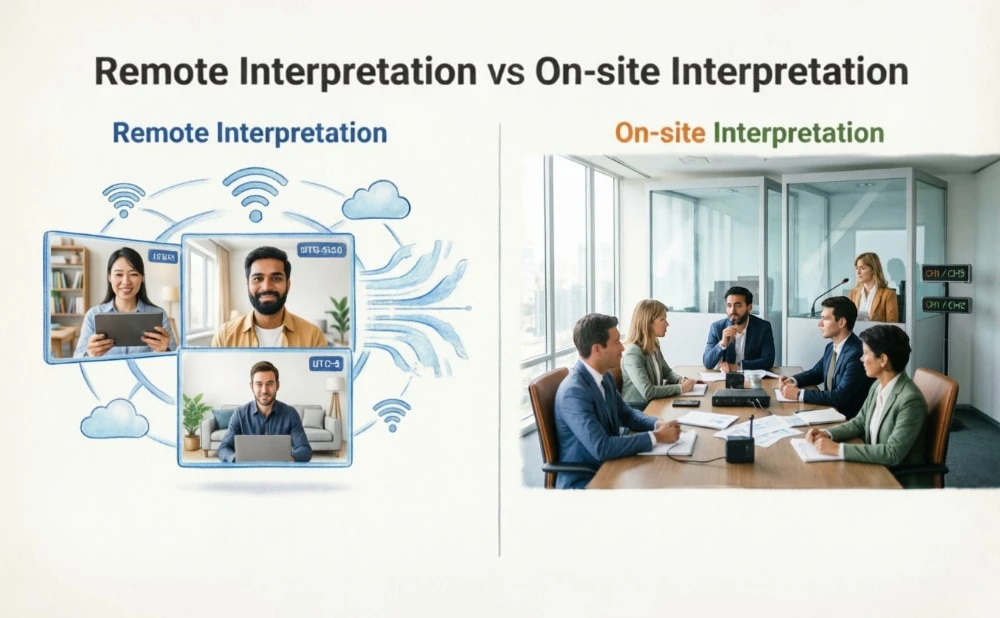
On-site or remote interpretation — which does your event actually need? On-site wins when audio quality, confidentiality, or presenter-listener interaction is the deciding factor — you control the signal path, the interpreters see the room, and nothing depends on venue internet. Remote interpretation (RSI) wins when interpreters are unavailable locally, when the event is already virtual or hybrid, or when travel and booth logistics would consume more of the budget than the interpreting itself. Neither is more professional. They fail in different places, and the useful question is which failure you can tolerate.
This comparison uses research from interpreting studies rather than vendor marketing, and it separates what the evidence supports from what the industry repeats.
The Short Answer
| Your situation | Better choice | Why |
|---|---|---|
| 100+ attendees in one room, high-stakes program | On-site | Direct control of audio; no connectivity dependency |
| Interpreters for your language pair are not in your city | Remote | Availability beats logistics; a strong remote interpreter outperforms a weak local one |
| Event is virtual or hybrid by design | Remote | Interpretation channel already lives where the audience is |
| Confidential negotiations, legal, medical | On-site | Fewer third-party platforms and recordings in the chain |
| Multi-city roadshow, same program repeated | Remote | Travel eliminated; consistency across dates |
| Small workshop, 20–50 people, one language | On-site (or consecutive, no equipment) | Cost of remote infrastructure exceeds the benefit |
| Very large plenary, 500+ | On-site for the room, remote for the online audience | Audience is physically split; serve each where it already is |
| Interpreters unavailable and no budget for travel | Remote | The alternative is no interpretation at all |
The Seven Dimensions That Actually Differ
Most comparisons list "cost, quality, flexibility." Those are outcomes, not dimensions. Here is what genuinely changes between the two models.
| Dimension | On-Site (OSI) | Remote (RSI) | Who controls it |
|---|---|---|---|
| Audio path | You own it: soundboard → interpreter console → transmitter → receiver | Depends on platform encoding, interpreter's home setup, and network jitter | On-site wins |
| Interpreter performance | Affected by booth construction, sightline, and boothmate proximity | Affected by console design, platform, and whether boothmates share a space | Depends on configuration — see below |
| Connectivity risk | None from the internet; only from your own equipment and batteries | Real: bandwidth, platform outage, home-office power | On-site wins |
| Cost structure | Booths, consoles, shipping, installation, technician time plus interpreter fees | Platform licensing and technical support plus interpreter fees | Remote usually cheaper in total |
| Scale ceiling | Bounded by booth count and receivers you can physically ship | Bounded by platform channel count | Depends on event design |
| Language-pair flexibility | Limited to interpreters you can bring to the venue | Access to any interpreter with a stable connection | Remote wins |
| Confidentiality & regulation | Closed system, no recordings unless you make them | Third-party platform, cloud processing, GDPR/data-handling questions | On-site wins |
Two rows deserve expansion, because the industry gets them both wrong.
What Research Actually Says About Interpreter Performance
The honest version is more interesting than "remote is worse."
A 2025 study published in Translation and Interpreting Studies (Chmiel, Spinolo, Korpal, Olalla-Soler, Rozkrut, Kajzer-Wietrzny & Ghiselli) put 36 professional English–Polish and Spanish–Italian interpreters through three remote configurations:
- Working with a co-located boothmate — both interpreters in the same physical space
- Working with a boothmate at a different location, communicating via chat
- Working with a boothmate in a virtual booth
Renditions, questionnaires, and eye-tracking data were all analyzed.
Findings:
- Objective accuracy and self-assessed performance scored lowest in the not-co-located setting — the split-boothmate condition.
- The difference between the co-located and virtual booth conditions was small, suggesting virtual booths "may effectively replicate traditional booths."
- Boothmate presence, unexpectedly, did not significantly affect cognitive load, anxiety, or user experience — professional interpreters adapt.
- Interpreters with positive attitudes toward technology and higher technical competence had better user experience and more structured visual attention.
That last point is the practical one. The variable that predicts remote interpreting quality is not "remote," it is how the remote setup is built and who is operating it. A hub-based RSI arrangement — interpreters together in a properly equipped facility — is structurally closer to an on-site booth than to a home-office setup. A home-office interpreter with a consumer headset and unstable bandwidth is a different product entirely, and lumping both under "RSI" is how procurement decisions go wrong.
Note the sample size: 36 interpreters. This is a well-designed study, not a universal law. Treat it as the best available evidence on configuration effects, not as a settled consensus on remote interpreting as a whole.
The Stakeholder Disagreement Nobody Puts in the Comparison Table
Here is a finding that should be on every event planner's desk, and almost never is.
A 2025 mixed-methods study in BMJ Open Quality (Ruiz, Chen, Brown, Cai, Hernandez Fernandez & Rodriguez) compared remote and in-person medical interpretation across three California community health centers, recruiting 303 Spanish-speaking patients for surveys and interviewing 19 clinicians.
Results:
- Patients: regression analysis found no association between interpreter delivery method and patient-reported experience of clinician communication or interpreter support.
- Clinicians: in interviews, they strongly preferred in-person interpreters, citing operational and communication challenges with remote delivery.
Sit with the structure of that finding. The people receiving the message reported no difference. The people sending the message reported a meaningful difference.
The transferable lesson for events: speakers and organizers perceive remote interpretation degradation more acutely than audiences do. If you run a post-event review and your speakers complain that the remote interpreter "didn't feel connected," that is a legitimate signal about the production experience — but it is not automatically evidence that the audience received worse interpretation. Meanwhile, if nobody complains at all, that is not evidence of quality, because the audience in the remote setting reported equivalent satisfaction even where professional observers expected otherwise.
The study's scope is healthcare, not conferences. Do not over-extend it. But the asymmetry is a useful check on how you gather feedback: ask the audience and the presenters separately, because they are measuring different things.
The Cost Math: Where the Money Actually Goes
The single most useful fact in this comparison comes from the interpreting logistics literature: for on-site interpretation, equipment and logistical costs — booth rental, shipping, setup, dismantling, and technician time — frequently exceed the interpreter fees themselves (Donovan, 2017).
That reframes the whole decision. When procurement compares "on-site vs remote," it usually compares interpreter day rates, which may be nearly identical between the two. The difference lives in the layer nobody itemizes:
| Cost line | On-Site | Remote | Whose budget |
|---|---|---|---|
| Interpreter day rate | Comparable | Comparable | Both |
| Booth / console | 4 / 4 | — | On-site |
| Shipping both directions | 4 / 4 | — | On-site |
| Setup and dismantling labor | 3 / 4 | — | On-site |
| On-site technician | 2 / 4 | — | On-site |
| Platform license | — | 3 / 4 | Remote |
| Technical support | — | 1 / 4 | Remote |
| Redundant connectivity (backup lines) | — | 1 / 4 | Remote |
| Travel and accommodation | 4 / 4 | — | On-site |
How to read the scale: 4 / 4 marks the largest cost line within that delivery model, 1 / 4 the smallest. The figures are relative inside each column, not dollar amounts — what matters is the shape of the budget, not the totals. Most of the on-site weight sits in logistics (four lines at 3–4), while the remote weight concentrates in a single line (the platform license). That is why remote budgets are easier to predict — and easier to under-budget, because connectivity redundancy looks optional until it isn't.
Across the literature, remote delivery generally produces a lower total budget even when interpreter daily rates are comparable (Moser-Mercer, 2018). That is the case for remote, and it is a strong one.
The counterweight is that a cheaper total budget purchased a setup with more ways to fail. Connectivity risk is not a theoretical line item — it is the reason large events keep a technical producer watching the platform during sessions.
Decision Tree: Pick Your Mode in Four Questions
Work down the list and stop at the first question you answer yes to.
Question 1 — Is the content high-stakes or confidential?
Legal proceedings, medical consultations, board-level negotiation, anything under an NDA.
→ On-site. Keep the chain closed. Do not route privileged content through a third-party cloud.
Question 2 — Is your audience physically split (some in the room, some online)?
→ Hybrid. On-site equipment for the room, RSI for the remote audience. Serve each group where it already is; do not make the room use a platform designed for remote attendees.
Question 3 — Are qualified interpreters for your language pair unavailable locally?
→ Remote. Availability beats proximity. A strong interpreter over a good connection outperforms a weak one who happens to be nearby.
Question 4 — Fewer than 50 listeners, one target language, everyone in one room?
→ On-site, and consider whether you need simultaneous mode at all. Consecutive interpretation with no equipment may be the better answer for a small group — or a simple FM system if the group is seated and the session runs long.
Default: if none of the above applies — large room, live audience, no confidentiality trigger, interpreters available — on-site, because you control the audio path and nothing depends on venue Wi-Fi.
The Hybrid Model: Where Most 2026 Events Actually Land
The binary framing is becoming obsolete. Most events that now use interpretation are neither fully on-site nor fully remote. The pattern that works:
| Layer | Solution | Reason |
|---|---|---|
| Audience in the room | Dedicated RF receivers, one per listener | No Wi-Fi dependency, no app, elderly-friendly |
| Audience online | RSI platform channel | They already need internet for the stream |
| Interpreters | On-site booth for major sessions; hub-based RSI for overflow languages | Rare language pairs rarely justify travel |
| Rare languages | AI speech translation as a fallback channel | Better than excluding the audience — see TT136 |
| Recordings | Captions generated post-event, reviewed before publishing | Transcripts are cheaper to fix than live audio |
That last row matters more than it appears. If you are already recording sessions, you have material for post-event multilingual content. Review and publish it rather than letting it sit.
Equipment List for Each Mode
Sizing differs meaningfully, so here is the practical split.
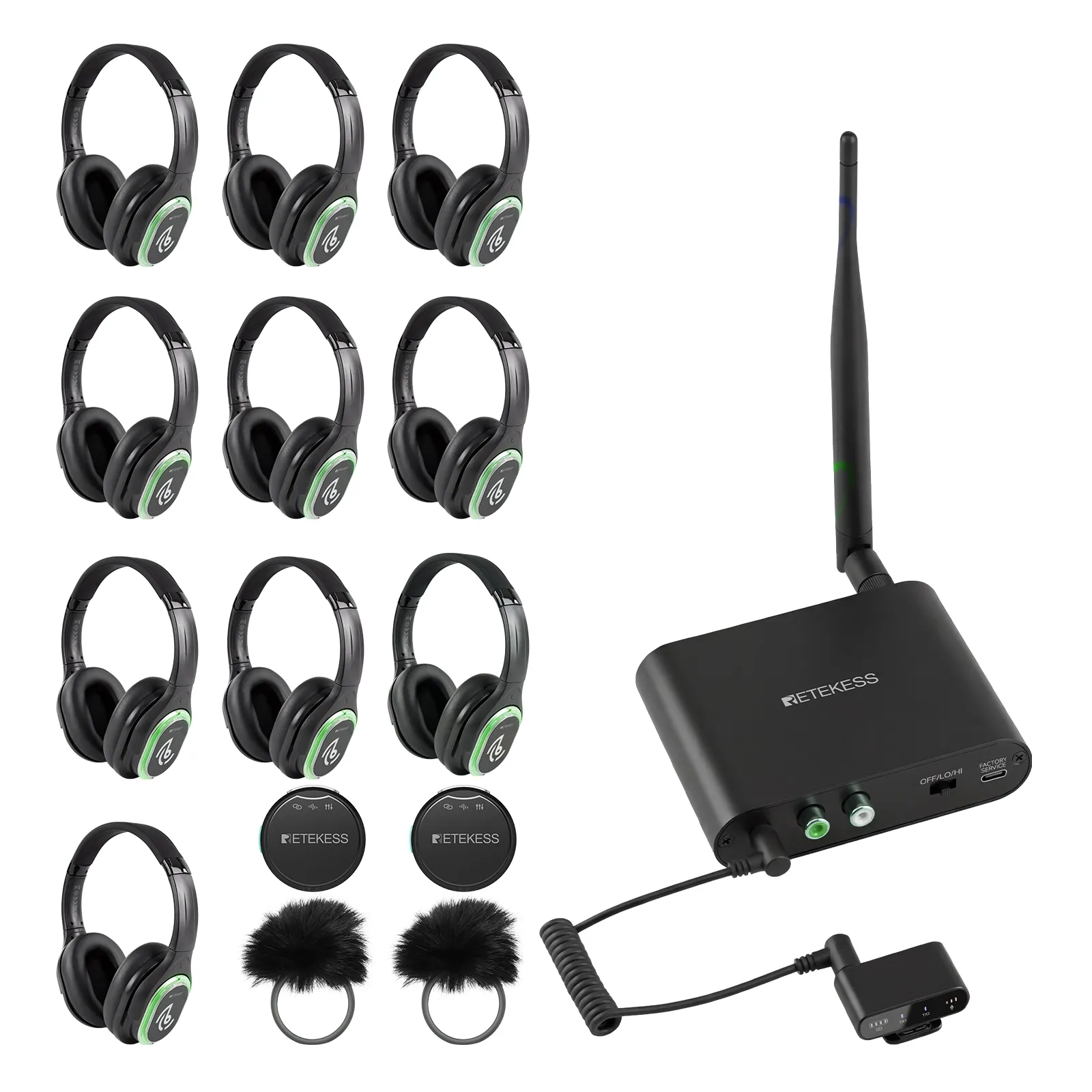
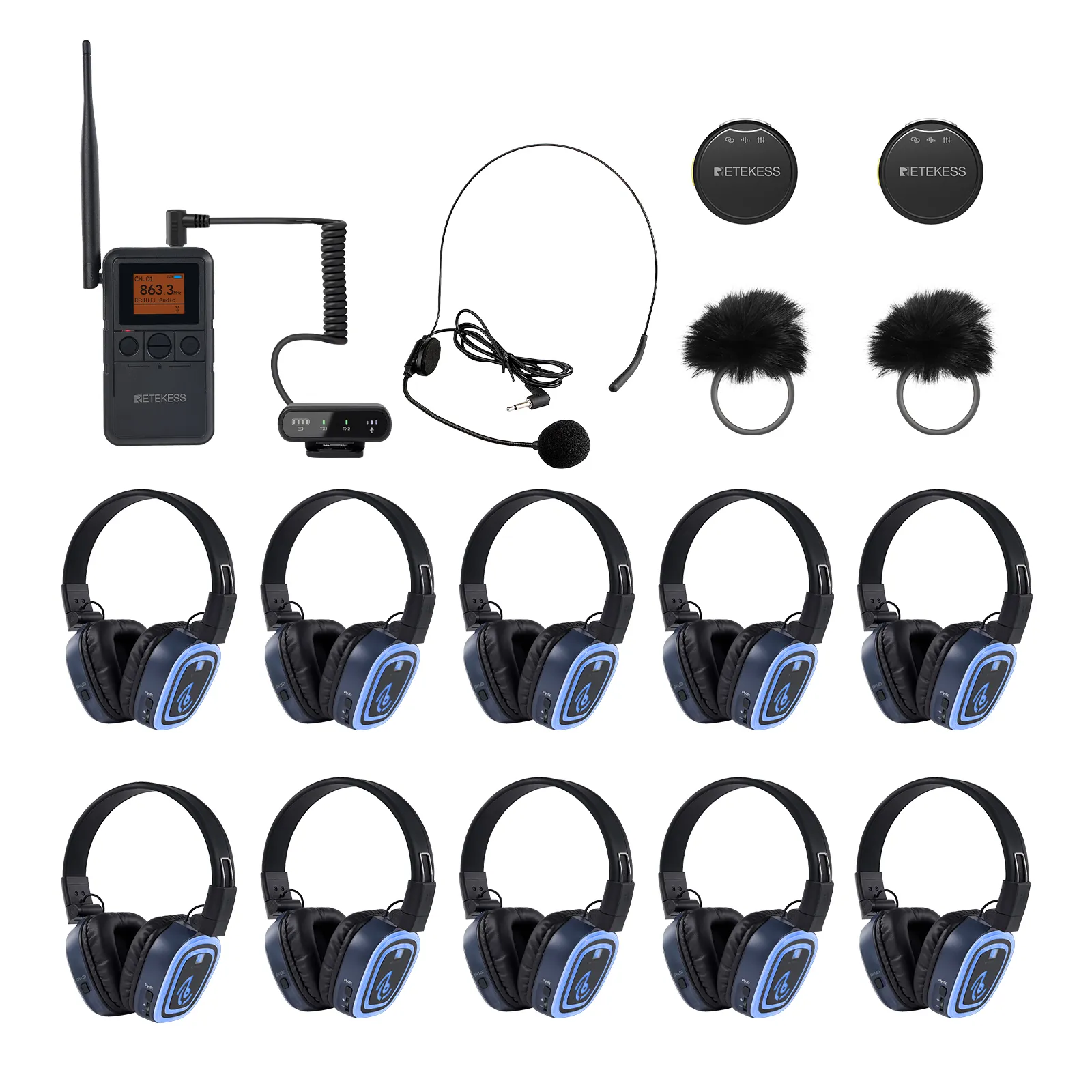
On-site, 100 listeners, 2 languages
- 4 interpreters (2 per language, rotating on the 20–30 minute cycle AIIC recommends)
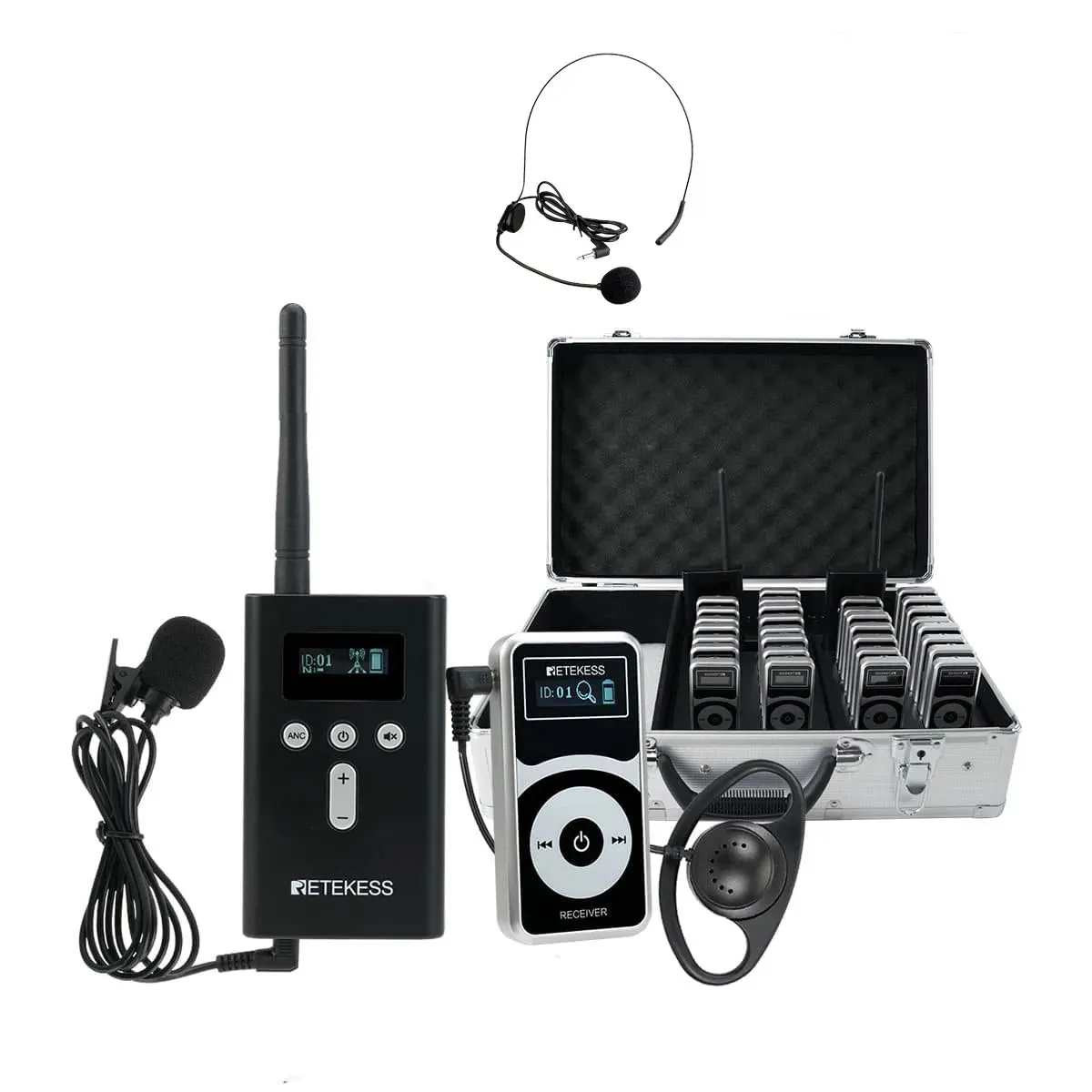
- 1 interpreter console per language — the TT119 accepts XLR, AUX, RCA, and USB so floor audio comes from the soundboard, not a room microphone
- 1 transmitter per language — the TT118 covers 20–200 listeners
- ~110–120 receivers for the target-language cohort, plus 10–15% spares
- One technician with a documented startup checklist
On-site, multi-session or multi-hall
- TT116: with 50 channels, if parallel sessions need separate language feeds
- T130P: for multi-day programs, where its 14–54 hour battery window removes nightly charging from the risk list
Remote / hub RSI
- Interpreters: high-quality headset, wired connection where possible, quiet dedicated space, backup internet
- Platform with interpreter console functionality and a channel per language
- Redundant audio path for interpreters — this is the failure that ends sessions
- A technical producer monitoring during live delivery, not just at setup
Hybrid
- Both lists above, plus a routing plan specifying which languages the room hears and which the stream carries
Frequency Compliance: The On-Site Risk Nobody Budgets For
One on-site risk is not technical but regulatory, and it surfaces after purchase.
Wireless audio operates in regulated spectrum. 72–76 MHz is legal in the US and Canada and not in the EU. 863–865 MHz is the EU general band. 470–694 MHz, 823–832 MHz, and 2.4 GHz carry their own conditions that vary by country. Buying a system in one market and deploying it in another without checking the allocation can mean operating an unlicensed transmitter.
Remote interpretation has no equivalent exposure — which is a genuine, rarely-credited advantage of RSI.
If you are buying rather than renting, state the destination country when you order so the compliant version ships. The full per-region breakdown is in Frequency Compliance for Wireless Audio.
FAQ
Which is better, on-site or remote interpretation?
Neither universally. On-site is better when you need to control the audio path, when content is confidential, or when presenter-audience interaction matters. Remote is better when interpreters are unavailable locally, when the event is already virtual or hybrid, and when booth logistics would cost more than the interpreting itself.
Does remote interpretation reduce quality?
It depends on configuration more than on distance. A 2025 study of 36 professional interpreters found that accuracy and self-assessed performance were lowest when boothmates worked from separate locations, but differed little between co-located and virtual-booth setups — suggesting a properly built virtual booth can replicate a real one. The determining factor is setup quality and operator competence, not the remote mode itself.
Is remote interpretation cheaper?
Usually, in total budget terms. Because equipment and logistics can exceed interpreter fees for on-site events, remote delivery typically lowers the overall cost even when interpreter daily rates are similar. The trade is added connectivity risk.
Do audiences notice the difference between on-site and remote interpretation?
Per one 2025 healthcare study, patients receiving interpretation reported no difference by delivery method, while clinicians strongly preferred in-person. Applied to events, that suggests speakers and organizers perceive more degradation than audiences report — worth knowing when you interpret your own feedback.
What is hybrid interpretation?
On-site equipment for the audience in the room and a remote interpreting platform for the online audience, with interpreters serving both. It is now the most common arrangement at events that have both an in-person and a streaming audience.
Can we use AI translation instead of interpreters for a remote event?
For informational or tour-style content, yes — that is the case AI translation exists to serve. For legal, medical, or high-precision content, no. Detail: AI translation devices vs. simultaneous interpretation systems.
What should we prepare for interpreters working remotely?
Four things: a wired or high-quality connection, a professional headset, a quiet dedicated room, and a backup audio path. Most remote interpreting failures are audio-path failures, and they end the session rather than degrading it.


![[18th Anniversary] 18 Years of Echoing Excellence: Making Communication Easier, Connecting Trust Beyond Borders](https://res.retekess.com/z_file/20260716/retekess-brand-story-making-communication-easier_20260716151044_7682.jpg)
![[18 Years in Wireless Communication] Silent Disco Systems Anniversary Celebration: Top-Selling Headphones & Event Mechanics Revealed!](https://res.retekess.com/z_file/20260713/18-years-in-wireless-communication-silent-disco-systems-anniversary-celebration_20260713175011_5749.webp)
![[Anniversary Carnival] Ding-dong! 18th Anniversary Mega Sale on Guest Paging & Calling Systems: Full Reveal of 12+ Products & Promo Rules!](https://res.retekess.com/z_file/20260713/18th-anniversary-mega-sale-on-guest-paging-calling-systems_20260713175257_0295.webp)
![[Retekess 18th Anniversary Teaser] Tour Guide System Exclusive Perks: Sneak Peek at Event Dates & Mechanics!](https://res.retekess.com/z_file/20260713/retekess-18th-anniversary-tour-guide-system-exclusive-perks--2-_20260713180135_6435.webp)
Follow Us
Pay With


 Google
 Amazon
Comments (0)