
Table of Contents
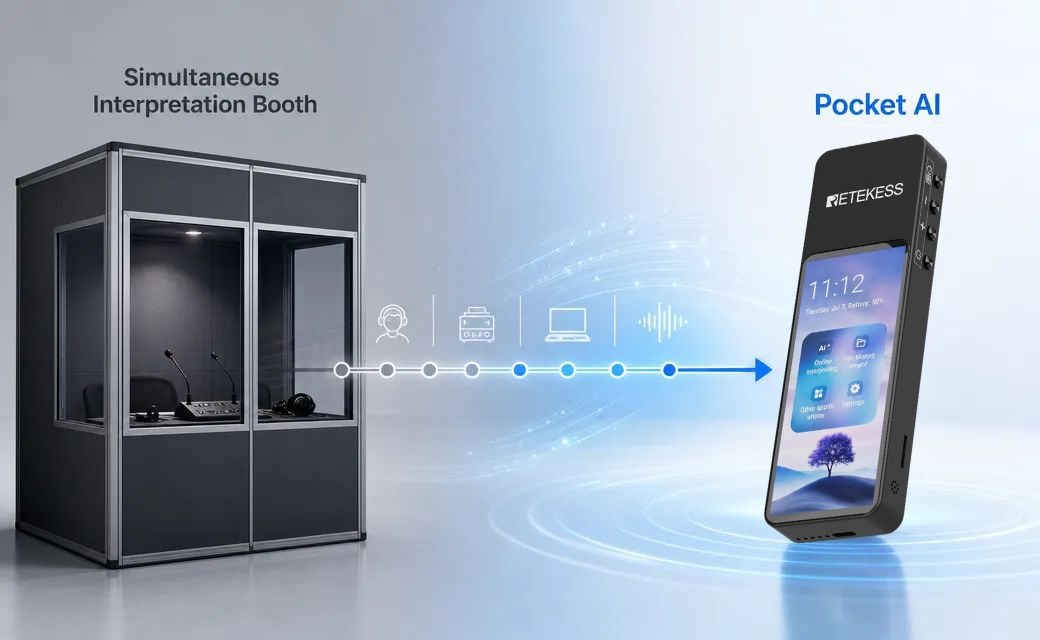
The Evolution of Simultaneous Translation: From Heavy Booths to Pocket AI
- Retekess
- Jul 27, 2026
In an era of borderless global collaboration, cross-border tourism, and international corporate training, real-time language communication and simultaneous translation system has evolved from a luxury to a necessity.
For decades, live simultaneous translation was exclusive to high-end international summits, relying on bulky, immovable booths and professional human interpreters. It was accurate but extremely costly, inflexible, and inaccessible for most small and medium-sized global communication scenarios.
Today, driven by artificial intelligence technology, live translation has broken free from traditional spatial and equipment limitations. Heavy fixed facilities are gradually being replaced by portable, intelligent pocket AI translation devices, bringing efficient and affordable multilingual communication to diverse offline scenarios.
This article traces the complete evolution of live translation technology, analyzes the pain points of traditional solutions, and explores how the new generation of AI translation hardware reshapes on-site multilingual interaction.
The Traditional Era: Bulky and Human-Dependent Interpretation Translation Booths (1960s–1990s)
Simultaneous interpretation as we know it was born at the Nuremberg Trials in 1945, but it did not become standardized until the 1960s. The International Association of Conference Interpreters (AIIC) established strict booth standards: soundproofing, direct sightlines to the speaker, dual interpreter seating, and hardwired infrared audio distribution.
For more than half a century, these heavy fixed booths have been the core carrier of high-precision live translation for top-level international conferences, United Nations summits, and large diplomatic events.
However, the limitations of booth-based interpretation are extremely prominent. 、
First of all, the equipment is highly fixed and requires professional on-site wiring and venue transformation, making it completely unable to adapt to mobile scenarios such as factory tours, outdoor exhibitions, and on-site training.
Secondly, this solution relies entirely on professional human interpreters, resulting in extremely high labor and time costs, which is unaffordable for most enterprises, tourism institutions, and small-scale international activities.
In addition, traditional booth interpretation only supports a limited number of mainstream languages, lacks coverage of minority languages, and cannot meet the increasingly diverse global communication needs.
Most importantly, traditional on-site interpretation only provides real-time audio output, with no automatic recording or sorting of translation content, leaving no valid data archives for subsequent review, summary, and training iteration.
For decades, this was the only way. If your event needed live translation, you started planning months in advance to secure booth space and interpreters.
The Transitional Stage: Wireless Tour Guide Systems With Functional Limitations (2000s–2010s)
To solve the mobility pain point of fixed booths, wireless tour guide translation systems gradually entered the market, becoming the mainstream alternative for small and medium-sized offline multilingual scenarios.
The first real shift came with radio frequency (RF) and infrared (IR) wireless distribution. Receivers shrank from brick-sized boxes to pocketable devices. Listeners could move around the venue. Installations became faster.
But the bottleneck remained: the human interpreter. Wireless systems only solved the distribution problem. They did not solve the source problem. You still needed trained professionals in a booth. You still faced interpreter fatigue, scheduling complexity, and per-hour costs that scaled with language count.
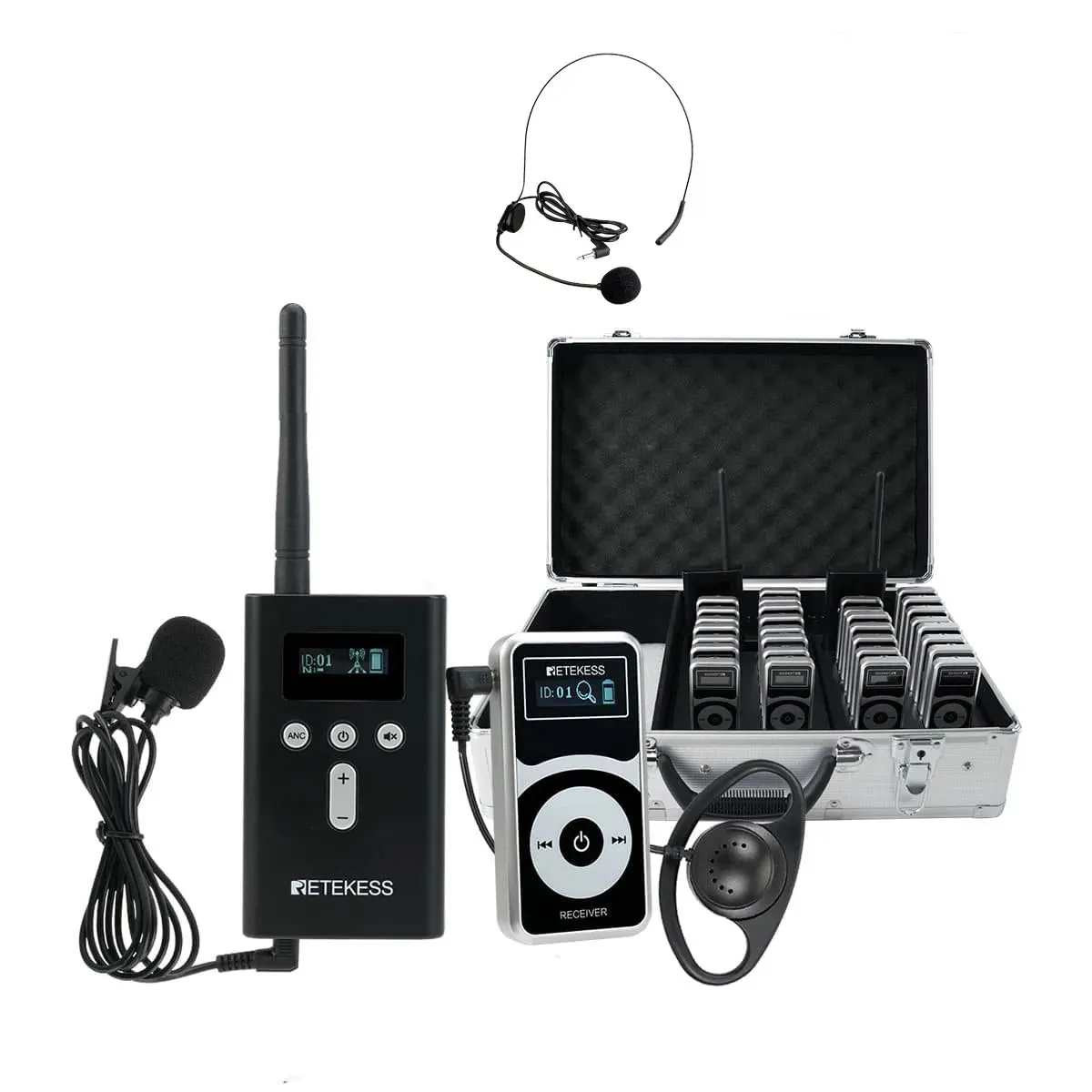
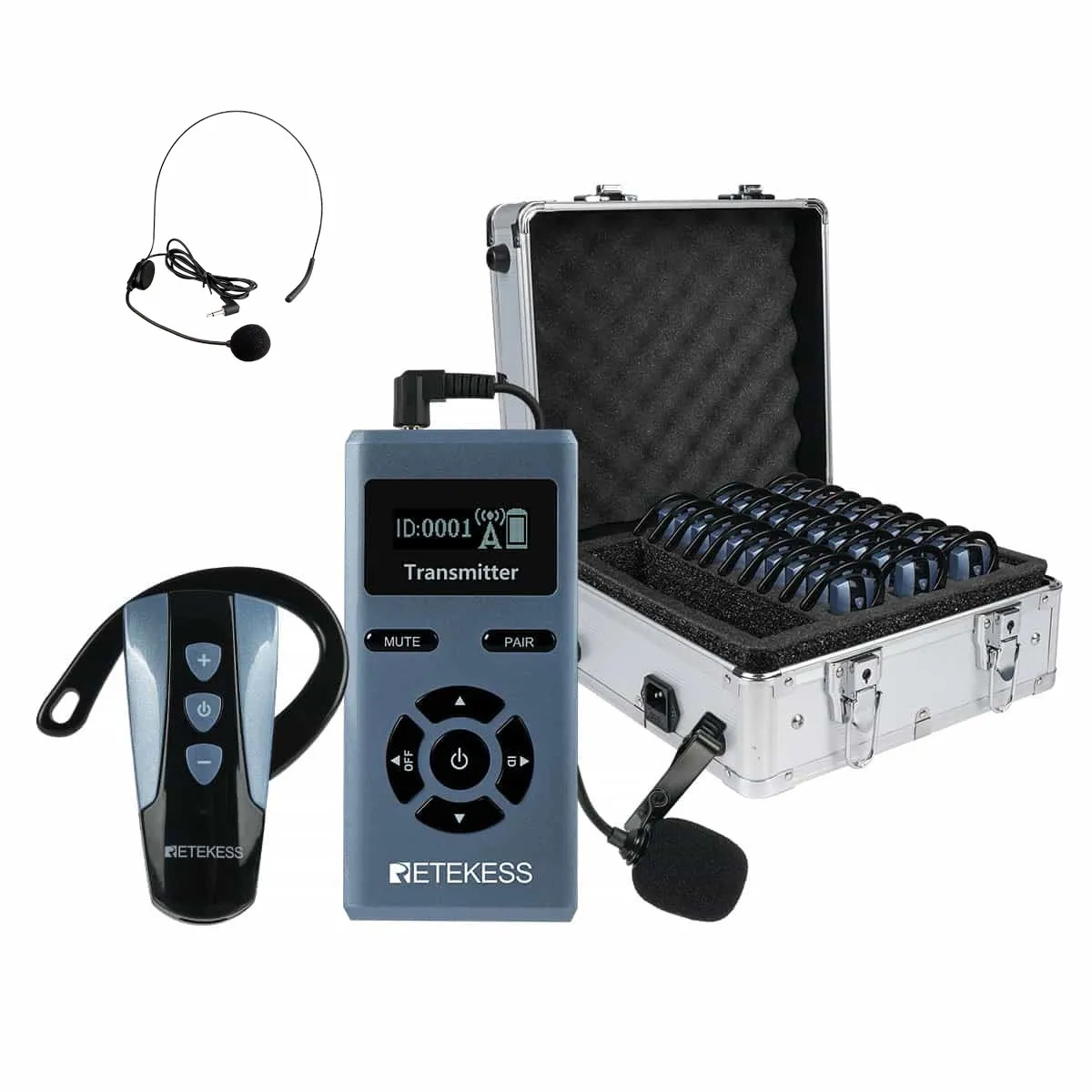
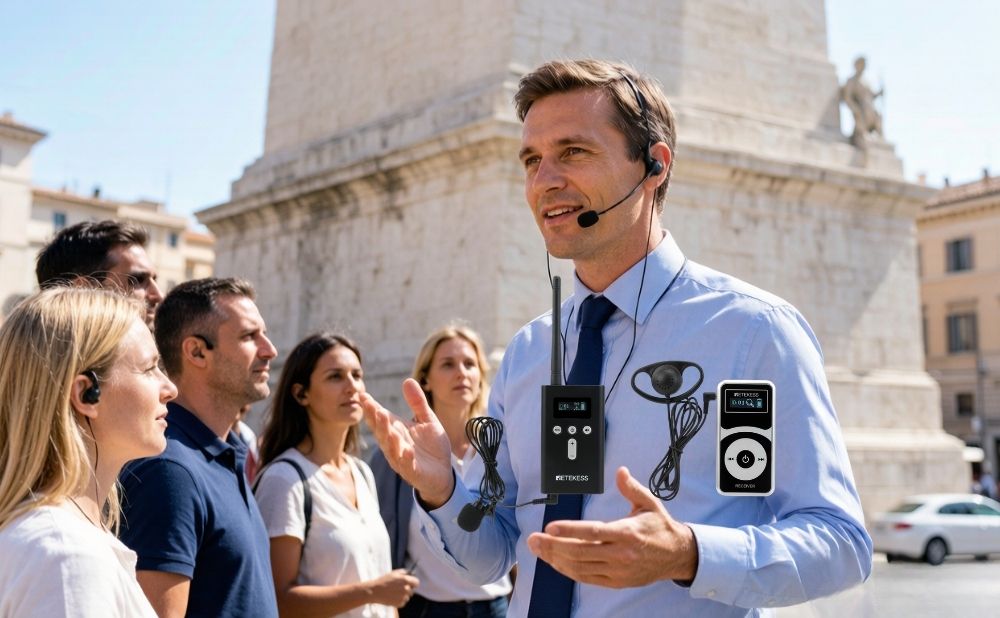
During this era, tour guide systems also emerged—single-channel or dual-channel RF transmitters that let a guide speak into a microphone while tourists listened on wireless headphones. These were excellent for monolingual tours. But if your group spoke three languages, you needed three guides or sequential tours.
The technology had democratized listening. It had not democratized translation.
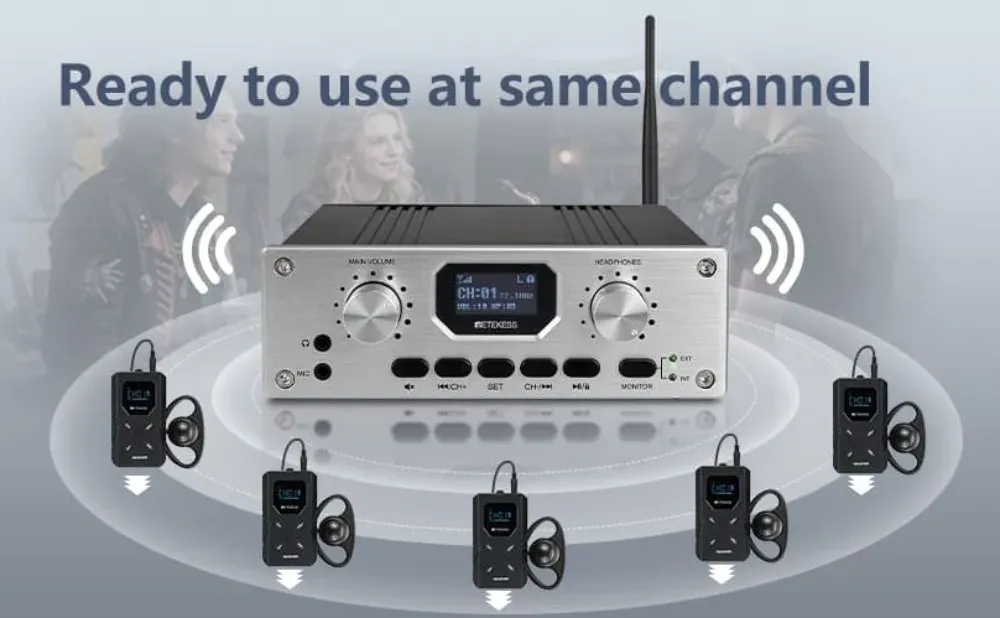
Retekess supplies professional tour guide and simultaneous interpretation systems. Click to learn more if you’re interested.
The App-Cloud Era: Smartphones and Cloud AI Changed the Economics (2015–2023)
Smartphones and cloud AI changed the economics. Apps like Google Translate, Microsoft Translator, and dozens of specialized tools could convert speech to text, translate it, and synthesize it back into speech—all through the cloud. For the first time, a tourist in Tokyo could point their phone at a Japanese menu and see it in English instantly.
For events, this era introduced "bring your own device" (BYOD) translation. Attendees downloaded an app, connected to Wi-Fi, and listened to AI-translated audio on their own headphones. Organizers loved the cost savings: no receiver rental, no booth installation.
But BYOD had cracks.
●Network dependency: Conference Wi-Fi is notoriously unreliable. A single router overload could drop fifty listeners mid-sentence.
●Latency: Cloud round-trips introduced 1–3 second delays. In live Q&A, that lag destroyed conversational rhythm.
●Device fragmentation: Android, iOS, different OS versions, Bluetooth codec incompatibilities—support became a nightmare.
●Audio quality: Phone microphones picking up a speaker across a room produced garbled input, which produced garbled translation.
The app-cloud era proved that AI translation was possible at scale. It also proved that smartphones were the wrong container for it.
The AI Revolution: Live Translation Enters the Pocket Intelligent Era (2024–Present)
With the rapid iteration of AI speech recognition, machine translation, and cloud computing technology, live translation has ushered in a disruptive revolution, completely overturning the century-old industry model. The core change lies in the transformation from "human-dependent, fixed, and single-function" translation to "AI-driven, mobile, and full-scenario intelligent" translation.
Unlike traditional solutions, the new generation of AI pocket translation devices uses portable hardware and integrates high-precision AI translation engines, delivering three major industry upgrades. These pocket-sized terminals combine:
●On-device neural processing: Dedicated NPUs (neural processing units) run compressed large language models locally, eliminating cloud latency.
●Professional audio front-ends: Directional microphones, noise suppression, and acoustic echo cancellation designed for conference environments—not phone calls.
●Dual-mode connectivity: Offline translation for stability, online translation for language breadth.
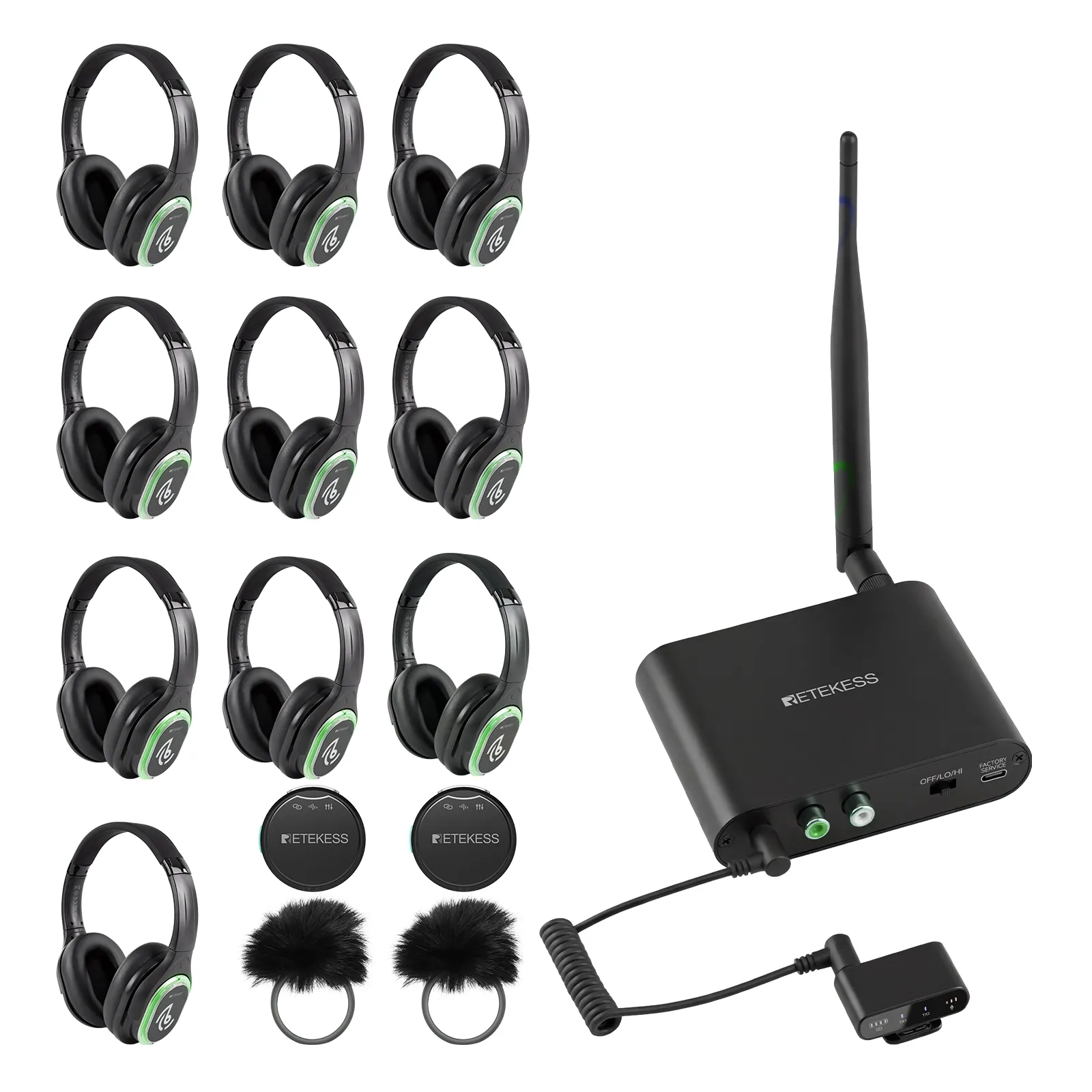
●Unified wireless distribution: Built-in RF or Bluetooth broadcast to dedicated headphones, replacing the BYOD chaos with a controlled audio chain.
This technological upgrade precisely matches the booming global diversified communication demands. It breaks the long-standing constraints of venue, cost, operation and data retention in the live translation industry, making professional real-time multilingual communication accessible and convenient for all types of commercial and public scenarios.
New Industry Benchmark: Retekess TT136 Auto Simultaneous Translation Tour Guide System
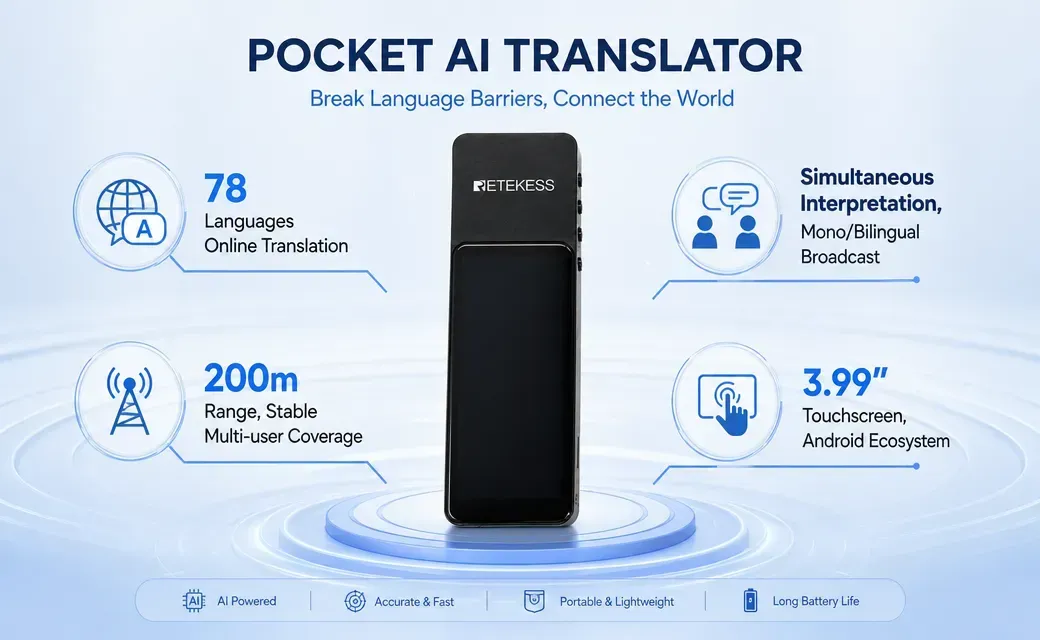
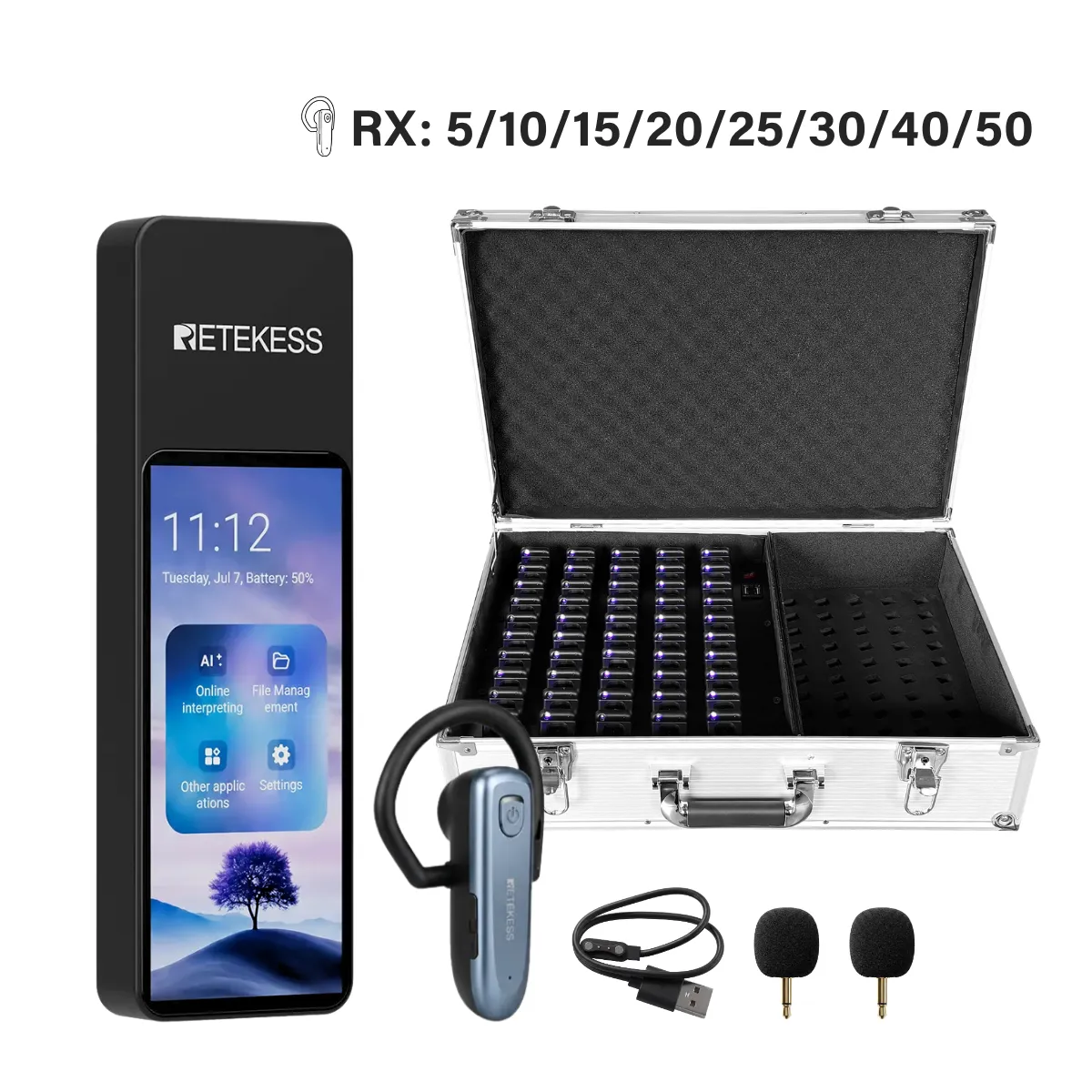
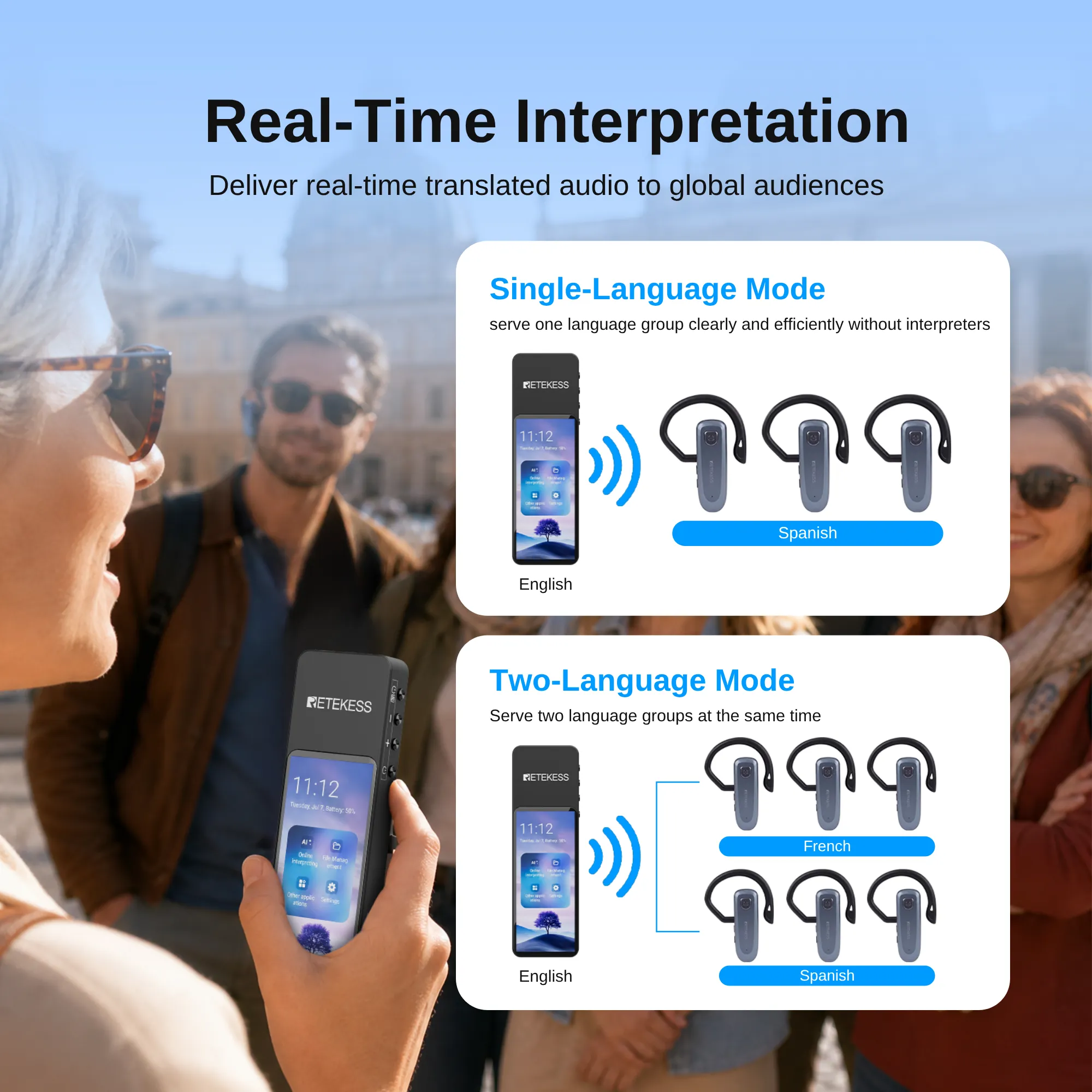
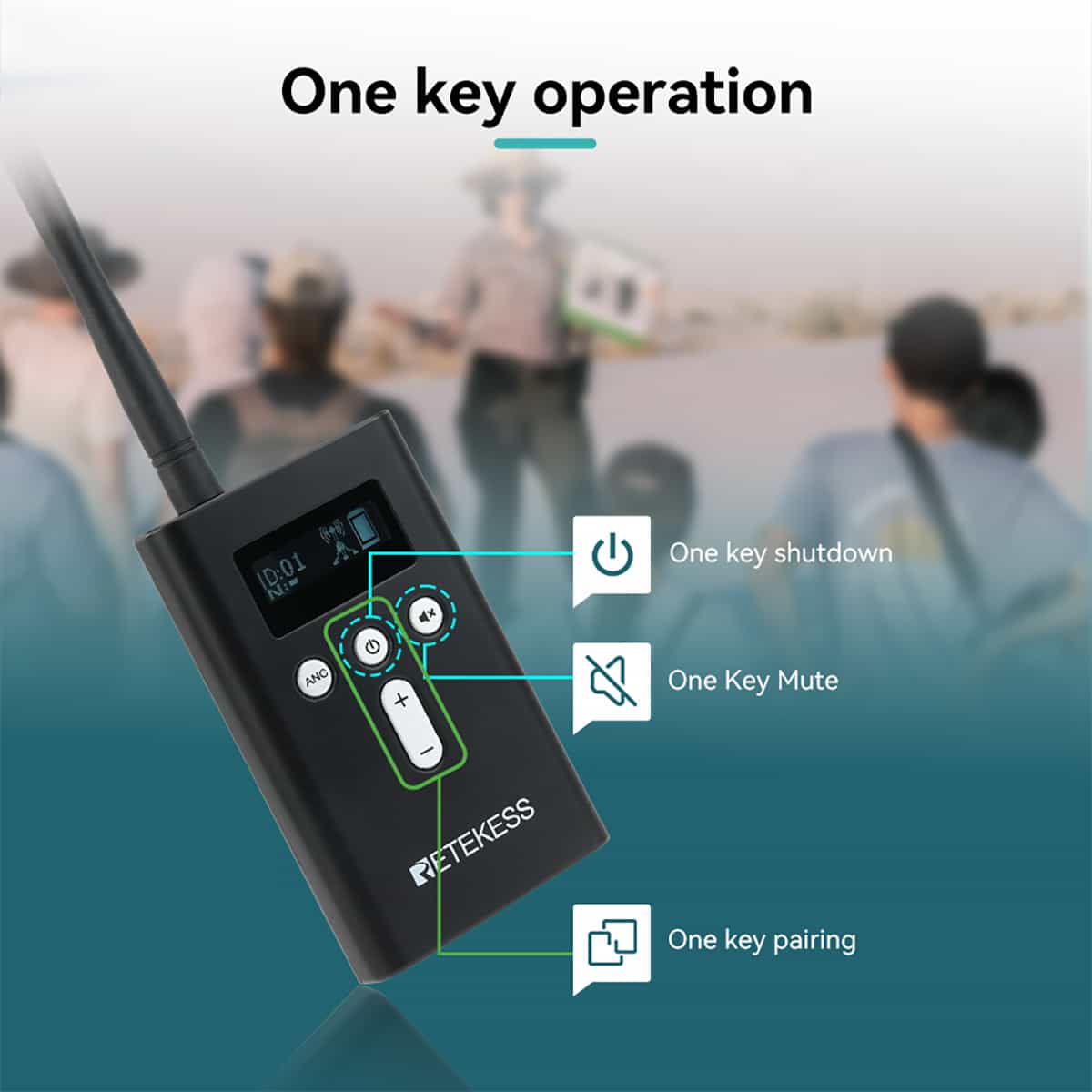
To match the fast-growing multilingual communication demands, audio communication brand Retekess will launch its upgraded all-in-one AI translation tour system TT136, filling the functional gaps of traditional wireless guide devices.
●Dual-mode Simultaneous Broadcast (Single/Bilingual)
Supports one-way single-language output or synchronous bilingual audio playback. Guides can deliver native speech while listeners receive translated content instantly, ideal for mixed local & foreign visitor groups.
●120 Global Languages Online Translation
Covers mainstream European, Asian, African and regional minority languages, far exceeding the 20-30 language limit of old tour translation systems, fully adapting to global cross-border travel and international corporate events.
●AI Translation Summary & Cloud Recording
Automatically stores all translated speech content after tours or training sessions, with AI-powered text sorting and summary. Enterprises can save translated records for internal review, training archives and meeting filing, a feature missing from traditional booth and wireless systems.
●Free Auto Language Recognition for Mixed Multilingual Scenarios
The transmitter auto-detects speech languages within preset language sets without manual channel switching. Perfect for multi-national tour groups, cross-border factory training and on-site exchanges where speakers switch between multiple languages randomly.
What Simultaneous Translation System Means for Event Organizers in 2026
The implications of this evolution are practical and immediate.
1. Cost structure has inverted.
Traditional simultaneous interpretation: high fixed cost (booth rental, interpreter fees) regardless of audience size. Pocket AI translation: fixed hardware cost, near-zero marginal cost per additional language or listener.
2. Setup time has collapsed from days to minutes
No booth construction. No interpreter briefing schedules. No receiver inventory management. Turn on the device, select languages, distribute headphones.
3. Language flexibility has become infinite
A traditional conference might offer English, French, and Spanish because those are the interpreters available. An AI-native event can offer Estonian, Thai, and Swahili with the same effort as offering German.
4. But human interpreters are not obsolete
For high-stakes diplomatic negotiations, nuanced legal proceedings, or emotionally charged keynote addresses, human interpreters still outperform AI in cultural nuance, tone calibration, and ethical judgment. The shift is not replacement—it is democratization. AI handles the long tail of languages and routine communication; humans focus on the highest-value, highest-complexity interactions.
Choosing the Right Approach for Your Event
|
Event Type |
Recommended Approach |
Rationale |
|
High-stakes diplomatic/legal |
Human interpreters + traditional booth |
Nuance, accountability, cultural sensitivity |
|
Corporate conference (5–10 languages) |
Edge-AI terminal + wireless headphones |
Cost, speed, flexibility |
|
Multinational training (mixed speakers) |
Edge-AI with auto-recognition mode |
Speakers switch languages naturally |
|
Tourism / museum / factory tour |
Pocket AI guide system |
Portability, 120+ language coverage |
|
Community / casual meetup |
BYOD app translation |
Lowest cost, acceptable quality |
It’s Retekess’s 18th Anniversary! New arrivals plus exclusive anniversary discounts for all wireless communication products. Shop our limited offers now.
FAQs
1.Do I still need human interpreters for my conference?
For high-stakes or culturally nuanced content, yes. For broad multilingual coverage, routine communication, or budget-constrained events, edge-AI terminals provide viable alternatives.
2.How many languages can AI translation devices handle simultaneously?
Modern systems like the edge-AI generation support 100+ languages online. Broadcast capability depends on the device—some support dual-language simultaneous output, others single-language with channel switching.
3.What happens if the internet connection fails during an event?
Quality devices offer offline translation for core languages as a fallback. For events in connectivity-challenged venues, verify offline capability before selecting a system.
4.Can these devices handle speakers who switch languages mid-sentence?
Advanced systems with free-recognition mode can automatically detect language switches from a preset pool. However, rapid code-switching within single sentences still challenges most AI models.
Leave a Reply

![[18th Anniversary] 18 Years of Echoing Excellence: Making Communication Easier, Connecting Trust Beyond Borders](https://res.retekess.com/z_file/20260716/retekess-brand-story-making-communication-easier_20260716151044_7682.jpg)
![[18 Years in Wireless Communication] Silent Disco Systems Anniversary Celebration: Top-Selling Headphones & Event Mechanics Revealed!](https://res.retekess.com/z_file/20260713/18-years-in-wireless-communication-silent-disco-systems-anniversary-celebration_20260713175011_5749.webp)
![[Anniversary Carnival] Ding-dong! 18th Anniversary Mega Sale on Guest Paging & Calling Systems: Full Reveal of 12+ Products & Promo Rules!](https://res.retekess.com/z_file/20260713/18th-anniversary-mega-sale-on-guest-paging-calling-systems_20260713175257_0295.webp)
![[Retekess 18th Anniversary Teaser] Tour Guide System Exclusive Perks: Sneak Peek at Event Dates & Mechanics!](https://res.retekess.com/z_file/20260713/retekess-18th-anniversary-tour-guide-system-exclusive-perks--2-_20260713180135_6435.webp)
Follow Us
Pay With


 Google
 Amazon
Comments (0)