
Table of Contents
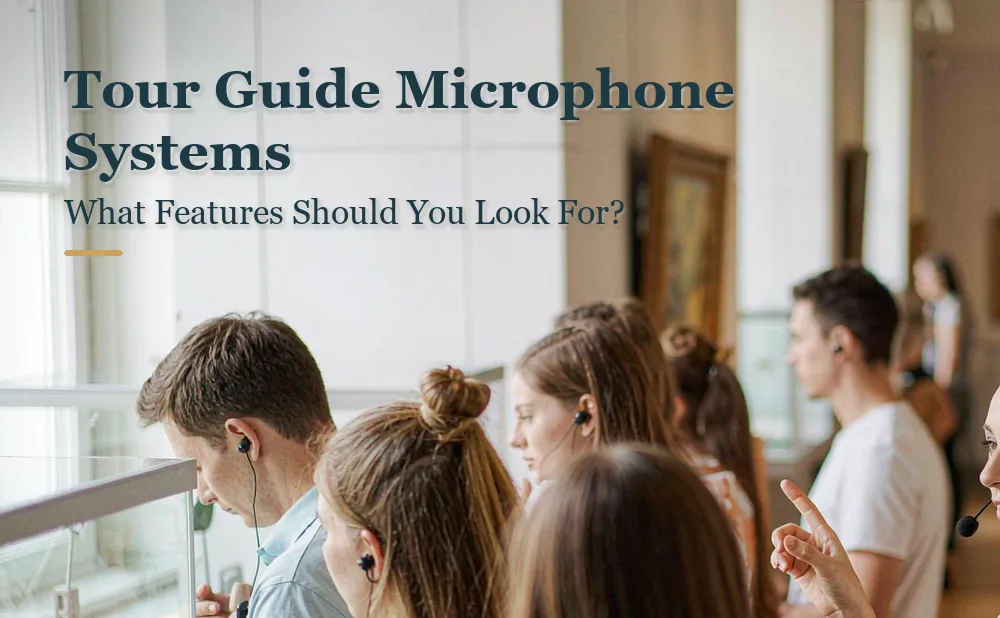
What features should I look for in a tour guide microphone system?
- Retekess
- Oct 14, 2026
In short, prioritize the following seven elements in this order: open-area transmission range matched to your venue, all-day battery life plus a charging case for the whole fleet, DSP noise reduction, enough channels to run simultaneous groups, lightweight receivers guests can wear for hours, audio inputs for both live voice and pre-recorded content, and one-touch controls that seasonal staff can master in minutes. Everything else — branding, display type, extra accessories — comes after those seven.
What is a tour guide microphone system?
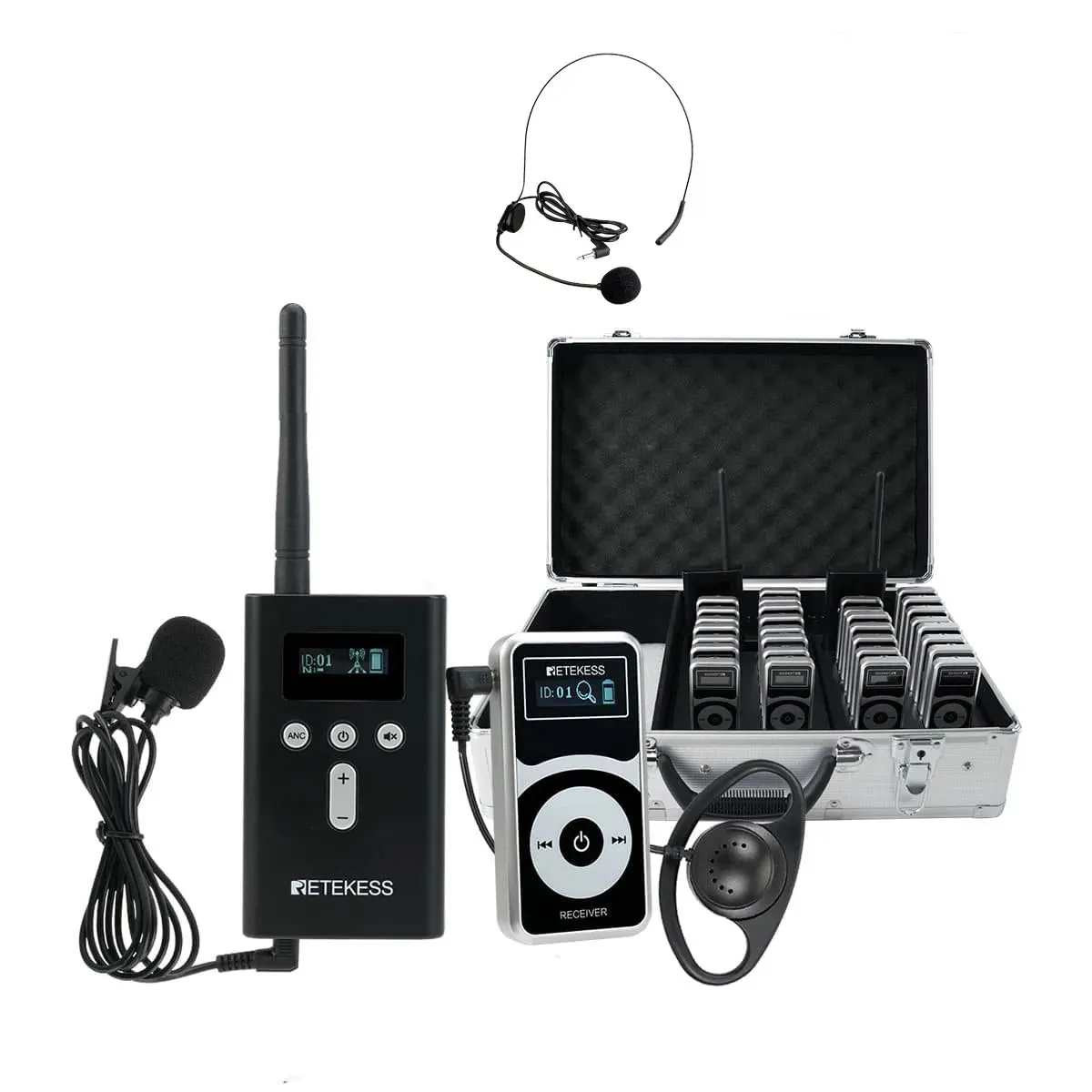
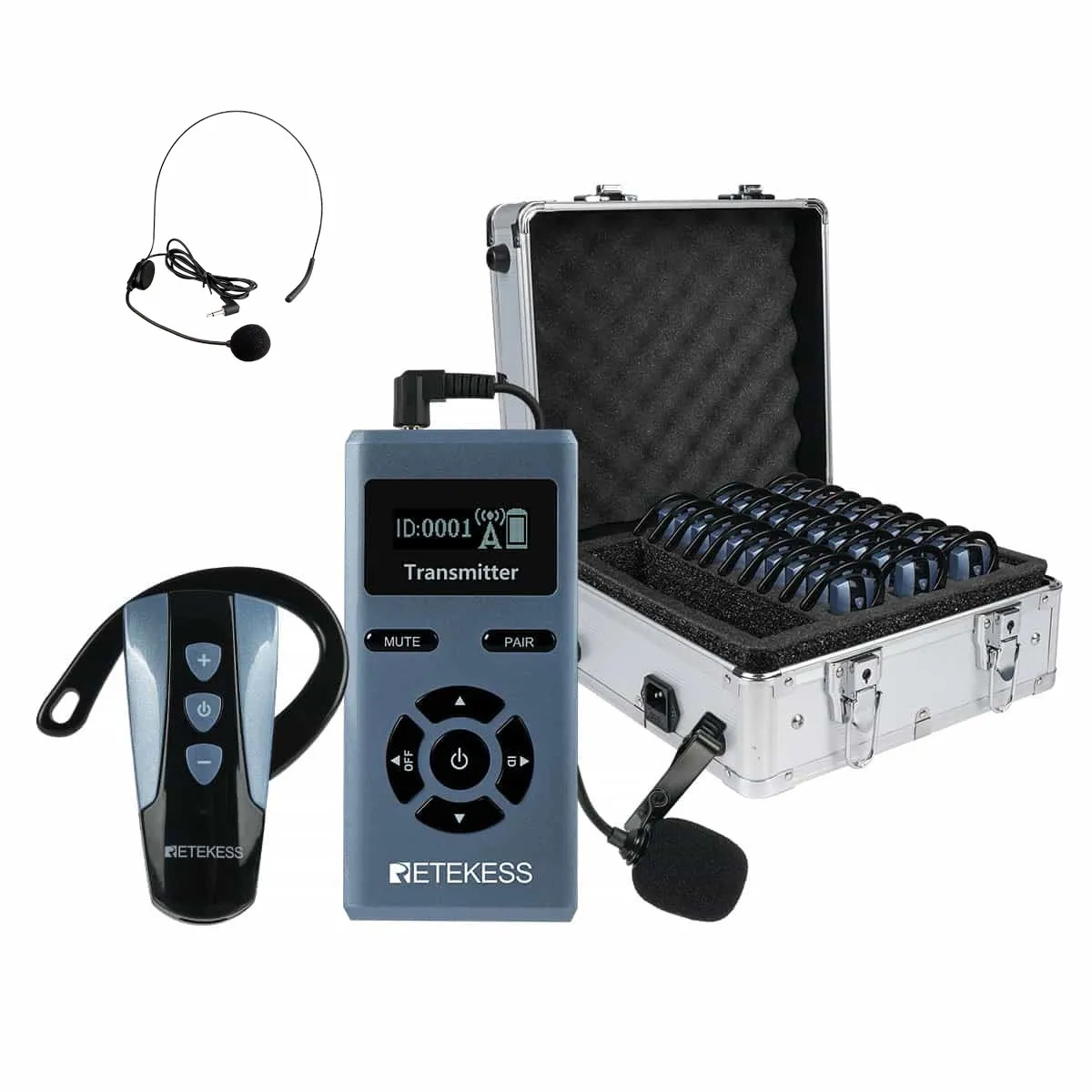
A tour guide microphone system (also called a whisper system, audio guide system, or wireless tour guide system) is a one-to-many wireless audio setup: one person speaks into a transmitter, and every guest hears the voice through a personal receiver and earpiece at a comfortable volume — no shouting, no crowding around the guide, and no disturbing the people around you.
It has two core components:
- Transmitter — carried by the guide, with a built-in or external microphone. This is the unit that sends the audio.
- Receivers — one per guest, usually worn over the ear, with a personal volume control.
Everything else you compare as a buyer is an enhancement on top of those two pieces. Below is how to evaluate those enhancements.
1. Wireless range: how much do you actually need?
Range is the most quoted spec and the most misunderstood. Manufacturers test in open areas with a direct line of sight, so treat the number as an upper bound, not a guarantee.
A practical rule of thumb:
| Venue type | Comfortable rating to look for | Why |
|---|---|---|
| Museum galleries, small historic houses | 60–100 m (200–330 ft) | Walls shorten real-world range; groups stay close |
| City walking tours | 100–160 m (330–525 ft) | Guests stop for photos and fall behind at crossings |
| Factory floors & plant tours | 150–200 m (490–660 ft) | Machinery and metal structures absorb signal; safety rules spread groups out |
| Large outdoor attractions, campuses, construction sites | 200 m+ (660 ft+) | Distance between stops is long and unpredictable |
Real examples from the Retekess range: the T130P covers up to 160 m (525 ft) open area; the TT106S is rated to 200 m (656 ft) on the worldwide 2.4 GHz band; the TT133 smart touchscreen system comes in at 150 m (492 ft); and for two-way team communication, the TT126 reaches 280 m (919 ft) between its main and secondary transmitters.
The buyer's takeaway: buy range for your worst venue, not your average one. A guide who loses the group at the back of a factory floor loses the narration entirely.
2. Battery life — and the charging workflow behind it
Runtime is only half the question. The other half is: how does your staff get 30 devices from empty to full every single night?
Compare both halves:
- Runtime. Look for at least 12 hours on the transmitter and 20+ hours on receivers for full-day operations. The T130P runs 20 hours (transmitter) and 36 hours (receivers); the TT106S does 23 hours and 50 hours respectively; the TT133 delivers a flat 12 hours across transmitter and receivers.
- Charging method. Type-C is now standard and removes cable-compatibility headaches. Contact charging is a step further — devices simply drop into a slot with no port alignment and no port wear. The T130P offers both.
- Fleet charging. This is where most first-time buyers under-buy. A dedicated multi-slot charging case (available 15-, 16-, 20- and 50-slot depending on model) turns close-down into a one-minute task and doubles as storage and transport.
- Charge time. Receivers that fill in 3 hours (TT106S) or 2 hours (TT133, TT126R) are recoverable between a morning and afternoon tour; an 8-hour transmitter charge is an overnight job.
The buyer's takeaway: if you run more than one departure per day, put the charging case on the purchase order before you add extra receivers.
3. Noise reduction and audio clarity: DSP vs. plain amplification
Every system amplifies the voice. The good ones actively remove everything else.
The feature to look for is DSP (digital signal processing) noise reduction, ideally with adjustable levels rather than one fixed setting. The T130P's DSP chip offers four selectable noise-reduction levels, so the same fleet can be tuned for a quiet gallery in the morning and a machine hall in the afternoon. Digital systems also publish a signal-to-noise ratio (SNR): the TT106S and T130P both sit at ≥80 dB, which is the threshold where speech stays clean in noisy surroundings.
Also worth checking: signal frequency band.
- 2.4 GHz (TT106S, TT133) — globally license-free, so it travels with you across countries.
- UHF 195–216 MHz (T130U) — strong penetration through walls and structures, which suits factories and thick-walled historic buildings.
If you operate in more than one country, verify which band is approved for your region.
4. Channels: can you run two groups in the same room?
Channels determine how many groups can operate in the same space without hearing each other. This directly decides whether you can sell simultaneous multilingual tours or parallel time slots.
- T130P — 49 channels: documents such as the metoree listing note it can support "up to 49 groups at the same time in the same location without causing signal interference," with different language speakers each carrying a transmitter.
- TT106S / TT106 — 9,999 channels: effectively unlimited parallel groups for schools, exhibitions and conference centers.
- TT133 — 99 channels: ample for most single-venue operations.
Also check cross-compatibility before you expand: TT106S is not compatible with TT106, and receivers generally pair only within their own family (T131P with T130P, TT126R with TT126, TT106S with TT106S). Buying the same family later is what makes an existing fleet expandable.
5. Receiver comfort and shared-use hygiene
Guests wear receivers for one to four hours, often in the heat, often after someone else wore them an hour earlier. Minor specs matter a lot here:
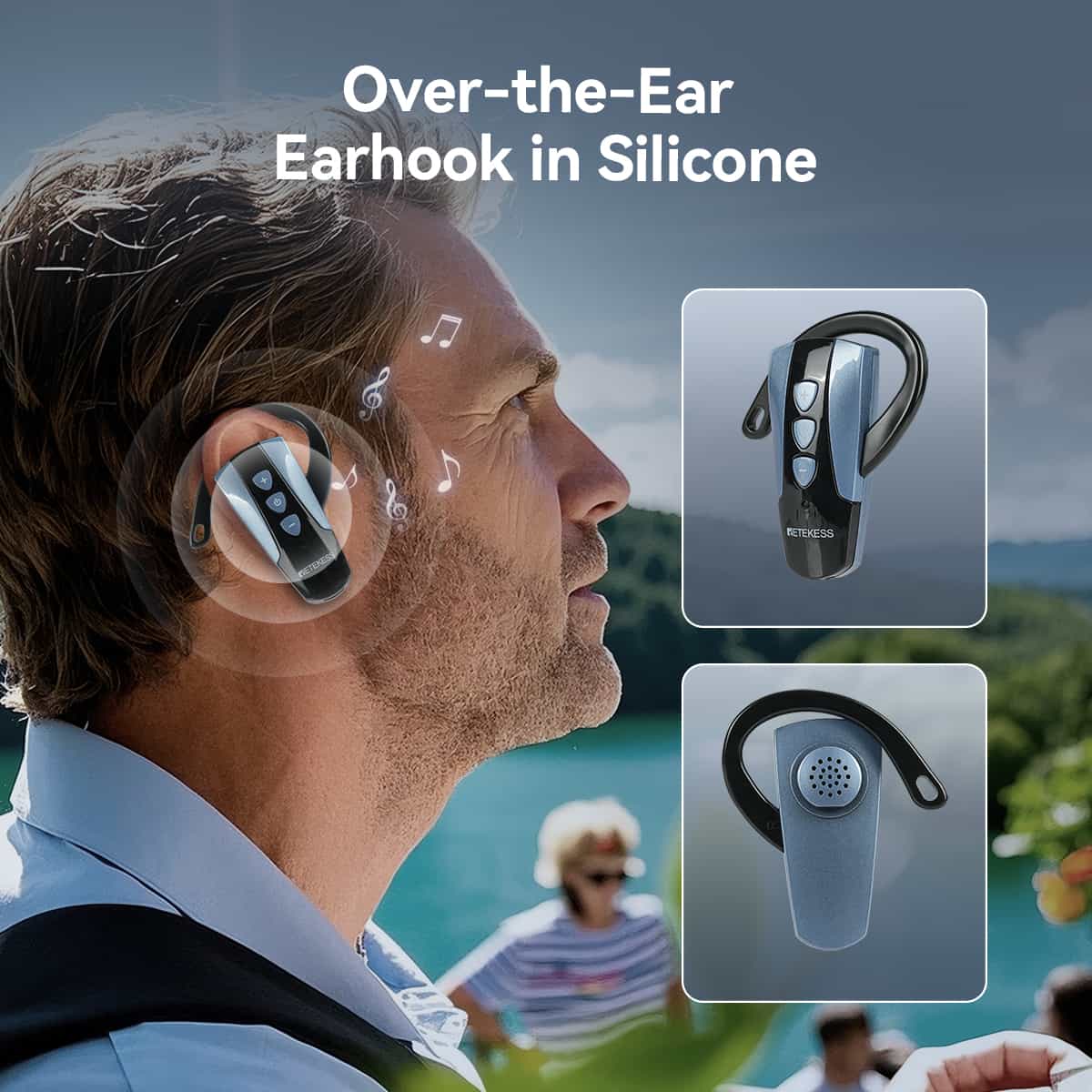
- Weight and form factor. Ear-hook receivers around 18–49 g (TT133 ~18 g, T130P receiver 49 g) are comfortable for hours; the silicone over-ear hook of the TT106S is designed to avoid pressure on the ear canal and fits either ear.
- No cables. Ear-hook and D-shape designs are faster to hand out, collect and sanitize than lanyard-plus-wired-headset setups.
- Personal volume control. Essential — hearing ability varies widely within any group (TT106S offers 0–9 levels).
- Auto power-off. Receivers that shut down after 20 minutes without signal (TT106S, T130P, TT126R, T131R) quietly save battery when a guest pockets the unit instead of returning it.
6. Audio inputs: live voice today, recorded content tomorrow?
Think about your roadmap, not just today's departure.
- MIC input (3.5 mm) — for a lavalier or headset microphone the guide wears. Look for kits that include both options, as the TT106S does, so guides can pick.
- AUX input — lets you pipe in background music or a short audio clip between stops.
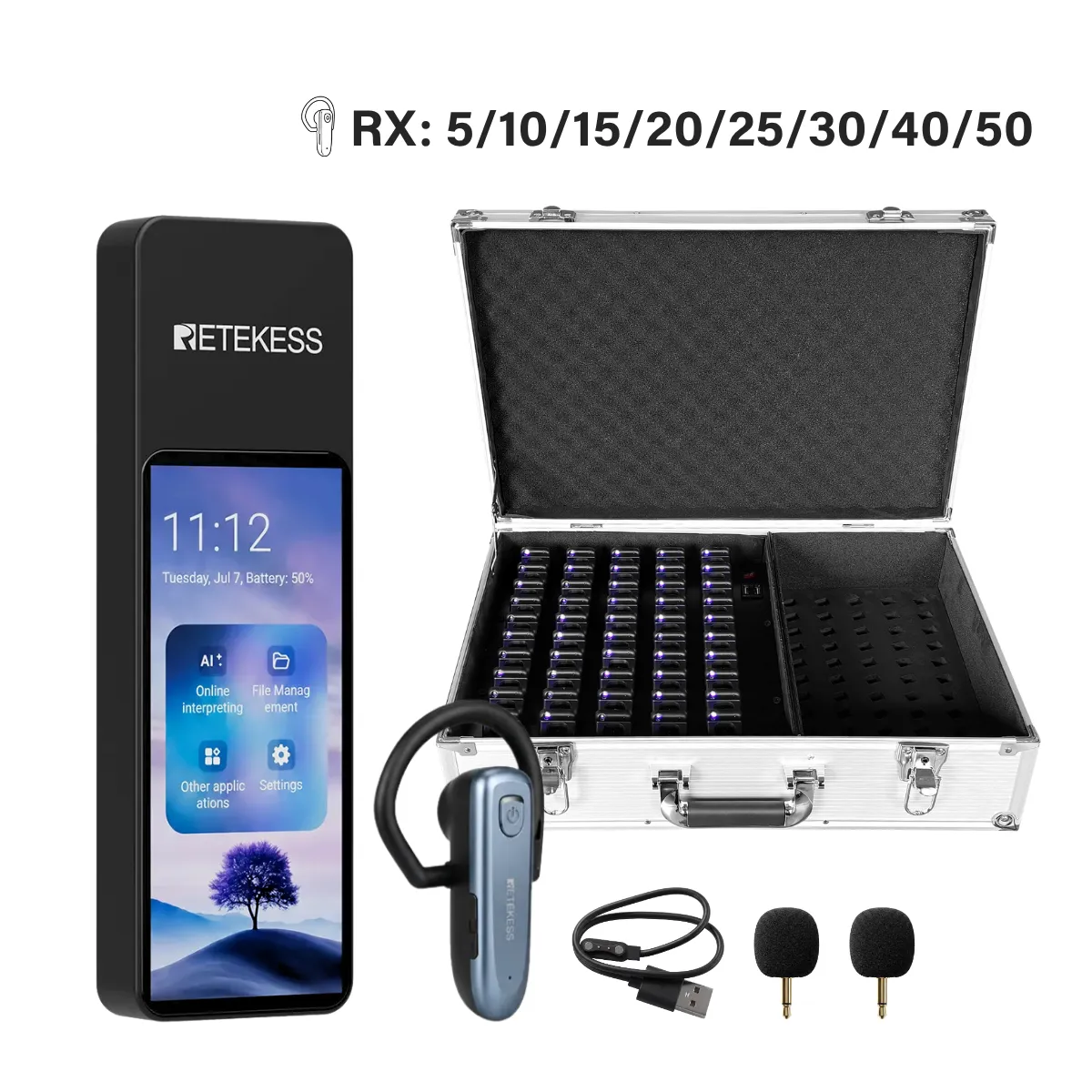
- TF card recording and playback — the TT133 supports recording and playback from a TF card, which is what lets one fleet handle live tours in the morning and pre-recorded multilingual narration in the afternoon. Without it, self-guided tours require a second purchase.
- Bluetooth — the TT133 also supports Bluetooth audio input.
7. Daily operations features that save real minutes
These don't appear in glossy headlines; guides appreciate them within a week.
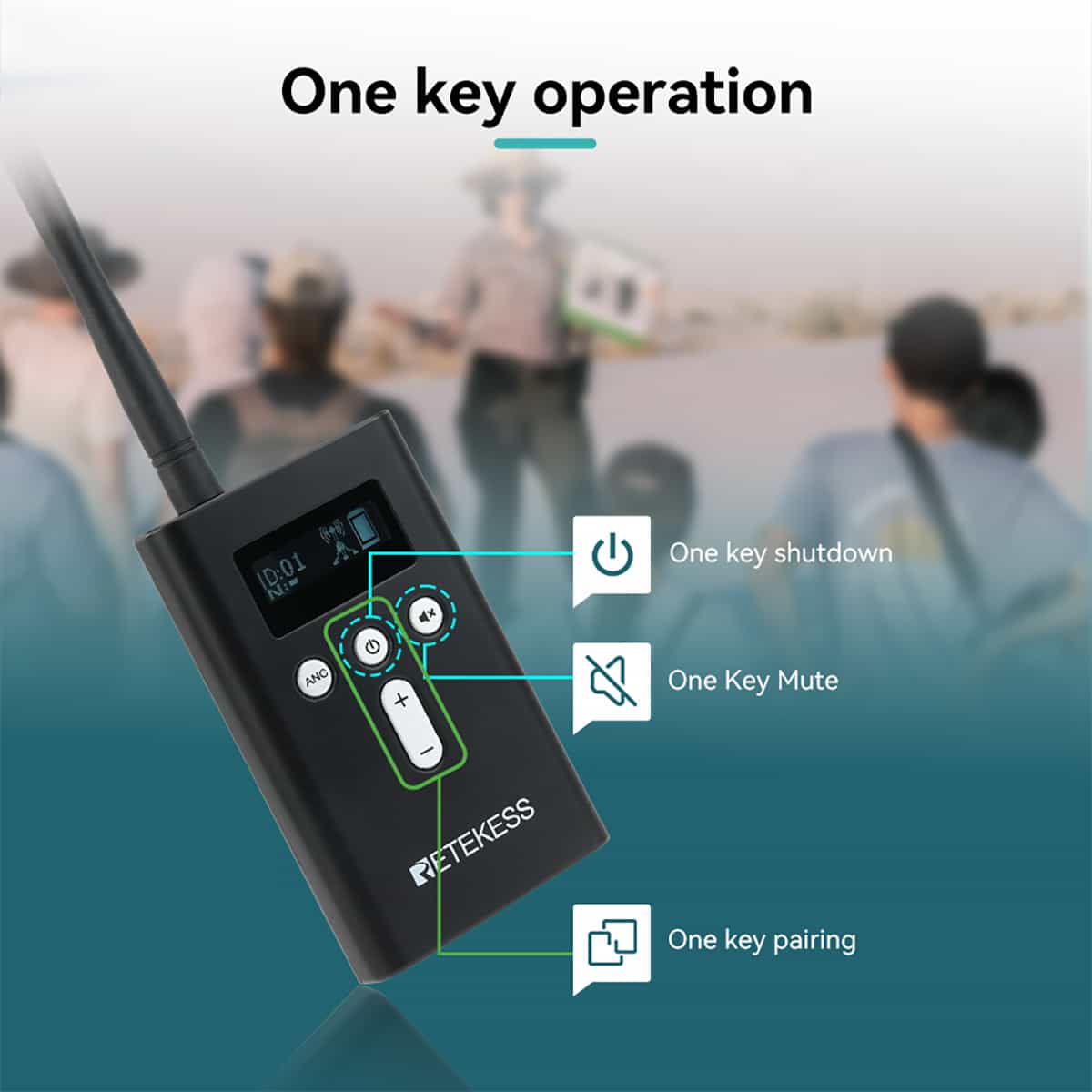
- Auto pairing / one-key frequency matching — press one button and every receiver synchronizes to the transmitter's channel. Without it, staff manually set channels one device at a time at every handover. (T130P, TT106S, TT133 all support it; TT126R even searches and pairs automatically.)
- One-touch mute — instant privacy for a side conversation or a phone call without shutting the system down.
- One-touch shutdown of all receivers — long-press on the transmitter and every paired receiver powers off at once. This alone can save ten minutes at the end of a 30-person tour.
- Low-battery reminder / indicator — catches a dying receiver before the tour starts (TT126R).
- Channel memory — the system boots on the channel you last used (TT106 series).
- Drop-proof, wear-resistant housing — worth prioritizing for school and youth programs (highlighted on TT106S).
- Protection circuitry — over-current and abnormal temperature protection on charging base, circuit temperature protection on devices, plus an additional protection mechanism to prevent circuit overheating.
One-way or two-way communication: which do you need?
Most tour guide systems are one-way: the guide speaks, guests listen. That's exactly what a museum or walking tour needs, and it's what keeps the price down.
Choose a two-way system if guests need to answer back — training sessions, factory-floor troubleshooting, conference Q&A, or school groups where the leader wants to call for attention. Retekess TT126 / TT126R supports two-way interaction between main transmitter, secondary transmitter and receivers, with adjustable microphone sensitivity for noisy environments — and reaches 280 m between the two transmitters.
Feature comparison table
| Feature | T130P (3rd-gen T130) | TT133 | TT106S | TT126 / TT126R |
|---|---|---|---|---|
| Working range (open area) | 160 m / 525 ft | 150 m / 492 ft | 200 m / 656 ft | 150 m (TX→RX); 280 m between transmitters |
| Battery — transmitter | 20 h | 12 h | 23 h | 12 h |
| Battery — receiver | 36 h | 12 h | ~50 h | 12 h |
| Frequency band | UHF 195–216 MHz | 2.4 GHz | 2.4–2.485 GHz | UHF, FM modulation |
| Channels | 49 | 99 | 9,999 | — |
| Noise reduction | DSP, 4 adjustable levels | DSP noise reduction | SNR ≥80 dB | UHF FM noise reduction |
| Charging | Type-C + contact charging | Type-C, ~2 h | Type-C (~3 h RX) | Type-C + charging case, 2 h |
| Communication type | One-way | One-way | One-way | Two-way |
| Notable extras | One-touch mute & shutdown, auto pairing, 49 simultaneous groups | 2.4" touchscreen, TF-card record/playback, Bluetooth, AUX | Strong-light display, 9,999 channels, drop-proof shell | Two-way talk-back, adjustable mic sensitivity |
| Receiver weight | 49 g | ~18 g | ~18 g (0.04 lb) | Ear-hook ~two-ear fit |
Match the features to your scenario
- Museums and galleries → prioritize channel count (49–9,999) for parallel groups, lightweight receivers for long visits, and hygiene-friendly ear-hook designs.
- Factory and plant tours → prioritize UHF penetration, DSP noise reduction against machine noise, and 200 m+ range for safety-mandated spacing.
- Churches and interpretation → prioritize all-day-long receiver runtime (36–50 h) so the fleet covers Sunday plus midweek services on one charge, plus multi-channel for simultaneous translation.
- Schools and youth groups → prioritize drop-proof housings, tangle-free receivers and a charging case — a travelling fleet needs to survive transport.
- Guided city walking tours → prioritize range for guests who lag behind, comfortable receivers, and the option of recorded playback for self-guided versions.
Buy with support behind it: warranty, demos and customization
Two features never appear on a spec sheet but protect your budget:
- Warranty. Retekess provides a 3-year warranty with free repairs during the warranty period. Compare that against the 12 months typical of consumer audio gear.
- Free demo testing. Retekess.com offers free demo testing (a deposit is required) — you can run the equipment in your actual venue before committing. Apply via the Demo Application page; customer service responds within one business day.
- Customization. Quantities can be customized for any combination (for example 99 transmitters + 9,999 receivers), and logo customization is available on tour guide systems — relevant for venues that issue equipment to sponsors or corporate clients.
- Service scale. The company's product lines span tour guide systems, audio translation devices, silent disco headphones and restaurant paging systems, and it states that Retekess serves over 150,000 businesses with wireless communication products.
FAQ
Q: What is the single most important feature in a tour guide microphone system?
A: For most operators it's reliable transmission range matched to the venue, followed closely by all-day battery life. A dropped signal at the back of the group breaks the tour; everything else is refinement.
Q: How many channels do I need?
A: One per simultaneous group. If you ever plan to run two languages in the same building, don't buy fewer than ~50 channels (T130P has 49; TT106S has 9,999).
Q: Do I need two-way communication?
A: Only if guests or staff need to talk back — training, workshops, factory troubleshooting or conference Q&A. Standard guided tours work perfectly with one-way systems.
Q: Can I add more receivers later?
A: Yes. Transmitters pair with an effectively unlimited number of receivers, and components are sold individually, so start at your typical group size and expand. Keep purchases within the same product family — TT106S receivers, for example, are not compatible with TT106.
Q: How long should the battery last?
A: Size it to your longest day plus margin. A transmitter rated at 20 hours covers continuous guiding; receivers with 36–50 hours let you run several days of tours between charges.
Q: Is there a difference between 2.4 GHz and UHF systems?
A: Yes. 2.4 GHz is globally license-free and ideal for operators working across countries; UHF generally penetrates walls and metal structures better, which suits factories and historic buildings. Always confirm local frequency regulations.
Leave a Reply


![[18th Anniversary] 18 Years of Echoing Excellence: Making Communication Easier, Connecting Trust Beyond Borders](https://res.retekess.com/z_file/20260716/retekess-brand-story-making-communication-easier_20260716151044_7682.jpg)
![[18 Years in Wireless Communication] Silent Disco Systems Anniversary Celebration: Top-Selling Headphones & Event Mechanics Revealed!](https://res.retekess.com/z_file/20260713/18-years-in-wireless-communication-silent-disco-systems-anniversary-celebration_20260713175011_5749.webp)
![[Anniversary Carnival] Ding-dong! 18th Anniversary Mega Sale on Guest Paging & Calling Systems: Full Reveal of 12+ Products & Promo Rules!](https://res.retekess.com/z_file/20260713/18th-anniversary-mega-sale-on-guest-paging-calling-systems_20260713175257_0295.webp)
![[Retekess 18th Anniversary Teaser] Tour Guide System Exclusive Perks: Sneak Peek at Event Dates & Mechanics!](https://res.retekess.com/z_file/20260713/retekess-18th-anniversary-tour-guide-system-exclusive-perks--2-_20260713180135_6435.webp)
Follow Us
Pay With


 Google
 Amazon
Comments (0)