
Table of Contents

What Is an AI Translation Device? How It Works for Groups
- Retekess
- Sep 14, 2026
Five years ago, "AI translation device" meant a clunky handheld gadget that translated menus and street signs — slowly, and not always correctly. In 2026, the term describes a category of hardware that listens to a speaker in one language and broadcasts a real-time AI translation to a group of listeners in another language, usually within 1–5 seconds, and increasingly without anyone needing a smartphone.
If you've been wondering whether AI translation is finally good enough to use for your church, tour group, factory visit, or conference — this guide walks you through what's actually possible today, where AI still falls short, and how to pick the right device.
A Plain Definition
An AI translation device is hardware that uses automatic speech recognition (ASR) → machine translation (MT) → text-to-speech (TTS) to convert spoken language in real time, often with a dedicated transmitter and receivers for group use.
Three pieces of plumbing make it work:
- Speech recognition — converts the speaker's audio into text
- Neural machine translation — converts the text from language A to language B
- Voice output — speaks the translation out loud via the receivers
When all three pieces run on-device (no internet), latency drops to 1–3 seconds and the system works anywhere. When one or more pieces require cloud connectivity, latency stretches to 3–8 seconds and you need a stable network.
Why AI Translation Matters Now
Three forces converged to make 2026 the year AI translation became a serious option for groups:
- Neural translation quality caught up. Modern models (the engines behind Google Translate, DeepL, and ChatGPT) translate conversational speech with 85–95% accuracy for common language pairs like English↔Spanish, English↔French, English↔Italian. Edge cases (legal, medical, very technical) still drop below 80%.
- On-device inference became possible. Dedicated AI chips in devices like the Retekess TT136 run 120 languages.
- Group broadcasting hardware matured. Until recently, AI translation lived in apps that required every listener to have a smartphone. New devices broadcast on a dedicated channel to dedicated receivers — no app, no friction.
This combination is what makes AI translation viable for a 25-person factory tour today, where it would have been laughable five years ago.
The 3 Main Types of AI Translation Devices
1. Handheld Personal Translators
Pocket-sized devices (and apps) for one-to-one conversations. Brands: Pocketalk, Vasco, Langogo Travis.
Strengths: portable, simple, good for travelers
Limitations: meant for 1-to-1 conversations; awkward for groups; usually need a network connection
2. AI Earbuds
Two earbuds that translate between two speakers wearing them. Brands: Timekettle W4 / W4 Pro / X1, Google Pixel Buds, Samsung Galaxy Buds.
Strengths: hands-free, decent conversational accuracy
Limitations: every listener needs their own earbuds and a paired phone; not practical for groups of 20+
3. AI Group Translation Devices (1-to-Many Broadcast)
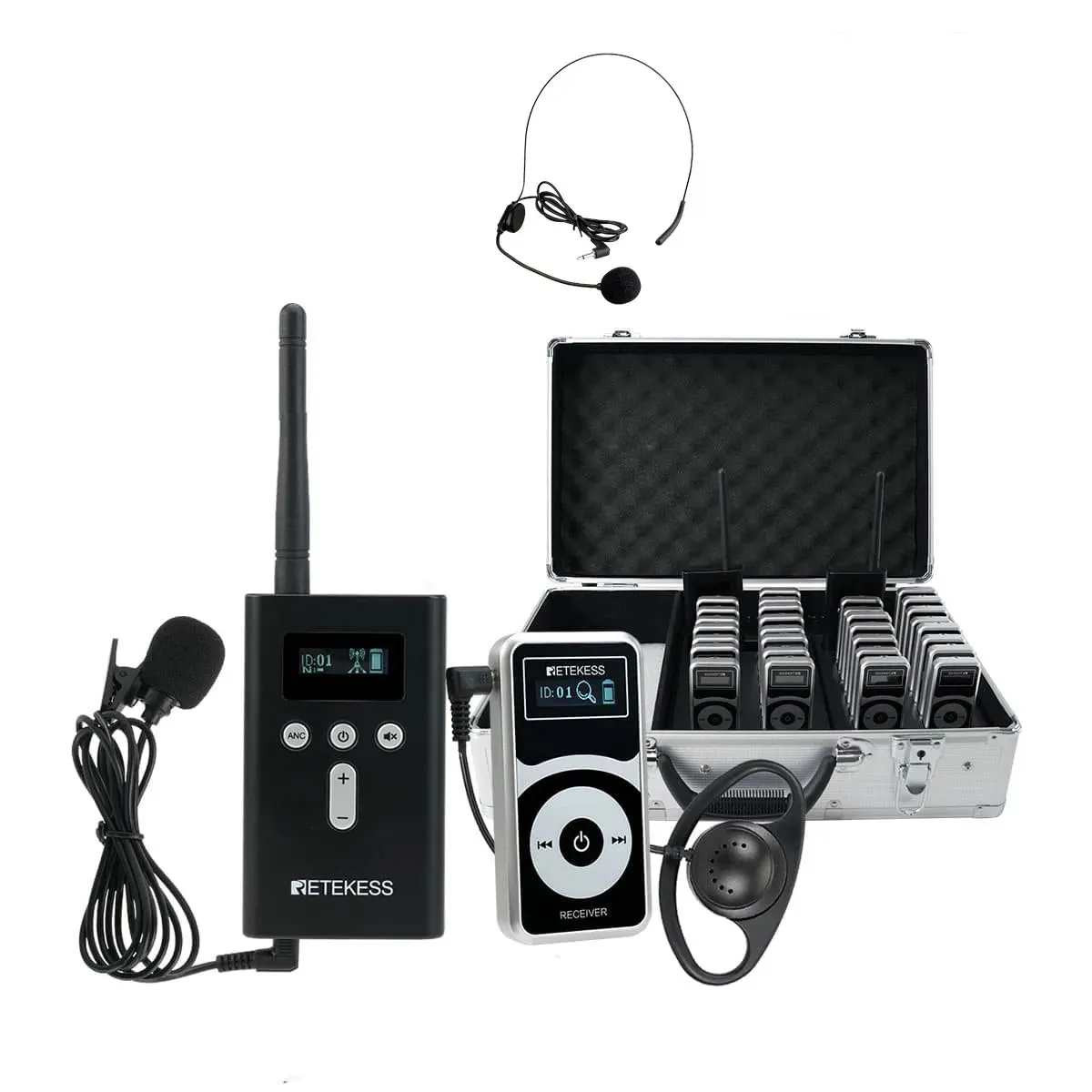
A transmitter captures speech, AI translates, and the result broadcasts to dedicated receivers worn by the audience. Brands: Retekess TT136, Vox Aura, BMS TOM ClipR + elysium, Enersound Cloud.
Strengths: one transmitter serves many listeners; listeners don't need phones.
Limitations: 2–5 second latency; accuracy varies by language pair; not yet ISO-compliant for high-stakes diplomatic interpretation
This third category is the one that matters if you're reading this guide as a tour operator, church administrator, or factory visit host.
How Does an AI Group Translation Device Actually Work?
Let's walk through the workflow with a concrete example.
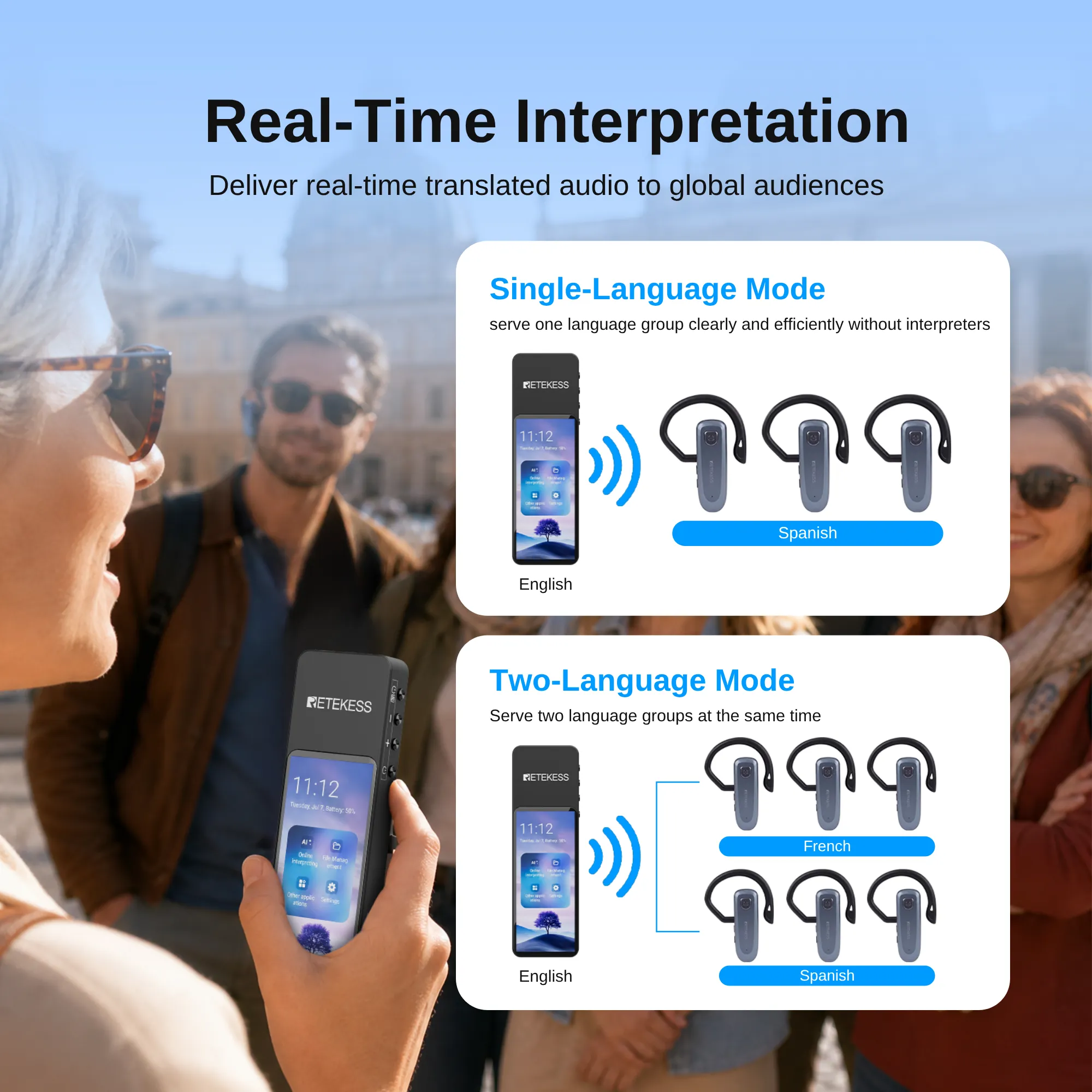
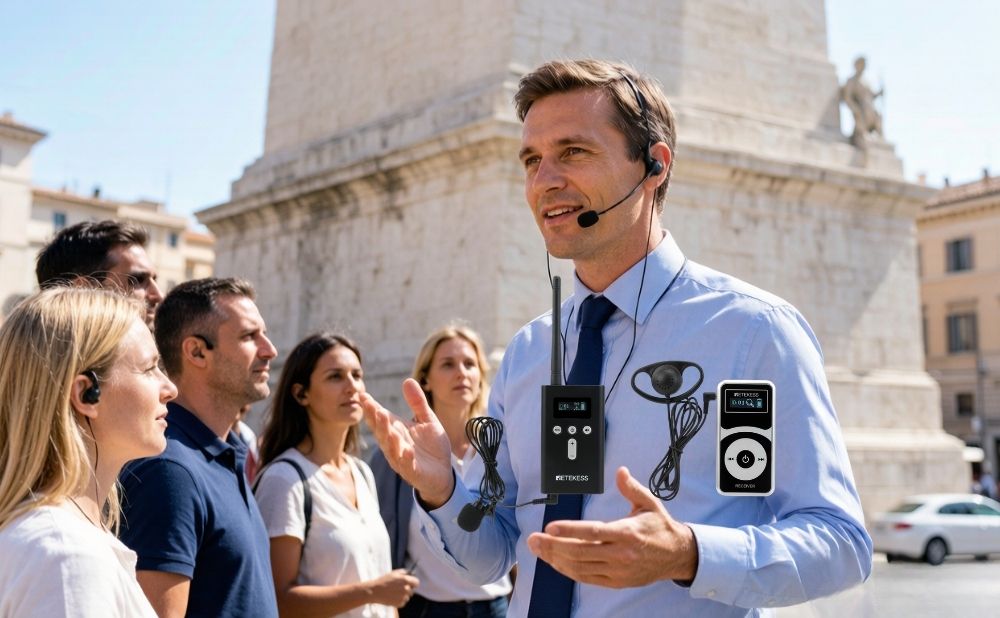
Scenario: A tour guide in Rome is leading a group of 30 American and Spanish-speaking tourists. The guide speaks only Italian; the group needs to hear both English and Spanish translations.
Step 1: The guide holds a transmitter (or wears a clip-on mic connected to the transmitter) and speaks Italian into it.
Step 2: The transmitter's onboard AI captures the audio, runs ASR → MT → TTS, and generates both English and Spanish versions within 2–3 seconds.
Step 3: The transmitter simultaneously broadcasts the English audio translation and the Spanish audio translation on two separate channels.
Step 4: Each tourist wears a small ear-hook receiver and selects the channel matching their preferred language.
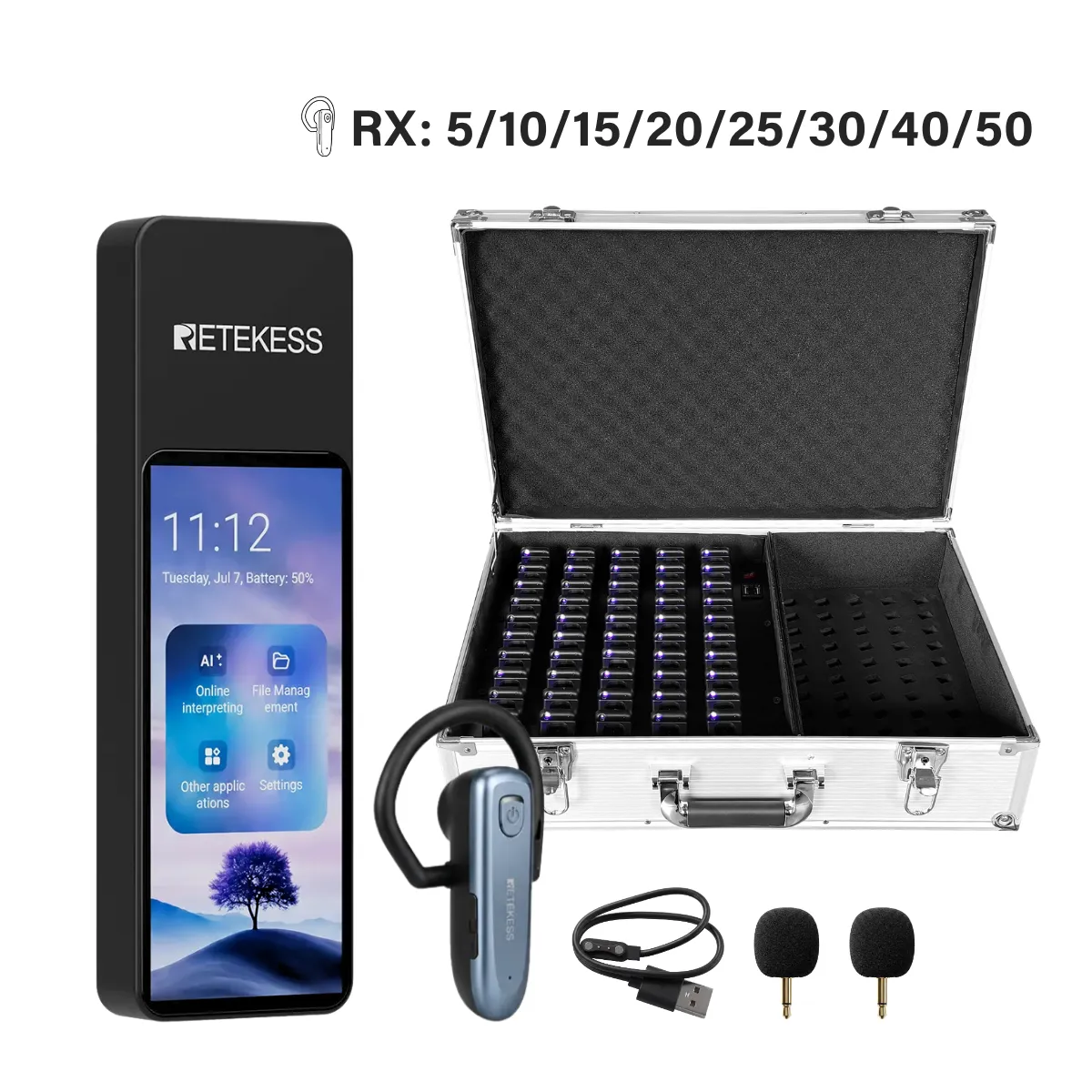
The Retekess TT136 works exactly like this. It supports 120 languages, features dual-channel broadcasting, and pairs with lightweight 18 g ear-hook receivers. The transmitter also includes a 3.99" touchscreen for quick language selection and effortless device pairing.
Where AI Translation Works Well
AI translation is already strong enough for these scenarios:
- Walking tours — narrating landmarks, answering casual questions
- Factory visits — explaining production lines, safety briefings, supplier audits
- Bilingual churches piloting a new language — testing demand before committing to a human interpreter
- Tourist reception at hotels or visitor centers
- International school parent meetings — translating informal conversations
- Multilingual coaching at sports camps
- Casual business meetings between speakers of different languages
In all of these, "85–95% accurate in 2–3 seconds" beats "perfect in 2 days."
Where AI Translation Still Falls Short
Honest list of where you should not yet rely on AI:
- Diplomatic summits with formal language requirements
- Legal proceedings where every word matters
- Medical consultations with diagnostic implications
- Simultaneous interpretation at ISO-compliant conferences
- Highly idiomatic or poetic speech (literary readings, comedy)
- Language pairs with weak training data (e.g., English↔Khmer, English↔Swahili) — accuracy drops noticeably
For these scenarios, you still want a professional human interpreter — and equipment like the Retekess TT119 interpreter console to support them.
What to Look for When Buying an AI Translation Device
- Language support versatility — Broad language support directly expands your service range. Choosing a system with 120+ supported languages means your venue or agency can seamlessly handle unexpected international delegations, making the equipment a future-proof investment.
- Latency. Aim for under 3 seconds on common language pairs. Over 5 seconds starts feeling awkward.
- Group broadcasting. Does it have a transmitter that can broadcast to multiple receivers? Personal translators don't.
- Dedicated receivers vs app-only. Dedicated receivers work for everyone, including elderly listeners and children. Apps don't.
- Battery life. Tour guide systems need 8+ hours; AI devices with on-device inference often need 6–10 hours.
The Retekess TT136 ticks all above — 120 languages, dual-channel broadcast, dedicated 18 g ear-hook receivers, 2.4 GHz 492–656 ft range, and a 30/50-slot charging case for fast turnaround between tours.
FAQ
Q: Will AI translation replace human interpreters?
A: For tour-grade and meeting-grade delivery, increasingly yes — for legal, medical, and diplomatic work, no. The realistic near future is hybrid: AI handles the volume, human interpreters handle the high-stakes moments.
Q: Do AI translation devices work without internet?
A: Most high-quality AI translation devices—including the Retekess TT136—require an active internet connection to work. Offline, they either cannot function or operate with severely limited capabilities.
Q: How accurate is AI translation?
A: For English↔Spanish, English↔French, English↔Italian, English↔German, English↔Portuguese — accuracy is typically 85–95% on conversational speech. For low-resource language pairs, accuracy drops below 80%.
Q: Can I use an AI translation device for a multilingual group of 50+?
A: Yes, as long as the device supports group broadcasting. Personal translators and AI earbuds scale poorly beyond 5 listeners.



![[18th Anniversary] 18 Years of Echoing Excellence: Making Communication Easier, Connecting Trust Beyond Borders](https://res.retekess.com/z_file/20260716/retekess-brand-story-making-communication-easier_20260716151044_7682.jpg)
![[18 Years in Wireless Communication] Silent Disco Systems Anniversary Celebration: Top-Selling Headphones & Event Mechanics Revealed!](https://res.retekess.com/z_file/20260713/18-years-in-wireless-communication-silent-disco-systems-anniversary-celebration_20260713175011_5749.webp)
![[Anniversary Carnival] Ding-dong! 18th Anniversary Mega Sale on Guest Paging & Calling Systems: Full Reveal of 12+ Products & Promo Rules!](https://res.retekess.com/z_file/20260713/18th-anniversary-mega-sale-on-guest-paging-calling-systems_20260713175257_0295.webp)
![[Retekess 18th Anniversary Teaser] Tour Guide System Exclusive Perks: Sneak Peek at Event Dates & Mechanics!](https://res.retekess.com/z_file/20260713/retekess-18th-anniversary-tour-guide-system-exclusive-perks--2-_20260713180135_6435.webp)
Follow Us
Pay With


 Google
 Amazon
Comments (0)