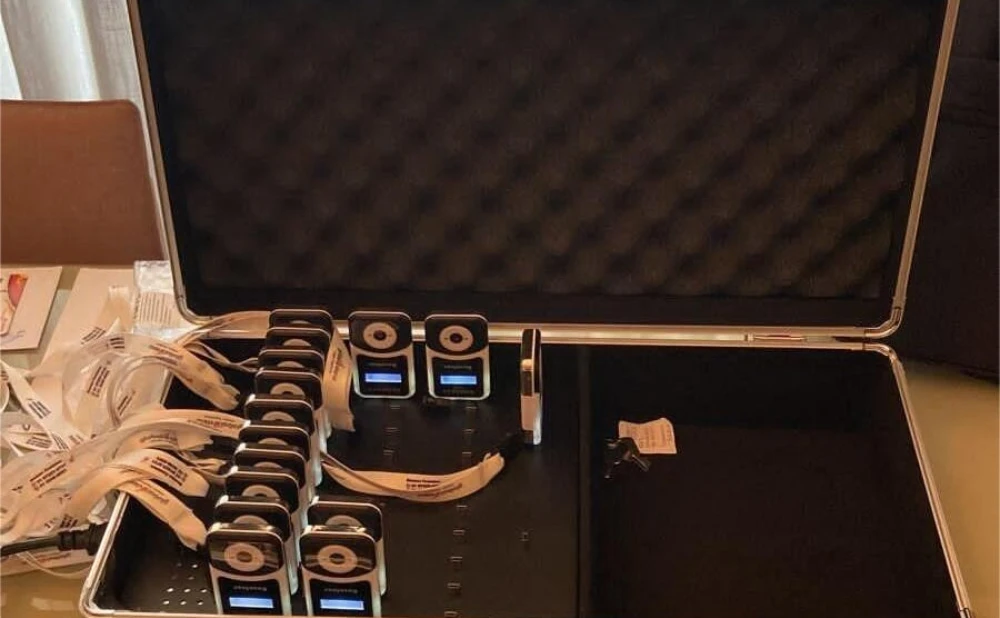
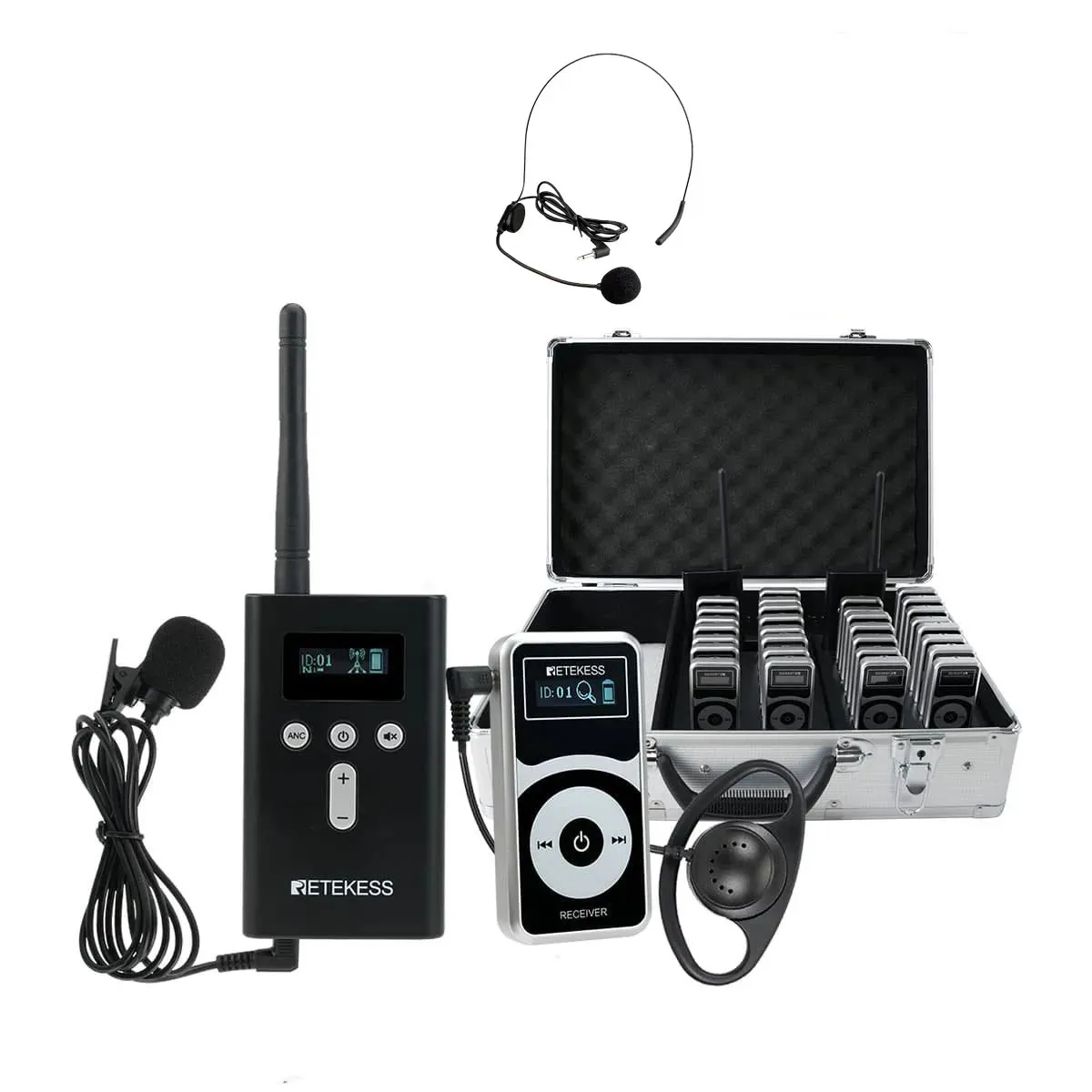
A tour guide microphone system is a one-to-many wireless audio setup: the guide speaks into a transmitter, and any number of listeners hear that voice at a constant volume through portable receivers. When you compare tour guide systems, seven features do most of the work. They are audio clarity and noise cancellation; a transmission range matched to your venue, roughly 50 to 200 metres; at least 8 to 12 hours of battery paired with a multi-slot charging case; twenty or more selectable channels so several groups can run side by side; the right choice between one-way and two-way communication;receivers light enough that guests can use them without instruction and setup time.
Audio clarity and effective noise management are critical for ensuring an effortless listening experience in tour guide and wireless communication systems, especially across expansive or high-noise environments.
High-Definition Audio: The primary goal is ensuring every participant hears you clearly without straining, even in large rooms or open spaces.
The measurable version of clarity is signal-to-noise ratio. Look for 80 dB or higher, together with a frequency response wide enough to carry speech naturally.
Environmental Noise Cancellation (ENC) / Active Noise Cancellation (ANC): If you lead tours in loud environments—like manufacturing plants, busy city streets, or crowded museums—look for systems with built-in AI noise reduction or directional microphones to filter out background chatter and wind.
Active noise cancellation, or ANC, is a feature of the headphones a listener wears; it cancels ambient sound at the ear. Environmental noise cancellation, or ENC, happens earlier, on the microphone signal itself, cleaning the voice before it is ever transmitted.
Hardware Integration: The T130P, TT133 models are equipped with built-in DSP noise cancellation to maintain reliable voice clarity in loud environments.
Consider how far apart your group will spread. Standard systems offer a range from 150 to over 300 feet (approx. 50 to 100 meters). Ensure the signal remains stable even if participants lag behind or turn a corner.
|
Venue type |
Recommended open-area range |
Recommended products |
|
Small indoor tour, church, gallery |
50-100 m |
T130S / T131S |
|
Museum floor, factory, outdoor attraction |
150-200 m |
TT133, T130P, T130U, TT106S |
|
Large auditorium, industrial plant, open site |
250 m and above |
TT126, T130T / T131T |
The transmitter and receivers should comfortably outlast your longest tour day. Look for a minimum of 8 to 12 hours of continuous use on a single charge.
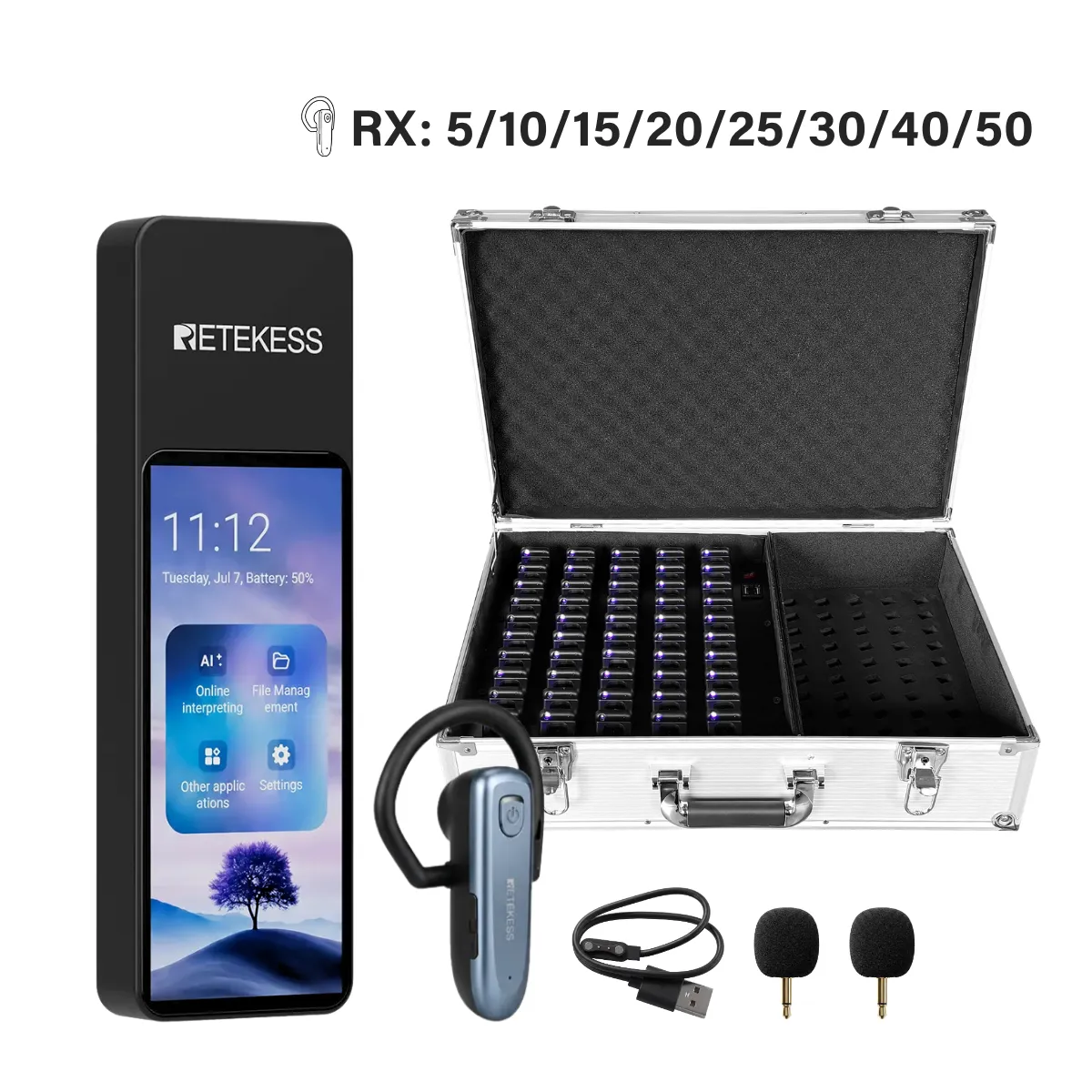
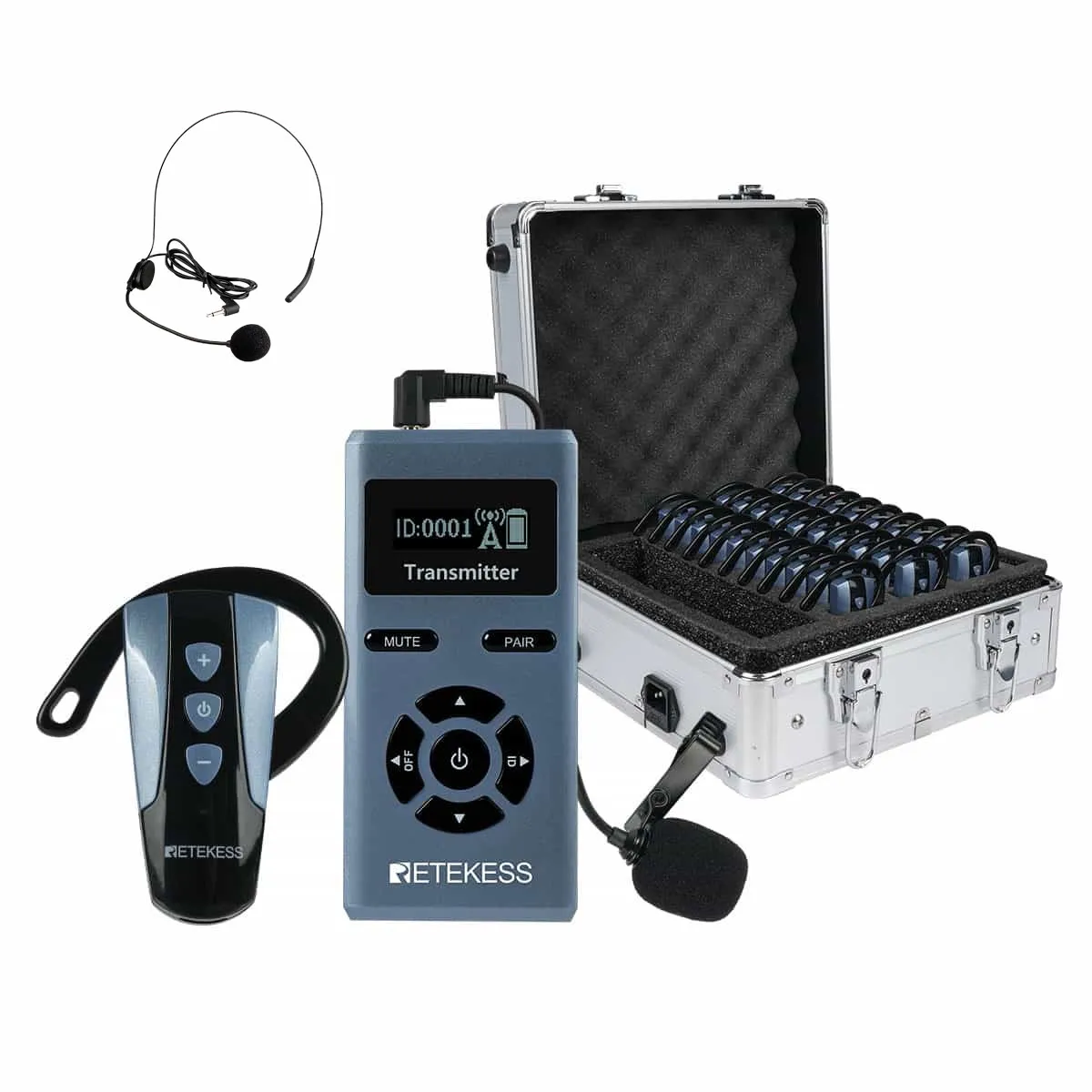
If you manage large groups regularly, drop-in charging storage cases that charge 10, 20, or 50 units simultaneously will save immense time and prevent cable clutter.
Start with the per-device number, because it does matter: eight to twelve hours minimum on both the transmitter and the receivers, or the second tour of the day begins with a recharge scramble. Several receivers in the range go considerably further, from 36 hours on the T131P to 40 on the T131U and 50 on the TT106S, which turns nightly charging into every-other-night charging and compounds into real time saved across a season.
The cost that hides is the charging itself. Picture twenty receivers, each with its own cable, each plugged into its own socket, every night. Someone plugs them all in, checks them all, unplugs them all and packs them all, twice a day if you run morning and afternoon departures. Once a fleet passes roughly ten units, that routine costs more staff time than the tour it supports, which is why a multi-slot drop-in charging case stops being an accessory and becomes part of the system. It charges, stores and transports the whole fleet in one motion, and cases sized for 16, 32 or 64 units match the fleet sizes most operators actually run.
Two smaller decisions are worth insisting on: USB-C or contact charging rather than proprietary plugs, and automatic power-off when no signal is present, so that a receiver left in a storeroom is not flat by morning.
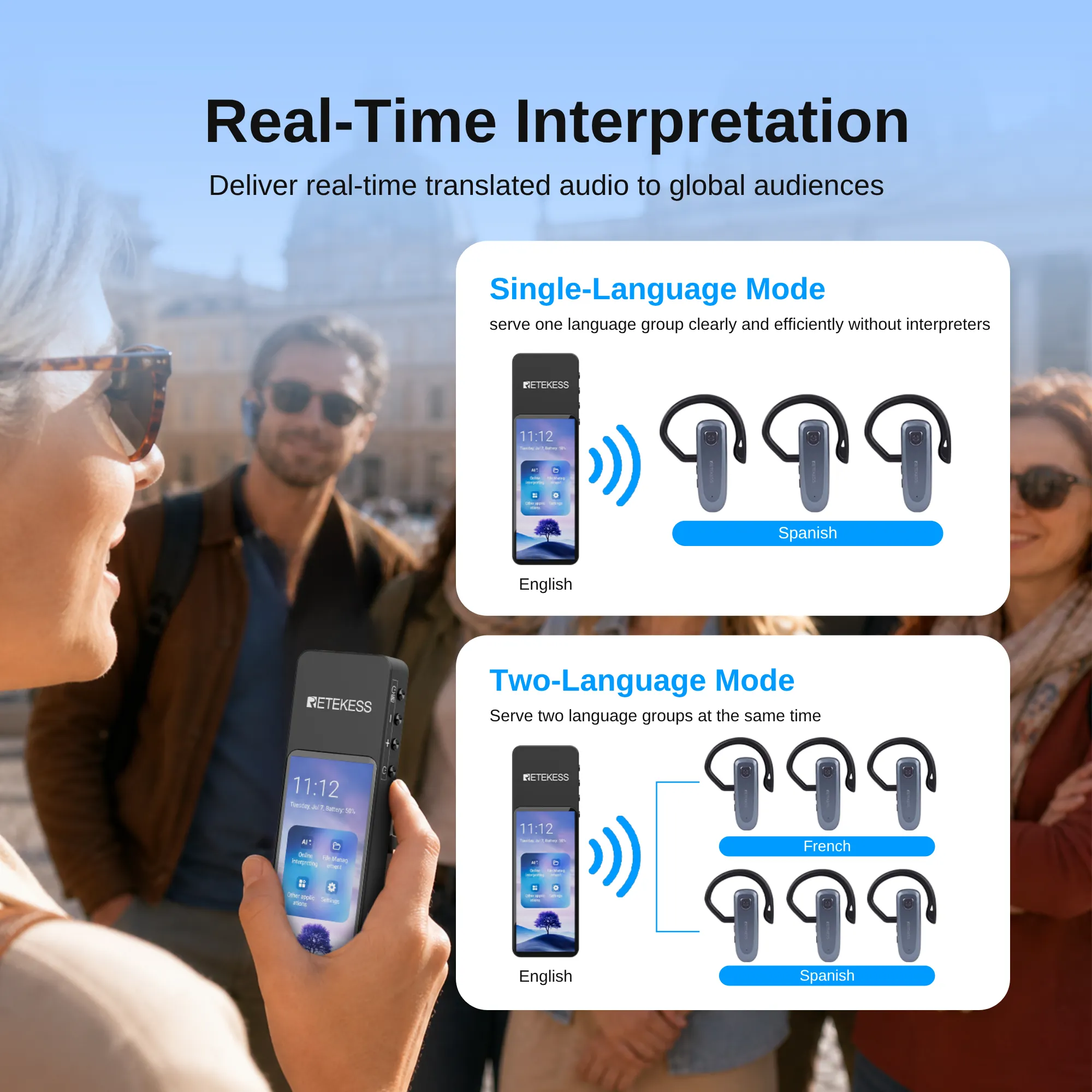
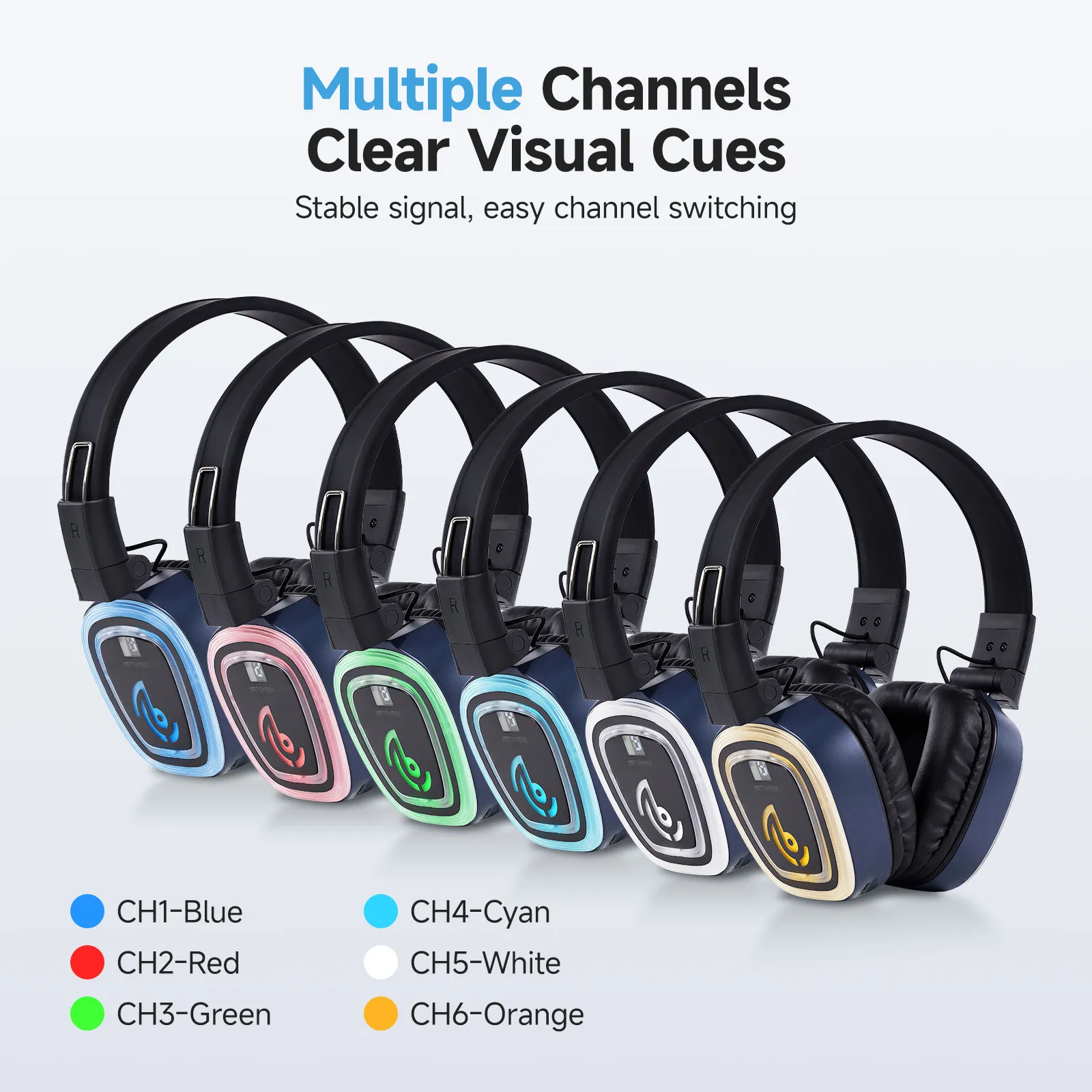
If you run multiple tours simultaneously in the same building, you need a system with multiple selectable channels (at least 20+) to prevent interference between groups. Also, check if the system allows you to easily add more receivers as your tour groups grow.
A channel is an independent audio lane on the same hardware, and the easiest way to see why the number matters is to picture the problem it solves. Two groups stand ten metres apart in one museum hall, each with a guide speaking into a transmitter. On the same channel, every guest hears both guides at once, half a sentence each, and neither tour works. Channels are what keep those two groups invisible to each other.
If two groups ever run at once, twenty or more channels gives comfortable room. If three or more run routinely, as in a museum with rotating school groups or a conference with several language tracks, look for 49 or more. It is worth pairing channel count with channel memory as well: a receiver that remembers its channel after a power cycle wakes up ready, while one that forgets has to be re-set every single morning, thirty times over.
|
Model |
Channels |
|
TT120 |
9 (nine coaches training at once) |
|
TT126 |
25 |
|
T130P / T131P, T130S / T131S |
49 |
|
T130U / T131U, T131R |
50 (US version) / 19 (EU version) |
|
TT133 |
99 |
|
TT106S |
9999 |
Most tour guide systems are one-way: the guide speaks and everyone listens. That is exactly right for a museum narration or a sightseeing walk, where questions naturally wait until the end and the guide's job is to keep the group moving.
Some tours, however, are conversations. On a factory walkthrough guests ask about a machine the moment they pass it; in VIP visits and training sessions the back-and-forth is the value. On a one-way system every question becomes a shouted interruption or a thought abandoned. That is the case for a two-way, or full-duplex, system, in which a guest presses a button and speaks into the same audio loop the whole group is hearing.
The TT126 is our two-way option: 280 metres of range, 25 channels and one to seven levels of adjustable microphone gain, available in configurations with up to three main transmitters. Where three people need to speak simultaneously, TT129 is the model to look at.
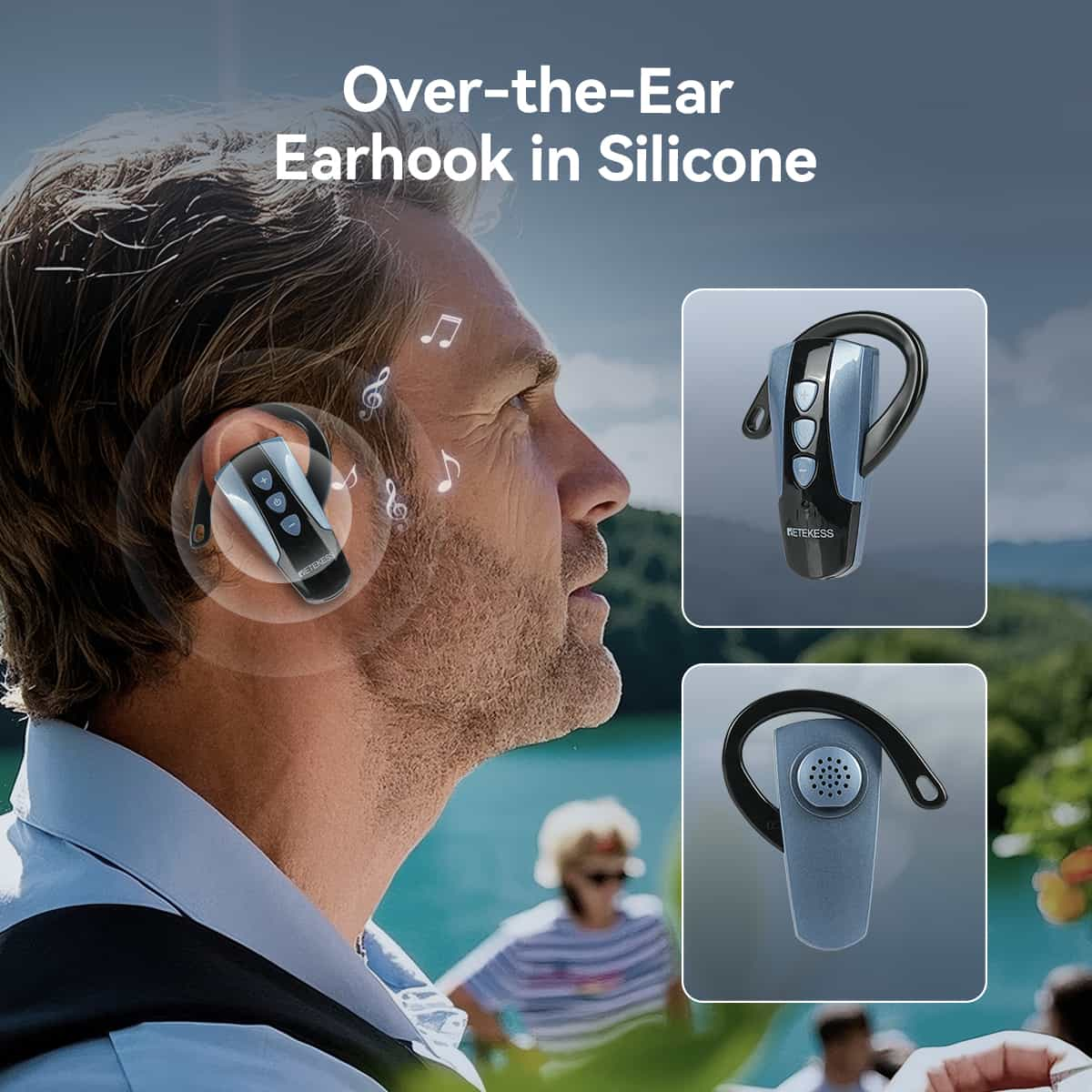
The participant receivers should be lightweight, comfortable to wear with a lanyard, and feature simple volume controls that guests can figure out in seconds without needing technical assistance.
Guest independence is the third piece. The control should be one obvious volume wheel or pair of large buttons, with no menu, and the test is whether a first-time visitor in their seventies can raise the volume without asking for help. A guide who has to walk down the line adjusting receivers has lost the first five minutes of every tour.
|
Model |
Receiver weight |
Design |
|
T131R |
15 g |
Open-ear ear-hook receiver, not in-ear |
|
TT133 |
18 g |
Ear-hook receiver with built-in display, non-in-ear |
|
TT106S |
18 g |
Ear-hook Receiver |
|
T131P |
49 g |
Standalone Compact Receiver with Lanyard,D-shape ear-hook, fits either ear |
|
TT120 |
39 g |
Bone conduction headphone receiver, open-ear |
How Much Setup Time Should a System Cost You?
Here is a cost that appears on no invoice: the ten minutes before every departure, spent walking down a line of receivers setting channels one by one. Multiply by two departures a day, by every guide, by every day of the season, and "setup time" quietly becomes one of the largest line items of owning a system.
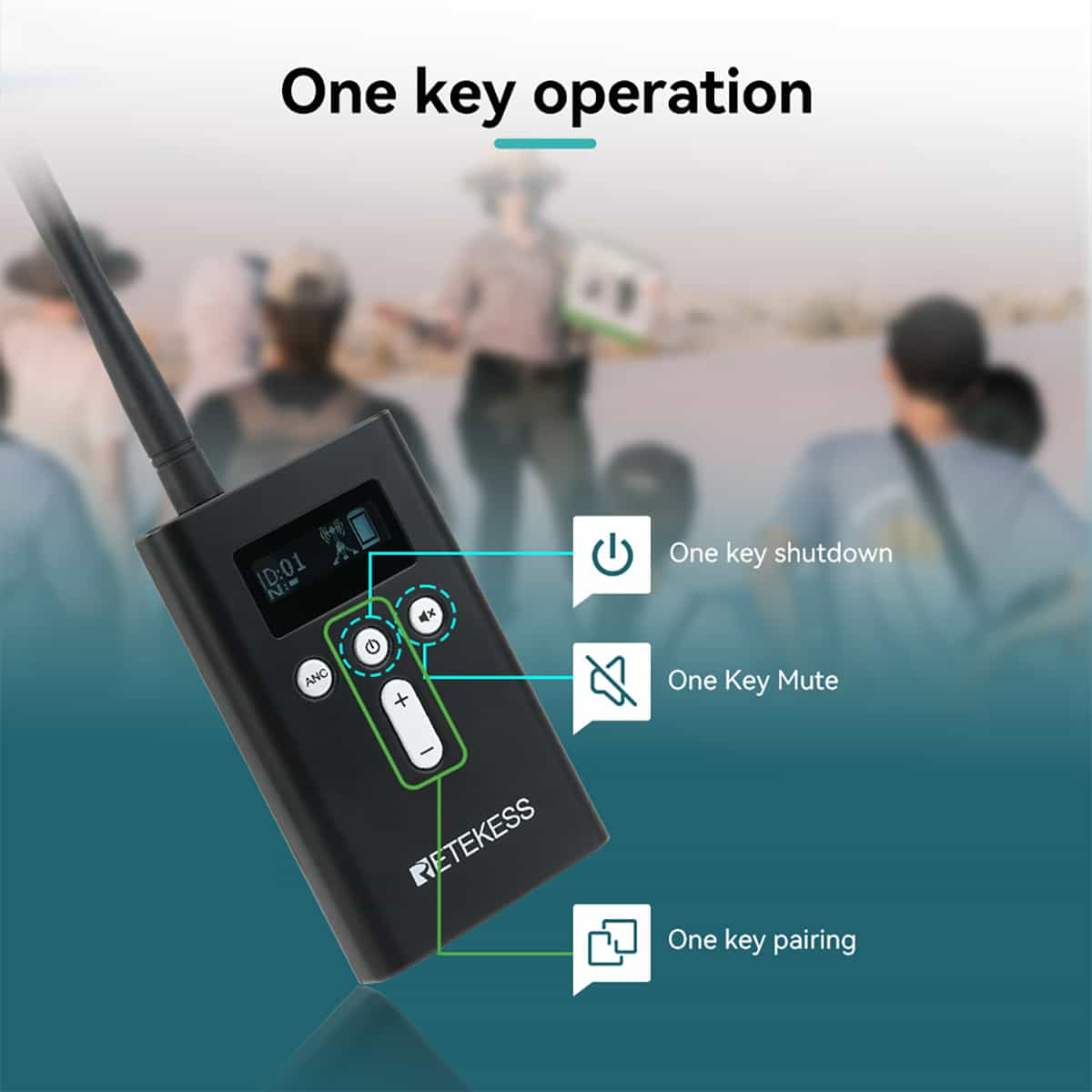
Good design spends engineering effort to erase that time, and the features to look for are specific.One-touch pairing synchronises the transmitter and every receiver at once instead of unit by unit. Channel memory means the fleet wakes on the correct channel after a power cycle. One-touch mute matters more than it sounds, because it is what lets a guide silence the loop instantly at a street crossing or during a safety announcement. A long-press group power-off ends the day in one gesture rather than thirty, and automatic shutdown after roughly twenty minutes without a signal protects the battery of units forgotten in a pocket. Large buttons, or a touchscreen on models such as the TT133, keep the whole set of controls usable by staff who run the system only occasionally.
The table below condenses the range into one view. Read it by column rather than by row: find your venue type first, then check the range and channel figures against the guidance above.
|
Model |
Range |
Receiver battery |
Channels |
Communication |
Best for |
|
TT133 |
150 m |
12 h |
99 |
One-way |
Touchscreen setup, pre-recorded routes, VIP reception |
|
T130U / T131U |
200 m |
40 h |
50 (US) / 19 (EU) |
One-way |
Factory tours, industrial sites |
|
T130P / T131P |
160 m |
36 h |
49 |
One-way |
Long-day tours, 1-4 level DSP |
|
TT106S |
200 m |
50 h |
9999 |
One-way |
Large fleets, minimal accessory management |
|
T130S / T131S |
100 m |
20 h |
49 |
One-way |
Churches, assisted listening |
|
T131R |
150 m |
13 h |
50 (US) / 19 (EU) |
Receiver only |
Expanding an existing T130U fleet |
|
TT126 |
280 m |
n/a |
25 |
Two-way |
VIP tours, training, Q&A |
|
T130T / T131T |
820 ft |
40 h |
19 (EU) / 50 (US) |
One-way |
Simultaneous interpretation |
|
TT120 |
120 m above water / 50 m under |
5 h |
9 |
One-way |
Swim and water sports coaching |
What features should I look for in a tour guide microphone system?
Audio clarity and noise cancellation; a transmission range matched to your venue, roughly 50 to 200 metres; at least 8 to 12 hours of battery paired with a multi-slot charging case; twenty or more selectable channels so several groups can run side by side; the right choice between one-way and two-way communication;receivers light enough that guests can use them without instruction and setup time.
How much transmission range do I need?
50-100 m covers indoor museum and church tours; 150-200 m suits outdoor attractions and factory floors; 250 m and above is for large auditoriums. Always check whether the quoted figure is measured in open space, because walls and steel structures shorten it.
UHF or 2.4 GHz, which should I choose?
UHF penetrates walls and steel better and suits heavy industrial sites; 2.4 GHz is licence-free worldwide and suits operators working across countries. Verify local frequency compliance before buying.
How long should the battery last?
Budget for 8-12 hours minimum on both transmitter and receiver. Longer is available where it matters: several Retekess receivers run 36-50 hours, which covers multi-day events without a mid-day recharge.
Do I really need a charging case?
Once you pass roughly ten units, yes. Charging twenty receivers individually by cable costs more staff time than the tour itself, and a 16-, 32- or 64-slot drop-in case also serves as transport and storage.
How many channels do I need?
At least 20 if two groups ever run at once, and 49 or more if three or more run routinely. Pair channel count with channel memory so receivers power on ready instead of being re-set every morning.
Can guests talk back to the guide?
Only on a two-way system. One-way suits narration where questions wait until the end; two-way suits training, VIP plant walkthroughs and interactive tours. Note that many systems allow only one transmitter per group, so confirm before assuming two presenters can both speak.
Which microphone should I use: headset, lavalier or handheld?
Headset or boom for walking and noisy routes, because it holds a fixed distance from your mouth. Lavalier is discreet but loses level when you turn away. Handheld works when several presenters pass one mic. Adjustable gain matters more than maximum volume.
Can I add more receivers later?
Yes, on scalable systems: buy receivers separately and keep the original transmitter. This is the main lever on long-term cost, so confirm separate-receiver availability before the first purchase.
Is the equipment waterproof?
Check the IP rating rather than the word waterproof. For water sports the TT120 receiver is rated IP68 for prolonged immersion and the transmitter IP54 for splashes; standard tour guide receivers are not designed for immersion.









 Google
 Amazon